VOL. 54, NO. 4
Masculinity, Extractive Violence, and the American West in Butcher’s Crossing
Najmeh Moradiyan-Rizi (Old Dominion University)
The frontier mythology and the romanticized notion of westward expansion come under heavy scrutiny and revision by various writers and filmmakers in the 1960s and 1970s. Yet as Wibke Schniedermann argues, this mythology itself is the result of “both adaptation and revision” (69). An imaginary frontier and its glorified conquest are “a source text, … which the Western adapts into folk tales, stage performances, novels, films, theme park rides, and other media. Revision … of the historical past as well as its fictionalized representations is not only unavoidable in this process, it constitutes a generative principle of the Western” (69). The Western genre’s revisionist practices of the 1960s and 1970s in literature and film thus continue to renegotiate and rewrite the conquest of the American West, this time not to glorify and celebrate it, but to critically assess an American origin myth, subvert its national ideals, and underline its perpetual violence in the process. Novels and films of the 1940s and 1950s anticipate this critically revisionist impulse, during an era profoundly altered by the horrors and violence of World War II. Examples include Walter Van Tilburg Clark’s novel, The Ox-Bow Incident (1940), and its 1943 filmic adaptation directed by William A. Wellman; Charles Neider’s novel, The Authentic Death of Hendry Jones (1956), and its 1961 filmic adaptation, One-Eyed Jacks, directed by Marlon Brando; and Oakley Hall’s novel, Warlock (1958), and its 1959 filmic adaptation directed by Edward Dmytryk. These texts present complex characters and themes exploring issues of justice, mob mentality, moral ambiguity, corruption, violence, and extractive capitalism to reveal the fragility of American civilization and the darker side of American westward expansion. Existing “on the margins,” they serve as “precursors to a counter-tradition that the Western tradition itself generates, a revisionist shadow, a parallel track to the imperial mainstream with all its ideological baggage” (Kitses 17).
The socio-political contexts of the 1960s—the civil rights movement, the Vietnam war, youth counterculture—bring this Western “counter-tradition” to the fore, allowing the genre to reinterpret the U.S.’s national past and its impact on the present. In this period the U.S. “loses her innocence” (Kitses 17), and the writers and filmmakers begin to confront the Western genre’s heavy “ideological baggage” of colonialism, racism, and extractive violence. While scholars and historians of the American West often consider Sam Peckinpah’s 1969 film The Wild Bunch as the beginning of this revisionist trend in cinema (Nelson; Aquila), in literature, John Williams’s Butcher’s Crossing (1960), which this study focuses on, and E. L. Doctorow’s Welcome to Hard Times (1960) serve as pioneering examples of the revisionist Western novel. In an interview Williams postulates that “[t]he West has been the victim of a bad and cheap mythologizing over the years,” which has been largely perpetuated through “an Eastern attitude about the West—very romantic, involving absolutely good guys and absolutely bad guys, involving all sorts of implications of capitalism, if you will” (Woolley 17; original emphasis). Butcher’s Crossing thus sets out to subvert the romanticized notion of westward expansion by exploring “the relationship between the Eastern idea of nature and the Western experience of nature” (Woolley 16; original emphasis). To do so, Williams culturally and geographically dislocates his white male protagonist “to draw the reader into a critical appraisal of the genre and the mythology upon which it is constructed” (Asquith 8). This narrative strategy, according to Mark Asquith, is “replicated in the work of Cormac McCarthy, Annie Proulx and Thomas McGuane whose youthful protagonists (always young men) find themselves lost” in the many settings of the American West (8).
In the same vein, Doctorow, after reading various “lousy” Western scripts for a film and television company as an editor in New York in the 1950s, was “forced to think about the use of Western myth” (McCaffery 33-34). He shares in an interview, “I developed a kind of contrapuntal idea of what the West must really have been like” (McCaffery 34). His revisionist novel, Welcome to Hard Times, adapted into a 1967 film of the same name directed by Burt Kennedy, begins with a scene of gruesome violence and immense destruction in which an unnamed white man, known as the Man from Bodie, wreaks havoc on a small mining town in the Dakota Territory without any provocation. He rapes and kills a prostitute and burns down the town, leaving ruin after moving away. As the novel progresses, however, this shocking opening scene becomes a relevant part of the natural and inevitable violence embedded in the idea of Western settlement and its capitalist development. As the novel’s main character Blue—who came to the West with high expectations of success—remarks, “Bad Men from Bodie weren’t ordinary scoundrels, they came with the land, and you could no more cope with them than you could with dust or hailstones” (6). Challenging the successful implementation of peace, law, order, and progress on the frontier, Doctorow presents a place in which Eastern settlers bring corruption, uncaring individualism, and violence in pursuit of selfish goals and materialistic gains, thus turning the town of Hard Times into a hard place to live. Winifred Farrant Bevilacqua notes that “the town exists only to sell sex, liquor, and general merchandise to the miners and … the land in it is viewed only as a commodity to be claimed or bought …” (87-88). The novel, in fact, juxtaposes the extractive and exploitative violence against the environment of the American West—the mining practices fueled by Eastern financing to extract gold from the nearby hills—with the violence against the female body, committed by white men against the town’s prostitutes, in order to critique what Sylvan Goldberg calls “penetrative violence—that is, a violence predicated upon incursion into physical space and material bodies, human and not—[which] lies at the heart of the genre of the Western, with its shootouts, beatings, and a sexual bravado that often tilts into explicit violence” (198).
To further explore the intersection of extractive practices, white masculinity, and violence on the Western frontier, this article offers a close study of John Williams’s revisionist Western novel Butcher’s Crossing and its 2022 filmic adaptation of the same title, directed by Gabe Polsky. I argue that Butcher’s Crossing not only critiques the romanticized notion of westward expansion in which individualism, violence, and grit of white men successfully dominate bodies both human (particularly women and Indigenous) and non-human, but also underlines the ways in which “white male violence extracts its own undoing” (Goldberg 198). In doing so, Butcher’s Crossing exposes deep contradictions that reside at the heart of the conquest of the American West, ones still impacting us today.
Butcher’s Crossing and the Western Paradox
Historians of the American West, such as Donald Worster, Sara Dant, and Patricia Nelson Limerick, have all pointed to what Worster calls the “Western Paradox” (81), which pulls at opposite ideological and experiential directions. According to Worster, among various myths about the region, the prominent one was the romanticized idea of settlement; “a story about a simple, rural people coming into a western country,” finding “homes in the undeveloped vastness …, bringing life to the land and turning it into the garden of the world” (6). At the same time, “the West was supposed to offer a place to escape civilization” (6), to offer a refuge away from the industrial East, and to enhance a man’s body and mind through intimate relationship with the nature and the Western landscape.1 For Worster, such a paradox toward the American West arises from the region’s landscape itself. As he mentions, “For all its scenic grandeur, for all its abundance of rock and minerals, this region’s landscape says, at least in biological terms, that this is a place of scarcity” (82). In the same vein, Dant argues that for some European and American settlers, the westward expansion “fulfilled th[e] biblical vision of a land of milk and honey, but for many the region constituted a harsh and unforgiving desert of aridity and struggle, while others envisioned it as a vast expanse of material wealth to exploit and plunder” (3). Therefore, as Dant contends, “This fusion of Edenic myth and environmental and economic reality shapes both the past and present” of the region (3). Pointing to this paradox at the heart of the conquest of the American West and as “the prime example of the boom/bust instability of capitalism,” Limerick also emphasizes that “Western history may well be the most dramatic and sustained case of high expectations and naïveté meeting a frustrating and intractable reality” (29).
By focusing on “the boom/bust instability” of the buffalo hide market in the late nineteenth century, John Williams’s well-crafted novel Butcher’s Crossing offers a wise scrutiny of the Western paradox and its entanglement with the plight of white masculinity and extractive violence. The story is set in the early 1870s in Butcher’s Crossing, a shabby town in Western Kansas, hastily built to facilitate the buffalo hide trade, and features a party of four white men who embark on a buffalo hunting expedition to a secluded valley in Colorado’s Rocky Mountains. The central figure of the story is Will Andrews, a twenty-three-year-old Bostonian and Harvard student who, in his third year at the college, gets inspiration from a lecture by Ralph Waldo Emerson to respond to his impulse of self-discovery in the wilderness by heading West (Figure 1). Williams uses this romantic tale of a tenderfoot coming to the West in hopes of finding his true masculinity to closely examine the “unquestioned gloss of the manic energies underlying westward expansion, manifest destiny, the ‘American spirit’ and its projection of an individualism which could only be sought and found in the wild open spaces of the American Frontier” (Latiolais x).
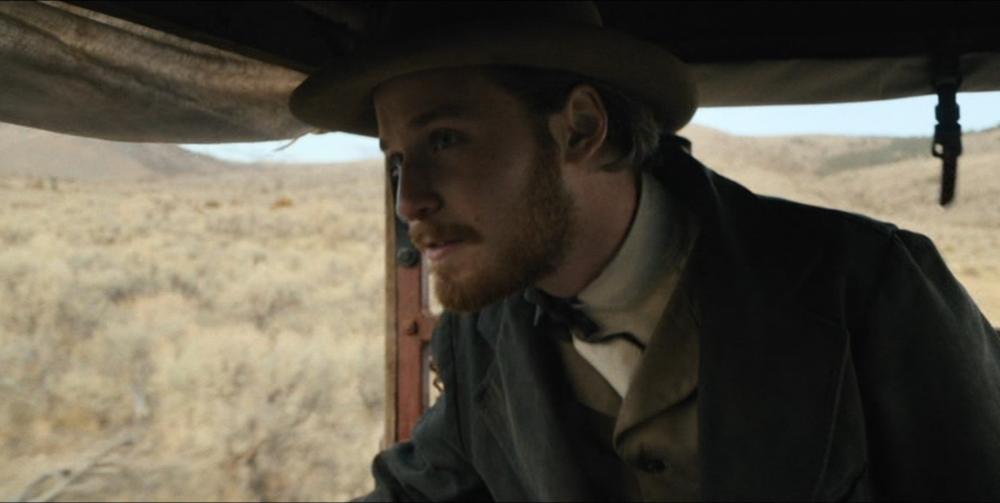
Upon arriving at Butcher’s Crossing, Andrews meets with J. D. McDonald, an exploitative hide trader and acquaintance of Andrews’s father, who is a Unitarian minister in Boston. McDonald is one of those individuals who think of the West solely in terms of extractive and economic practices; in the novel he refers to himself and own kind as “Men with vision” (20). As such, he cannot understand the romantic urge of Andrews, who wants to see and know the West and ultimately find and know his true self. McDonald expresses contempt for buffalo hunters and warns Andrews to stay away from them as they will “ruin” him “like buffalo lice” (21). But Andrews is determined to talk to the hunters in the hope of joining them and experiencing the frontier firsthand. McDonald thus reluctantly refers him to a hunter named Miller. Gregory Alan Phipps writes that “Miller is one version of a quotidian pragmatic individual: independent, hardened by manual labor in the West, and practical in his approach to life” (339). Therefore, soon after meeting Andrews, Miller manages to talk him into financing a hunting expedition to the Rockies, where ten years ago he came across thousands of buffalo with prime hides in an isolated valley. Andrews agrees. Joining them are the old, Bible-quoting, one-handed Charley Hoge, who serves as Miller’s sidekick and camp helper, and the skilled but temperamental skinner Fred Schneider.
As Andrew C. Isenberg notes in his history of the bison’s extermination, “Beginning in the 1830s, … and continuing until the 1870s, the bison’s skin became the most marketable natural resource in the plains” (105). By the time Miller and Andrews are planning their hunting trip, therefore, a period of overhunting for hide trade and sport, “aided by aggressive railroad expansion across the west” (Schneider 805), is well underway and negatively impacting the buffalo population in the region. While moving through the terrains of Western Kansas, Miller’s party comes across “thirty or forty” buffalo carcasses scattered on the prairie (Williams 80). Examining the scene in the novel, Miller laments to Andrews, “There was a time, in the days of the big kills, when you could look a mile in any direction and see the bones piled up. Five, six years ago, we’d have been riding through bones from Pawnee Fork clean to the end of the Smoky Hill. This is what the Kansas hunt has come to” (81). But in addition to the excessive hunting, other factors such as “the loss of habitat to homesteads and climate change, as well as competition and diseases from introduced European cattle” contributed to the decline of the buffalo population in the American West (Schneider 805). This cumulative set of factors, coupled with forceful acquisition of tribal lands and disruption of Indigenous ways of life, makes clear that “the intentional eradication of buffalo from the plains played a key role in implementing settler colonialism” (Schneider 806). By primarily focusing on excessive hunting and buffalo hide trade, Williams’s Butcher’s Crossing critiques white men’s extractive violence and colonialism at the heart of westward expansion.
The noticeable absence of Indigenous people from the story points to the entanglement of buffalo eradication with “an attempt to eradicate tribal nations” (Schneider 816). Brief references to Indigenous people occur only a few times in the novel when, for example, the party comes across the buffalo carcasses on the prairie and Miller explains to Andrews, “The Indians used these bones for everything from needles to war clubs—knives so sharp they could split you wide open” (81). On another occasion, the party comes across some Indigenous families, who are living near a river in their dugouts, and Miller scornfully comments, “River Indians … They ain’t worth shooting anymore” (85). Earlier in the novel, Miller recalls the large herd he first saw in the Rockies several years ago with the same lack of sensibility: “I had the feeling no man had ever been in that valley before. Maybe some Indians a long time ago, but no man” (34). In these instances, Miller’s comments ignorantly regard Indigenous people as part of the past, similar to the buffalo vanishing from the plains. Yet, as Williams astutely indicates throughout the course of the story, it is in fact the white men who are vulnerable, not only to a harsh Western landscape, but to their very own brutal actions. The novel, in the words of Goldberg, “shows the ways in which even when scarred by human action—or perhaps expressly when marked by the damaging effects of the accretive practices of extractive colonialism—the western environment threatens the very same human bodies that put the land [and its Native inhabitants] under threat” (203).
Translating Butcher’s Crossing into Film
Gabe Polsky’s 2022 filmic adaptation of Williams’s novel successfully sets the revisionist tone from the beginning through its creative use of visuals and editing. The film begins with a drawing depicting a herd of buffalo roaming the open prairie, followed by an image of a bustling industrial district showcasing settlers’ trades. A wagon carrying Will Andrews, engulfed by the wide-open landscape, forges its way westward toward Butcher’s Crossing. Andrews’s arrival is interspersed with a range of historical photographs and images, such as a photo of the famous Long Branch Saloon in Dodge City, Kansas; a photo of some settlers camping near their wagons on the westward trail; an ad depicting John Gast’s American Progress painting, with lines in bold font declaring, “Go West! Wild Frontier / Indian Land For Sale”; a photo of two white male hunters standing on top of a buffalo carcass; a photo of four Native Americans sitting on the ground near their tipis; and a drawing depicting a Native-American horseman hunting a buffalo with an arrow. These images thus subtly underline the profoundly damaging effects of westward expansion on the Western environment and Native American communities and serve as a critical framing of the film’s revisionist narrative.
While the film successfully transports the critical reading of the frontier mythology from the book to the screen, various critical pieces written on the film assert the common assumption that “[t]he book is always better than the movie” (Cahir 13, original emphasis). The assumption, as Linda Costanzo Cahir explains, underlines the fact that “Literature, generally, still occupies a more privileged position in the cultural hierarchy than movies do” (13). Therefore, readers tend to evaluate a literature-based film based on the book it is derived from, often overlooking the specificities of a new medium—cinema—into which the book has been adapted. Michelle Nijhuis, for instance, writes that “the film does no justice to its source.” Ryan Gilbey similarly argues, “Any screen version would need to find a cinematic equivalent for the prose’s tensile strength … In this shallow, corner-cutting adaptation, the director and co-writer Gabe Polsky doesn’t come close.” Others call the film “unfocused, distant, and flat” (Daniels), and the characters “thinly written” (Leydon). Williams’s novel employs what Leo Robson calls “the regime of methodical close description,” which profoundly evokes the natural world and its elements as well as the characters’ thoughts and their relationship with each other and the environment. The attempt to adapt such a richly descriptive novel into a film thus seems a challenging task. Yet, to better evaluate a literature-based film, such as Butcher’s Crossing, Cahir recommends looking at it “as a translation of the original text,” and therefore, “an act of interpretation” (14, original emphasis).
In this regard, Cahir proposes three distinctive approaches through which films translate literature: literal translation, traditional translation, and radical translation (16-17). While literal translation aims to create a plot that closely resembles the text and its details, radical translation “reshapes the book in extreme and revolutionary ways …” (17). Traditional translation is the most common approach in which the filmmaker adheres to “the overall traits of the book (its plot, settings, and stylistic conventions)” (16) but changes the details based on certain needs and necessities. According to Cahir, the alterations may stem from the filmmaker’s style and creative vision, or “a need to keep the film’s length and its budget manageable, and to maintain the interests and tastes of a popular audience” (21). In the case of Butcher’s Crossing, the length and production constraints seem to have been the deciding factors shaping the film’s traditional translation. As Polsky in an interview mentions, “[W]e had only 19 days to shoot this very, very epic movie, and challenging movie. The weather, the animals, the buffalo herd, the locations, it was an impossible thing” (Hermanns). Emphasizing the “difficult” production process of the film, Polsky thus asserts, “it was just survival to shoot this movie in that amount of time” (Hermanns). This limited shooting time inevitably prompts the film to condense, or gloss over, some parts of the novel. The filmmaker manages to bring some additional violence to the story, such as the mutilated body found by the party at an isolated trading outpost, supposedly attacked by Native Americans, and Charley Hoge’s (Xander Berkeley) death in the hunting camp as the result of being severely beaten by Fred Schneider (Jeremy Bobb), but still the film at times feels rather rushed. As Robert Daniels argues, “Due to the film’s curt passage of time, you continually feel that Polsky is operating with less-than-ideal constraints; the 107 minutes dedicated to the story fall woefully short of accommodating the director’s desires.” In this regard, Daniels specifically claims that the film comes short of depicting the long and difficult journey that the party must endure. He writes, “The trek to Miller’s [Nicolas Cage] buffalo oasis is an arduous one. And yet, other than a couple of stops along the way … the psychological implications of wandering a vast desert expanse without water are summed up through a dreadfully edited fever dream experienced by a dehydrated William [Fred Hechinger].”
Additionally, given that the trip from Butcher’s Crossing, Kansas, to the valley in the Rockies is an arduous journey, and that the men must endure extreme conditions—scorching hot weather, lack of water, intense thirst, and heavy snow blizzard—some critics have aptly pointed out that the film’s visuals do not manage to effectively indicate the impact of these environmental conditions on the characters’ bodies (and minds). Michelle Nijhuis, for instance, postulates,
Butcher’s Crossing is a quiet novel, but its characters are incessantly menaced by the elements, by one another, and by what they find—and don’t find—within. The film is about as menacing as Little House on the Prairie. The town of Butcher’s Crossing is too neat, and its people are too attractive; Miller, Andrews, and their companions are suspiciously clean and well-fed, even in the depths of their suffering. … Though the film adds two murders to the novel’s plot, no one ever seems to be in much danger—except, of course, the bison, whose pointless slaughter is effectively portrayed.2
The film also adds a visual reference to an Indian Burial Ground in the valley where the party camps to kill the herd. The reference implies that Indigenous people have been in this area, and the place is not as unexplored as Miller initially described it to Andrews. Nevertheless, this visual reference comes across as a disturbing trope given the violence that is being committed on this land by the party toward the buffalo whose “deliberate extermination … had a devastating impact on the tribal nations of the Great Plains, because of their spiritual, economic, and cultural importance” (Schneider 804). Writing in the context of horror film genre, Laura Hall asserts, “Different iterations of the Indian Burial Ground trope impose mythologies on lands where white settler violence has left its mark. Blame can then be shifted away from white settlers (fictional or otherwise) who perpetuate violence and onto the mythological Indian (the savage within, the savage outside)” (140). Similarly, in the unfolding horror in the Rockies, the Indian Burial Ground trope moves the roots of sheer violence away from the white men, who are committing the slaughter, and onto a threatening landscape haunted by the spectral presence of Indigenous people and spirits.
Aside from these shortcomings and considering the production limits the project faced, Polsky focuses on finding “the soul of every scene in the most efficient way” (Hermanns) and ultimately manages to bring “the ‘spirit’ or ‘essence’ of the work” to the screen (McFarlane 9). Furthermore, the film features strong performances and a striking cinematography that beautifully captures the diverse and grand Western landscapes. The film was shot in Montana, and according to the acknowledgment titles at the end of the film, on the land owned by the Blackfeet Nation, who also handled the buffalo featured in the film. Reflecting on this collaboration in an interview Polsky mentions,
I’m not sure what would have happened without them. First of all, they have a pretty big herd [of buffalo] up there. There’s not a lot of big ones together in the United States. Secondly, their knowledge and experience with the animal was critical in all aspects — with the way … that they’re hunted, the way that they skin, the spirit of the animal — the stuntmen and the buffalo handlers were critical in pulling this very difficult shoot off and in a small amount of time. It was incredible. Then we did a lot of ceremonies with them before we shot with the animal, which was incredibly special. [Given] the whole history of our country and the animal, to do it with them was special and necessary. (Saito)
This collaboration, in fact, highlights the endurance and perseverance of Indigenous people in the face of settler colonialism and extractive violence, the history of which the film in part refers to, as well as the active role of Indigenous communities in buffalo restoration in today’s American West.3 As Lindsey Schneider asserts, “For Indigenous people, buffalo restoration is inherently a matter of decolonization because it is about Indigenous resurgence and collective continuance” (816).
The film also brings Williams’s novel to a wider audience, while underlining its main critique of the conquest of the West. Both the novel and the film emphasize the impact of white masculinity, settler colonialism, and extractive violence, along with the natural environment, on shaping the course of westward expansion. And based on the novel, the film successfully manages to present “a blunt-force cautionary tale depicting how the West was lost because of men like Miller, who wantonly raped the land while seeking fortunes, or in Will’s case, satisfying their curiosity” (Leydon).
Butcher’s Crossing: (Un)Making the Man in the Western Novel and Film
Butcher’s Crossing offers a close study of masculinity. On the one hand, it is a coming-of-age story of a young man, Will Andrews, hoping to find his true identity and manhood in the wilderness of the American West. On the other hand, it is a critique of manhood and masculinity made in the West through the figure of Miller. Lee Clark Mitchell aptly points that “from the beginning the Western has fretted over the construction of masculinity, whether in terms of gender (women), maturation (sons), honor (restraint), or self-transformation (the West itself),” and therefore, it is a genre “deeply haunted by the problem of becoming a man” (4). Instead of celebrating “the construction of masculinity,” however, Butcher’s Crossing underlines a brutal process that ultimately leads to (self)destruction.
During his first meeting with Miller at Jackson’s Saloon, Andrews also meets Francine, a local prostitute, who, according to Miller in the novel, “is a necessary part of the economy” in Butcher’s Crossing, as she provides a man with “something besides liquor and food to spend his money on, and something to bring him back to town after he’s been out on the country” (29-30). In other words, the women’s bodies, like the land, are treated as a commodity existing to benefit the needs of white men. Andrews, who is a virgin, seems strongly attracted to Francine. A few days before the party heads to the Rockies, Francine takes Andrews to her room, a moment that is also featured in the film. While sitting close to each other, Francine examines Andrews’s hand, commending its softness (Figure 2). “That’s the only thing I don’t like about the men here. Their hands are so rough,” says Francine (61). She knows that once Andrews embarks on the buffalo hunting expedition, he will no longer be the same young and tender person who he is today; he will be forever changed both physically and emotionally. In the novel, she laments to Andrews, “[Y]ou will become like the others,” hardened by the wind, the sun, and nature. To which Andrews decries, “I will only become myself!” (61).
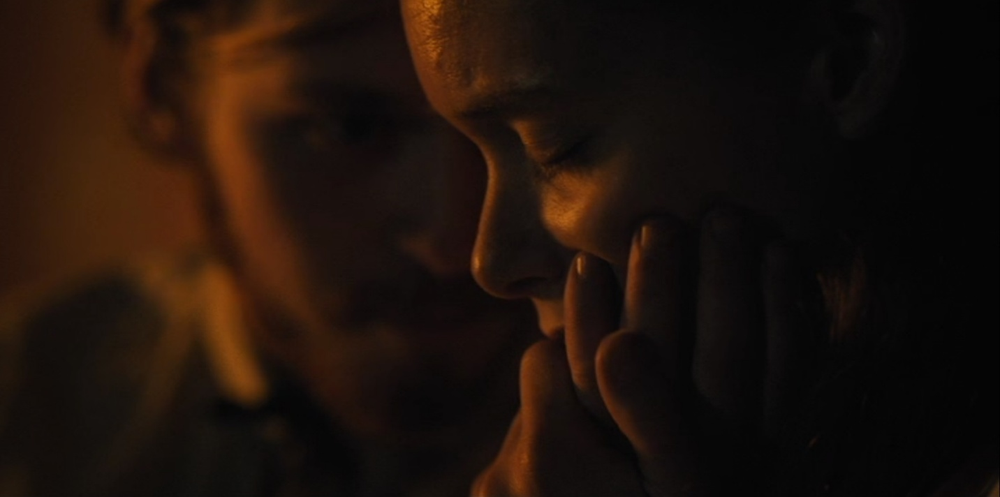
Williams also delicately muddies Andrews’s seemingly tender and respectful attitude toward Francine by highlighting his pity and contempt for her and her way of life, as a woman without agency and “a poor, ignorant victim of her time and place” (60). This view of Francine extends to how Andrews and other men in the party see the natural world and the non-human, which supposedly exist to only serve the men and contribute to their process of ‘becoming a man.’ Not being fully a man yet, Andrews does not consummate the relationship; he suddenly rushes out of Francine’s room and restlessly awaits the party’s departure from Butcher’s Crossing. Moving through and penetrating the land thus comes first and becomes a necessity for the penetration of women’s bodies. Later, upon returning to Butcher’s Crossing from the hunting trip, Andrews spends several days with Francine (in moments not featured in the film), having sex and objectifying her body. Then, he feels a sudden urge to leave the town and head West again. Before leaving Francine’s room, he puts some money on the table, thus reducing the sexual relationship to a commodity to be bought, just like the buffalo hides that are intended for a trade.
Andrews’s masculinity develops via other means, too. Early in the course of their westward journey, his body begins to show signs of pain, a necessary process of hardening and becoming a man, as the novel describes it: “The heat throbbed against Andrews’s body, and his head pounded painfully with the beat of his pulse; already the flesh on his upper thighs was tender from rubbing against the saddle flaps, and his buttocks were numb on the hard leather of the seat” (70). The film also depicts this bodily pain as the result of a long ride on a stiff saddle, as Andrews struggles to walk when the party camps for the night. Schneider tells Andrews that he has “saddle rot” and urges him to give his lower body some fresh air to prevent his balls from getting swollen. But as pointed out earlier, for the most part, the film does not effectively show the men’s bodily changes, particularly that of Andrews. The novel, on the other hand, constantly emphasizes this matter:
Day by day he [Andrews] felt the skin of his face hardening in the weather; the stubble of hair on the lower part of his face became smooth as his skin roughened, and the backs of his hands reddened and then browned and darkened in the sun. He felt a leanness and a hardness creep upon his body; he thought at times that he was moving into a new body, or into a real body that had lain hidden beneath layers of unreal softness and whiteness and smoothness. (86)
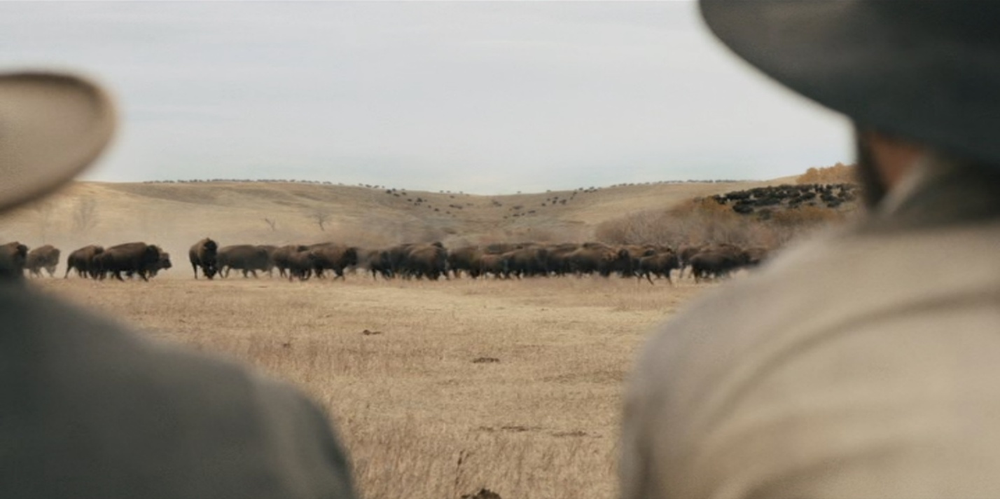
Once in the valley, the killing of buffalo and months-long isolation in the wilderness further harden Andrews. Not only does he assist Miller in the slaughter of the herd—after all, it is his money that has made this trip in general, and the purchase of ammunition and other tools in particular, possible—but also he gets a chance to kill a few buffalo and skin many others, butchered by Miller (Figure 3 and Figure 4). Andrews thus becomes accustomed to the violence, the blood, and the cutting of once-living bodies. He comes to experience the land and the West not only through a sense of vulnerability and pain, but also through a sense of becoming closer to nature, a paradox of conquest and kinship, destruction and restoration.
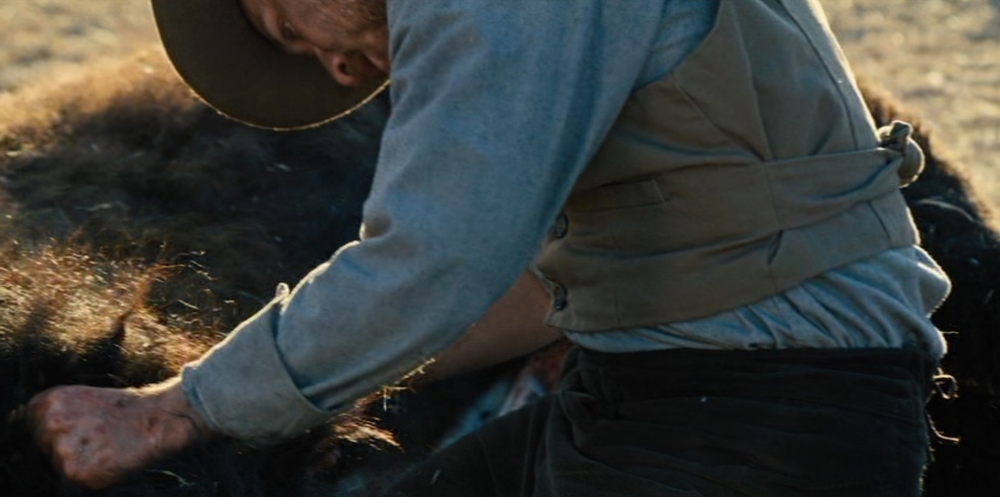
From the beginning of the story, when he arrives at Butcher’s Crossing for the first time, Andrews has a westward urge, and throughout the course of the narrative his gaze and his mind wander westward. He at first has a “utopian view of the West,” a place where “the opportunity for renewal, for self-transformation, for release from constraints associated with an urbanized East” allows a man to find his true self and identity (Mitchell 5). He often compares what he has read about the West with his actual experiences, and it is this immediacy of being in the West that deepens his understanding of the place. Andrews gradually acquires the traits of the land, becoming rough, hard, and unforgiving.
Miller, on the other hand, has already achieved this utmost unity with the Western landscape, and through the course of the journey, he does not change much, except for getting more comfortable as the party moves farther away from the town and closer to the wilderness. He knows the route by closely observing the unmarked landscape, feeling the land, and sensing the water. Reflecting on Miller’s character, Jack Brenner writes that “he is, of all the men in the party, the one most likely to have experienced that surge of unity Andrews desires. His knowledge of the landscape is intuitive, nearly mystical; he shuns civilization; he has long lived by the rhythms of the natural world” (252-253). Miller’s ruggedness and strength are also masculine features that have long been celebrated in the genre of Western. As Susan Lee Johnson reminds us, “The construction of a masculine West was part and parcel of a larger late nineteenth-century ‘crisis of manliness’ in the United States—a crisis in which older definitions of white, middle-class manhood that emphasized restraint and respectability (manly men) gave way to newer meanings that focused on vigor and raw virility (masculine men)” (497). Butcher’s Crossing, however, questions the nature of Miller’s masculinity, presenting it not as a virtue but as an empty pragmatism and brutality.
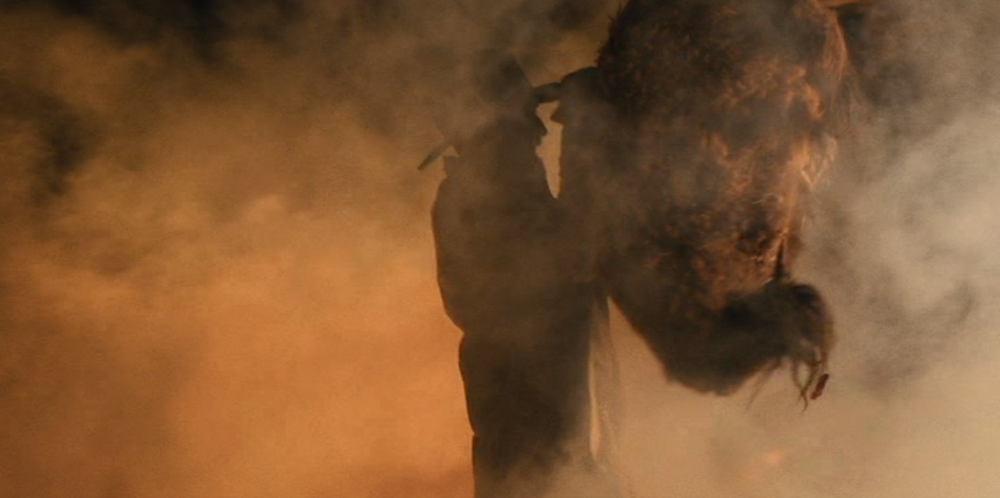
Miller’s brutality is nowhere more present than in his slaughter of the buffalo (the heart of Butcher’s Crossing, featured prominently in novel and film). He senselessly kills thousands of buffalo, more than Schneider and Andrews can skin. Miller, in fact, in the novel becomes “a mechanism, an automaton, moved by the moving herd” (137), as he methodically kills one buffalo after another. And Andrews comes to understand “Miller’s destruction of the buffalo, not as a lust for blood or a lust for the hides or a lust for what the hides would bring … [but] as a cold, mindless response to the life in which Miller had immersed himself” (137). Brenner in this regard observes that Miller’s ruthless hunt is “for a process that will lock out emptiness” (253). That the process of westward expansion and conquest of the West turns out to be “empty” is Butcher’s Crossing’s revisionist message: white men’s extractive violence and destruction built this process, ultimately contributing to their own annihilation. Once back in Butcher’s Crossing, Miller realizes that the market for buffalo hide has crashed and thus McDonald can no longer buy his prime hides, which further highlights the senselessness of his slaughter. McDonald tells Miller in the novel, “[T]he hide business is finished. … Just like you’re finished, Miller. And your kind” (247). The extractive and harmful practices of hunters and traders oversaturate the market and thus bring forth their own demise. While the town’s empty and dead state clearly suggests the end of a boom period as many have now abandoned the place or are in the process of doing so, Miller does not want to believe what he sees and hears. Outraged, he sets McDonald’s stacks of useless buffalo hides on fire, a scene emphasized in the film, too (Figure 5). While the town’s people, including Andrews, are shocked by the unexpectedness and extent of the fire, they do not do anything to stop Miller or extinguish the fire. Miller’s fiery rage not only shows the disintegration of his identity, but it also brings forth another destruction that seems to signal the looming destruction of the town itself.
Significantly, what leads the men to this point in the story is historical amnesia. McDonald, for example, reminds Miller in the novel that the collapse of the buffalo hide market is similar to what happened to the beaver fur market, in which Miller himself was involved: “You trapped beaver once, didn’t you? When they stopped wearing beaver hats you couldn’t give the skins away. Well, it looks like everybody that wants one has a buffalo robe; and nobody wants any more” (247). Charley Hoge also ignores his traumatic experience of losing one of his hands in a blizzard in the Rockies some years earlier, and after a mild pushback agrees to join Miller and others for the buffalo hunting expedition. They again get caught in a severe snowstorm in the mountains, and the shock of the experience revives Hoge’s past trauma, sending him into a psychological spiral that makes him numb to his surroundings. He survives the excruciating blizzard and successfully makes his way back to Butcher’s Crossing with Miller and Andrews (Schneider gets killed when the party is crossing an overflowed river on their way back to the town). In the film, however, Hoge gets severely beaten by Schneider, who realizes that he has been poisoning his food. To prevent Hoge’s further suffering, Miller kills him with his gun and buries him with his bible in the valley (in the film, Schneider also gets killed on their way back to the town, when the heavily loaded wagon he is driving cracks on a steep hill, thrusting the entire load of buffalo hides and Schneider down into a valley). By underlining these failures “to attend to the knowledge one already has, Butcher’s Crossing seems to insist, the trouble of extractive masculinity is its failure to make use of its own understanding of its identificatory relationship to a western environment that shows little regard for our precarious existence—just as we have” (Goldberg 206).
This amnesia is not limited to these characters but can be found in historical realities such as buffalo restoration efforts, grounded as they were in the “formulation of frontiersman-turned-conservation-hero on the one hand, and a national desire to halt the destruction of what remained of the frontier on the other” (Schneider 807). These efforts aimed to continue not only the valorization of Western masculinity, but also the disposition of Indigenous people from their lands. Regarding the former, Andrew C. Isenberg observes, “The installation of bison in managed preserves in the early twentieth century by the American Bison Society emerged from a concern by the officers of that organization that masculine virtues were on the wane in urban America. To reverse that decline, the Society resolved to preserve the bison as a reminder of frontier manliness” (5). Regarding the latter, Schneider reminds us, “Although the eradication of buffalo may be more readily acknowledged as part of a larger strategy to weaken the political and economic power of tribal nations and expropriate their land, buffalo conservation also functioned as a way to legitimize and naturalize the transformation of tribal land into federal refuges for what remained of the West’s buffalo populations” (808). The white men’s extractive practices and subsequent efforts to supposedly mitigate their own harmful actions have thus clearly put “more bodies under threat than just the white men …” (Goldberg 206), even though Butcher’s Crossing does not explicitly acknowledge this matter, given that its focus solely remains on the white men’s extractive violence and its impact on their own undoing.
At the end of both novel and film, Andrews leaves Butcher’s Crossing, heading further West; as Williams describes it, “Except for the general direction he took, he did not know where he was going; but he knew that it would come to him later in the day. He rode forward without hurry, and felt behind him the sun slowly rise and harden the air” (274). This time, Andrews’s westward journey is without clear direction, perhaps in an effort to get away from himself, from what the West has made of him. The ending seems to imply that “just as Eastern ‘ideas’ failed Andrews so has Western ‘experience’” (Hutchison 255). And at the heart of this experience is an embedded violence that needs to be removed in order to offer new possibilities and alternative paths forward: an extremely difficult, if not impossible, task for the Western genre, given that making a man in the Western and moving toward “an exhibition of manly restraint” inevitably require “the proof of generic excess in the form of repeated violence” (Mitchell 155).
Endnotes
1 The notion of the West as a restorative place for men can be seen in Dr. Silas Weir Mitchell’s medical practice. A nineteenth-century pioneer physician and neurologist, Mitchell specialized in ‘Rest Cure,’ a “highly gendered response to the new condition named ‘neurasthenia’ by his compatriot George Beard in 1869: a nervous disorder or exhaustion … specifically modern and originating in America” (Bold 59). As Christine Bold explains, “When Mitchell diagnosed neurasthenia in women, he recommended absolute bed rest, absence of intellectual or creative activity, massage, over-feeding, and … electro-therapy. … When Mitchell diagnosed neurasthenia in men, he prescribed a trip west, with as much vigorous outdoor activity and the recording of closely observed detail as possible” (59).
2 In the same vein, Ryan Gilbey mentions, “No matter how nasty things get, the screen stays spick-and-span; clothes appear pressed, skin exfoliated. Even after months in the wild, there is no sense that anyone pongs …”
3 For more information on the decades-long role of the Blackfoot people to bring wild buffalo back to their land and restore their traditional culture and ways of life see acclaimed documentary Bring Them Home (2024), directed by Ivy MacDonald, Ivan MacDonald, Daniel Glick.
Works Cited
Aquila, Richard. The Sagebrush Trail: Western Movies and Twentieth-Century America. U of Arizona P, 2015.
Asquith, Mark. Lost in the New West: Reading Williams, McCarthy, Proulx and McGuane. Bloomsbury, 2021.
Bevilacqua, Winifred Farrant. “The Revision of the Western in E. L. Doctorow’s Welcome to Hard Times.” American Literature, vol. 61, no. 1, 1989, pp. 78-95.
Bold, Christine. The Frontier Club: Popular Westerns and Cultural Power, 1880-1924. Oxford UP, 2013.
Brenner, Jack. “Butcher’s Crossing: The Husks and Shells of Exploitation.” Western American Literature, vol. 7, no. 4, 1973, pp. 243-259.
Cahir, Linda Costanzo. Literature into Film: Theory and Practical Approaches. McFarland & Company, 2006.
Daniels, Robert. “Butcher’s Crossing.” Roger Ebert, 20 Oct. 2023, https://www.rogerebert.com/reviews/butchers-crossing-movie-review-2023. Accessed 16 Aug. 2025.
Dant, Sara. Losing Eden: An Environmental History of the American West. New ed., U of Nebraska P, 2023.
Doctorow, E. L. Welcome to Hard Times. Simon and Schuster, 1960.
Gilbey, Ryan. “Butcher’s Crossing review – Nicolas Cage keeps quiet in buffalo-hunting western.” The Guardian, 1 Nov. 2023, https://www.theguardian.com/film/2023/nov/01/butchers-crossing-review-nicolas-cage-western-john-williams. Accessed 16 Aug. 2025.
Goldberg, Sylvan. “Extractive Masculinity: The Western’s Precarious Male Bodies in the Anthropocene.” The Routledge Companion to Gender and the American West, edited by Susan Bernardin, Routledge, 2022, pp. 197-209.
Hall, Laura. Bloodied Bodies, Bloody Landscapes: Settler Colonialism in Horror. U of Regina P, 2025.
Hermanns, Grant. “Gabe Polsky Interview: Butcher's Crossing.” Screen Rant, 26 Sept. 2022, https://screenrant.com/butchers-crossing-gabe-polsky-interview/. Accessed 17 Aug. 2025.
Hutchison, Anthony. “‘Young America’ and the Anti-Emersonian Western.” Western American Literature, vol. 55, no. 3, 2020, pp. 237-260.
Isenberg, Andrew C. The Destruction of the Bison: An Environmental History, 1750-1920. Cambridge UP, 2000.
Johnson, Susan Lee. “‘A Memory Sweet to Soldiers’: The Significance of Gender in the History of the American West.” Western Historical Quarterly, vol. 24, no. 4, 1993, pp. 495-517.
Kitses, Jim. “Introduction: Post-modernism and The Western.” The Western Reader, edited by Jim Kitses and Gregg Rickman, Limelight, 1998, pp. 15-31.
Latiolais, Michelle. “Introduction.” Butcher’s Crossing, by John Williams, New York Review Books Classics, 2007, vii-xv.
Leydon, Joe. “‘Butcher’s Crossing’ Review: Nicolas Cage’s Slow-Burn Turn Propels Gabe Polsky’s Grimly Fatalistic Western.” Variety, 21 Oct. 2023, https://variety.com/2023/film/reviews/butchers-crossing-review-nicolas-cage-1235764218/. Accessed 16 Aug. 2025.
Limerick, Patricia Nelson. The Legacy of Conquest: The Unbroken Past of the American West. Norton, 1987.
McCaffery, Larry. “A Spirit of Transgression.” E. L. Doctorow: Essays and Conversations, edited by Richard Trenner, Ontario Review P, 1983, pp. 31-47.
McFarlane, Brian. Novel to Film: An Introduction to the Theory of Adaptation. Clarendon P, 1996.
Mitchell, Lee Clark. Westerns: Making the Man in Fiction and Film. U of Chicago P, 1996.
Nelson, Andrew Patrick. Still in the Saddle: The Hollywood Western, 1969-1980. U of Oklahoma P, 2015.
Nijhuis, Michelle. “Butcher’s Crossing Betrays the Brilliant Novel That Inspired It.” Literary Hub, 18 Oct. 2023, https://lithub.com/butchers-crossing-betrays-the-brilliant-novel-that-inspired-it/. Accessed 11 Oct. 2025.
Phipps, Gregory Alan. “Pragmatist Individuals and the Nineteenth-Century American West in Wallace Stegner’s Angle of Repose and John Williams’s Butcher’s Crossing.” Western American Literature, vol. 55, no. 4, 2021, pp. 323-350.
Robson, Leo. “John Williams and the Canon That Might Have Been.” The New Yorker, 11 Mar. 2019, https://www.newyorker.com/magazine/2019/03/18/john-williams-and-the-canon-that-might-have-been. Accessed 11 Oct. 2025.
Saito, Stephen. “Gabe Polsky on Navigating Treacherous Territory in ‘Butcher’s Crossing’.” The Moveable Fest, 19 Oct. 2023, https://moveablefest.com/gabe-polsky-on-navigating-treacherous-territory-in-butchers-crossing/. Accessed 17 Aug. 2025.
Schneider, Lindsey, “Decolonizing conservation? Indigenous resurgence and buffalo restoration in the American West.” Environment and Planning E: Nature and Space, vol. 6, no. 2, 2022, 801-821.
Schniedermann, Wibke. “Revision as Nostalgic Practice: The Imagined Adaptation of The Ballad of Buster Scruggs.” Adaptation, vol. 15, no. 1, 2020, pp. 68-83.
Williams, John. Butcher’s Crossing. New York Review Books Classics, 2007.
Woolley, Bryan. “An Interview with John Williams.” Denver Quarterly, vol. 20, no. 4, 1986, pp. 11-31.
Worster, Donald. Under Western Skies: Nature and History in the American West. Oxford UP, 1992.