VOL. 54, NO. 4
Ghost Whispers in the Archives: Retelling History and Family Lore Through Speculative Nonfiction
Laura Valeri
Author Statement
“Ghost Whispers in the Archives” deviates from more traditional scholarship by positioning speculative nonfiction as an adaptive narrative practice at the intersection between creative nonfiction craft and adaptation studies. Structured differently from a traditional scholarly argument, the essay weaves personal narrative with craft analysis and theoretical inquiry to examine how speculative nonfiction transforms fragments of history and memory into narratives that reframe archival erasures and the absence of reliable facts from liabilities to generative sources of meaning. Speculation in this context is not invention but a response to absence, a way of thinking through the gaps that archives leave unresolved.
The essay draws on material from a larger work in progress, Two Truths and a Lie, a speculative nonfiction manuscript that examines the political forces in post-war Italy surrounding my grandfather’s untimely death, and affecting my family’s eventual migration to the United States. Excerpts of Two Truths and a Lie have appeared in literary journals, including a chapter titled “Storybook Endings,” published in Consequences Forum, cited in this essay as one example of the speculative strategies discussed. Nonetheless, the project’s ongoing development is thematically relevant, as the essay confronts a variety of challenges through an analysis of existing speculative nonfiction texts. This process serves as a practical demonstration of how speculative nonfiction, like adaptation, involves acts of reinterpretation that reshape and enrich inherited narratives, transforming missing records and other uncertainties into meaningful storytelling through new perspectives and alternative literary forms.
By approaching speculative nonfiction through the lens of adaptation, the essay invites readers of Literature/Film Quarterly to consider adaptive processes beyond literary texts and screen media. Speculative nonfiction adapts not only stories but also fragments of archives, cultural artifacts, memory, and historical interpretation, reshaping these into narrative through acts of imaginative reconstruction. This method broadens the scope of adaptation studies to include forms of narrative that reconstruct histories where documentation remains incomplete.
Recovering The Past
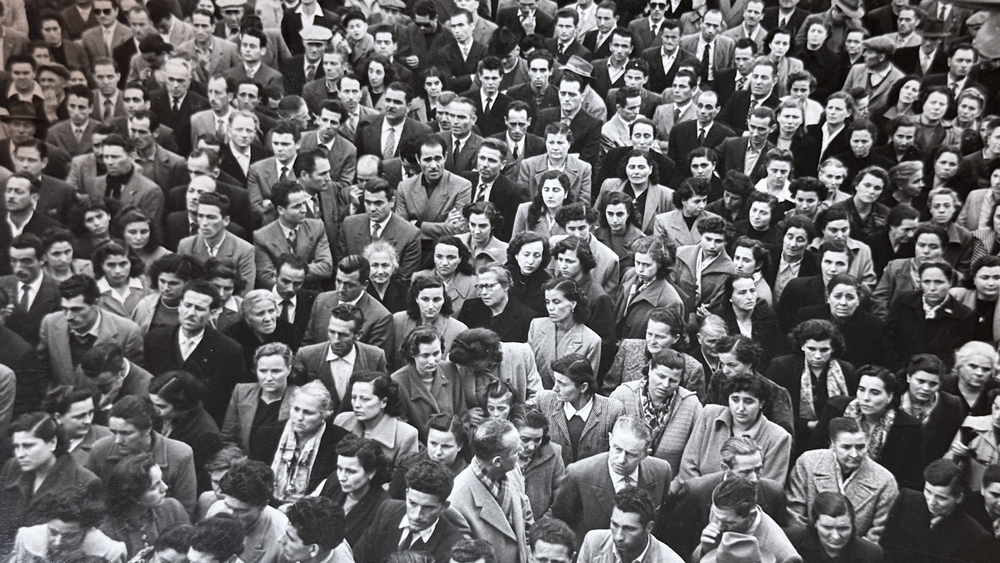
The photo labeled Figure 1 was recovered from my mother’s storage unit in Italy. I can point to my grandmother, recognizing her round, pale face, the sullen, heavy eyes, the broad, unsmiling mouth. Not far from her is my great-grandmother, recognizable to me, forty years or so since I’ve last seen her, because of that serious, dignified look that distinguishes her from so many faces in this photo, some of them relatives I ought to recognize but can’t. Unseen, swallowed by the crowd, is my mother, a few days from her 12th birthday, as important and invisible as my grandfather was to all these people pressing in from the sidewalks into this street, bleeding past the edges of this photo onto alleys beyond sight, crowding into the fog of speculation, hundreds, perhaps thousands enduring the chill wind of a cold grey day.
I won’t tell you yet what drew them to Piombino, or what my grandfather had to do with it, but I invite you to imagine it. Because, like all retellings, like all adaptations -- like this photograph -- the details we share and those that are missing invariably shape our perceptions, inviting speculation where certainties are absent, beckoning us to imagine what might have been, what’s missing, and what other versions may exist.
Mine is a retelling of family lore that braids personal and political history, tracing how the United States' interests entangle with my birth country, Italy, and profoundly shaped my ancestors’ destinies and mine. My work is an adaptation in the way that historiography is an adaptation: dramatized, reframed, incomplete. It excavates the facts behind family lore to reconstruct its place within a fraught and censored history suspended in a liminal space between faulty memories and missing records, bracketed between ellipses and question marks with no clear beginning or ending.
Retelling Censored History
My work in progress, Two Truths and a Lie, explores how interventions from the United States into Italy’s postwar economic and political development set into motion forces that led my family to emigrate to the United States in 1978. In Italy, the 1970s are known as The Years of Lead, a period of terrorism so violent that it threatened the collapse of Italy’s democracy. When statesman Aldo Moro was kidnapped and murdered after fifty-five days of captivity, my father decided it was time to leave. A child of the war, he’d always dreamed of emigrating to America. Moro’s assassination turned that dream into a necessity. For me, this transatlantic move at twelve was a defining event.
Historians disagree on many of the circumstances surrounding Moro’s case, but concur that he was targeted for brokering the “Historic Compromise,” a deal that would have allowed the Italian Communist Party (PCI) to share governance with the Christian Democrats (DC) and to participate in Italy’s government for the first time since the PCI was banned in 1947. Historians suggest that both the KGB and the CIA were implicated in Moro’s disappearance, perceiving the compromise as a threat. I have since wrestled with the irony of fleeing to the country that may have participated in destabilizing the one I came from.
There’s another irony at work. My grandfather died under suspicious circumstances in 1951. He was a Communist, an uncomfortable truth I have hesitated to share. In Mussolini’s time, Communism meant being an enemy of fascism; in the post-war period, it meant promoting peace over NATO militarization. For my grandfather, it meant advocating for labor reforms despite the intimidation tactics that entities within and outside Italian authority enacted to suppress. For NATO and Americans, Communism meant a threat of Soviet takeover. To this day, mentioning the word in connection with my grandfather makes me anxious. I worry I might be instantly labeled, with all the dark connotations of over a century of political tensions, authoritarian corruption, and misinformation.
My grandfather was a Communist, an identity he defended with his life, but he was also many other things: a welter-weight pugilist climbing the ranks to a regional belt until he was drafted into Mussolini’s war; a veteran of Albania, and Russia, a medic who spent eight years running through gun fire, negotiating snow and ice and subzero temperatures to rescue the wounded and recover the dead; a member of an elite Alpine unit, the Cuneense, one of less than 300 of the 11,000 to survive the Soviet counteroffensive when Axis troops retreated; a partisan, committed to liberate Italy from Nazi occupation; a furnace operator at a steel mill, working double shifts six days per week in a position where mistakes had life and death consequences; a section leader of the Communist party in a local district representing two major steel plants crucial to labor unions; a beloved son, a brother, a friend to multitudes, and most of all, a husband and father.
In the last year of his life, in 1951, he was a mayoral candidate for Piombino. Weeks before the elections, he was returning home from a late meeting, riding the back of a friend’s motorcycle. A truck blinded them with its high beams. They didn’t see the misplaced A-frame roadblock in their lane and crashed. The official story is that what killed my grandfather was a rock that shattered the back of his head and speared the medulla oblongata. But there’s another story: an aunt once claimed he was murdered. Back then, I thought my aunt was delusional. I’d observed women of her generation treat with suspicion any glance sent their way, any word uttered by neighbors. Yet, despite my skepticism, her words lingered.
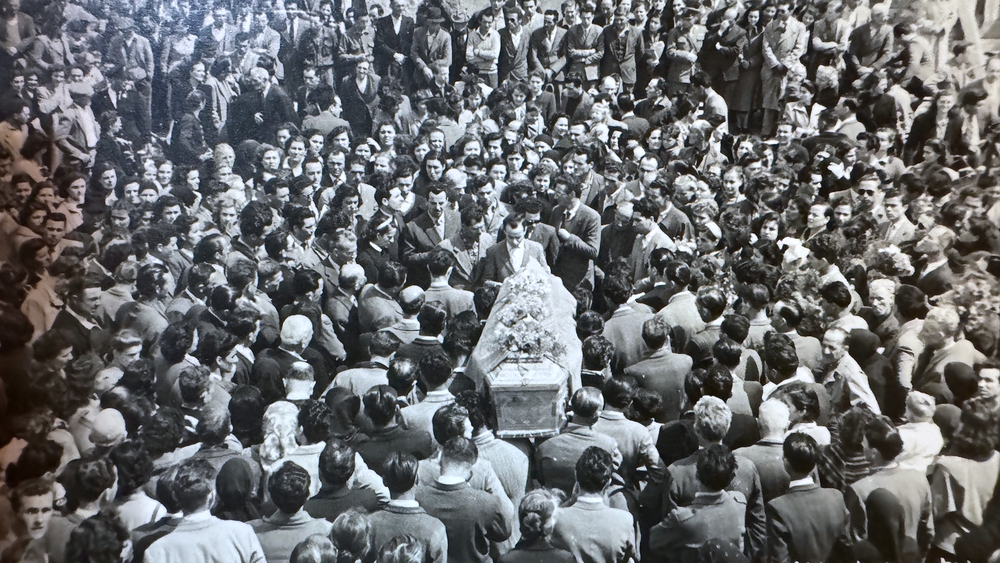
It wasn’t until decades later that I learned how Communists in post-war Italy were often detained, tortured, or killed without due process, and that multiple agencies operated in Italy with a mission to suppress all leftist movements by any means necessary. In the 1990s, when Operation Gladio was first uncovered, records emerged detailing these persecutions. I then found a surveillance file in Rome, misfiled, requiring “attentive surveillance” of my grandfather, deemed dangerous because “capable of inciting large crowds.”
The photo you see here (Figure 2) was taken at my grandfather’s funeral in 1951. I had always heard that “all of Piombino” came to pay homage, but I didn’t take it literally. He was more important than I’d realized.
History is a trickster: a Communist grandfather, an American granddaughter. I’ve had to parse how I feel about America’s post-war interventions in Italy—grateful for the dangers averted of Soviet domination; disturbed by the violation of democratic principles. My project is not about solving a possible murder mystery but exploring how unanswered questions relate to me and my family history as I navigate this age of polarization, misinformation, and increasing unrest, similar to the one my grandfather left behind.
I never dared to write this as a real-life story. Fiction seemed the safer way. But fiction requires precision—a plot that hinges on a measurable objective, a character arc that challenges the protagonist’s moral makeup—elements that require precision, and therefore, too much invention. My grandfather’s life is to me but a handful of anecdotes. Besides, what I find most compelling about his story lies precisely in its omissions. Turning it into fiction dims the brightness of a lived experience that illuminates what is missing and forever lost.
The Emergence of Speculative Nonfiction
The term speculative nonfiction sounds like an oxymoron for a genre that evolved from journalism and remains rooted in verifiable facts. Robin Hemley and Leila Philip first introduced the term with the launch in 2018 of their co-founded literary journal, appropriately titled Speculative Nonfiction. The first issue features a “Manifesto” advocating for “[e]ssays that tilt more towards metaphor than fact” and “exist in a crack between genres.” The authors distinguish speculative nonfiction from the lyric essay, a genre known for its hybridity and poetic elements, often associated with “formal speculation,” but to Hemley and Philip, “the lyric essay does not own speculation." They bring attention to essays that “use speculation as methodology and content” and how the current taxonomy fails to account for them. The manifesto concludes by inviting us to “set aside that tired dog of truth vs. fiction and consider afresh the literary territories nonfiction is charting in the 21st century.” Author Sean Glatch more succinctly defines the genre as one that uses “speculation, wondering, or invention as tools for uncovering different truths” (“Truth in Possibility”).
Speculative nonfiction empowers writers to write about histories unrecoverable through archives and stories that resist documentation but remain powerful precisely because of their omissions. They are stories grounded in lived experience that draw from invention, metaphor, and symbols to capture emotional truths, thriving in the tension between clarity and uncertainty, fact and imagination.
Speculation as a method isn’t new. Many celebrated works of creative nonfiction rely on informed conjecture when facts falter. Truman Capote’s In Cold Blood, for example, reimagines its subjects’ thoughts in the absence of verifiable records. Sebastian Junger’s The Perfect Storm likewise speculates about the final moments of a doomed commercial fishing crew, using research and testimony to reconstruct plausible actions and thought processes.
Similarly, Joan Didion’s The White Album blends reportage with meditation. Its focus on the narrator’s perceptions characterizes the New Journalism movement, giving rise to the creative nonfiction form. “We tell ourselves stories in order to live,” (11) Didion declares in the opening line, skeptical of the human need to ascribe meaning to every occurrence. Didion resists closure, favoring emotional truths that emerge from images and impressions.
But what happens when no personal details survive? No letters, no witnesses, no context to reconstruct? These are the landscapes that speculative nonfiction empowers us to explore; stories where omissions and the questions they invite form meanings not easily articulated through traditional methods.
Ancestral Cautionary Tales
Maxine Hong Kingston confronted unknowable histories in her essay “No Name Woman,” an early model of speculative nonfiction. In it, Kingston’s mother reveals a family secret about an aunt in China who conceived a child outside of wedlock. The villagers, enraged by the scandal, destroyed the family home. The aunt gave birth, hiding in a pigsty, but drowned herself and her newborn in the well. Shamed and deliberately erased from family memory, she survives only as a cautionary tale.
But Kingston feels the need to excavate the untold details, sensing that the most meaningful aspects of the story lie in its omissions. She tries to reconstruct what her family won’t share -- her aunt’s choices, her desires, and fears. She uses a method that author Lisa Knopp, writing about “No Name Woman,” calls perhapsing (“Perhapsing”), signaling with words like “may” and “perhaps” imagined aspects of the story, leveraging invention as a necessary means to the truth:
Perhaps she had encountered him in the fields or in the mountains…perhaps he first noticed her in the marketplace. He was not a stranger because the village housed no strangers…His demand must have surprised, then terrified her. She obeyed him; she always did as she was told. (6)
The speculative deepens: Kingston reimagines her aunt as rebellious and eccentric, then as romantic and naive, not to uncover a single truth but to understand the silences shaping her own inheritance, “to figure out how the invisible world the emigrants built around our childhoods fits in solid America.” (5-6) The haunting, then, is generational, the nameless aunt a palpable absence but one defining for the living.
Kingston’s aunt has been haunting her for twenty years, and not always benevolently (16). I also feel haunted by the ghost of my grandfather. I possess no letters written in his hand, and have no personal connection to him except through the anecdotes shared with me, already eroded by time and too many retellings. Yet, like Kingston, I sense the missing limb of that family tree as important to my own place in the world. I’m compelled to imagine how an entire life, once widely known in Piombino, could vanish from public memory yet remain deeply rooted in my family’s identity and my understanding of myself in the world.
Archival Silence
Saidiya Hartman’s “Venus in Two Acts” is a seminal speculative nonfiction text for teaching writers how to respond to the erasure of marginalized voices from history. Hartman examines the archival records of the Atlantic slave trade, where the only evidence of enslaved Black girls appears in the testimony of their captors. But the documents are records of abuse, not of personhood. These women survive only as evidence of the slave traders’ crimes, their identities distorted into the libidinal fantasies and ghastly humiliations detailed in court records (2).
Hartman calls this the problem of “archival silence”: how to document lives lived without re-enacting the violence? It may be possible to reconstruct through research some approximation of the conditions endured on those ships, but that would yield a re-enactment of their suffering, condemning these girls to the same violence twice. Yet silence is complicity, leaving unchallenged the Black Venus construct imposed on them by their rapists, propagated through cultural artifacts and literature.
Hartman turns to the speculative to lend dignity to the existence of enslaved girls, imagining them as frightened friends, comrades in captivity who console one another, sharing empathy where there is none to be had from their captors (8). This approach is not without its problems: it risks romanticizing atrocity, but these speculative reimaginings become a way of witnessing: they may not recover what’s lost, but they honor and restore those lives to dignity: “it would not be far-fetched to consider stories as a form of compensation or even as reparations, perhaps the only kind we will ever receive” (4).
Although my work cannot claim the scale or urgency of Hartman’s subject, my grandfather’s story also speaks to deliberate erasures enacted to control the victor’s narrative. After years of research into post-war Italy, I’ve encountered archival neglect so specific that I am comfortable calling it deliberate: missing hospital, police, and autopsy reports, vanished court records, and a surveillance file that survived only because it was misfiled in Rome. Even municipal memos referenced in that file have disappeared from local archives. This pattern feels purposeful, part of a larger effort to suppress Communist voices and control historical memory.
There are also silences closer to home: my grandmother had a fifth-grade education and wrote little. I have no letters from the front, no diary, only a pocket photo of her at seventeen that survived the war with my grandfather, so creased it’s nearly torn. These absences form a negative archive, a collection of losses, secrets, and censorship that together whisper a story of poverty, oppression, and grief. Hartman teaches me to listen to those voids, and to acknowledge both the limits and the necessity of imagination in communing with the ghosts while accepting that the fragments recovered may be less important than the questions they leave behind.
Intertextuality as Allegory & Metaphor
In her speculative nonfiction memoir, In The Dream House, Carmen Maria Machado defines the memoir as “an act of resurrection” that can “manipulate time; resuscitate the dead” (6). Memoir, she argues, seeks justice or clarity by restoring context to lives distorted or silenced by others. But, like Hartman, she acknowledges that some stories are “irrevocably missing from our collective histories” (6).
In the Dream House, the life that Machado is trying to resurrect is her own, recovering it from an abusive same-sex relationship that confused and blurred her sense of self. Lacking documentation or applicable precedents, she turns to metaphor and intertextuality to make sense of what has no public narrative: “The abused woman,” she writes, “has been around as long as human beings,” yet “the conversation about domestic abuse within queer communities is even newer, and more shadowed…the queer abused-reveals itself as another ghost that has always been here, haunting the ruler's house” (6).
Without archives to consult, Machado creates her own symbolic lexicon: the Dream House of the title is both a physical place where the relationship evolves, and a metaphorical space to observe the mechanisms of abuse. In a chapter titled, “Dream House as Not a Metaphor,” Machado describes the physical details of the house, concluding, “it is important to remember that the Dream House is real. It is as real as the book you are holding in your hands” (9), but in subsequent chapters, it shifts into something less tangible: “Dream House as Deja Vus” (98), “Dream House as Cautionary Tale” (106). The Dream House is both dream and nightmare, a promise of domestic joy that ultimately delivers confusion, dislocation, and fear.
At times, Machado draws on pop culture artifacts to translate trauma into shared imagery. In “Dream House as Five Lights,” Machado describes a Star Trek: The Next Generation episode titled “Chain of Command” in which Captain Picard, under torture, is told to admit there are five lights when there are only four. When Picard is safely back on the Enterprise, debriefing, he admits that torture made him believe he could see five lights. Machado offers no commentary; the parallel is implicit. Like Picard, she is both captive and participant in the delusion.
Like Machado, I lean on cultural artifacts for the emotional truth of some of my work. Episodes of mid-century Italian history relevant to my grandfather’s story are so absurd that they resist straightforward narration. Thankfully, filmmakers and songwriters of the 1950s and 60s captured that absurdity in ways that feel truer than could be accomplished through documentation.
An example is the opening segment of Tutti A Casa (Everybody Go Home), a 1960 film directed by Luigi Comencini that captures the baffling inadequacy of Badoglio’s surrender to the Allies in 1943. It was announced over the radio without warning to high military command, who never gave orders to troops still embedded with the Germans, Italy’s allies until that moment. As a result of that haphazard surrender, a significant number of Italians were killed, and countless others ended up in German concentration camps without so much as a bullet being fired.
I translate a sequence from Comencini’s film that takes place at a military base in 1943, where a cook accidentally intercepts Badoglio’s broadcast while fiddling with the radio. A series of phone calls ensues between officers on the base, high command, and a Lieutenant at an outpost who is facing threats from German tanks demanding the outpost’s immediate surrender. A baffled Colonel reflects: “Incredible. The Germans found out before we did. The last order we received was to make soldiers sing while marching.” (00:09:51)
Another artifact I use is Renato Carosone’s 1956 song, “Tu Vuò Fà L’Americano” (“You wanna be American”), mocking Italy’s postwar fascination with American culture. A favorite from my father’s youth, when the family moved to the US, the song transformed into a sardonic commentary on our futile, at times ridiculous attempts to assimilate and adapt to American culture:
The film and the song serve a dual purpose: they effectively exemplify complex circumstances and situations, while also delivering a resonant emotional truth with a comedic sense of irony characteristic of Italian culture. They substitute documentation with shared cultural echoes that are as haunting as they are authentic, expressing truths beyond the reach of records and archives.
Interviewing Memory
Engaging with the self, particularly around trauma, can be perilous terrain for memoirists, but speculative nonfiction offers flexible methods to mine interior landscapes. The Tale, a genre-bending memoir film by Jennifer Fox, is an illuminating example. The film opens with Fox’s mother accidentally discovering an essay that Fox wrote at age thirteen, describing her sexual relationship with her forty-year-old coach and her friendship with the woman who groomed her for it. Confronted by her mother, Fox is forced to interrogate what she had once perceived as a beautiful and transformative experience. She uses her reportage skills as a seasoned documentary filmmaker to track down and confront her abusers.
What makes the story unique is hardly the deflections, manipulations, and lies she navigates as she confronts the two aged adults around this taboo subject. Rather, it’s the candid revelations gleaned from interviews she conducts in her own mind, imagining conversations with her thirteen-year-old self and with the two adults as they once were. The speculative aspects of her research are as poignant and revelatory as the real-life confrontations are elusive and disappointing.
Fox thus reinserts herself in her own story as both adult observer and child participant, asking the difficult questions that the real-life adults evade through guilt, manipulation, and deflection. The past is retold and adapted with the insights that emerge from Fox’s mind interviews, illuminating with stark clarity the self-deceptions and ambiguities that can veil such abuse even as it unfolds in plain sight of attentive parents and guardians.
The most chilling moments are the confrontations that occur between adult Fox and her thirteen-year-old self: “I got an A,” young Jennifer says, grinning with confidence. “I’m not the victim in this story. I’m the hero. He felt hurt, not me.” Self-deception masquerades as empowerment, while trauma hides behind the stories we tell ourselves to survive. “You couldn’t even think that their lives might continue without you,” adult Jennifer says, a line loaded with dark implications about the complicity of silence, the consequence of self-deception.
Fox has gifted writers a means to time-travel through lived experience. For my work in particular, those interviews allow me to navigate not just misremembered moments but also the contradictions inside anecdotes my mother has shared about her father over the years. They change from telling to telling, challenging my notes and my memory, and resisting efforts to confirm any version as correct. These variations may be her subconscious attempts to retain ownership of her past, of the little time she shared with her father, fighting the theft of memory with the richness of imagination. Her inconsistencies, too, are a way to honor and dignify her loss, a way to seek reparation, but having the tools to define these nuances is necessary.
Our past is an assemblage of perceptions, a collection of volatile impressions influenced by context. Jennifer Fox inspires me to revisit the same moments from different ages, discovering that every return alters the past anew. The speculative in this case allows us to acknowledge this instability, not as failure, but as evidence of the living nature of memory itself.
Folktales and Fairy Tales as Guides
Speculative nonfiction often draws on myth and folklore to articulate inner realities that ordinary language may find difficult to define. Jami Nakamura Lin’s The Night Parade exemplifies this approach. Writing about her bipolar disorder, Lin turns to Japanese folktales to express experiences too volatile for clinical or confessional prose. A mother who knows herself incapable of harming her own child, Lin is reluctant to describe the episodes of rage she experiences with her condition: “I’m afraid of people seeing the words bipolar and rage and mother in the same story. This is why, when I speak of rage, I shroud it in metaphor” (62).
Lin, skeptical of “the tidy arc” of the typical mental illness memoir and its trajectory towards recovery (63), summons Japanese folklore to represent the often unresolved, inexplicable complexities of the subconscious mind, particularly through stories about the oni-babas, “formerly human women who have transformed into human hags and often feed on human flesh” (45). In the chapter titled “The Rage,” she weaves her own bipolar episodes with the tale of the woman from Mino, an oni-baba who kills her husband out of jealousy, and transforms into a monster, but before she destroys herself, manages to warn other women not to be consumed by emotion. “This is the curse of being alive,” the oni-baba says. “You get hungry” (58). Lin’s retelling exposes the impossibility of clean resolutions; her story, like the folktale, ends in fire and ambiguity. Myth becomes both container and mirror for what cannot be healed or resolved.
I have sometimes tried to find in Italian folklore a metaphorical correlative to my experience, but it’s an English tale that haunts me, instead, since I first saw its 1951 Disney rendition as a child: Alice’s Adventures in Wonderland. The story exuded a darkness that traumatized me and latched onto my subconscious. Alice is always lost, in the wrong place, trying to get home but finding no help, as everyone around her seems wrapped in self-centered absurdity. That sense of dislocation and bewilderment caught up with me in 1978, when my family moved to the United States. Since then, it’s been Alice who gave me the language to express my perpetual disorientation:
You’re stuck for years in that rabbit hole, but, unlike Alice, you lack the confidence to call out the sham. You tumble from one lunatic situation to the next, too tall, too short, too old, too young, too prudish, too bold, too exotic, too white: the only constant is that you don’t fit. You crashed this tea party too late, and the Mad Hatter turned you into the joke; at the grand event everyone’s headed to, if anyone sees you at all, it’s the paper queen shouting, “Off with her head!”
Lin demonstrates that myth allows us to write the unspeakable self obliquely. The fantastic becomes a code for lived experience, giving shape to emotions that resist elucidation. Like Kingston’s “No Name Woman” or Machado’s Dream House, these fables of hunger, confusion, and metamorphosis allow us to dwell in the space between what can be proved and what can only be understood emotionally.
The Paranormal and The Numinous as Lived Experience
Many speculative nonfiction writers turn to the supernatural to articulate experiences that reason cannot adequately define. Sofia and Del Samatar’s Monster Portraits, for example, is the siblings’ story about growing up biracial (Somali-American) in the 1980s. Illustrated bestiaries allegorize and meditate on episodes of otherness, blurring the lines between autobiography and myth. Similarly, Laraine Herring in A Constellation of Ghosts navigates her cancer diagnosis in conversations with her deceased father, whom she envisions as a chain-smoking crow, who occasionally breaks from the symbolic to manifest as paranormal intervention. In one instance, he leaves her life advice on her answering machine (48). In these stories, the numinous becomes a form of dialogue: with grief, with illness, and with one’s divided self.
For writers shaped by cultures where the miraculous and the mundane coexist, blurring the real with the numinous often feels necessary to the authenticity of a real-life story. Harrison Candelaria Fletcher’s Descanso for My Father captures this concept perfectly. Researching the life of a father who died when he was too young to remember, Fletcher occasionally includes stories of ghost visitations and sightings told by relatives. “Estoy muerto!” (32) an ancestor cries from beyond, a message heard simultaneously in two households. Fletcher does not rationalize it. He reports it factually because to his family, it was a fact.
My family history is riddled with stories that seamlessly slip from the mundane to the surreal with twists reminiscent of the original Grimm fairy tales in darkness and opacity. My grandmother was an especially gifted storyteller. She could weave an anecdote about sighting a neighbor at the grocery store and shift into describing a young woman who died of malaria during the war, but warned her lover in a dream that she’d be waiting for one last embrace from him. She’d describe how the lover returned, unearthed the corpse, and found it had not decayed, but it dissolved into dust soon after her lover’s parting embrace. In the next breath, she would talk about chores left undone, or about the proper way to dress for church.
In a Paris Review interview, Gabriel Garcia Marquez once claimed he developed his magical realism style to emulate the style in which his grandmother told stories: “She told things that sounded supernatural and fantastic, but she told them with complete naturalness… I had to write them with the same expression with which my grandmother told them: with a brick face” (Stone). The genre had its roots in Germany and Italy, and I’ve always suspected it was because the atrocities of the Fascist regime and the war must have seemed as surreal as the ghost stories and superstitions that people of her generation grew up accepting. For those who have lived under prolonged national trauma, there may be no difference: the atrocious strikes as randomly as the miraculous, and neither has pattern or meaning.
It would be impossible, therefore, to speak about my mother without mentioning the ritual she endured as a newborn, bathed in wine and coated in sugar when a neighbor suggested the child had been cursed, or the visitations of ghosts that have appeared to her, light switches turning on, doors slamming shut at the whim of a violent mood. And there are her curses, which she denies but which worked too often to be dismissed. My siblings and even my late father could attest to their eerie precision.
I often find myself believing these liminal worlds more than the fragments recovered from history books and archival documents. Knowledge is not only empirical. It can be experiential, intuitive, and inherited. Passages concerning my grandmother must perforce also compass the power of her grief, losing my grandfather, keeping her teetering on the verge of insanity for years:
Some mornings, we find Anna staring at her mother’s side of the bed, empty and cool already. Her grandmother, following her gaze, murmurs, “You see that? Up early, then gone. That’s it. To that cemetery. It’s an obsession. Every Tuesday. She’s fixated on that cemetery.”
That’s where we find Liliana in the days, months, and years after Nello’s death. Drifting with the leaves from tombstone to tombstone, tracing the contours of cherubs and angels of stone. She prefers the twilight, when the blurring of darkness and daylight erase the lines that separate the things she can touch from the things she can’t, that hurt her so much.
She watches graves being dug, caskets lowered into the ground, and tries to persuade herself that her husband is not a body, that she may yet catch a glimpse of a soul detaching from flesh or bone. She doesn’t know what it might look like, only that it will matter, that the ghosts clogging her lungs, blurring her eyes, will disperse with the fumes of her breath into the cold air.
To claim an authentic reconstruction of my ancestors’ lives and their context necessitates my embracing the miraculous, the spectral, the prophetic, and even the bouts of mental instability as lived experience, as true and real as the food they ate and the clothes they wore. To do otherwise would be to condescend and devalue the experience, to dilute with post-millennial skepticism what to them was absolute truth.
Writing True-Life Unknowables
Metaphorical language arises naturally to express with candor and honesty the voids that open inside me as I consider who I am, and how I fit or fail to in the world I’ve inherited, where the continuance may lie, and where it may have threaded off into an unexpected direction. The works of the speculative nonfiction authors I’ve cited have given me more than strategies; they’ve given me a framework for a story that once seemed impossible to share.
At the conclusion of a chapter titled “Storybook Endings,” published as an excerpt in Consequences Forum, allegorical language gleaned from Samatar, Machado, Lin, Herring, and others bridges the past and the present to address the unseen monsters of fascist surveillance and those that threaten me today in a United States increasingly controlled by techno-oligarchy:
In fairytales, there are heroes and monsters, and so it is with this story. The princess is now a young Liliana, just turned seventeen. She doesn’t know the spell she’s about to cast, so powerful that it cannot be undone by salt, or Bible verse, or holy water. The handsome prince is Nello, the talk of the town. But this is Italy. It’s the 1930s. Blackshirts patrol the streets and beat random passersby with sticks and tire irons, just to establish their apex status. Mussolini covets Libya, Albania, and Greece. There are plenty of monsters. Pick one. Pick four or four thousand. (Valeri)
Later, in the same chapter:
And that’s how her story ends. The princess became a store clerk; the prince turned into a ghost. And the monsters? They’re still there, without scales or jagged teeth, without fire-breath or claws. They shed their uniforms for suits, disappearing in recondite offices, into the basements of government and corporate buildings, nameless and silent, always watching, always waiting, concealed by wires and screens. (Valeri)
I’ve titled my work Two Truths and A Lie because distinguishing between these is a theme that echoes through the distortions of family lore and the untruths foisted upon the Italian citizens by corrupt government entities and foreign powers. But there’s another play between truth and lie, having to do with the uncertainties involved in attempting to parse through a story riddled with erasure, censorship, negligence, conspiracy, perhaps even tall tales. What is true of all adaptations, all reconstructions is that each truth may contain its own lie, and every lie may conceal a seed of truth.
I once came across a quote from Italo Calvino, in an article in which he laments the impossibility of translating the real Italy to those outside the culture—not just because of the dialects differing from region to region, and the cultural differences embedded in the lexicon, but also because of the opacity that dominates Italy’s history:
Italy is a country where many mysterious things happen, which are every day widely discussed and commented on but never solved; where every event hides a secret plot, which is a secret and remains a secret; where no story comes to an end because the beginning is unknown, but between beginning and end we can enjoy an infinity of details.
Calvino’s observation could serve as an epitaph for my grandfather’s story, but it also describes the work of speculative nonfiction: between beginnings we cannot pinpoint and conclusions we may never reach, we gather what details we can and attend to their echoes. We learn to embrace uncertainty, to write not towards closure, but towards meaningful resonances. We imagine to honor; we speculate to witness.
I retrace my grandfather’s outline in the negative spaces he left behind, not to resurrect him but to validate his presence: the missing records, the distorted anecdotes, the grief in my grandmother’s voice, and the photo of a crowd that once overwhelmed a street in Piombino. Each of these fragments is a portal, an invitation to commune with the past, to witness it, not as it presents itself in the archives, but as it suggests itself in these silences. To write the true-life speculative is to remain open to the whispers of ghosts who want to be teachers, who share their impressions of life, of the onset of fascism and war, of the scars left on a nation, shadows, then as now, bleeding from the edges of what appears as budget, bureaucracy, legislation, order. The people have changed, the technologies transformed, but have we?
Speculative nonfiction offers no definitive answers, no solutions, no clarity into what might have been or what might become, but it gives absence a voice. It proves that what cannot be documented or verified can still be experienced meaningfully, and therefore deserves to be named. To write such stories is to live in the company of ghosts. The archives may never be complete, but we continue to listen for the whispers.
Endnotes
1 Translation is my own and adapted to retain the rhythm of the song.
Works Cited
Calvino, Italo. “The Written World and The Unwritten World.” The Paris Review, 5 Jan. 2023, https://www.theparisreview.org/blog/2023/01/05/the-written-world-and-the-unwritten-world/.
Capote, Truman. In Cold Blood. Random House, 1965.
Carosone, Renato. “Tu Vuo’ Fa’ L’Americano.” 1956. Tu Vuo’ Fa’ L’Americano, Butterfly Music, 2007.
Didion, Joan. The White Album. 1979. New York, Farrar, Strauss, & Giroux, 2009.
Fletcher, Harrison Candelaria. Descanso For My Father: Fragments of a Life. Lincoln, NE: Bison Original, 2012.
García Márquez, Gabriel. “The Art of Fiction No. 69.” Interview with Peter Stone. The Paris Review, no. 82, 1981, theparisreview.org/interviews/3196/the-art-of-fiction-no-69-gabriel-garcia-marquez.
Glatch, Sean. “Truth in Possibility: Writing Speculative Nonfiction.” Writers.com, 22 Dec. 2025, writers.com/writing-speculative-nonfiction.
Hartman, Saidiya. “Venus in Two Acts.” Small Axe, vol. 12, no. 2, 2008, pp. 1-14.
Hemley, Robin, and Leila Philip. “Manifesto.” Speculative Nonfiction, 2018, www.speculativenonfiction.org/manifesto.
Herring, Laraine. A Constellation of Ghosts: A Speculative Memoir with Ravens. Raleigh, NC: Regal House Publishing, 2021.
Junger, Sebastian. The Perfect Storm. W.W. Norton, 1997.
Kingston, Maxine Hong. “No Name Woman.” The Woman Warrior: Memoirs of a Girlhood Among Ghosts, Vintage International, 1989, pp. 1-16.
Knopp, Lisa. “‘Perhapsing’: The Use of Speculation in Creative Nonfiction.” Brevity, 8 Jan. 2009, www.brevitymag.com/craft-essays/perhapsing.
Lin, Jami Nakamura. The Night Parade: A Speculative Memoir. Mariner Books, 2023.
Machado, Carmen Maria. In The Dream House: A Memoir. Graywolf Press, 2019.
The Tale. Directed by Jennifer Fox, performances by Laura Dern, Ellen Burstyn, and Jason Ritter, HBO Films, 2018.
Tutti a Casa (Everybody Go Home!). Directed by Luigi Comencini, performance by Alberto Sordi, Dino de Laurentiis Productions, 1960.
Samatar, Sofia, and Del Samatar. Monster Portraits. Rose Metal Press, 2018.
Valeri, Laura. “Storybook Endings.” Consequences Forum, July 12, 2026, https://consequenceforum.org/storybook-endings/