VOL. 54, NO. 4
A Creature of a Different Kingdom: Fight Club and the Uncanny Body
John Hodgkins
It is in moments of illness that we are compelled to recognize that we live not alone but chained to a creature of a different kingdom, whole worlds apart, who has no knowledge of us and by whom it is impossible to make ourselves understood: our body.
--Marcel Proust, The Guermantes Way (404)
Introduction
Since their respective releases in 1996 and 1999, Chuck Palahniuk’s novel Fight Club and David Fincher’s film adaptation have been scrutinized by critics for what the texts might be telling us about the state of late-twentieth century American manhood, or the deleterious effects of living in an oppressive late capitalist consumer culture, or even the dangerous, patriarchal allure of fascism. What has been less remarked on, though, is what I consider to be a central preoccupation of these works: bodies in crisis, particularly due to illness. Consequently, this essay takes a close and careful look at such bodies in both incarnations of Fight Club, and examines how illness—in particular mental illness—renders these bodies uncanny. In the process, I contextualize Palahniuk’s novel within the genre of Gothic literature, and draw direct parallels between the book and its adaptation to Robert Louis Stevenson’s classic 1886 novella The Strange Case of Dr. Jekyll and Mr. Hyde. I also attend to ways in which, in both works, the protagonists’ uncanny estrangement from their corporeal selves seems to infect the very structure and fabric of the texts themselves, thereby rendering novel and film, in a sense, textual bodies in crisis.
Uncanny Bodies and the Gothic
Anyone who has ever struggled with mental illness knows the feeling:
My mind is not my own. It has become unruly, disruptive. It feels as if it has turned against me, in fact, and the more I try to rein it in, to get my thoughts and emotions under control, the more resistant to such efforts my mind becomes. This is an unsettling position in which to find oneself. We tend to understand our minds—the seat of our consciousness—to be synonymous with our identities, indeed our very being: I think, therefore I am. If that synonymy is ruptured, as mental illness effectively transforms a mind into a site of contestation, so too is the sense of self ruptured. That is to say, my mind, which is “me,” becomes at the same time something that is “not me,” something it seems as if I am fighting against. This creates a sensation of being somehow beside or outside of oneself: no longer a unified and integrated whole, I now find myself engaged in a pitched battle to retain (or regain) mastery over that which I used to take for granted, if I considered it at all: my thinking, feeling body.
To experience mental illness—or any illness, for that matter—in this way is to experience the uncanny. Sigmund Freud famously described the uncanny as an affective state “undoubtedly related” to fear, dread, and horror, triggered when what is familiar to us (heimlich) suddenly becomes unfamiliar (unheimlich), when what once appeared safe and ordinary unexpectedly becomes threatening and extra-ordinary (219-20). According to Fredrik Svenaeus, it is precisely this sort of uncanny defamiliarization that occurs when we fall ill. Sickness, Svenaeus suggests, estranges us from our bodies: it forces us to acknowledge that we are not fully in control of our corporeal existence, that our physical selves will sometimes act contrary to our conscious wishes, which in turn leads to feelings of “not being at home” in one’s own skin, of “being controlled by someone or something other than oneself” (“Das Unheimliche” 5). As a consequence, as my once familiar mind and flesh come to seem increasingly ungovernable and unfamiliar, I will likewise come to regard my body as something that is, in Svenaeus’s words, “alien, yet, at the same time, myself” (“Body Uncanny” 131). Or, put another way, by making my intimately known, lived body newly foreign and even frightful to me, illness is rendering said body markedly uncanny.
For Stephen Burwood, there is a distinct trace of the Gothic to be found in this notion of experiencing one’s body as uncanny. When our bodies are healthy, Burwood argues, they are essentially “hidden” from us, in that we generally don’t spend our days thinking about or acutely aware of our bodies when they are hearty and “compliant” (274). Illness changes this. Illness forces the body to emerge from its “habitual self-concealment” and into “our conscious awareness,” where it “reveals itself as a recalcitrant existence, something which has its own agenda apart from my intentional projects and goals” (266). This language, not coincidentally, brings to mind Friedrich Schelling’s influential conceptualization of the uncanny as the name for all things that should have remained secret and hidden but have somehow come to light (Freud 224). In Burwood’s formulation, it is the “resurfacing body,” as he terms it, that should have remained hidden from our everyday thoughts and lives, in its taken-for-granted-ness, but which is forced by illness into the light of our conscious attention, bringing with it suppressed fears of mortality and a recognition of our fragile materiality (274). In this way, Burwood explains, the resurfacing body—one’s formerly healthy, often overlooked body growing notably strange and menacing due to sickness—enacts a kind of return of the repressed, an idea key to Freud in his theorizing of the uncanny, and a defining trope of Gothic literature and film.
While Burwood makes no mention of specific Gothic texts in his discussion, it is not difficult to identify a host of fictional works that would appear to be illustrating this affinity between the uncanny body and Gothicism he proposes. One thinks, for instance, of Oscar Wilde’s 1890 novel The Portrait of Dorian Gray, and its titular character’s desire to use a seemingly supernatural painting to escape aging, illness, and what Kelly Hurley—in a discussion of a different Gothic tale—calls the “human body in all its gross materiality” (113), only to have that body forcefully reassert itself, leaving him in the end “withered, wrinkled, and loathsome of visage” (Wilde 254). Or one might consider Charlotte Gilman’s 1892 short story, “The Yellow Wallpaper,” and its depiction of a woman so alienated from her own mind and body by suffocating, patriarchal strictures, she ultimately seeks a kind of symbolic liberation through a dissociative psychological break. But perhaps the most apposite (and iconic) example for the purposes of this study is Robert Louis Stevenson’s The Strange Case of Dr. Jekyll and Mr. Hyde. On its surface, Stevenson’s 1886 novella is the story of Dr. Jekyll, who comes to suspect that “man is not truly one, but truly two”—that is, each of us consists of a civilized, moral side and a more primitive side we seek to suppress, which fight for primacy in our consciousness (111). Jekyll attempts to resolve this struggle by inventing a potion that will give free license, for limited periods of time, to his darker self (who takes on the name Mr. Hyde), thereby allowing Jekyll to essentially exorcise his worst impulses and live the respectable, upright existence he believes is expected of him. The first time Jekyll, in the guise of Hyde, comes to gaze upon his own reflection, however, he quickly discovers that the two sides of his character are not so easily disentangled—that for all of Hyde’s ugliness and inclinations towards evil, which Jekyll would like to think are separable from his virtuous everyday persona, “[t]his, too, was myself” (114). Jekyll’s recognition of Hyde as both somehow apart from and yet integral to his identity as he apprehends it, and by extension his burgeoning conviction that each human soul is, in some sense, at war with itself, marks Stevenson’s tale as deeply uncanny.
In light of Burwood, though, we might also begin to conceive of Stevenson’s text not only as a Gothic exploration of what Jekyll calls the spiritual “duality of man,” but as a metaphorical consideration of the human body rendered uncanny by illness (111). Jekyll’s description of the contest he is waging against his own psyche, after all, sounds very much like the description of someone contending with acute mental illness. This is particularly the case late in the narrative, when Jekyll expresses his fear that the more Hyde evades his efforts at repression and forces himself into consciousness, the less in command of his own thoughts and actions Jekyll feels, so much so that he even fears “the balance of my nature might be permanently overthrown” (119). Jekyll’s anxiety about potentially ceding control over his body to what is, in point of fact, an endogenous component of that body dovetails quite closely with Burwood’s aforementioned characterization of the ill body as “something which has its own agenda apart from my intentional projects and goals.” And it’s worth noting that as Jekyll’s anxieties intensify, his physical state deteriorates in concert with his psychic well-being: his appearance, when in the guise of Hyde, is variously depicted as “abnormal and misbegotten” (106), evincing “an imprint of deformity and decay” (114), with “shrunken limbs” and “corded and hairy” hands (124). Such depictions are redolent of the cruel language historically applied to those coping with physical disabilities, whether caused by disease, genetic disorders, or environmental circumstances. With Jekyll, then, we are given a character who, in his efforts to plumb the depths of good and evil within the human heart, turns his body against itself, mentally and physically; through his hubris and recklessness, Jekyll becomes, in effect, his own affliction, and in so doing he comes to personify the uncanny dread that can arise when illness alienates us from our resurfacing bodies, leaving us instead—in the words of Proust—chained to a creature of a different kingdom.
Dr. Jekyll and Mr. Durden
A comparable uncanniness, I argue, suffuses Chuck Palahniuk’s 1996 novel Fight Club, which differs rather significantly in tone and style from Stevenson’s text, but may be productively thought of as a sort of violent, postmodern reimagining of the latter. Although Fight Club is not generally or popularly categorized as a work of Gothic fiction, a handful of critics have enumerated multiple ways in which Palahniuk’s narrative bears the imprint of the genre. Cynthia Kuhn, for one, divines in the novel “a veritable catalogue of Gothic conventions: decrepit mansion, mysterious stranger, ancestral curse, clandestine behavior, raging madness, eerie doubling, astonishing grotesqueries, and unavoidable monster” (36). Joe Nazare concurs, adding to this list Palahniuk’s mobilization of “Gothic rhetoric” and the use of an insane asylum as the setting of the story’s finale (2; 4). And Sladana Stamenkovic, arguing that Fight Club should rightfully be appreciated as belonging to the genre of the “Postmodern Gothic,” zeroes in on the text’s use of a doppelganger as a central figure in the story, going so far as to say of one character: “Following the tradition of Stevenson’s famous novel, Tyler Durden is to the narrator…what Mr. Hyde is to Dr. Jekyll” (408). This analogy by Stamenkovic is a compelling one, for, to be sure, there are unmistakable parallels that can be drawn between Stevenson’s characters and Palahniuk’s, as even a cursory consideration of Fight Club’s plot makes clear. In Palahniuk’s tale, for example, the protagonist—our unnamed narrator—is a man, like Jekyll, dissatisfied with his life. In the narrator’s case, his spiritual malaise appears to spring from several sources: his chronic insomnia; his lack of a meaningful job and relationships; his immersion in a superficial consumerist culture; and his lack of any paternal or religious authority figures in his life, among them. This existential discontentment spurs the narrator to seek other means of fulfillment, such as attending evening support groups for people suffering from any number of deadly ailments, where he ultimately meets a potential love interest, Marla Singer. Eventually, the narrator’s unfulfilling existence is upended when he comes face to face with a man named Tyler Durden, who, we subsequently learn, is a manifestation of the narrator’s subconscious yearnings. Just as Jekyll creates Hyde to live out those darker urges he possesses but suppresses, so too, it becomes evident, has Palahniuk’s narrator (unwittingly) conjured up his alter ego to live the life he seemingly cannot: one that is nonconformist, anti-materialistic, and primal. And once Tyler has ventured into consciousness and the world at large, setting up fight clubs and a quasi-terrorist group called Project Mayhem, he, like Hyde before him, becomes increasingly reluctant to cede control of said consciousness back to his creator. This leads, in the end, to a pitched struggle between the narrator and Tyler Durden, as it did between Dr. Jekyll and Mr. Hyde, for primary mastery over their shared mind and body.
If Stevenson’s Gothic novella has commonly been interpreted as a commentary on the bipartite nature of humanity (i.e., we are each possessed of the capacity for both good and evil, are at heart half angel and half fiend), then Fight Club has just as regularly been construed as a commentary on the state of late twentieth-century American manhood—or, to be more precise, late twentieth-century American masculinity. This masculinity, critics like Matt Jordan and Amirhossein Vafa and Rosli Talif assert, is in crisis in Palahniuk’s telling, undermined by (among other factors) an oppressive capitalist consumer culture and the perceived breakdown of traditional patriarchal order, the latter prompting the narrator to portray himself lamentably as belonging to “a generation of men raised by women” (50).1 Such analyses are frequently insightful and illuminating, but in focusing chiefly on the text’s cultural or ideological underpinnings, they also tend to elide from the conversation a central preoccupation of Fight Club: bodies in crisis, often due to illness. Consider, for instance, the support group meetings that the narrator compulsively attends. As Olivia Burgess observes, all of these therapy sessions “revolve around the body in some way: testicular cancer, parasites, brain dysfunction, degenerative bone disease, leukemia. These are unpleasant aspects of embodiment, but nevertheless they are reminders of the body’s existence” (270-271; emphasis in original). Of course, to be reminded of one’s body—which, following Burwood, remains secret and hidden when we are healthy—is to become to some degree estranged from it, a point the narrator makes clear by describing a fellow support group attendee suffering from brain parasites thusly: “At night, Chloe ran around the maze of her own collapsing veins and burst tubes spraying hot lymph. Nerves surface as trip wires in the tissue. Abscesses swell in the tissue around her as hot white pearls” (36). Chloe, in other words, is no longer “at home” in her uncanny body: rather than being “herself,” her body is now something to get lost in, to trip over, to be surrounded by—something that is simultaneously “her” and “not her.”
A similar, though more intense, uncanniness brought about by illness soon comes to grip our narrator. The narrator, who keeps tucked into the frame of his mirror a photograph of a birthmark on his foot once mistakenly diagnosed as Kaposi sarcoma, and who later grows enamored of a series of magazine articles “where organs in the human body talk about themselves in the first person,” begins attending Remaining Men Together, a support group for those with testicular cancer (58). At one of these sessions he improbably meets Marla Singer. The narrator initially views Marla as an interloper, we’re informed, a “[f]aker”–this despite the fact that Marla arguably has more right to be at a cancer support group meeting than he does (she has two lumps in her breasts) (18). His professed hostility, however, is belied by the romantically-charged language with which he recounts their first direct interaction: “her eyes come together with mine” (18). Indeed, toward the end of the novel, we learn that this is the precise moment, in fact, when Tyler Durden is born; the narrator is seen by Marla, and sees himself through her eyes, and apparently deems what he sees insufficient to win her affections. He suffers a psychic rupture, and creates for himself “the other side of my split personality,” a side that is “funny and charming and forceful and independent” in ways that he believes he is ordinarily not (196; 174). Tyler, then, for all of “his courage and his smarts,” for all of his charismatic qualities that draw Marla (and many others) to him, is fundamentally a product of suppressed fears and insecurities and family traumas, bubbling to the surface of consciousness in the form of “a disassociative personality disorder. A psychogenic fugue state. Tyler Durden is my hallucination” (174; 168). And as the narrator, along with the reader, finally recognizes Tyler for what he truly is—not a prophet or savior or surrogate father figure come to redeem a neutered postmodern masculinity, but rather the figment of a disturbed mind—the narrator finds himself, like Chloe, progressively alienated from his own body.2 Instead of experiencing his afflicted body as a maze, though, as Chloe does, the narrator’s mental illness transforms it into an adversary, an antagonist: illness transforms his own mind, to borrow the words of Dr. Jekyll, into an “insurgent horror” that “lay caged” inside of him (Stevenson 128). In his desperation to be free of this horror, the narrator follows in Jekyll’s footsteps and attempts suicide, firing a gun into his own mouth (the narrator survives the attempt; it’s unclear whether or not Tyler does). This shocking act of violence, coming near the conclusion of the novel, constitutes not just the dramatic climax of Palahniuk’s narrative; it also signals that, in this moment, the narrator’s escalating estrangement from himself is all but complete: his body has been rendered so foreign to him, so uncanny, its utter and right-away destruction seems to him a palatable alternative to letting Tyler Durden “take over” and discovering what else he may have in store (173). To any readers who have suffered under the yolk of serious illness, whether mental or physical, and for this reason despaired of ever feeling comfortably at home in their bodies once again, such a sentiment might sound a chillingly familiar chord.
This vein of concern for, if not preoccupation with, bodies in crisis running throughout Fight Club is evidenced not only in its portrayals of the lived bodies of characters like Chloe and the narrator; it also manifests, I submit, in an intertextual tension woven throughout the novel’s narrative and structural tissue, making Fight Club itself a kind of textual body in crisis. Chuck Palahniuk hints at the roots of this tension in his afterword to the 2005 paperback edition of the book. In setting out to write his novel, he explains, he was hoping to tell an “updated” version of The Great Gatsby, but one that mobilized an aesthetic borrowed from the movies: “Instead of walking a character from scene to scene…there had to be some way to just—cut, cut, cut. To jump. From scene to scene. Without losing the reader. To show every aspect of a story, but only the kernel of each aspect. The core moment. Then another core moment. Then, another….Think of the movie Citizen Kane….That’s what I wanted to do” (215; 213). Put a different way, Palahniuk aspired for Fight Club to be, at once, a work that partakes of literary tradition while also appropriating and experimenting with cinematic style. According to Cynthia Kuhn and Lance Rubin, the author certainly succeeds in regard to the former aspiration, winning for himself with Fight Club (and subsequent novels) a place firmly within the history of American letters, in particular “the American Gothic lineage,” alongside authors like Edgar Allan Poe, Shirley Jackson, and William Faulkner (4). And yet, as I read and reread Fight Club, it is not the text’s dialogue with antecedent literature that always grips me so forcefully; rather, it is this latter stylistic striving toward the filmic that draws and holds my attention—the cinematic blood coursing insistently, palpably, through the book’s textual arteries.
One can detect this pulsing intermedial ambition, most immediately, at the plot level, which is laden with direct and indirect movie references. Tyler, for example, works nights as a projectionist, and is at various points compared to Norman Bates’s mother in Psycho and the mentally ill title character of Sybil (173; 196). Indeed, with his larger-than-life “Great and Powerful” persona, Tyler Durden seems, at times, less a fully realized, flesh-and-blood human being than a hyperbolic movie character who has stepped straight off of the silver screen (199). The narrator reinforces this impression in describing Tyler as “a projection” (with its echoes of both the psychic and the cinematic) who has prominent “cigarette burns marching up his arms” (“cigarette burns” being a projectionist’s term of art, we learn, for the changeover cue marks found at the ends of film reels) (168; 69). If Tyler, as a textual creation, owes as much to cinema as to literature, then so too can the novel’s prose style be understood as similarly hybrid, drawing as it so often does on movie-minded language that seeks to blur the boundaries between the verbal and the visual. That is, in Fight Club, a shadowy hand’s fingers are not long but “Nosferatu-long” (33); a Chevy Impala does not simply have a wide windshield, but a “wraparound Cinemascope windshield” (88). Likewise, the text’s structure evinces the influence of the cinematic as well, as the narrative channels, in places, the rhythm and logic of film editing. We see this, for instance, when the narrator is trying to convey to the reader—through a sort of verbal montage—the hurried, dislocating nature of his peripatetic lifestyle:
You wake up at O’Hare.
You wake up at LaGuardia.
You wake up at Logan. (25)
Or when the narrator, in a practically Hitchcockian manner, strategically interrupts the flow of his narration to inform us how long it will be until the bombs that Tyler Durden and his minions have planted in the Parker-Morris Building explode: “Nine minutes” (13); “Eight minutes” (14); “Three minutes” (15). Soviet filmmaker Dziga Vertov, pondering the influence of his directorial aesthetic on the prose aesthetic of author John Dos Passos, once speculated that he'd “infected” Dos Passos with what he termed his “kino-eye” (or “cinema-eye”) (174). In moments like those detailed above, it feels as if Fight Club could well be grappling with its own cinematic infection: it is a book, one senses, that yearns, strains to be a movie, or at least movie-like.3 It is a novel that pushes and pulls at its own textual boundaries, leaving it—like its narrator—“of two minds,” a discursive construction that never quite strikes the reader as being entirely comfortable with or satisfied in its own literary skin. Interestingly, a corresponding dynamic can be detected at play in David Fincher’s film adaptation of Palahniuk’s novel, released in 1999, another textual body wrestling with an uncanny estrangement from itself. A closer look at Fincher’s work should help to illustrate this affinity.
Tyler Durden Goes to Hollywood
In her stimulating consideration of the titular fight clubs which proliferate throughout Palahniuk’s narrative, Olivia Burgess characterizes them as offering participants “an immediate connection with a primal, fully embodied” experience (265). It’s tempting to draw a direct parallel here with Fincher’s film, henceforth referred to as Fight Club ’99, which has often been perceived as affording viewers the cinematic equivalent of this sensorial somatic experience. Frankly, it is difficult to find an article or review of the movie that doesn’t describe the text as “visceral,” a trend typified by critic Bob Graham, who writes of the film’s “power on a visceral level,” going so far as to label Fight Club ’99 (with admiration) “a sucker punch to the audience” (Graham). And to be sure, the work does confront viewers with an abundance of jarring, graphic images of bodies being assailed and ravaged: close-ups of faces pummeled by fists and smashed into concrete floors; blood flowing extravagantly from gruesome lacerations and broken noses; a chemical burn, sizzling, on the back of a hand; a gunshot exit wound, dripping gore from the back of a shattered skull; a handgun’s muzzle placed into an open mouth and fired. The list could go on. Particular attention is given, not surprisingly, to the body of our protagonist, identified in the credits simply as “Narrator” and played by Ed Norton. The opening sequence of the movie, in fact, quite literally takes place inside of the narrator’s body: a hectic tracking shot speeding along the synapses within his brain, and ending when the camera pulls back—as if emerging from between the narrator’s eyebrows—and settles into an extreme close-up of his eyes, wide and frightened as they peer over the barrel of a gun (see Figure 1). This suggests to viewers right up front that much of what we see and hear will be mediated by the narrator’s subjectivity and that the text is singularly attuned to, and colored by, what is going on “inside his head.” The ensuing film confirms this initial impression. Consider, for example, the ways in which Fight Club ’99 employs sound to place us inside the narrator’s celluloid corporeality. Through the use of voiceover, we are given direct access to the narrator’s thoughts and fears (with much of the language coming straight from Palahniuk’s novel). More subtly, the soundtrack—in select scenes—impressionistically conveys to viewers a sense of the narrator’s bodily experience in a given moment. When the narrator is first punched by Tyler Durden (Brad Pitt), we hear a heartbeat-like pulsing, softly at first and then growing, as if Tyler’s blow has awakened him from a deathful slumber and brought him back to life. Later, after fight club is well underway, the voice of the narrator’s boss is “turned down,” rendering his dialogue barely audible, and reflecting the narrator’s increasing disinterest in his job. And during his fight with a character called Angel Face, as the narrator vents his pent-up resentment with brutal, determined focus, the background noise gradually fades away until we are left only with the sickening thuds of fists colliding against vulnerable flesh.
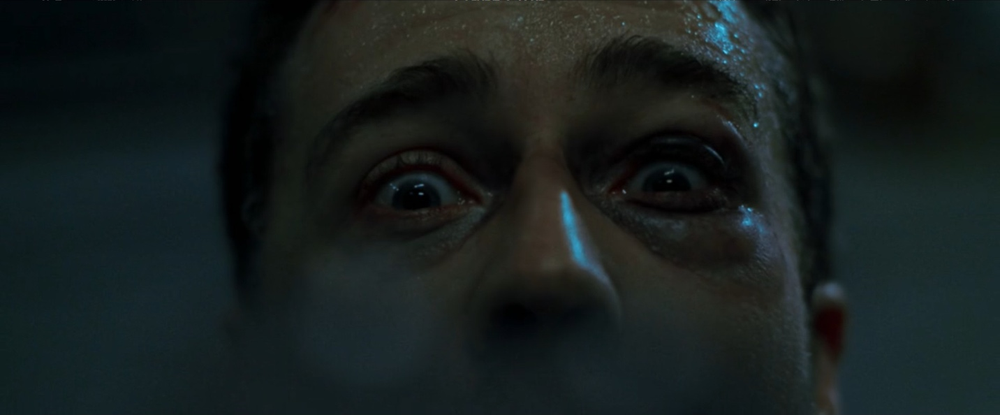
Complementing such aural strategies to place audience members inside the narrator’s subjectivity, and thus align us with him psychologically and somatically, are images that appear to spring from—or are filtered through—his mind’s eye. They include the narrator’s visits to his “meditation cave,” an icy imaginary cavern in which he meets his “power animal” (a talking penguin); his bleary, slow-motion memories of sleeping with Marla (Helena Bonham Carter); and, of course, any image involving Tyler Durden. By rooting us so firmly within the narrator’s interiority, in these ways and others, and by yoking us so intimately to his mind and body, the text, in effect, positions us to vicariously participate in the subsequent unraveling of said mind and body, right alongside the narrator. His confusion becomes our confusion, as it becomes harder and harder to distinguish between events actually occurring within the movie’s diegetic world and his own mental projections. His frustration becomes our frustration, as the narrator’s own body (in the form of Tyler) turns violently against him, thwarting his “intentional projects and goals” at every turn. Put differently, as the narrator’s mental illness steadily intensifies throughout the story, and his resurfacing body turns at first unruly and then wholly mutinous, the film—skillfully deploying an array of immersive cinematic techniques—seeks to affectively enmesh us in the narrator’s deepening sense of estrangement from himself, so that we too may experience, if only for the duration of the narrative’s running time, what it feels like to live in the skin of an uncanny body.
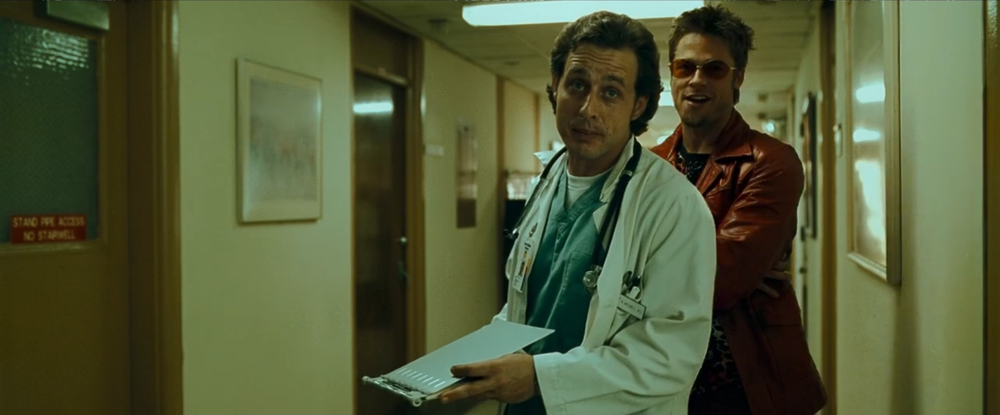
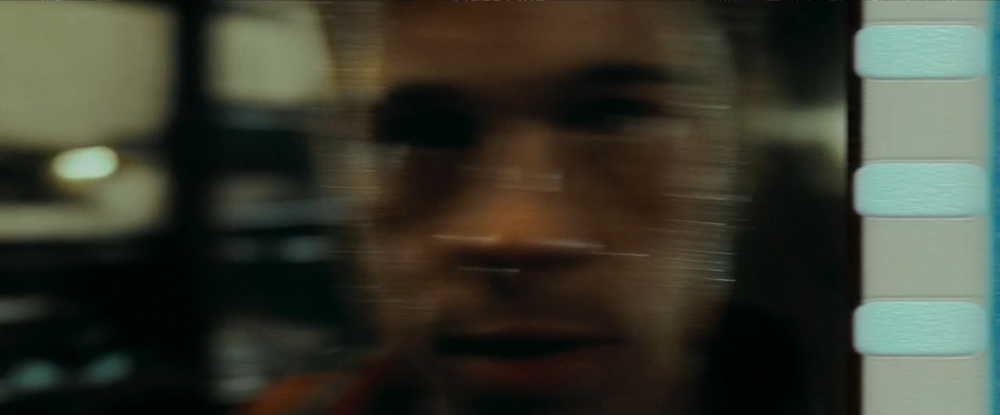
As noted, though, the narrator’s is not the only body to be rendered uncanny as Fight Club ’99 unfolds. Concurrent with the narrator’s progressive transformation into what Marla will ultimately call “Dr. Jekyll and Mr. Jackass,” the film’s textual body, I would argue, undergoes its own form of uncanny estrangement from itself. Certainly, this is an unusual claim to make, with its intimation of a movie engaging in a kind of thinking and feeling about its state of being. But, from early on in the text, Fight Club ’99 makes abundantly clear that it is acutely aware of itself as a film (it’s almost as if the intermedial impulse of Palahniuk’s novel evolves, in the adaptation, into a sort of compulsive self-reflexivity—that is to say, both texts, each in its manner, are more or less obsessed with “the movies”). Humorous, knowing allusions are made to Meryl Streep, Forrest Gump, and William Shatner, and at one point the narrator goes so far as to stare into the camera and intone in voiceover: “I’d like to thank the Academy.” This aesthetic stratagem—having the narrator look and talk straight into the camera lens—becomes a running motif in Fight Club ’99, and serves both to nicely evoke the noir-inflected first-person narration of Palahniuk’s book while also expressly calling attention to the cinematic apparatus through which Palahniuk’s work is being adapted, a rather brazen violation of the rules of Hollywood’s traditional “invisible style” of filmmaking. Tyler soon joins in the fun himself, demonstrating for viewers how he likes to edit a single frame of pornography into the children’s movies he’s projecting, and pointing out to us the changeover cue marks (or “cigarette burns”) in the very film we’re watching. What begins in fun, though, quickly becomes more fraught: as Tyler Durden comes to prove himself less a boon companion to the narrator than a grave threat to the latter’s bodily health and autonomy, so does he seemingly prove himself a danger to the integrity of Fight Club ’99’s textual body. We get inklings of this early on. Before Tyler is officially introduced to us within the diegesis, for instance, we periodically catch near-subliminal glimpses of him in the background, as if Tyler has spliced single frame images of himself into the text in an attempt to burrow his way into the film’s consciousness, just as he has burrowed his way into the narrator’s (see Figure 2). This struggle for agency reaches an inflection point roughly an hour into the narrative, when Tyler, for the first time, addresses the camera directly (previously a prerogative reserved for the narrator). In response, the film shudders and shakes violently, rocking back and forth with increasing intensity, until the sprocket holes lining each side of its celluloid strip are revealed (see Figure 3). There is, in this instant, a distinct measure of frenetic, panicky energy, as though the text is engaged in a frantic game of tug-of-war with Tyler, desperately trying to resist the pull of his magnetic persona, trying to fend off his determined efforts to infiltrate and exercise influence over its cinematic consciousness (or what Daniel Frampton would call its “filmind”), and thus take control over all that we are seeing and hearing (6). Fight Club ’99, in other words, finds itself—alongside the narrator—forced into the decidedly uncanny position of having to defend itself from a parasitic foe that springs from within.
Viewers might assume that this internal threat Tyler poses both to the mind of the narrator and the filmind of the text is finally vanquished in the movie’s concluding scene, during which the narrator fires a gun into his own mouth, hoping to rid himself of his psychic doppelganger. The assumption is not unreasonable: after all, once the shot has rung out, we see a trickle of smoke escape from Tyler’s lips in response, and when he then spins and falls to the floor, apparently in his death throes, an enormous exit wound in the back of his head is revealed. But the affliction that is Tyler is not so easily cured. Minutes later, just before the final credits roll, we see it: a single frame of pornography, spliced into the text. The suggestion, of course, is that Tyler Durden is not only alive; he is still scheming to impose his will on his hosts, character and film alike. Naomi Mandel, in her fascinating reading of Fight Club ’99 through the lens of hacker culture, interprets this concluding moment as the adaptation “identif[ying] itself as having been hacked by Tyler,” a hacker (she goes on to explain) being someone who seeks to infiltrate a system and turn it against itself (182). The same can be said of a virus, or most any illness for that matter (including mental illness). Tyler Durden, a creation and incarnation of mental illness, manifests many of the characteristics we associate with it: he is intrusive, insistent, disruptive, overpowering (at times), and destructive. He seeks to infiltrate systems—in this case bodies, both physical and textual—and render them new and strange, at once familiar and unfamiliar. And, as the final flickering images of Fight Club ’99 indicate, Tyler is, above all, tenacious, maddeningly thwarting the designs of those who would root him out of mind and filmind together. In its diegetic content and its filmic form, then, Fincher’s text is staging for viewers a vivid cinematic encounter with an acute and obstinate mental illness, one that happens to go by the name of Tyler Durden, and affectively involving us in some of the fears, frustrations, and even failures such an encounter can beget. In doing so, Fight Club ’99, like Palahniuk’s novel and Stevenson’s novella before it, helps us to more fully—and yes , viscerally—apprehend the uncanny feelings that arise when illness effectively turns one’s mind against itself and when illness (of whatever variety) alienates one from one’s own body, throwing that body into crisis. These uncanny feelings, no doubt, will strike certain fortunate audience members as something entirely new and foreign to their lived experience; for others, however, the saga of Tyler Durden speaks—if hyperbolically—a truth we’ve come to know all too well: that oftentimes our most determined foes are, in actuality, ourselves.
Conclusion
In her critical examination of the role that bodies play in fin-de-siècle Gothic texts, Kelly Hurley explains that rather than a depiction of the human body as stable and normative, the Gothic tradition instead offers readers “the spectacle of a body metamorphic and undifferentiated; in the place of the possibility of human transcendence, the prospect of an existence circumscribed within the realities of gross corporeality; in place of a unitary and securely bounded human subjectivity, one that is both fragmented and permeable” (3). While neither Chuck Palahniuk nor David Fincher’s respective iterations of Fight Club—appearing, like the aforementioned tales by Wilde, Gilman, and Stephenson, at the anxious cusp of a new century—are regularly characterized as Gothic, Hurley’s description could just as easily and accurately be applied to Fight Club and Fight Club ’99. In both novel and film, bodies metamorphose, through sickness, violence, and acts of self-reinvention; characters find themselves trapped within the reality of their increasingly unruly, recalcitrant physical selves; and subjectivity splinters as minds, like the flesh, turn foreign and ungovernable. These works, then, are highlighting for us, vividly and palpably, bodies in crisis—and exploring the ways in which we may find ourselves progressively estranged from those same resurfacing bodies. It is not simply the characters in these texts that are experiencing this strange sense of uncanny defamiliarization, I argue; this unsettling estrangement appears to infect the very structure and fabric of the works themselves, turning them, effectively, into textual bodies in crisis. In this way, Fight Club and Fight Club ’99 should be understood as unmistakably following in the Gothic tradition, and going even further, perhaps, than some of their generic forebears in exploring the uncanny reverberations that can occur when illness strikes our heretofore comfortable, lived corporeality, leaving us yoked to that Proustian creature who simultaneously is and is not oneself.
Endnotes
1 Tellingly, while in Stevenson’s story Jekyll confesses in the end that he has come to regard Hyde with “a father’s interest,” only to be met with “a son’s indifference” in return (120), in Fight Club this dynamic is reversed: the narrator looks up to his creation, at least at first, as an authority figure there to fill the void left in his life by paternal absence, to serve as “God and father” (199).
2 It is not clear that all readers of Fight Club—or the culture writ large that’s been influenced by the novel and its film adaptation—fully appreciate this point: that Tyler is a function of the narrator’s mental illness, and should not be uncritically embraced as a (anti)hero or exemplar of “manliness.” For example, in recent years, certain voices of the new “MAGA” right and so-called “manosphere” have—either wittingly or through cultural osmosis—adopted language and attitudes that seem decidedly Durden-esque. Take the following two passages. The first comes from Palahniuk’s novel, when Tyler, in the depths of his megalomania, lays out his vision for what the world will look like after his movement brings a supposedly emasculated postmodern civilization to an abrupt end; the latter comes from the far-right figure who posts on social media as “Bronze Age Pervert,” identified by journalist Graeme Wood as Costin Alamariu, and relays BAP’s fantasy about a civilizational collapse and the ideal world that will follow:
You’ll hunt elk through the damp canyon forests around the ruins of Rockefeller Center, and dig clams next to the skeleton of the Space Needle leaning at a forty-five degree angle. We’ll paint the skyscrapers with huge totem faces and goblin tikis, and every evening what’s left of mankind will retreat to empty zoos and lock itself in cages as protection against bears and big cats and wolves that pace and watch us from outside the cage bars at night. (124)
Here is my vision for true justice, the justice of nature: the zoos opened, predators unleashed by the dozens, hundreds…four thousand hungry wolves rampaging on the streets of these hive cities, elephants and bisons stampeding, the buildings smashed to pieces, the cries of the human bug shearing through the streets as the lord of beasts returns. Manhattan, Moscow, Peking reduced to ruins overgrown by vines and forest, the haunt of the lynx and coyote again. (qtd. in Wood 26)
The parallels between these passages are striking—as is the fact that the latter is being presented unironically, not as an apocalyptic fever dream produced by a mental delusion, but rather as part of a political manifesto that has sold thousands of copies and garnered the author hundreds of thousands of social media followers.
3 It’s worth noting that this imagistic impulse only intensifies in Palahniuk’s sequels to Fight Club (Fight Club 2, published in 2016, and Fight Club 3, published in 2020), which take the form of graphic novels, a medium suggestive of cinema in its overt blending of the verbal and the visual.
Works Cited
Burgess, Olivia. “Revolutionary Bodies in Chuck Palahniuk’s Fight Club.” Utopian Studies, vol. 23, no. 1, 2012, 263-280.
Burwood, Stephen. “The apparent truth of dualism and the uncanny body.” Phenomenology and the Cognitive Sciences¸ vol. 7, no. 2, 2008, pp. 263-278.
Citizen Kane. Directed by Orson Welles. RKO Radio Pictures, 1941.
Fight Club. Directed by David Fincher. 20th Century Fox, 1999.
Fitzgerald, F. Scott. The Great Gatsby. 1925. UMV Publishing, 2022.
Forrest Gump. Directed by Robert Zemeckis. The Tisch Company, 1994.
Frampton, Daniel. Filmosophy. Wallflower Press, 2006.
Freud, Sigmund. The Standard Edition of the Complete Psychological Works of Sigmund Freud, Volume XVII: An Infantile Neurosis and Other Works. 1917-1919. Translated by James Strachey, Vintage Books, 2001.
Gilman, Charlotte Perkins. “The Yellow Wallpaper.” 1892. The Dark Descent, edited by David G. Hartwell, Tor, 1987, pp. 460-471.
Graham, Bob. “A Knockout ‘Fight’/Norton and Pitt don’t pull any punches.” San Francisco Chronicle, 28 Apr. 2000, https://www.sfgate.com/movies/article/A-Knockout-Fight-Norton-and-Pitt-don-t-pull-2762299.php. Accessed 25 June 2022.
Hurley, Kelly. The Gothic Body: Sexuality, Materialism, and Degeneration at the Fin De Siècle. Cambridge UP, 1996.
Jordan, Matt. “Marxism, Not Manhood: Accommodation and Impasse in Seamus Heaney’s Beowulf and Chuck Palahniuk’s Fight Club.” Men and Masculinities, vol. 4, no. 4, 2002, pp. 368-379.
Kuhn, Cynthia. “I Am Martha’s Monstrous Wound: Fight Club and The Gothic.” Reading Chuck Palahniuk: American Monsters and Literary Mayhem, edited by Cynthia Kuhn and Lance Rubin, Routledge, 2009, pp. 36-48.
Kuhn, Cynthia, and Lance Rubin. “Introduction.” Reading Chuck Palahniuk: American Monsters and Literary Mayhem, edited by Cynthia Kuhn and Lance Rubin, Routledge, 2009, pp. 1-8.
Mandel, Naomi. Disappear Here: Violence After Generation X. Ohio State UP, 2015.
Nazare, Joe. “Gothic Trappings: Paradox and Postmodern Terror in Palahniuk’s Fight Club.” Macabre Republic, 10 Nov. 2010, http://macabre-republic.blogspot.com/2010/11/gothic-trappings-paradox-and-postmodern.html. Accessed 1 Jul. 2021.
Palahniuk, Chuck. Fight Club. New York: W.W. Norton & Company, 1996.
---. Fight Club 2. Dark Horse Books, 2018.
---. Fight Club 3. Dark Horse Books, 2020.
Proust, Marcel. The Guermantes Way. 1920. Translated by C.K. Scott Moncrieff and Terence Kilmartin, The Modern Library, 1993.
Psycho. Directed by Alfred Hitchcock. Paramount Pictures, 1960.
Stamenkovic, Sladana. “The Darkness Within Us: Postmodern Gothic in Chuck Palahniuk’s Fight Club.” Annual Review of the Faculty of Philosophy, Novi Sad, vol. XLI, no. 1, 2016, pp. 399-419.
Stevenson, Robert Louis. The Strange Case of Dr. Jekyll and Mr. Hyde. 1886. New York: Signet Classics, 2012.
Svenaeus, Fredrik. “The body uncanny—Further steps towards a phenomenology of illness.” Medicine, Health Care and Philosophy, vol 3, no. 2, 2000, pp. 125-137.
---. “Das unheimliche—Towards a phenomenology of illness.” Medicine, Health Care and Philosophy, vol. 3, no. 1, 2000, pp. 3-16.
Sybil. Directed by Daniel Petrie. Lorimar Productions, 1976.
Vafa, Amirhossein, and Rosli Talif. “Manhood in crisis: powerlessness, homophobia and violence in Fight Club.” Pertanika Journal of Social Science and Humanities, vol. 19, no. 2, 2011, pp. 449-457.
Vertov, Dziga. Kino-Eye: The Writings of Dziga Vertov, edited by Annette Michelson, translated by Kevin O’Brien, U of California P, 1984.
Wilde, Oscar. The Picture of Dorian Gray. 1890. The Modern Library, 2004.
Wood, Graeme. “The Rise of Bronze Age Pervert.” The Atlantic, vol. 332, no. 2, Sept. 2023, pp. 20-29. Academic Search Complete.EBSCOhost, research.ebsco.com/plink/31431ab4-79c7-3ab5-a59e-72e9caa066bf.