VOL. 54, NO. 4
Dually Constituted: Adapting the Autoethnographic Global South Subject in the Persepolis Film and Comic
James Hodapp
Dedicated to the memory of Marjane Satrapi, an inspirational innovator of the comic form.
In the English introduction to her seminal comic memoir Persepolis (2001), Marjane Satrapi unambiguously states that her goal in writing the book is to correct misconceptions about Iran in the West. Although the nearly three-hundred-and-fifty-page narrative centers around her coming of age in Iran under the Islamic Republic and her move to Europe, Satrapi avoids ascribing personal expression or self-realization as the raison d’être of her “story of a childhood,” as it is subtitled. Instead, she declares that Persepolis writes back to the West as a corrective gesture:
Since then [the 1979 Iranian Revolution], this old and great civilization has been discussed mostly in connection with fundamentalism, fanaticism, and terrorism. As an Iranian who has lived more than half of my life in Iran, I know that this image is far from the truth. This is why writing Persepolis was so important to me. I believe that an entire nation should not be judged by the wrongdoings of a few extremists. I also don't want those Iranians who lost their lives in prisons defending freedom, who died in the war against Iraq, who suffered under various repressive regimes, or who were forced to leave their families and flee their homeland to be forgotten (5).
While memoirs inherently center memory, it is noteworthy that the memory work Satrapi foregrounds is political and national in scope. Satrapi does not highlight her personal history, though, or that of her eminent family – her great-grandfather was the emperor of Persia for nearly 50 years – in her preeminent paratextual statement on her popular book, which has sold over two million copies to date (“Marjane Satrapi”). Instead, she bemoans representations of Iran and proposes her comic as an intervention that counters the flattening and demeaning narratives of Iran that have circulated in the West in the 20th and 21st centuries.
On the surface, foregrounding the political elements of an insider’s account of Iran while pairing it with a personal narrative of development is not problematic. Recently, though, critics have questioned Satrapi’s representations of women, Muslim headscarves, and Islam in Iran in her comic, so much so that a critical momentum within comic studies has emerged concerning the text. As most readers will know, Persepolis was adapted into a film less than a decade after the publication of the final volume of the comic. Like the comic, the film was a critical and commercial success, but unlike the comic, the film has not been critically examined for its representations of these subjects. This article takes as its first task the examination of the film Persepolis through critiques of the comic to understand how the adaptation of form, from comic to animated film, shifts the text’s ideology concerning women, the headscarf, and Islam in Iran. Ultimately, I argue that despite significant formal changes – such as the introduction of color and the reorganization of the text’s chronology through a narrative framing device – the film version of Persepolis maintains, and at times even amplifies, the flattening representations of these subjects.
As a self-proclaimed insider, Satrapi positions herself as a guide for Euro-American readers into Iran, presenting it as an isolated locale. She inhabits a rhetorical position predisposed to offer outsiders insight into Iran to disrupt Orientalist approaches to it, particularly in France, where she lived most of her life and where she originally published the book and made its subsequent film. However, the ideologies in her memoir often align with populist French critiques of Islam, particularly in regard to women’s headscarves as inherently oppressive, morphing her positionality in and outside of the book as an elite French insider using her Iranian background as ideological cover to critique Islam in ways that align with mainstream French politics of the right (and increasingly the center and left). In effect, critics of the comic have questioned whether Persepolis deploys its Global South positionality within Iranian culture less to reveal an isolated culture and more to express an exile’s marginal, outdated, and even misrepresentative view of Islam in Iran.
These provocative contentions almost universally ignore that Persepolis was adapted into a popular film, directed by Satrapi herself, that garnered virtually universal praise. The 2007 film was nominated for 59 awards (including the Palme d'Or and an Oscar for Best Animated Film), won 29 awards (including César Awards for best first feature and best adaptation), maintains a 96% score on Rotten Tomatoes, and made nearly twenty-three million dollars at the box office alone (not including home sales such as physical media and streaming – currently on Amazon Prime) (IMDB). Essentially, the movie was a global popular and critical success and is just as likely (if not more) to inform the reception of Persepolis in popular culture. Given that context, if someone has encountered Persepolis, it is equally as likely that they have seen the film as read the book. And yet the film escapes critiques about the comic, despite sharing a narrative.
Clearly, an adaptation studies approach would benefit discussions of Persepolis, as it traverses two artistic forms: comics and film. Its place in global culture cannot be confined to its “origin text,” and its film version is not merely a novelty afterthought, any more than the film can be fully accounted for by reading the comic. A reckoning of Persepolis as a dually constituted adaptation is in order, then. As much as I would like to extensively unpack the ways in which the comic and film dually constitute the entirety of Persepolis, in containing the analysis to an article rather than a book, I will consider the main points of contention surrounding the comic – namely, its representation of Islam and women, with particular attention to Muslim women’s headscarves. In part, this means I will analyze the film Persepolis through critiques of the comic that it has largely escaped, but, more importantly, I will examine both versions in tandem to argue that Satrapi’s ideological bent against Muslim women’s headscarves converges in the two forms, establishing a consistent ideology. Via the framework of adaptation studies (with an assist from autoethnography), I ultimately close-read two versions of Persepolis’ most representative scene to demonstrate that rather than the intervening years between authoring the comic (the late 1990’s) and directing the film (the mid- aughts) diminishing her critique of Islam in Iran, Satrapi instead used the intervening years to sharpen Persepolis. Rather than appeasing her critics, she bolsters her position, leaving us with two consistent though very differently structured texts whose formal characteristics create a unified whole. In other words, although differently structured and narrativized, the film Persepolis does not meaningfully depart from the comic and instead reinforces Satrapi’s arguments about Islam, particularly the headscarf, in Iran.
In brief, Persepolis (both the comic and the film) tells the story of Marji, a nickname for the young Satrapi, from childhood to young adulthood. Marji begins her life in Iran as an only child of two well-educated parents, attending an elite Francophone school. Soon, the Islamic revolution unfolds, and not long afterward, the devastating Iran-Iraq war decimates the country and is used by the Islamic Republic as a pretext for brutal crackdowns on individuals whom it deems disloyal. After several run-ins with various iterations of the morality police, Marji’s parents send her abroad to Europe, where she is isolated and unhappy. After returning home on several occasions, it becomes clear to all involved that Marji may not be able to move freely between Iran and Europe for much longer. Marji, who has adjusted to life in Europe as a teen, leaves Iran for good.
As noted above, however, Satrapi’s project is much larger than a personal coming-of-age story, since it also aims to explain contemporary Iran to foreign audiences. Anjali Singh, who acquired it in France for Random House and translated it from French into English, contends: “… she really wrote it to explain her experience to the comic artists and Parisians she was living amongst after she had left Iran” (Singh). Singh’s contention here aligns with Satrapi’s, in her introduction and many paratexts, that the audience for this tale of an Iranian girl is foreign rather than Iranian—Persepolis has been translated into 24 languages, though tellingly not Farsi. Persepolis, then, resembles what the notable postcolonial scholar Mary Louise Pratt has termed autoethnography. For Pratt, autoethnography refers to instances in which those impacted by colonialism represent themselves to colonial metropoles in ways legible to them, while asserting their own self-understanding and agency. She writes that autoethnography
refer[s] to instances in which colonized subjects undertake to represent themselves in ways that engage with the colonizer's own terms. If ethnographic texts are a means by which Europeans represent to themselves their (usually subjugated) others, autoethnographic texts are those the others construct in response to or in dialogue with those metropolitan representations… (Pratt 7).
When Satrapi characterizes discourse on Iran as “far from the truth” in her introduction and references the “so many mistakes” circulating about the country that the text corrects, and we identify the primary audience as Euro-American, we can see Persepolis’ autoethnographic qualities. It takes the form of a comic, or bande dessinée, with a long-standing tradition in France, and addresses that European metropole’s notions of Iran.
Extending Pratt’s initial intervention, David Butz and Kathryn Besio contend that autoethnography “has strategic ambitions beyond simple translation. It is an inseparable mix of accommodation and resistance: accommodation in terms of idiom, resistance in terms of at least some of its content” (14). For Butz and Besio, autoethnographies retain self-representative agency as per Pratt’s original formulation and inherently resist the ideologies of the colonial audience for whom they are explicitly written. By its nature, autoethnography refutes hegemonic colonial ideologies, and its content almost always uses that positionality to heighten resistance.
Autoethnography encapsulates what Satrapi aspires Persepolis to be: a fully realized assertion of Global South subjectivity created for a Euro-American audience that resists the normative assumptions about Global South subjectivity held by that audience. Its duality in theory enables a scenario in which authors do not exoticize their own culture, assuage white liberal guilt, sell out, or simply pander, because even though the audience is acknowledged as uninformed and even discriminatory against the Global South culture being represented, the book is unaffected, maintaining its integrity by standing up against the modern embodiments of coloniality in its own languages and forms(in this case, comics and film). Such a complex ideological maneuver is difficult to achieve, but it is precisely this challenging combination for which Persepolis aims and is praised.
Summarizing the praise for the comic Persepolis is even more overwhelming than summarizing the praise for the film. In 2001 Volume 1 won the prestigious Coup de Coeur Award (now called Prix Révélation) at the Angouleme International Comics Festival; Volume 2 won the festival’s prize for Scenario the next year; and it has earned many international prizes, such as the American Library Association Award for Best Book for Young Adults. It is on innumerable top ten lists. Moreover, The Guardian ranked it the forty-seventh-best book of the 21st century, and The New York Times ranked it forty-eighth on its list (The Guardian) (The New York Times). It is also routinely considered part of the foundational canon of graphic novels and comics, alongside Art Spiegelman’s Maus (1991) and Alison Bechdel’s Fun Home (2006). Beyond this acclaim in popular media, the book has also garnered so much scholarly acclaim that Chris Reyns-Chikuma and Houssem Ben Lazreg, reflecting in 2017 on their own reading of Persepolis, state that “It is important to note that none of these skeptical or negative critiques have ever been written about Persepolis” (Reyns-Chikuma and Ben Lazreg 770). That is, it has mostly been a sacred cow of comics: immensely popular and influential in popular and scholarly discourses, and few critiques beyond opaque gestures to its flaws have been forthcoming in the over twenty years since its publication…until recently.
These newer critiques of Persepolis have begun to question the accuracy of its representations of Iran. Morrow and Hasan cut straight to the point by arguing that the comic too simply suggests “the theocracy that Ayatollah Ruhallah Khomeini imposed on Iran is representative of all Islam,” a refrain seen in several articles that points to an oversimplification of Islam in the book. (2) For these critics, the Islamic Republic uses Islam as a rationale for all manner of brutality against its citizens without the text noting that this usage contradicts the ideology and practices of Islam writ large the world over. Morrow, Hasan, and others worry that the comic invites a conflation, especially for a Euro-American audience, between Islam and the weaponized form used by the Ayatollah’s brutal regime. They are clear that Persepolis “vociferously blames Islam for Iran’s misdeeds at home and abroad,” arguing that the comic is Islamophobic (2). Others agree, such as Azadeh Ghanizadeh, who manages to be even more direct in stating, “Persepolis is distinctly Islamophobic and Eurocentric” (4), while Zeiny, Yusof, and Hashim are only slightly less critical, arguing that Persepolis is one of many women’s memoirs from the region constructed by their authors “to meet political demands of the West through creating Islamophobia” (215), bringing a negative connotation to the comic’s autoethnographic approach. The most nuanced take on Persepolis vis-à-vis its representation of women and Islam is Yalda Hamidi’s “Politics of Location in Persepolis,” which argues that Satrapi has made “an undeniable contribution to challenging the dominant narratives of nationhood and female citizenship by documenting the trauma of the Iranian Left in the nation's history” (239). Hamidi argues, however, that Satrapi’s color-blind politics of race and antireligious politics of gender overlook other Iranian Muslim women’s existence and experiences. The article argues against reading and teaching Persepolis as representative of Iranian women and instead as a specific, singular coming-of-age story about a highly privileged person set in part in Iran—a direct contradiction to how Satrapi and her paratexts tell us to read it.
These criticisms of the comic version of Persepolis, while few in number, represent a growing criticism of it. Moreover, as scholars from the Global South, these critics offer a counter-narrative to the book’s overwhelming praise, which has come primarily from the Global North. Strangely, though, even as these critiques have been forthcoming, especially regarding the comic, similar critiques of the film have not emerged, despite its popularity equaling or surpassing the comic’s. Whether or not we agree with these critiques of Persepolis, we cannot simply pretend they do not exist, that they do not represent a trend in scholarship on the comic, or that there are no consequences for the film.
The questions for us then are manifold. Does Persepolis succeed in fulfilling its autoethnographic aspirations as expressed in Satrapi’s introduction and other paratextual materials, given that scholars increasingly doubt the resistance implied by the term in the comic form? More to the point for adaptation studies, how does the ideology of autoethnography travel between the comic and the film to create a plausibly consistent Persepolis despite the texts’ content not aligning with the author's paratextual assertions?
Although this kind of theory and distance reading can provide some insight into the fault lines of debates over the comic and how they may or may not relate to the film Persepolis, to address these complex questions of representation properly, we need to close-read particular moments within the comic and film with attention to adaptation studies to determine the relationship between the two forms of the Persepolis narrative.
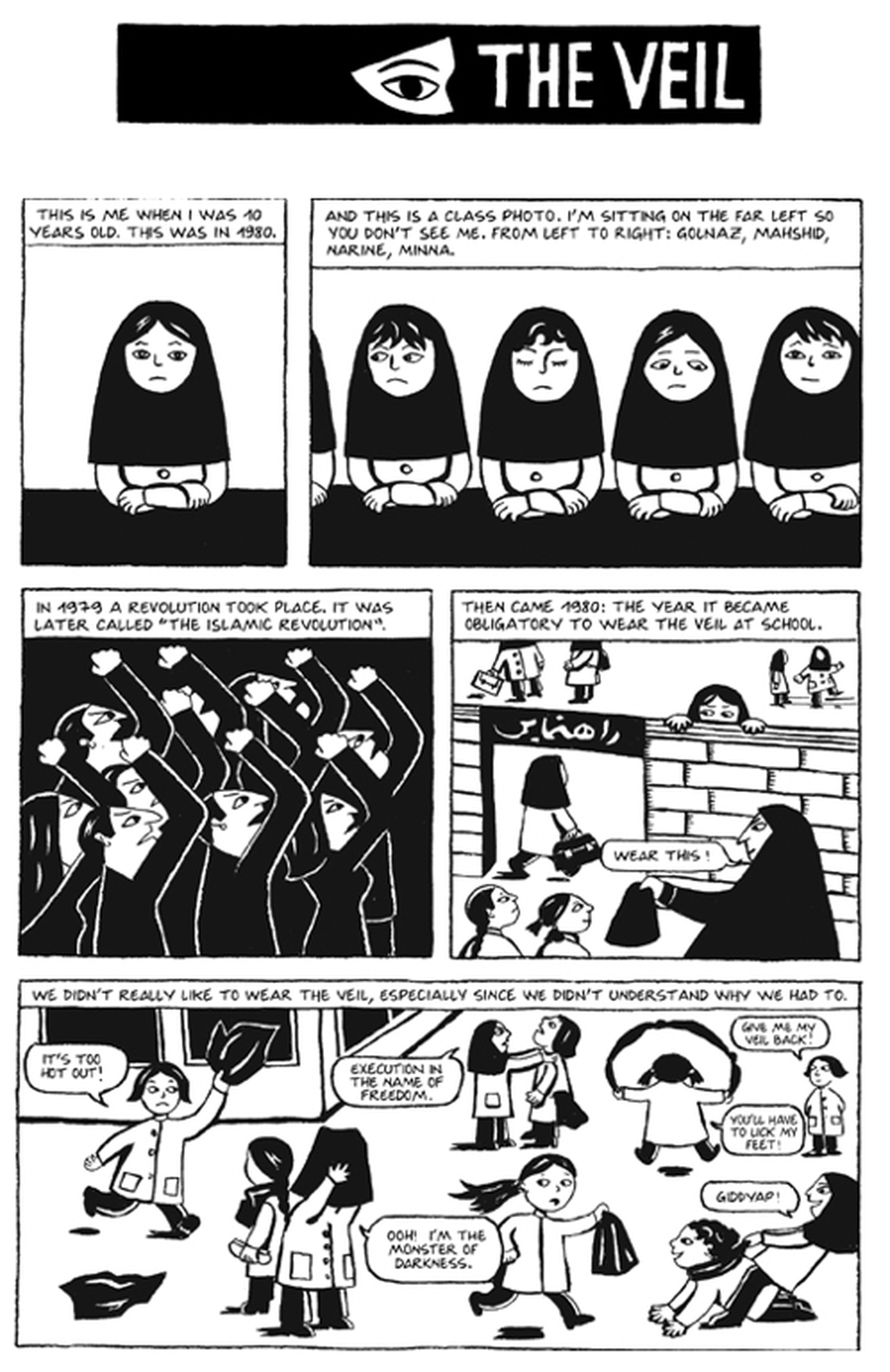
The characterization of Islam in the story, particularly regarding Muslim headscarves, is the focus of most critiques of the comic. Persepolis, the comic, begins with an illuminating episode called “The Veil” (Figure 1). In this episode, Satrapi recalls being at school when the Islamic Republic forced women and girls to wear the headscarf. To put it mildly, they are not pleased, as evidenced by their dour faces in the first two panels, which mark them as individuals robbed of their subjectivity—appearing the same beneath the veil. She writes, “We didn’t really like to wear the headscarf.” The “we” here refers, in part, to her classmates, but also suggests that girls and women in general do not want to wear headscarves, an attitude repeated throughout the text. Soon after this episode, Satrapi mentions that, unlike nearly every child in Iran, she attended a private, non-religious French school in Tehran—the only one in the city—where members of the Shah’s family and the last empress of Iran also attended. When we also consider that Satrapi’s grandfather was the prime minister at one point and that her great-grandfather was the ruler of Iran for nearly 50 years at the end of the 19th century, we begin to see that Satrapi is far from the average Iranian, as a Francophone secularist directly descended from a line of rulers going back centuries. The shared subjectivity implied by her “we” begins to crack as we realize that she cannot represent the average Iranian or fulfill the conditions necessary for a seamless autoethnography.
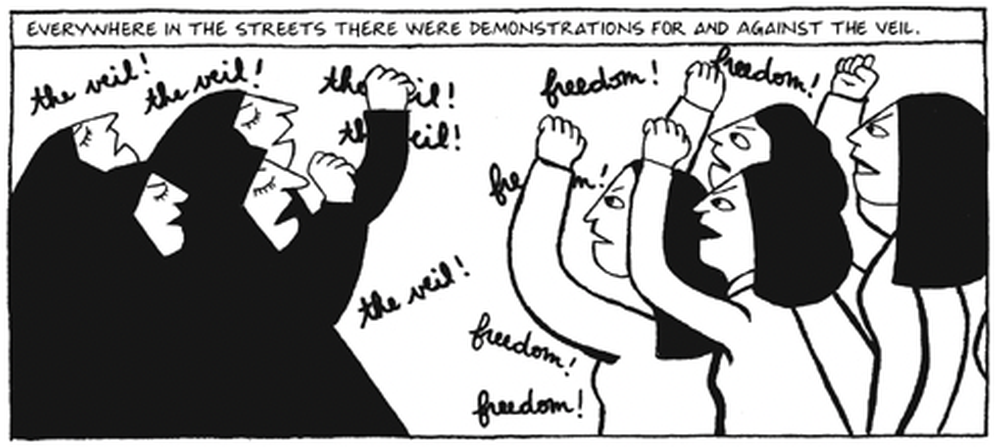
Beyond Satrapi's inability to gauge the sensibilities of the average Iranian vis-à-vis the veil, four pages later in the same “The Veil” episode, she moves beyond her personal observations to characterize Iran’s political climate at the time. In Figure 2, she represents large-scale societal disagreements over the headscarf in Iran. In this panel, the veil is put in direct opposition to freedom, making it clear, through opposing black-and-white figures on opposite sides of the panel, that the veil signifies oppression, in contrast to the women without the veil shouting “freedom!” In this formulation, which is not problematized or elaborated on later in the text, there is no room, figuratively or within the panel, for the reasonable notion that a woman could wear a veil and be free – that the veil, for many women, represents freedom via a deep and profound relationship with god. Satrapi’s own experience is clearly one of the veil as an imposition, and that should not be dismissed, but her privileged and secular view does not represent the role of the headscarf at large in Iran. In this panel (Figure 2), the initially personal view of the headscarf expands to characterize all of Iran. It is this political statement about the nature of Iranian women’s relationship to the headscarf that the above critiques challenge. In short, they read it as an exaggerated mischaracterization of women in Iran and the place of headscarves in Muslim culture. For them, Satrapi is doing just as she promises in the introduction by representing Iran to a Western audience, but rather than challenging shallow and stereotypical notions about the country, in keeping with her autoethnographic proclamations (namely, that the veil is an exclusively oppressive garment), it reinforces Eurocentric notions that Islam is oppressive and that the veil is a tool of that oppression.
The explicit anti-headscarf content on this page is essential, but Satrapi also employs an overlooked formal narrative element to emphasize the veil's centrality: time. Persepolis follows a chronological order. As the story unfolds, Marjane ages. When turning the pages, time advances in a standard linear fashion—except for the opening veil episode. Instead of starting when Marjane is at her youngest in the book, six years old, the narrative begins on page one with the veil incident, which occurs when she is 10. After this episode, the story jumps back to Marjane’s earlier years, when she is six, and proceeds in chronological order, eventually catching up to the opening scene and moving beyond it in time. This is not a framing device, as it is used only once here and not revisited. The headscarf is so vital that Satrapi restructures her narrative around it, thereby contradicting the rest of the book's narrative temporality. The veil isn’t just one of many themes; it is the political and formal core of the story. For Satrapi, a headscarf cannot be merely a moment of personal struggle but must be highlighted as a social injustice reflecting the brutality of the Iranian regime and Islam. Placing it at the start, out of chronological order—unlike any other event—serves this purpose while mirroring the Euro-American, particularly Francophone, obsession with the veil. Furthermore, each episode has a title, but the veil’s significance is so great that “The Veil” is the title of two episodes—the first and a later one when Marjane returns to Iran. Not only does the book focus on the veil’s content, but its structure—temporal and titling—also centers it.
Satrapi’s personal relationship with the headscarf is not at stake in this intervention—her experience is her own—but her claim to represent other women in Iran is. Persepolis lacks a clear distinction between Islam as a religion and how the state weaponizes Islam, including the headscarf, against women. Satrapi fails to differentiate between Islam writ large and the perverse iteration used by the Iranian regime, especially for non-Muslim readers whom she identifies as her primary audience. In the world of Persepolis, women either wear the headscarf unwillingly or weaponize it unscrupulously for their own gain. There are no women in the text who willingly wear it as a sincere object of devotion, and this is misrepresentative of Iranian women and Islam. Millions of Muslim women in Iran and other countries embrace the headscarf, but Satrapi bristles at this simple fact, unable or unwilling to decouple Islam and the regime. Her characterization of Islam as inherently oppressive of women is not an unintended side effect of the narrative—a sign of its incomplete coming of age—but an actively pursued agenda.
While avoiding passé questions of fidelity, we must wonder whether the film Persepolis challenges this fixation on the veil or reinforces it, and moreover, what narrative tools it uses to do so if we are to consider Persepolis as constituted by both forms. Unlike the comic Persepolis, the film begins at Charles de Gaulle Airport in Paris when Marjane is a teenager. It also begins in color, while the entirety of Persepolis, the comic, is in black and white. Despite these core formal changes, as well as those inherent to the adaptation of comics to animated film—such as sound, music, motion, etc.—the film's narrative ideology vis-à-vis Islam remains strikingly consistent.
With the 2007 release of the film adaptation of Persepolis, which she directed, Satrapi had a chance to reconsider how the headscarf structures the story and shapes the characterization of Islam. Although major changes to the plot might have been unlikely, the adaptation represents a liminal space wherein she could have shifted the tone on any number of topics, including the headscarf. The space between the two texts of Persepolis represents a moment of potential transformation not only between forms, as required of any adaptation, but also of political approaches. In other words, the obsession with the veil could have been elided and/or the attitudes towards it shifted. Indeed, Satrapi changed many episodes in the comic, either removing, shortening, or altering them in the film, in part because of the nature of adapting a nearly 350-page comic for the screen, but also to highlight or deemphasize narrative strains. For example, in the comic, Satrapi’s family has an illiterate live-in maid whom Marjane befriends and manipulates over the course of multiple episodes, who is entirely absent in the film. Many of the scenes in Austria are not present, including an extended visit from her mother amid a bout of depression. Other differences abound, but the point here is that Satrapi embraces, rather than resists, the transformative nature of adaptation in the film Persepolis.


However willing Satrapi was to transform many elements of the comic, the film reifies rather than amends the book’s placement of the headscarf as the fulcrum of the story, as well as the comic’s criticisms of it. Although the film Persepolis begins even later in Satrapi’s life, when she is an adult in France at the airport preparing to return to Iran for a visit, it remains fixated on the headscarf. As seen in Figures 3 and 4, the film begins with Marjane before a flight to Iran. In the washroom, seemingly dissociating, she silently puts on her headscarf (Figure 3). No dialogue occurs at this point. She then appears at the ticket counter, where she is asked for her passport and ticket. She is so overwhelmed by having to wear the scarf that she doesn’t hear the agent, who repeats herself as people behind her grow annoyed (Figure 4). Finally, Marjane sighs and resigns herself to her fate. Following the scene at the ticket counter in the film, she stops to smoke a cigarette when her younger self, in black and white, runs past, signaling a transition to her early life that places us in the same chronological time, around six years old, that comes after “The Veil” episode in the comic Persepolis (Figure 5).
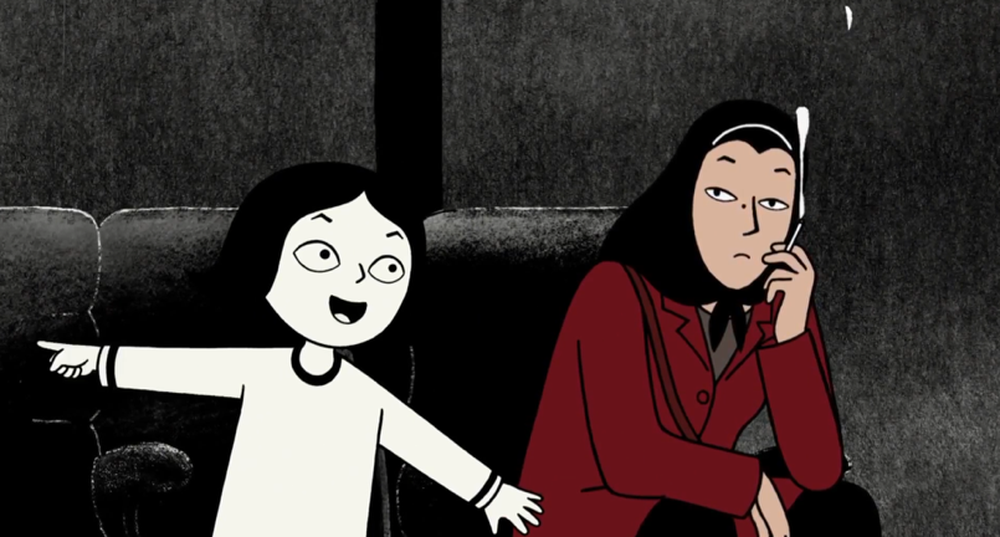
Changing Marjane's age at the start of the narrative offers a different emotional impact, and unlike the comic, this scene at the airport in color acts as a framing device as the film ends with Marjane in the same red coat at the airport in Paris (as well as a return to the frame in the middle of the film). This airport scene is not in the comic Persepolis, and “The Veil” episode in the comic is not in the film, but the two are nearly interchangeable. The two texts remain remarkably consistent despite surface-level changes, emphasizing the headscarf as a symbol of women’s oppression. The adaptation of Persepolis does not challenge or alter the comic's perspective; instead, it reaffirms it nearly a decade later, creating an essentially frictionless, dual-constituted Persepolis in which the two forms are largely interchangeable regarding Islam and the headscarf. Even if one is among those readers/viewers who refuse to accept the growing criticism of Persepolis’ representation of Islam, this shared formal characteristic between the two versions has yet to be noted or analyzed.
In trying to pinpoint salient ideological moments that traverse individual iterations of an adapted text, such as Persepolis, several approaches within adaptation studies can guide us in useful directions. Brian McFarlane asks, “What are the essential, identifiable, and transferable elements of a narrative, and how do we transfer them to a different medium?,” making the case that some elements of a narrative are more inherently important than others (i.e., central to their ideology) and more transferable between forms (6). Similarly, in Story and Discourse: Narrative Structure in Fiction and Film, adaptation scholar Seymour Chatman draws on Bakhtin and other narrative theorists, distinguishing between transferable surface “story” elements and more essential “discourse” elements, indicating, as McFarlane does, that we should bracket the superficial story elements of an adapted text and focus on how two texts converge to produce similar meaning. Essentially, McFarlane and Chatman argue that surface similarities and differences between versions of an adapted text should be given less emphasis than deeper, more essential elements. Moreover, how these deeper elements move across texts should be at the core of our considerations of adaptations.
How do we distinguish between surface elements and the more deep-seated critical ideological ones in Persepolis? The above comparisons of the comic and filmic versions of the text demonstrate that the central concerns of Persepolis are readily apparent, as is Satrapi’s willingness to discard surface elements that do not contribute to them. Persepolis, the film, is a tight 96 minutes, compared to the nearly 350-page comic, and many elements of the comic are left out rather than shoehorned-in to maintain fidelity. Persepolis, as texts and in its paratexts, clearly announces its ideological concerns as focused on criticizing the regime and correcting misrepresentations of Iran, alongside other considerations, such as the maid narrative strain and the many negative stories in the comic about Europeans, which represent surface adornments. This division is not always tidy, but the point here is that in adapting the comic, Satrapi does not lose sight of her ideology. This consistency functions formally as well because the film replicates Satrapi's iconic black-and-white drawing style, departing from it only briefly within the color frame. The stark black and white style for which Satrapi is known in Persepolis, as well as in all her other comics, is as indispensable as its ideological and political concerns. Satrapi has said in interviews that her primary anxiety in making the film version was directing a team of creators to execute her vision, especially animators who had to imitate her drawing style (Shaikh). The two considerations of representing Iran via a spare comic style—form and ideology—are inseparable as “essential” or “discourse” level qualities of the adaptation.
As Satrapi's admission of the tension between comics and animation attests, the relationship between the two forms cannot be overlooked. Adaptation scholars Brandon Chua and Elizabeth Ho have argued for the “compatibility of film and comics as forms of sequential art that rely on image based story telling” in their seminal Routledge Companion to Global Literary Adaptation (16), while Linda Wu in her influential article on Scott Pilgrim comics and film argues that comics and film have “overlapping vocabularies” (418). These are two prominent examples of the widely accepted connection between comics and film, especially animated film. However, Satrapi herself contends: “Animation and comics are false siblings. They resemble one another, but they're two completely different things” (“How to Film a Graphic Novel”). I mention this point because it is tempting to assume that Persepolis is so consistent as a text across forms because comics and animated films are so closely formally aligned. A surface consistency of image style, Satrapi’s iconically simple drawing, belies important differences and, more importantly for us, the intentionality and ability of the adaptation to present a consistent text in two forms.
Though formal and thematic differences abound between the two forms of the text, Persepolis presents a fascinating case of authorial control and consistency within adaptation studies. While the shift to animation inherently requires additive elements like voice and music, the film closely mirrors Geoffrey Wagner’s concept of “transposition”—a direct, minimally interfered transfer to screen or “given directly on screen with a minimum of interference,” as he puts it (67). This formal closeness ensures that the politics of both texts must be located firmly with Satrapi. Treating the film as a transposition counters the impulse to separate Satrapi from the film’s ideology in service to accounting for the collaborative nature of filmmaking. Instead, it frames adaptation through Sarah Cardwell’s lens, which asks us to avoid understanding adaptation as an opportunity for “betterment” and instead to see it as an “aid to the survival of the original” that serves as a means to “revitalize the source” (2). This conceptualization accurately describes Satrapi’s method. Rather than using the adaptation to “improve” or adjust her commentary on otherness and Islam (particularly regarding the headscarf), she appropriates the new medium to “revitalize” the same discourse, thereby ensuring its continued relevance. The power of Persepolis’ adaptation lies in this successful revitalization, not in a revision or “betterment” of its ideology.
Historical and cultural contexts are also important in understanding the persistence of the headscarf critique in both comic and film. Both Persepolis texts emerged from France in the early 2000s, just as France, a self-professed liberal society, became increasingly amenable to the illiberal practice of diminishing the free practice of Islam, with particular vitriol reserved for the headscarf via a series of bans which became formal law, surviving even an appeal to the supreme court, in 2010. Marie Le Pen is the most visible sign of this shift, both as an ardent Islamophobe and as the leader of a far-right party largely defined by xenophobia that has gained more of the electorate with every passing presidential election, gaining 18% in 2012, 34% in 2017, and 41% in 2022. This is all to say that the French state’s and population’s increased acceptance of discrimination against women who wear the veil coincided with the publication of both Persepolis texts, which provide us with more insight as to why that part of the story is essential and transferable, while others were omitted, and why its popularity may be tied to it not attempting to completely fulfill autoethnography’s call to resistance. None of this is to say that Satrapi supports veil bans—indeed, she said she did not because they limit women’s bodily autonomy and because she fears they would make headscarves taboo and thus cool and popular for young Muslim women in France. However, we cannot simply ignore the inconvenient points of agreement between Persepolis and the context in which it was published or the fact that Satrapi’s objections to the veil bans came not only from their illiberalism but also from her interpretation that they are ineffective at getting women to give up the veil, which she clearly desired (Shaikh).
This pattern, in which Satrapi reinforces reductionist stereotypes of non-Western cultures while making otherwise legitimate critiques of the West, is evident again in a 2005 interview she gave to the Asia Society. In the interview, she discusses the ongoing process of adapting Persepolis into a film and begins to talk about religion in French society. She says:
But what about when the Pope [John Paul II] died, and everyone was mourning? And everyone was saying, ‘The Pope, what a nice man, what a wonderful man,’ but for Christ's sake, this Pope, he has gone to Africa, and he has said to people not to use contraception, and fifty percent of Africa, they have AIDS. This guy, he is a killer, and he is an asshole (Shaikh) (Italics mine).
This quote regarding religion in France is metonymic of Satrapi’s rashness regarding Islam in Persepolis because in the quote, as in the book and film, she sincerely strives to be iconoclastic—upending the notion that the Pope should be praised in the aftermath of his death —arguing instead that his death is a moment to hold him to account for his actions. She sets herself against mainstream notions of respect for the Pope in Europe and breaches taboos about religiosity. Along the way, though, she makes a wholly inaccurate and racist remark about half of Africa (population roughly 1 billion) having HIV/AIDS. She distracts from her main point about the Pope while also revealing an important carelessness in her thinking that accepts and amplifies inaccurate, negative, and reductionist views of Africans. I’m not claiming that Satrapi is racist, but that in her haste to condemn the Pope, she also cruelly mischaracterized and disparaged Africans who are already overlooked and maligned in Euro-American media. While we need not fully condemn Satrapi’s views on race via this comment, we also cannot ignore that her comments on Africans dovetail with some of the worst racialist impulses of her adopted home and reductionist views of Islam in her work.
In the same way, Persepolis is clearly aimed at the brutality of the Islamic Republic, which has committed confirmed acts of murder, rape, and torture on a mass scale that are often difficult for outsiders to gain insight into. Like her critique of the Pope, her criticisms of the regime are valid and seem to be made in good faith. But like her mischaracterization of Africa and AIDS/HIV, in its fervor to legitimately criticize the regime, Persepolis mischaracterizes Islam and women who wear the headscarf as sincere symbols of their faith. Satrapi diminishes the salient elements of her critique of the regime by not being careful enough about essential, related topics concerning Iranian women whose perspectives differ from hers. Just as one does not need to malign Africa by grossly exaggerating HIV/AIDS rates to criticize the Pope, one does not need to cast Islam as barbaric and headscarves as inherently oppressive to decry the Islamic Republic.
Ultimately, this article has shown that the two versions of Persepolis share this unsavory characteristic, creating an ideology that runs across both iterations to form a consistent text, harnessing the power of adaptation not to take up its own autoethnographic challenge to more fully represent marginally positioned Muslim women but to undermine them and their religion to Western readers. In writing and adapting her text, Satrapi also adapts the autoethnographic Global South subject by professing adherence to its tenets of representation and resistance, yet in practice uses her power to represent to overaccommodate her audience and their views, even their prejudices. Although the inherent tension in the autoethnographic process can partially rationalize Satrapi’s need to simplify complex subjects such as women, headscarves, and Islam in Iran to make them legible to Western readers, it does not entirely account for the persistent problems in the comic and film.
Works Cited
“The 100 Best Books of the 21st Century.” The Guardian, Guardian News and Media, 21 Sept. 2019, www.theguardian.com/books/2019/sep/21/best-books-of-the-21st-century.
Ashcroft, Bill, et al. The Empire Writes Back: Theory and Practice in Post-Colonial Literatures. Routledge, 1989.
Bechdel, Alison. Fun Home. Penguin Random House Grupo Editorial Espa, 2012.
Butz, David, and Kathryn Besio. “The value of autoethnography for field research in transcultural settings.” The Professional Geographer, vol. 56, no. 3, 2004, pp. 350–360, https://doi.org/10.1111/j.0033-0124.2004.05603004.x.
Cardwell, Sarah. Adaptation Revisited: Television and the Classic Novel. Manchester University Press, 2002.
Cartmell, Deborah, and Imelda Whelehan. Adaptations: Critical and Primary Sources. Bloomsbury Academic, 2022.
Chatman, Seymour. Story and Discourse: Narrative Structure in Fiction and Film. Cornell UP, 1980.
Chua, Brandon, and Elizabeth Ho. The Routledge Companion to Global Literary Adaptation in the Twenty-First Century. Routledge, 2025. Ghanizadeh, Azadeh. “Global Mobility and Subaltern Knowledge: A Transnational Feminist Perspective on Marjane Satrapi’s Persepolis.” Peitho./ vol. 25, no. 1, 2022, pp. 9-34.
Hamidi, Yalda N. “Politics of Location in Persepolis: The Social and Literary Construction of the Place, Space, and Belonging for Iranian Women in Persepolis versus Iran.” Journal of Middle East Women’s Studies, vol. 18, no. 2, 2022, pp. 238–259, https://doi.org/10.1215/15525864-9767870.
“Marjane Satrapi.” Penguin Random House Speakers Bureau, 13 June 2024, www.prhspeakers.com/speaker/marjane-satrapi.
McFarlane, Brian. Novel to Film: An Introduction to the Theory of Adaptation. Oxford University Press, 1996.
Morrow, Colette and Rukhsana Hasan. “The Dissimilitude Paradox in Literary Studies: Islamophobia in Satrapi's Persepolis, Heterogeneity in Neshat's Women Without Men, and Finding a Way Forward in the New White Supremacist Era in the US.” Journal of Gender and Social Issues, vol. 17, no. 1, 2018, pp. 1-18.
The New York Times Books Staff. “The 100 Best Books of the 21st Century.” The New York Times, The New York Times, 14 May 2024, www.nytimes.com/interactive/2024/books/best-books-21st-century.html.
“Persepolis.” IMDb, IMDb.com, 22 Feb. 2008, www.imdb.com/title/tt0808417/.
Pratt, Mary Louise. Imperial Eyes: Travel Writing and Transculturation. Routledge, 1992.
Reyns-Chikuma, Chris, and Houssem Ben Lazreg. “Marjane Satrapi and the graphic novels from and about the Middle East.” Arab Studies Quarterly, vol. 39, no. 1, 2017, https://doi.org/10.13169/arabstudquar.39.1.0758.
Satrapi, Marjane. The Complete Persepolis. Pantheon Books, 2007.
---. “How to Film a Graphic Novel.” The Guardian, Guardian News and Media, 16 June 2011, www.theguardian.com/film/2011/jun/16/how-to-film-a-graphic-novel.
Shaikh, Nermeen. “Marjane Satrapi: ‘I Will Always Be Iranian’.” Asia Society, 2005, https://asiasociety.org/marjane-satrapi-i-will-always-be-iranian..
Singh, Anjali. “Editor of Persepolis on Bringing Graphic Novel to United States.” Building a Book, 24 August 2023, https://www.youtube.com/watch?v=ZcPIwyzUL8k.
Spiegelman, Art. Maus. Voyager, 1991.
Wagner, Geoffrey Atheling. The Novel and the Cinema. Fairleigh Dickinson UP, 1975.
Wu, Lida Zeitlin. “Transmedia Adaptation, or the Kinesthetics of Scott Pilgrim Vs. The World..” Adaptation, vol. 9, no. 3, 2016, pp. 417–427, https://doi.org/10.1093/adaptation/apw033.
Zeiny Jelodar, Esmaeil, et al. “Muslim Women’s Memoirs: Disclosing Violence or Reproducing Islamophobia?” Asian Social Science, vol. 10, no. 14, 2014, https://doi.org/10.5539/ass.v10n14p215.