VOL. 54, NO. 3
The Gallic Veil: French Loanwords as Rhetorical Irony in the Coen Brothers' O Brother, Where Art Thou?
David Pascucci
Introduction
The Coen Brothers' O Brother, Where Art Thou? (2000) announces its classical pedigree in its opening frames, quoting Homer's invocation to the muse before plunging viewers into Depression-era Mississippi (see Figure 1). Yet this purported adaptation of The Odyssey contains a curious linguistic phenomenon: rather than Greek references or Homeric diction, the screenplay deploys French loanwords and phrases with remarkable frequency, particularly through its verbose protagonist, Ulysses Everett McGill (George Clooney). This paper argues that the Coen Brothers employ French linguistic elements as a sophisticated rhetorical strategy that operates ironically on multiple registers, characterological, sociocultural, and meta-textual, to interrogate American myths of education, refinement, and cultural inheritance while simultaneously undermining the very notion of "faithful" classical adaptation.

The strategic use of French in a film ostensibly based on Greek epic poetry represents more than mere period color or comic malapropism. It functions as what Kenneth Burke would term "equipment for living," revealing how language serves as both social currency and performative identity in American culture (293). Through systematic analysis of the screenplay's French linguistic elements, this paper demonstrates how the Coen Brothers create a rhetoric of fraudulent sophistication that simultaneously mocks and sympathizes with characters desperate to transcend their circumstances through the deployment of borrowed cultural capital.
This linguistic strategy becomes particularly significant when considered within the broader context of adaptation. As Linda Hutcheon observes in A Theory of Adaptation, the process of adaptation always involves translation across not just media but also cultures, historical periods, and interpretive communities (145). The Coen Brothers' substitution of French for Greek linguistic references foregrounds this translational dynamic, making visible the cultural distances and class anxieties that attend any act of classical appropriation. Rather than attempting to bridge these distances transparently, the film dramatizes them through linguistic performance and failure.
Theoretical Framework: Language, Class, and Cultural Capital
To understand the rhetorical function of French in O Brother, Where Art Thou?, we must first establish the historical relationship between French language acquisition and class aspiration in American, and particularly Southern, culture. Pierre Bourdieu's concept of "linguistic capital" provides essential groundwork: language functions as a form of symbolic capital that can be accumulated, displayed, and exchanged for social advantage (54-55). In the post-bellum and Depression-era American South, French represented the linguistic currency of an aspirational aristocracy, a vestige of Louisiana's colonial heritage and broader European cultural pretensions.
The historical specificity of this French-inflected cultural aspiration deserves closer attention. Following the Louisiana Purchase and throughout the nineteenth century, French language competence functioned as a marker of refinement in the American South, particularly among the planter class that sought to distinguish itself from both Northern industrialists and the region's poor white farmers (see Figure 2). This aspirational Francophilia persisted even as actual French linguistic competence declined, creating precisely the conditions for the kind of malapropistic performances the film dramatizes. By the Depression era, French phrases had become fossilized markers of a class identity that economic collapse had rendered increasingly hollow.
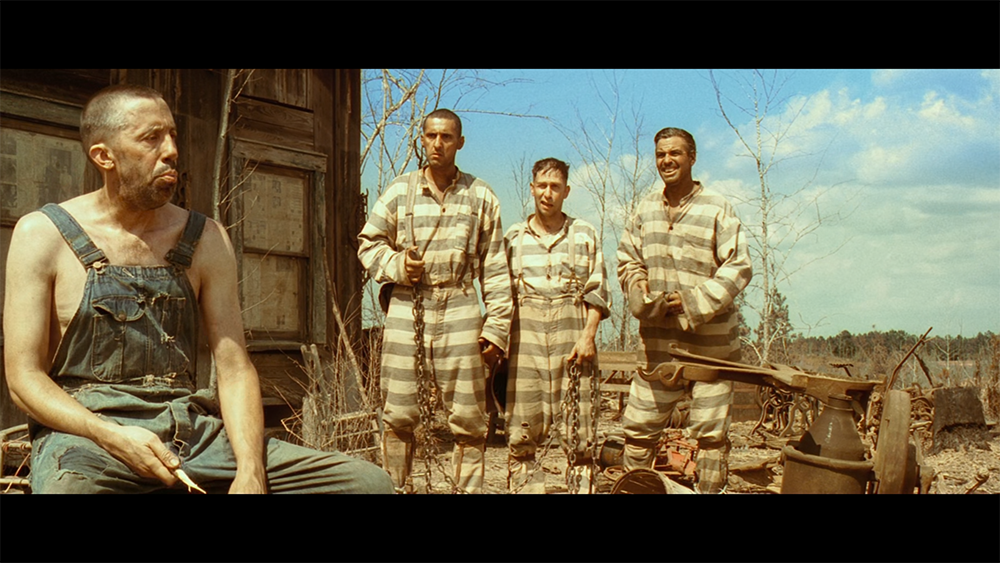
The deliberate mispronunciation and misapplication of French terms in the screenplay, what we might call "malapropistic French," creates what Linda Hutcheon identifies as "irony's edge": a double-voiced discourse that simultaneously invokes and undermines the authority it appears to claim (Irony's Edge, 11). When Everett addresses a waitress as "mamzel" or Pete aspires to work as a "maider dee," the characters reveal both their awareness of linguistic hierarchies and their exclusion from genuine participation in them. This move creates what Mikhail Bakhtin would recognize as a "dialogic" tension between aspiration and reality, between the language of refinement and the vernacular of poverty (324).
Moreover, the film's approach aligns with what James Naremore identifies as a key dynamic in adaptation studies: the tension between cultural prestige and popular accessibility. Naremore argues that adaptation always negotiates between "the culture of the university and the culture of show business," between legitimacy and entertainment (9). The Coen Brothers' deployment of garbled French dramatizes precisely this negotiation; their characters reach for cultural legitimacy through French phrases even as those very phrases reveal their distance from genuine educational credentials.
The Rhetoric of Everett: Vanity and Malapropism
Ulysses Everett McGill serves as the primary vehicle for the film's French linguistic strategy, and his character demands close rhetorical analysis. Everett's self-presentation relies heavily on verbal performance; stripped of all other forms of capital whether financial, social, or educational; he possesses only his "capacity for abstract thought" and his volubility. His deployment of French terms functions as verbal peacocking, an attempt to distinguish himself from his companions through linguistic display.
Consider Everett's first significant French deployment: addressing a waitress as "mamzel" while ordering "gratinated potatoes" and "your finest bubbly wine." The corruption of "mademoiselle" to "mamzel" performs multiple rhetorical functions simultaneously. First, it establishes Everett's pretension. He believes this term elevates the interaction to a more refined register. Second, the mispronunciation immediately undermines that pretension, revealing his actual distance from genuine French linguistic competence. Third, the performance itself matters more than accuracy; Everett traffics in the appearance of sophistication, understanding that in his social context, few interlocutors possess the knowledge to challenge his linguistic authority.
The scene's visual composition reinforces this linguistic performance. Everett delivers his French-inflected order while leaning back with studied casualness, his hair pomaded to perfection despite his convict status. The film thus establishes what Erving Goffman would term "front stage" behavior, a carefully managed self-presentation designed to control how others perceive the performer (22). Everett's French phrases function as crucial props in this performance, verbal accessories to his sartorial attention and postural swagger. That the waitress responds without apparent notice of either his French attempt or his affectation suggests the success of his performance within his immediate social context, even as the film's audience recognizes its fraudulence.
The film's use of "maider dee" proves particularly rich for analysis. When Pete fantasizes about his post-treasure future, he imagines: "Go out west somewhere, open a fine restaurant. I'm gonna be the maider dee. Greet all the swells, go to work ever' day in a bowtie and tuxedo." The phonetic rendering of "maître d'hôtel" as "maider dee" accomplishes several rhetorical objectives. It preserves Pete's vernacular authenticity. He has heard this term but lacks the cultural context to pronounce it correctly. Simultaneously, it reveals how French terminology has penetrated even working-class American aspirations, becoming a synecdoche for upward mobility itself. The "maider dee" represents not merely a job but a performed identity, one requiring costume ("bowtie and tuxedo") and theatrical greeting of "swells."
Most significantly, Pete's dream reveals the psychological function of these French terms: they represent transformative magic, linguistic talismans that can transmute a convict into a gentleman through mere utterance and performance. This aligns with J.L. Austin's theory of performative utterances, language that doesn't describe reality but creates it (6-7). For Pete and Everett, French terms function as performative speech acts, attempting to conjure a reality of refinement that material circumstances deny them.
Yet the film complicates this reading by suggesting genuine pathos beneath the pretension. When Everett insists on his Dapper Dan pomade or maintains his elaborate vocabulary even in extremis, we witness not mere vanity but a desperate attempt to maintain human dignity in dehumanizing circumstances. His French phrases, however garbled, represent acts of resistance against a social order that would reduce him to his prison number or his poverty. In this sense, Everett's malapropisms participate in what Michel de Certeau calls "tactics" or creative resistances employed by the powerless to assert agency within systems not of their making (29-30).
The Sociolinguistic Geography of French in the American South
The screenplay's deployment of French cannot be separated from its specific geographic and temporal setting. Depression-era Mississippi existed at a particular intersection of cultural forces: the remnants of plantation aristocracy, the proximity to French-influenced Louisiana, and the economic devastation that rendered class pretensions simultaneously more desperate and more absurd. The film's attention to this sociolinguistic geography reveals sophisticated understanding of how language functions as both regional marker and class indicator.
Big Dan Teague's self-identification as "Big Dan toot court," a mangling of "tout court" (meaning "simply" or "without elaboration") exemplifies the screenplay's sociolinguistic precision. "Tout court" represents an advanced French idiom, suggesting intellectual sophistication beyond mere vocabulary. That Big Dan attempts this phrase while introducing himself as a Bible salesman creates multiple layers of irony. The phrase itself means "without elaboration," yet Big Dan is anything but simple or straightforward, he's a confidence man and murderer. His French affectation, like his biblical sales pitch, represents another con, another performance of false authority.
The film situates French linguistic pretension alongside other forms of fraudulent cultural capital. Wash Hogwallop's home contains a "byurra" (bureau) with Mrs. Hogwallop's belongings, the French furniture term persisting even in rural poverty. Later, Penny McGill mentions her "chiffonier," another French furniture term that has been absorbed into Southern domestic vocabulary. These terms reveal how French linguistic elements have sedimented into Southern speech patterns, no longer recognized as foreign but accepted as the natural vocabulary of domesticity or what linguists might call "lexical borrowing" that has achieved full integration.
This integration paradoxically makes French terms both accessible and mystifying. Characters deploy French loanwords that have become English (bureau, chiffonier) without recognizing them as French, while simultaneously attempting French phrases (au revoir, mademoiselle, maître d') that they lack the cultural competence to pronounce correctly. This creates a linguistic landscape where French exists simultaneously as familiar and foreign, integrated and aspirational, naturalized and exoticized.
The film's soundtrack reinforces this linguistic hybridity. T Bone Burnett's musical arrangements blend traditional American folk forms with sophisticated production techniques, creating what might be termed sonic "malapropism," familiar melodies performed with technical precision that both honors and ironizes the source material. The music thus operates in parallel to the French linguistic elements: both involve taking cultural materials associated with refinement (French language, studio production) and applying them to vernacular content (Depression-era dialogue, Appalachian ballads) in ways that create productive tension between form and content.
Meta-Textual Irony: Greek Epic, French Pretension, American Vernacular
The most sophisticated level of the Coen Brothers' rhetorical strategy operates meta-textually, in the relationship between source material and adaptation. The film's opening epigraph from Homer's Odyssey ("O muse! / Sing in me, and through me tell the story / Of that man skilled in all the ways of contending,") establishes classical Greek epic as the narrative's foundation. Yet the screenplay systematically avoids Greek linguistic or cultural references in favor of French ones. This substitution itself functions as rhetorical commentary on the nature of cultural translation and adaptation.
The absence of Greek references paradoxically emphasizes the film's distance from its source material. The Coens are not attempting faithful adaptation but rather structural appropriation, using the Odyssey's narrative skeleton while filling it entirely with American vernacular content. The deployment of French rather than Greek linguistic elements underscores this displacement. French, not Greek, represents the language of aspiration and cultural capital in the American South. A character who attempted Greek phrases would seem learned or pedantic; one who attempts French seems pretentious and social-climbing, a crucial distinction for the film's satirical project.
Moreover, the French-for-Greek substitution comments ironically on the American relationship to European culture generally. Classical education in America has traditionally meant Latin and Greek, the languages of "high" culture and genuine learning. French, conversely, represents "polite" culture, social refinement rather than intellectual depth. By having his characters reach for French rather than Greek, the Coen Brothers suggest an American culture more concerned with social performance than genuine classical learning. Everett may name himself after Ulysses, but his cultural aspirations extend only to ordering in mangled French, not to engaging with Homer in the original Greek.
This substitution becomes more pointed when we consider that the Coens have admitted in interviews to never having read Homer's Odyssey in its entirety, relying instead on secondary sources and cultural knowledge of the epic's basic plot structure. Their adaptation thus mirrors Everett's own relationship to culture, aspirational, performance-based, and grounded more in appearance than deep engagement. This parallel between filmmaker and protagonist creates what Linda Hutcheon calls "knowing wink" irony, the filmmakers and audience share knowledge that the characters lack (Irony's Edge, 58). Yet the Coens implicate themselves in Everett's pretensions, suggesting that all cultural appropriation involves similar dynamics of partial knowledge and strategic performance.
We recognize that Everett's pretensions are misplaced, that his French is garbled, that his claim to intellectual superiority is undermined by every malapropism. Yet the film never quite mocks him; there's sympathy in the portrayal, an acknowledgment that language represents one of the few available tools for self-fashioning in a context of extreme material deprivation. This sympathetic irony extends to the film's own adaptive practice. The Coens don't mock Homer or classical tradition; rather, they acknowledge the impossibility of direct access to that tradition and create instead a vernacular American response to classical themes.
George Nelson and the Performative Failure of French
The character of George "Babyface" Nelson (see Figure 3) provides a crucial test case for the film's French rhetorical strategy. When Nelson bids the Soggy Bottom Boys farewell, he attempts: "Or-voir, Itta Bena!" This mangling of "au revoir" (goodbye) reveals several dynamics worth examining.

First, Nelson's French attempt occurs at a moment of performative grandiosity, he's just robbed a bank and is making his theatrical exit. The French phrase functions as verbal flourish, an attempt to add continental sophistication to his gangster persona. Second, the mispronunciation as "or-voir" (which would literally mean "gold-to-see" if it were French at all) reveals Nelson's even greater distance from genuine French competence than Everett's. Nelson represents pure American bravado with the thinnest veneer of cultural sophistication.
Third, and most significantly, Nelson's French failure occurs in a context of ultimate performative success, he's pulled off the robbery, evaded capture (temporarily), and demonstrated his criminal prowess. Nelson's continued criminal effectiveness despite his garbled French suggests that in the film's moral universe, actual competence matters more than linguistic performance. His malapropisms merely color his self-presentation without undermining his capabilities. This stands in contrast to Everett, whose linguistic performances substitute for rather than supplement actual capability.
The screenplay thus establishes a hierarchy of performative authenticity. Nelson's failed French doesn't undermine his criminal authenticity; Everett's failed French reveals his lack of the sophistication he claims; Big Dan's French seals his fraudulence as a Bible salesman. In each case, French linguistic deployment serves as a diagnostic tool, revealing character through the gap between aspiration and execution.
Nelson's character also illuminates the film's engagement with American mythologies of the outlaw. As Richard Slotkin argues in Gunfighter Nation, American culture has long romanticized the criminal as a figure of authentic individualism opposed to social constraint (5). Nelson embodies this mythology, his violence coded as genuine self-expression rather than pretension. His botched French thus reads differently than Everett's, where Everett's malapropisms reveal inauthenticity, Nelson's reveal excess, a man so authentically himself that even his cultural aspirations can't undermine his essential nature. The film thus uses French linguistic performance to navigate between different American archetypes: the confidence man (Everett), the outlaw (Nelson), and the villain (Big Dan).
The Sirens Scene and Linguistic Seduction
The film's famous "Sirens" sequence provides additional insight into how French linguistic elements function within the broader adaptive project. When the three convicts encounter the women washing clothes in the river, the scene briefly suspends the film's linguistic comedy. The sirens speak no French, deploy no malapropisms, and engage in no verbal performance whatsoever. Instead, they sing wordlessly before the scene dissolves into ambiguous aftermath.
This linguistic silence proves significant. The sirens represent a moment when language fails, when Everett's verbal facility cannot protect him. His French phrases, his elaborate vocabulary, his rhetorical skill, none of these matter in the face of direct sensory seduction. The scene thus suggests limits to linguistic performance as a mode of agency or protection. Where Everett's French allows him to maintain dignity and assert identity throughout most of the film, the sirens episode reveals how such linguistic strategies can be circumvented by experiences that operate beneath or beyond language. Figure 4 shows the primary layers in the staging of the sirens scene, where the music’s slow tempo creates an ominous effect.

The scene also comments on the film's relationship to its Homeric source. In Homer's Odyssey, Odysseus must physically restrain himself and his crew to resist the sirens' song. The Coens update this by making the encounter mysterious and ambiguous, we don't know exactly what happened, suggesting that some experiences resist narrative coherence. This connects to the film's broader linguistic project: just as the characters' French malapropisms reveal the gap between aspiration and reality, the sirens scene reveals the gap between language and experience, between what can be narrated and what must remain mysterious.
The Politics of Translation: From Homer to Hollywood via France
The film's French linguistic strategy ultimately comments on the politics of cultural translation and appropriation. The Coen Brothers are not the first to transpose Homer's epic to a new context. The Odyssey has been continuously adapted, translated, and reimagined throughout Western literary history. Yet by choosing French rather than Greek as their "high culture" linguistic reference point, the Coens make visible the mechanisms of cultural appropriation and class aspiration that adaptations often naturalize.
Roland Barthes argued that myth functions by transforming history into nature, making the contingent seem inevitable (129). The deployment of French in O Brother performs the opposite operation: it denaturalizes cultural hierarchy by making its performance visible and awkward. When Everett says "mamzel," we see the machinery of class aspiration operating; we witness the attempt to claim cultural capital through linguistic performance. The mispronunciation doesn't just fail, it reveals the failure inherent in such claims, the impossibility of bridging class divides through vocabulary alone.
This meta-textual awareness extends to the film's relationship with its own audience. The Coen Brothers assume a viewership capable of recognizing both the French references and their garbled execution, creating what Umberto Eco calls a "Model Reader," an ideal audience positioned to appreciate multiple levels of textual irony (7). Such an audience laughs at the mispronunciations while simultaneously recognizing them as authentic to character and setting. This double consciousness, appreciating both the accuracy of the representation and the inaccuracy of the represented French, creates the film's characteristic ironic tone.
In addition, the film's approach resonates with broader debates in adaptation studies about fidelity and transformation. As Robert Stam argues, adaptation criticism has too often judged films according to their faithfulness to source texts, privileging original over adaptation in ways that replicate problematic hierarchies of cultural authority (54). The Coen Brothers sidestep this trap by making their distance from Homer obvious and productive. By substituting French for Greek, malapropism for accuracy, and Depression-era Mississippi for ancient Mediterranean, they assert adaptation's right to radical transformation rather than reverential reproduction.
Conclusion: Linguistic Rhetoric of Cultural Translation
The French linguistic elements scattered throughout the screenplay function as markers of translational distance and aspiration. They represent the cultural and temporal distance between ancient Greece and modern America, while simultaneously suggesting that such distances can never be fully bridged, only performed, approximated, gestured toward through imperfect linguistic appropriations. Everett's garbled French stands as synecdoche for the film's entire adaptive project: aware of classical tradition, aspiring to engage with it, but ultimately producing something distinctly American, vernacular, and irreducibly distant from its sources.
The Coen Brothers' rhetorical strategy thus achieves remarkable sophistication through apparent simplicity. By having their characters reach for French sophistication and fall short, they create a linguistic correlative for the film's broader themes: the gap between aspiration and reality, the performance of identity in the absence of stable social position, and the translation of high culture into vernacular contexts. The French phrases that pepper the screenplay function simultaneously as character development, social satire, and meta-textual commentary on the nature of adaptation itself.
In the end, the film suggests that fraudulent sophistication, Everett's malapropistic French, his dubious claim to intellectual superiority, his performance of refinement, may be all that's available to those denied access to genuine cultural capital. Yet rather than simply mocking such pretensions, the Coen Brothers treat them with a measure of sympathy, recognizing that language represents crucial tool for self-fashioning and dignity in contexts of material deprivation. If Everett's French is garbled, his heroism, like his claim to be paterfamilias, is nonetheless real, performed into existence through sheer verbal will.
The film's use of French ultimately reveals what Fredric Jameson calls the "political unconscious" of American culture: our ambivalent relationship to European cultural authority, our faith in performance and self-fashioning as means of social mobility, and our simultaneous reverence for and distance from classical tradition (20). In choosing French over Greek, malapropism over accuracy, and vernacular over classical diction, the Coen Brothers create a linguistic landscape that is authentically American in its contradictions, aspirational yet practical, reverential yet irreverent, sophisticated yet simple.
The result is a film that honors Homer not through faithful translation but through radical transposition, proving that adaptation requires not fidelity but imagination, not accuracy but authenticity to one's own cultural moment and context. The French loanwords that structure the film's comic and satirical registers finally reveal themselves as strategies of survival, linguistic performances that allow characters to assert dignity and identity even when stripped of all other forms of capital. In making this visible, the Coen Brothers create not just an adaptation of Homer but a meditation on adaptation itself, on the formidable undertaking of translating across cultures, classes, and centuries.
Works Cited
Austin, J.L. How to Do Things with Words. Harvard University Press, 1962.
Bakhtin, Mikhail. The Dialogic Imagination: Four Essays. Translated by Caryl Emerson and Michael Holquist, University of Texas Press, 1981.
Barthes, Roland. Mythologies. Translated by Annette Lavers, Hill and Wang, 1972.
Bourdieu, Pierre. Language and Symbolic Power. Edited by John B. Thompson, translated by Gino Raymond and Matthew Adamson, Harvard University Press, 1991.
Burke, Kenneth. The Philosophy of Literary Form: Studies in Symbolic Action. 3rd ed., University of California Press, 1973.
Coen, Ethan, and Joel Coen. "O Brother, Where Art Thou?" Screenplay, 2000.
de Certeau, Michel. The Practice of Everyday Life. Translated by Steven Rendall, University of California Press, 1984.
Eco, Umberto. The Role of the Reader: Explorations in the Semiotics of Texts. Indiana University Press, 1979.
Goffman, Erving. The Presentation of Self in Everyday Life. Anchor Books, 1959.
Hutcheon, Linda. Irony's Edge: The Theory and Politics of Irony. Routledge, 1994.
---. A Theory of Adaptation. Routledge, 2006.
Jameson, Fredric. The Political Unconscious: Narrative as a Socially Symbolic Act. Cornell University Press, 1981.
Naremore, James, editor. Film Adaptation. Rutgers University Press, 2000.
O Brother, Where Art Thou? Directed by Joel Coen and Ethan Coen, Buena Vista Pictures, 2000.
Slotkin, Richard. Gunfighter Nation: The Myth of the Frontier in Twentieth-Century America. University of Oklahoma Press, 1998.
Stam, Robert. "Beyond Fidelity: The Dialogics of Adaptation." Film Adaptation, edited by James Naremore, Rutgers University Press, 2000, pp. 54-76.