VOL. 54, NO. 3
Samuel Beckett and Luis Buñuel, Surrealist Filmmakers
James Paul Mesiti1
While Samuel Beckett’s affinities with Surrealism are well documented, critics have rarely examined how surrealist aesthetics operate within his individual works. Film (1964) was first conceived as a cinematic exploration of Bishop Berkeley’s dictum esse est percipi (“to be is to be perceived”). During the twenty-two‑minute short feature, the protagonist, O for “Object” (played by Buster Keaton), is relentlessly pursued by E for “Eye,” whose viewpoint is the same as that of the camera. Throughout the chase, O shields his face, preserving an “angle of immunity” to evade E’s gaze and, by extension, any relation to E in a bid to attain “non‑being” (Beckett, Film: Complete Scenario 11). Despite his original intentions, Beckett’s investigation of perception ultimately reconstitutes surrealist frameworks in dialogue with Surrealism’s foremost filmmaker, Luis Buñuel.
To begin, I demonstrate how Beckett addresses the fundamental concerns of modernist cinema’s first wave when Buñuel was a surrealist militant and how Film reconsiders his approach to translation and his interdisciplinary methodologies. This allows me to evaluate Beckett’s inversion of Buñuel’s popular narrative, portraying the development of civilization from the state of nature, as a representation of Surrealism’s decline from its revolutionary roots. I then situate Buster Keaton as a surrealist figure, whose casting in the role of O undermines Beckett’s ability to render Berkeleyan philosophy and reframes Film according to surrealist aesthetics. Structurally, Film uses the pursuit of desire as its working mechanism and revises Buñuel’s exaggerated use of montage. Thematically, it introduces the surrealist androgyne around these formal elements, anchored around the interplay between dream and reality. These two dimensions fail to reconcile, producing failed surreality and revealing how Surrealism was reconfigured in the latter half of the 20th century after its avant-garde phase had yielded to the calamities and hardships that defined the era.
Late to Cinema
Cinema offered Beckett a novel outlet and potential solution for his concern that the artistic object is fixated in the time and moment of its perception, which he had expressed as early as his three dialogues with Georges Duthuit (Antoine-Dunne, “Beckett, Eisenstein and the Image” 194). Soviet filmmaker Sergei Eisenstein provided the theoretical foundation for cinema’s early directors during the avant-garde, as well as later for Beckett a possible solution to art’s inherent limitations imposed by perception. Beckett himself wrote to Eisenstein in 1936 with the desire to learn the cinematographic trade under his guidance but never received a response (Letters 1929-1940 317). Eisenstein would have likely been drawn to the request but was reportedly distracted by the adjustments he was making to his Bezhin Meadow (1937) and a smallpox outbreak, which affected the film’s production in Stalinist Russia (Leyda 59).
In his montage theory, Eisenstein conceptualized cinema’s distinct ability to juxtapose opposing shots in the creation of a new element, superseding the simple sum of their separate parts (The Film Sense 7-8). In a later essay, titled “Laocoön” he suggests that film is not restricted by the same medium-specific characteristics of the other art forms. Instead, the filmmaker has predominance over the way in which separate fragments are reconfigured when they are projected. By deploying images that are tied to Deleuze’s notion of the immutable reality of cinema, film participates in both the dimensions of time and space (Antoine-Dunne, “Beckett, Eisenstein and the Image” 195).
Buñuel is among these early filmmakers whose work was shaped by Eisenstein, most notably through his own theory of cinema, “Découpage, or Cinematic Segmentation,” which largely reaffirms Eisenstein’s ideas and culminates in his first production, An Andalusian Dog (An Unspeakable Betrayal 131-135). As Telotte expands on this time, in citation of Marcus, “one attuned to the period’s emphases on speed, change, and the subjective nature of experience, became ‘inseparable from cinematic consciousness’, that is, from a familiarity with how film’s mobile eye controls and constructs our sense of space and time” (235). A growing consciousness in late modernism propelled a search for understanding this same consciousness in the still developing cinematic medium (Marcus 44-45).
Beckett arrives late to cinema but seeks to analyze a similar question as the avant-garde filmmakers of the first half of the twentieth century with an equal measure of inexperience and curiosity. He belongs to silent film’s resurgence of modernist cinema’s second wave (1959 – 1975ca), challenging Hollywood’s realism of the time (Paraskeva 2-5; Bouchard 127-128). Aesthetically, Beckett recognizes his relationship to the first era of modernist cinema. He explicitly sets its period for “about 1929,” the same year An Andalusian Dog was released, also opting for a black‑and‑white silent short save the “sssh!” of the woman to her male partner while O flees along the wall line in part one (Paraskeva 2-5; Film: Complete Scenario 12). Similarly, An Andalusian Dog was originally a silent short film in black and white until Buñuel retrospectively incorporated sound in 1960. The gaze-play of E in pursuit of O acts as the primary marker that signals back to cinema’s basic methods of function.
Beckett’s exploration of perception through cinema underpins his transdisciplinary process that constantly seeks to expose each medium’s unique properties as a part of his artistic interest in failure and the ability to express (Jeffery 21). Here, it is to determine whether avoiding relation is possible, which the spectator will ultimately learn it is not. For Buñuel, cinema’s innate disposition towards perception is the point of departure in his career. In the introductory sequence of An Andalusian Dog when he steps from the position of director to filmed object and slits Simone Mareuil’s eye (see Figure 1), he establishes both his authorial hand and his experimentation with cinema’s mechanisms that will endure throughout his work. Buñuel recognizes that distinct from the other art forms, in cinema perception can be both thematic and structural, which Beckett will also introduce through his mediation of Berkeley’s philosophy.
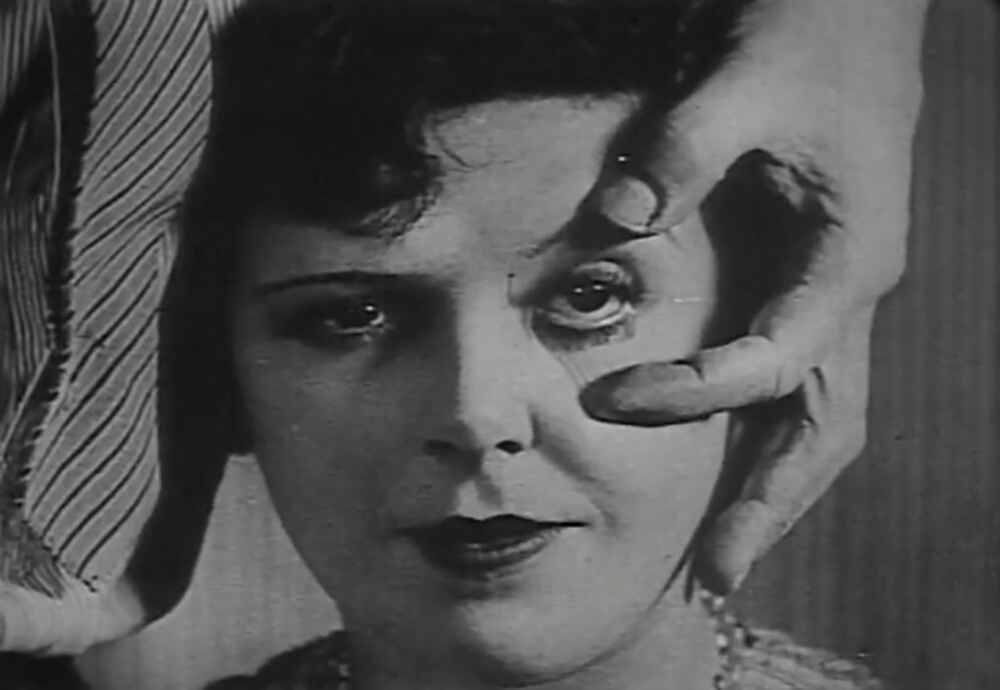
Beckett was not unfamiliar with Spain’s avant-garde, and he would have been aware of Buñuel and An Andalusian Dog during his two-year appointment at École Normale in Paris that began in 1928. The surrealist film premiered in the French capital on June 6, 1929, and its original two-month run was extended to eight because of its commercial success (Knowlson 425).2 The first English version of its screenplay was included in a special September 1932 issue of the magazine This Quarter that was dedicated to Surrealism. Beckett had collaborated in the same edition and translated more than fifty of the two hundred pages (Germoni and Sardin 740).
Many of his translations became personal works deviating from their original versions through a change of register, an alteration in punctuation, or the addition of new and erudite references. In some cases, Beckett engages with Surrealism’s automatism, either polishing its syntactical chaos or imposing an ironic tone that seemed to mock the practice in some of its own texts. In other moments, he archaizes the language (744-750).
Fernández and Garre García admit that there is a “strangeness” that originates from Beckett’s intersection in between languages, meeting in his translative work and permeating throughout the diversity of his oeuvre (3).3 Film is a testament to his interdisciplinarity and resonates with Surrealism’s own. Although it is not linguistic, Film manifests this strangeness as a product of Beckett’s reengagement with modernist cinema amongst his constant struggle with the deficiencies of language. Surrealism’s emphasis on the visual image resonates with Beckett’s silent film and how it appeals to a field of visual imagery (Federman 48).
Like his translations, Film is archaic in the way it revisits modernist cinema’s fundamental frameworks, which I outline above. It also tempers the anarchy behind Buñuel’s own automatic practices from the same period through the chase narrative’s cohesion.4 As a surrealist adaptation within the same media, Film adds new elements while others are lost, introducing Berkeley as a new reference consistent with his translations that did the same. This process is rejuvenative (Stam 62), belonging to Surrealism’s redefinition after the midpoint of the century.
Surrealism’s centrality and the rigidity of its ideologies disbanded as a consequence of the experiences that characterized the second half of the 20th century, which included war, exile, nuclear proliferation, and the Cold War. This gave artists the freedom to be openly subjective and not feel bound to the approaches that anchored its avant-garde period, such as their Freudian inspired creative approaches or diverse collective mythologies. In artists not previously directly associated with Surrealism, its emergence in their work can best be interpreted as a “ghost,” as Blanchot understands, in which it surfaces in unique and unexpected moments and artistic expressions as if it had become an interruption of the unconscious itself (85). Beckett does not consciously invoke the movement, and it is this lack of awareness that becomes an essential factor in his cinema falling into surrealist aesthetics. Film rechannels the movement’s cinematic manifestations and tenets that Buñuel embodies as a part of the aesthetic discipline that emerged after the movement’s avant-garde.5
Buñuel’s Masterplot in FILM
Beckett’s allusions to Buñuel are many and are particularly notable in the surreal settings he employs.6 As Friedman expands, “while uniquely personal, [Beckett] often echoed the work of his surrealist predecessors: a literature of bodily decrepitude, of suffering and endurance, of sudden, gratuitous violence, set in a bleak, devastated, and surreal landscape” (28). Specifically, the working image for his drama Happy Days (1961) repeats the closing scene of An Andalusian Dog. The play begins with the protagonist Winnie buried above her waist like Buñuel’s film where the final two characters are similarly buried in the epilogue.
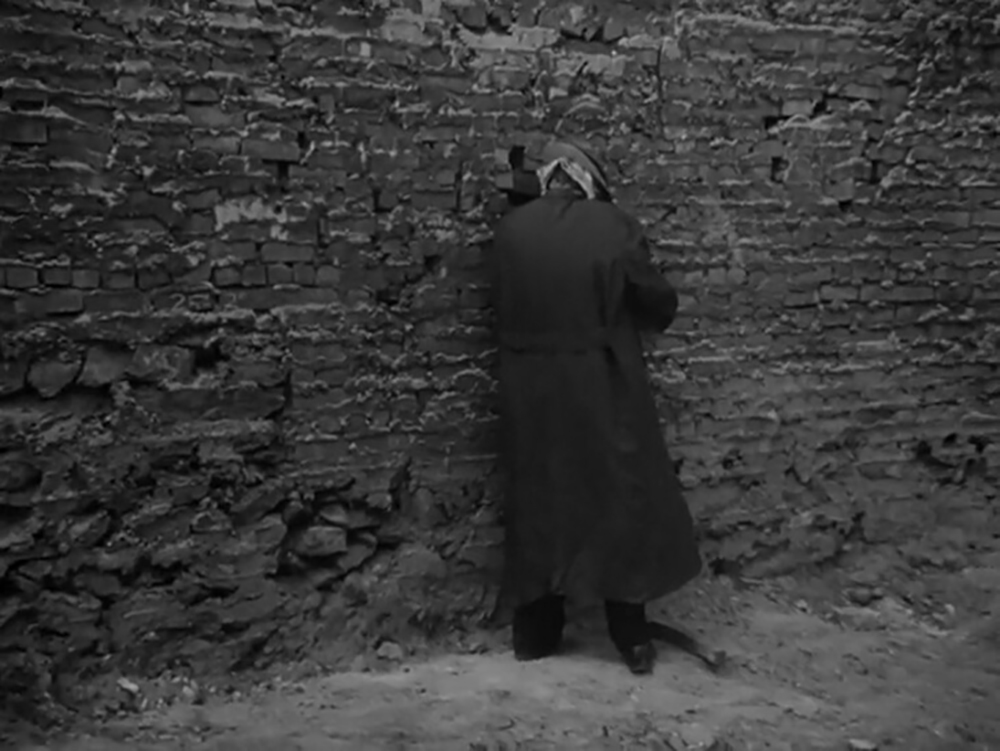
The play radicalizes it as its starting point to create a familiar atmosphere that Beckett will seek three years later in his cinematic venture (Talens 26). He aspired to create “unreality” in the setting of Film and the street scene where the narrative begins (Film: Complete Scenario 12). The idea is that O does not exist until E’s perception, where the “unreal climate” acts as this intermediate dimension. However, unreality is not truly achieved aesthetically. The rubble-filled street corridor and the initial apparent limitlessness of the wall in the first part of Beckett’s short are not new. They bear a resemblance to the desolate and barren earth mound of Happy Days, and to what the original 1932 English version of the manuscript that Beckett would have seen describes as the “limitless desert” at the close of An Andalusian Dog (157; see Figures 2 and 3).
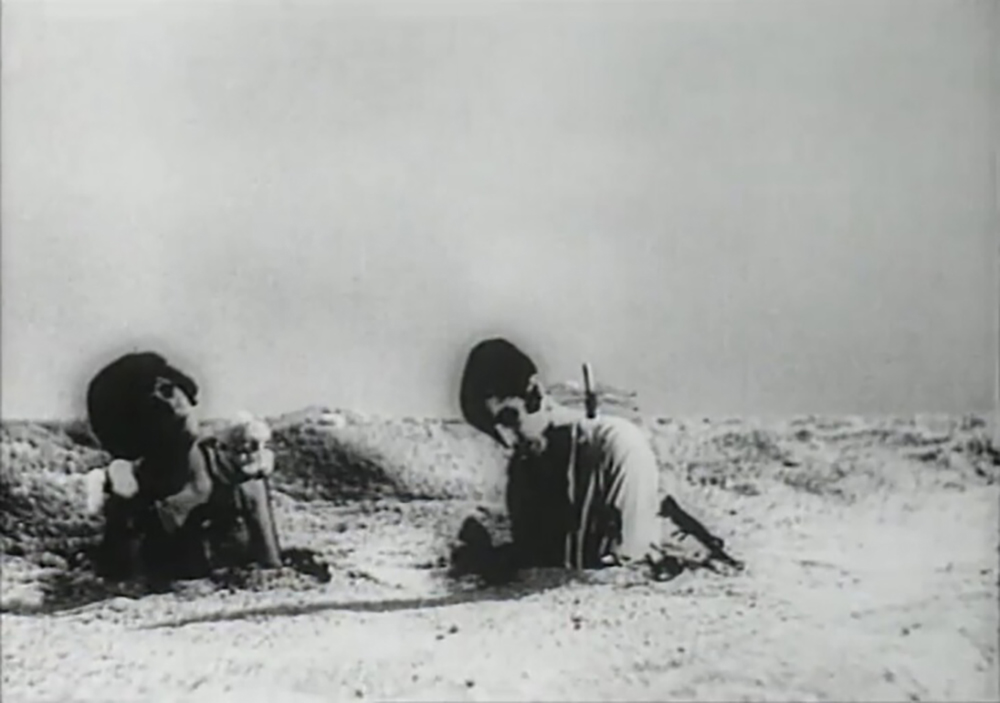
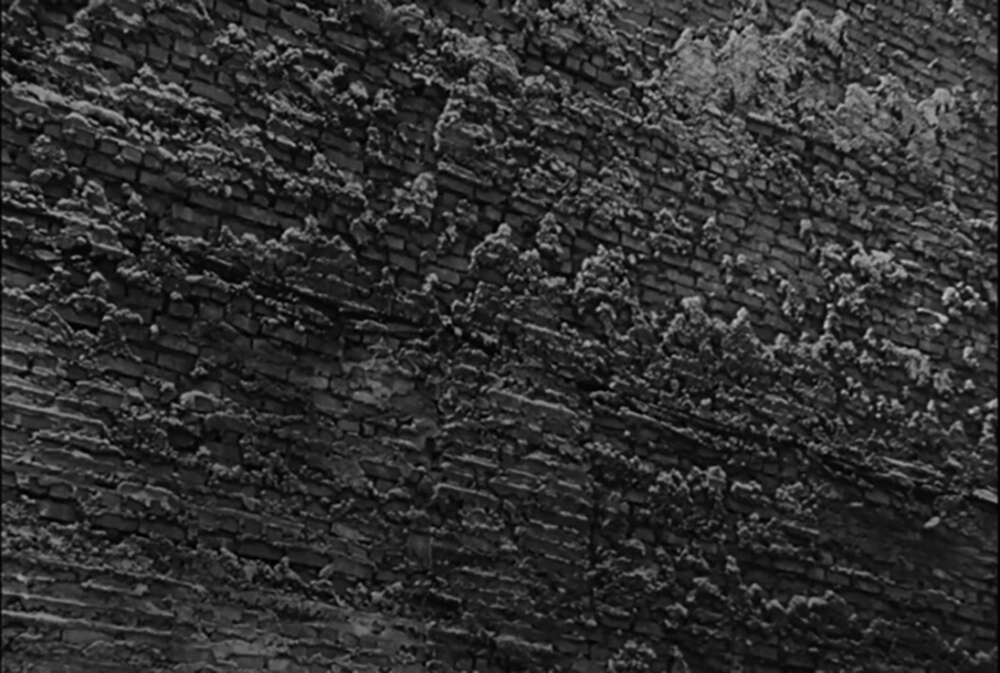
At the time of the short’s release, Buñuel was still developing what would later become his masterplot, or central narrative that can be found across his cinema. López summarizes it as the “transit from instinct to convention, from the state of nature to society (“Una imposible inocencia” 479; my trans.). Like Beckett’s own adaptation, Buñuel will reconfigure the ending of An Andalusian Dog as his starting point for his next film The Golden Age (1930), where he is able to strengthen his masterplot with greater narrative coherence. In its prologue, there are a series of shots that are set within a largely comparable desolate landscape, depicting scorpions and emphasizing their aggressive traits. It has an informative, almost objective character that Buñuel will fully exploit later in Land without Bread (1933). When it concludes and the main story begins, the scenography changes, yet the island environment where the bandits live conveys a similar appeal of an unaffected terrain before the arrival of the Mallorquins, bringing civilization (López, “Una imposible inocencia” 478-479).
Beckett gathers these different characteristics to the same effect at the beginning of Film when the camera lens slowly scans the edge of the wall from left to right, panning the rooftops and sky, then later pausing at the staircase, which O will soon ascend. It gradually returns from the opposite direction back toward its original position facing the wall. In this initial sequence, the camera lens is seemingly disinterested and wandering as it assumes a more documentary mindset that is also reminiscent of de Chirico and the feeling of imminence that saturates his piazzas. The transition to the chase is abrupt and startles the viewer as the camera quickly snaps to Keaton.
In select pictures, Buñuel manifests his nuclear story differently as a result of Europe’s calamities and the decay of Surrealism’s ideological vigor.7 A return to the natural environment and state of innocence is deemed impossible, replaced by a context where only the strongest survive (López, “Una imposible inocencia” 488). Like the Spaniard, McMullan explains that “Beckett’s work is saturated with the cultural fragments and ghosts of twentieth century Europe” (143).8 Similar to how the closing image of An Andalusian Dog inspires the baseline of Happy Days, Beckett’s starting point is this state of languish, hostility, and conflict.
Through his experiment with perception, Beckett is driven by the same factors that convinced Buñuel to adjust the central theme he championed in his two preeminent surrealist works, An Andalusian Dog and The Golden Age, whose plots were no longer able to conjugate the outlook of the time. In this sense, Film is a surrealist work that implements characteristics of the movement’s revolutionary peak but submits them to a bleak and decadent filter that reflects the lost vigor of the avant-garde period in the decades that followed it. This dynamic clarifies the variances, as well as the likenesses, between Buñuel’s early cinema and the surrealist expression of Film, which I will now explore.
Humor, Surrealism, and Buster Keaton
In his screenplay to the production, Beckett will emphasize the importance of humor in the short’s tone and O’s behavior, writing: “Climate of film comic and unreal. O should invite laughter throughout by his way of moving” (Film: Complete Scenario 12).9 Humor is often a driver of Surrealism’s dialectical relationships that seek resolution. Consider the brutality or horror of Buñuel’s eye slashing in An Andalusian Dog with, for example, a later sequence after the third title screen when the camera quickly pans from Pierre Batcheff lying in bed to two hands shaking a cocktail, which has been read as a masturbation joke (Hammond, qtd. in Russell 48; see Figure 4). These gags may not be outwardly humorous to the viewer but their comedic root, perhaps originating from Buñuel’s stay in the Residencia de Estudiantes, reconciles the openly grotesque moments (Russell 46-48). They constitute the work’s metaphor for repressed male sexual desire (Bertetto 194; Blakeston 143; Carnero, “Del subconsciente” 162; Drouzy 44–51; López, “Film, Freud, and Paranoia” 37–40; Sánchez Vidal 25–26).
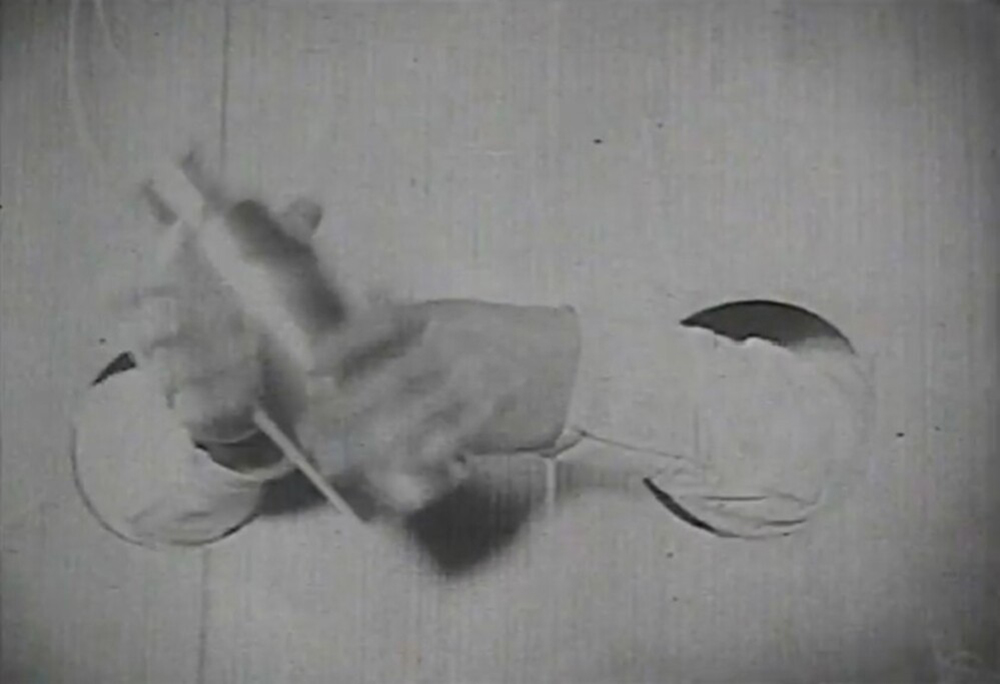
These gags incarnate Surrealism’s ideological basis rooted in the reconciliation of opposites, stemming from Hegelian and Marxist dialectics. In the first manifesto, Breton refers to the union of dream and reality according to these terms: “I believe in the future resolution of these two states, dream and reality, which are seemingly so contradictory, into a kind of absolute reality, a surreality” (Manifestoes 14). Surreality, thus, becomes understood as the transcendental and marvelous space that unification yields. It sustains An Andalusian Dog, despite the grotesque and horror-filled moments that may suggest otherwise. A key difference in Surrealism’s post-revolutionary era, to which I argue Film belongs, is that this same sense of sublimity falters, despite also juxtaposing contradictory qualities, such as humor and terror.
In Film, these elements are expressed through the terror of E’s chase and the role of O played by Buster Keaton, who according to Deleuze was uniquely suited for the part (23). In its closing moments, E finally surpasses the 45° angle of immunity while O sits, revealing E as a double of O and concluding that the pursuit was one of self-perception. Terror manifests in O’s desire to be absent, becoming an act of self-negation as the self’s mirror image (Perlmutter 88). Particularly in the moments when the pursuit seems to temporarily pause, Keaton’s interpretative personality shows its strongest colors.
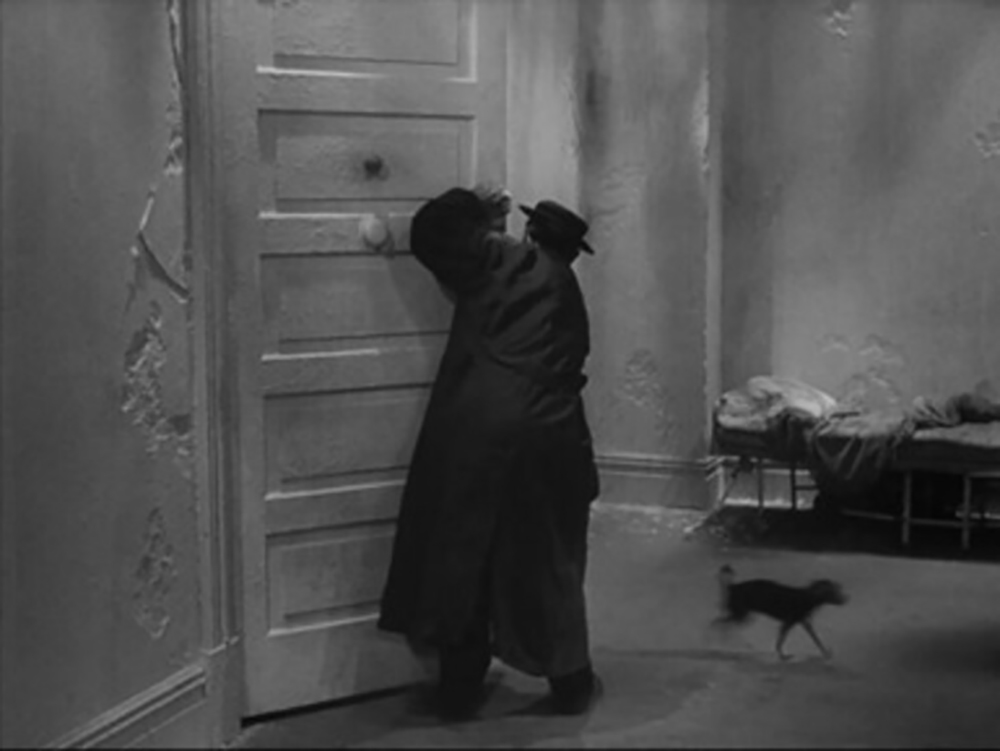
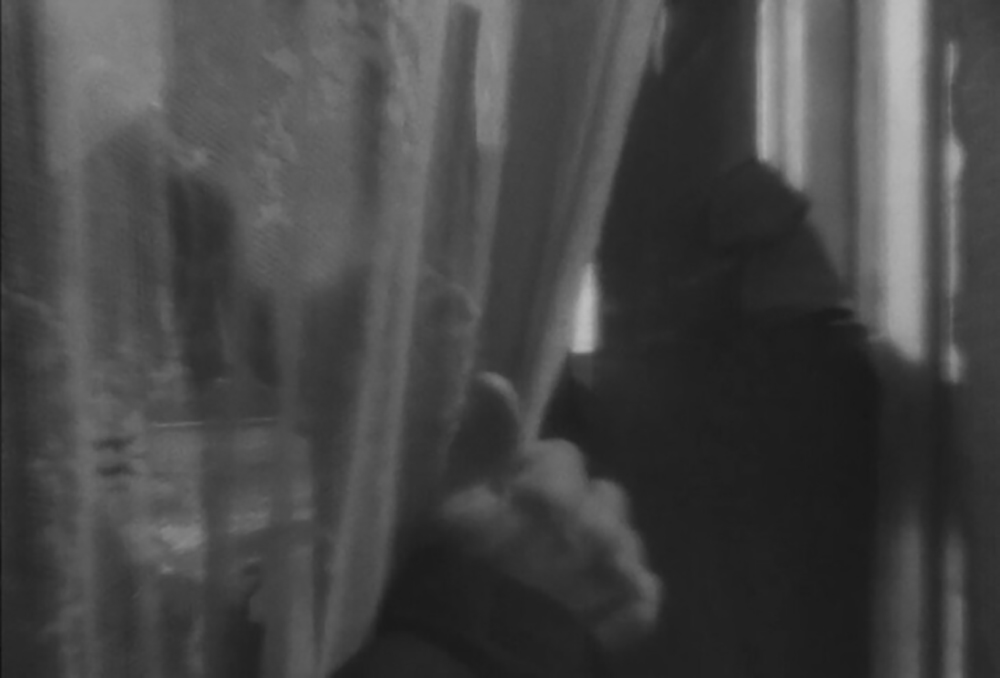
In the third part of the film, O enters the room and tries to avoid perception by all means necessary: he draws the curtain, pushes the gaze of the dog and cat away, and then covers the mirror with a blanket. Following, he finds himself again among the stare of the two pets and, all while maintaining his angle of immunity, proceeds to put them out of the room one after the other. As he sets one animal outside, the other repeatedly evades him and runs back in until he is finally able to expel both (see Figure 5). The director of Film Alan Schneider describes this sequence as “straight slapstick, a running gag, the little man versus a mutely mocking animal world” (81).
Keaton’s slapstick and gag-riddled performance encompass his roles that revolve around objects rather than subjects where, according to Lastra, “the self becomes a thing among things.” In a typical Keaton film, the narrative structure is easily predictable, however his interactions with objects are the opposite (24-25). This stems from his beginnings as a child entertainer in his parents’ vaudeville act, in which he recalls being treated as a “human mop” in the family’s physically rough and demanding brand of comedy (My Wonderful World 13). Like Keaton’s interactions with objects that dictate any role he plays, in Buñuel’s cinema, his characters often lose their agency as they assimilate into the world of objects.
In his formative years, Buñuel also recognized this function of the American actor. In a 1927 essay titled “Buster Keaton’s College” he will write “Buster Keaton’s expressions are as modest as, for example, a bottle’s; the dance floor of his pupils is round and clear, but there his aseptic spirit does pirouettes. The bottle and Buster’s face have infinite points of view” (An Unspeakable Betrayal 110). According to Buñuel, Keaton’s comedy harmonizes his cinema and the medium’s distinct traits, in contrast to his contemporary Charlie Chaplin, who was preferred among the French surrealists (111). Keaton risks the production being inseparable from his own cinematic persona, removing it from the philosophical debate that Beckett wanted (Ardoin 9-10), which is evident in the short’s commercial reception of the time. For example, a September 1965 review in Time would comment that “the startling but quite predictable reason that Film scores is its sole actor: Buster Keaton” (“Cinema: Festivalities”).
Ross Lipman in his 2015 documentary about Film examines how Beckett’s original philosophical underpinnings evolved amid his inexperience and the growing concerns that surrounded the production of the work. These struggles remind us of his failed attempt at contacting Eisenstein in 1936 in which he stated that his primary interest lay “naturally in the scenario and editing end of the subject” (Letters 1929-1940 317). His emphasis on not only learning cinema’s more technical aspects but also understanding the nuances of redacting a script under the Soviet filmmaker is noteworthy. It offers insight into both the challenges that burdened the creation of Film and Beckett’s difficulty in translating his interpretation of Berkeleyan philosophy to both the cast and crew members, Keaton and Schneider among them.
Lipman highlights that one of the obstacles that emerged was who was going to play the part of O. Initially, Keaton was not among Beckett’s first choices, he had originally approached Chaplin, who declined. When Keaton was eventually offered the role, he felt obligated to accept, as he was in the later stages of his career and was no longer receiving as many parts as he once was. He was not interested in the plot of Film, nor did he try to understand the role of Berkeley’s philosophy, yet he remained highly professional throughout filming. For their part, Beckett and Schneider never consulted Keaton for his technical knowledge in order to minimize any potential tensions between the established veteran and their amateurism. E’s desire to perceive O, O’s desire to avoid perception, and Beckett’s desire to express Berkeley meet and unify in Keaton and the tragedy of his character.
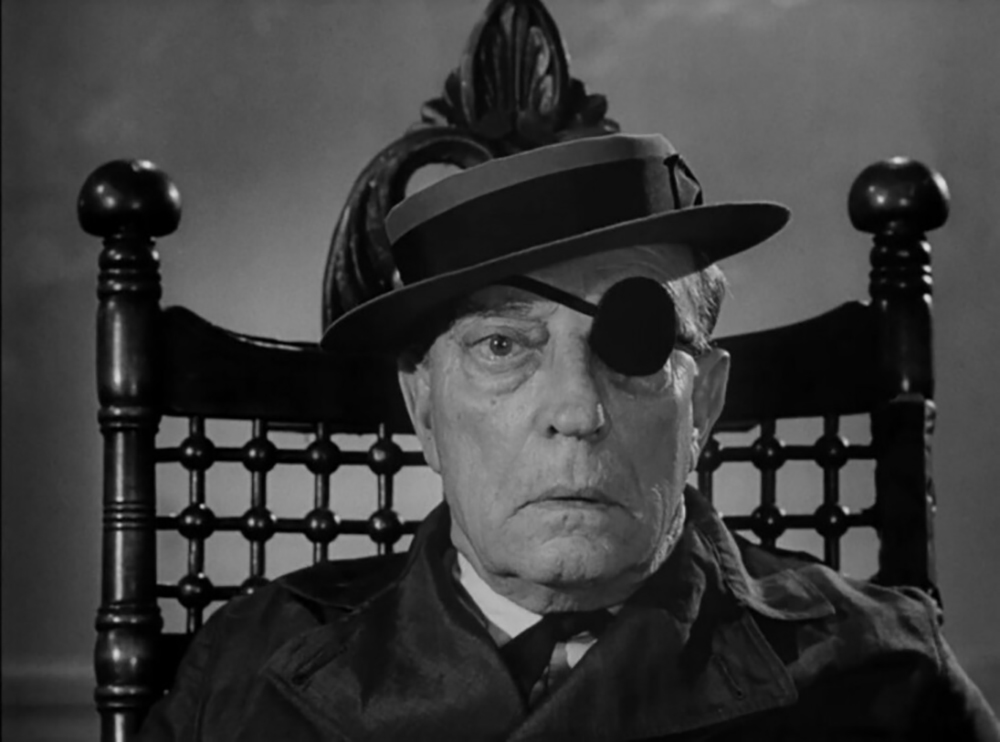
When E surpasses the angle of immunity while O sleeps, the actor’s hallmark – his face – can assume full protagonism. The distress of O contrasts with the expressionlessness of E, typical of Keaton, until O’s alarm momentarily adopts the same deadpan (see Figure 6), before he covers his face, ending the narrative. Beckett is not the first to use Keaton’s signature as a ready-made model in an attempt to convey a specific or personal theme. Alongside Dalí, Buñuel had met poet and playwright Federico García Lorca in the Residencia de Estudiantes and were close friends before their falling out past the midpoint of the decade. In Lorca’s short play Buster Keaton Takes a Walk (1928), he situates the actor’s eyes and facial expression as a source of surrealist play. The points of comparison between the avant-garde piece and Beckett’s incursion into cinema are striking.
The piece describes a tale of Keaton whose odd bicycle trip is filled with surrealist encounters and distortions. It is lyrical and verbal, capable of transmitting cinema’s essence, but whose intention is to be read (Havard, “Lorca’s Buster Keaton” 13-14). One of the main themes is Keaton’s struggle to communicate where the brief dialogue is juxtaposed with descriptive lyricisms. In one moment, Keaton falls off his bike and says, “I don’t want to say anything. What am I going to say?” to which an unknown voice responds, “Fool” (5).
The actor provided Lorca with an artistic object that he used as a canvas to instill his tragic and melancholic motifs, as well as a mask to conceal them (Havard, “Lorca’s Buster Keaton” 14, 19). This becomes evident in the description of the actor’s eyes that contrasts the play’s trite dialogue:
He keeps walking. His eyes, infinite and sad like those of a newborn beast, lilies, angels and belts of silk dream. His eyes, made of the glass’s ass. His stupid boy eyes. That are too ugly. That are too beautiful. His ostrich eyes. His human eyes in the safe equilibrium of melancholy. (5)10
Part of the tragedy is Lorca’s foresight to the end of the silent film era before the impending arrival of talkies (Allen 29). His work helps to clarify what effect is produced when Beckett anachronistically casts the actor, even if unwillingly at first. Keaton’s fate in Buster Keaton Takes a Walk is left to the silence of written text because of his struggle to communicate and due to the work’s hybridity, whose product is not necessarily meant to be performed but read.
Film revisits the end of silent film according to a comparable sense of agony that Lorca originally explores. An aging Keaton performing a role for a piece set in 1929 creates a deterministic, decadent atmosphere – perception is inescapable. His powerlessness for Lorca is mirrored in O’s inability to elude the gaze of the self E. It complicates the premise of the film’s narration of anti-relation that Beckett desired and, instead, repositions the picture according to surrealist structures, which I detail in the next section.
Desire and Montage
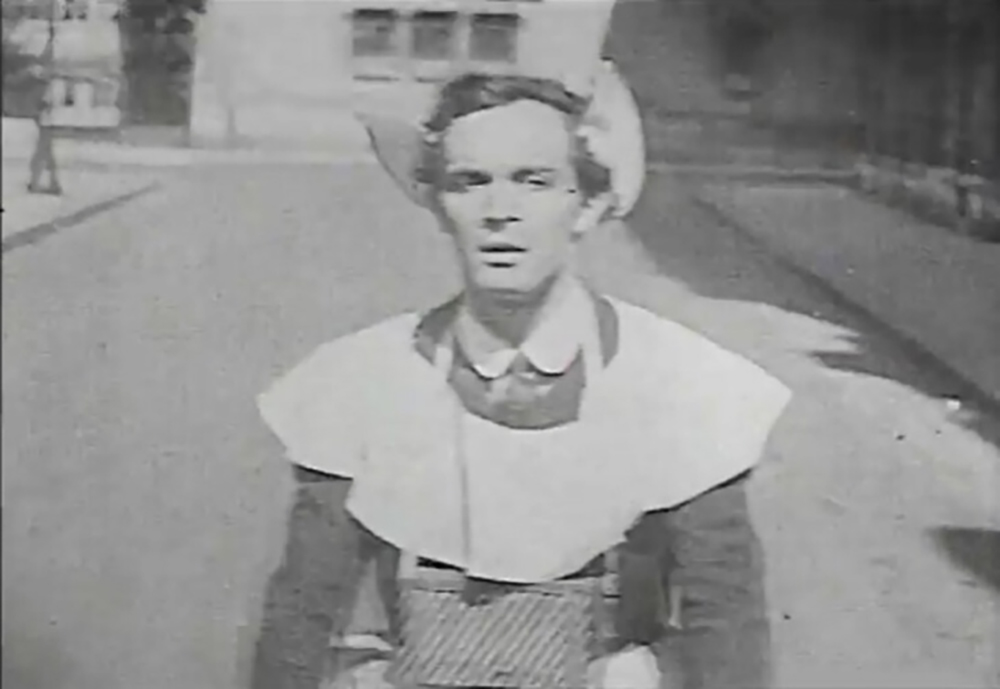
An Andalusian Dog and Film are both centered around elements of desire, which ground their form. After Buñuel cuts Simone Mareuil’s eye (see Figure 1 above), establishing his authorial presence and concern for perception, the next scene is of Pierre Batcheff cycling as he wears women’s garbs over his grey suit (see Figure 7). In this sequence, the cyclist represents the androgynous person found across Buñuel’s oeuvre. It was an icon the surrealists employed to symbolize the harmonious unification of opposites and of dream and reality. In a later moment, the androgyne will return, lying in bed before panning to the cocktail shaker (see Figure 2 above). Shortly after, a man enters and strips the androgynous person of their female clothes and, consequently, their genderless condition. Through this depiction, Buñuel and his co-filmmaker Dalí are proposing self-sufficiency within the film’s extended metaphor of repressed male sexual desire (López, “Viridiana” 223-226). The initial tranquility of the cyclist previews Batcheff’s male character’s stalking of his female counterpart played by Mareuil; a pursuit later interrupted by the reappearance of the androgyne, offering a brief respite from the aggression and violence similar to the function of Keaton’s humor in Film.
Metz explains that “cinema is only possible through the perceptual passions: the desire to see…which was alone engaged in silent film” (181). O’s attempt at avoiding perception and relation is aggravated by the same medium which provokes a perceptual desire to see him. Like Mareuil’s character is for Batcheff’s, this dissonance establishes O as an object of desire for E, materializing through objective chance. In a 1935 lecture “Surrealist Situation of the Object” given in Prague, Breton defined it as “that sort of chance that shows man, in a way that is still very mysterious, a necessity that escapes him, even though he experiences it as a vital necessity” (Manifestoes 268). As chance objects, Mareuil’s character and O must be meaningful. With varying degrees of success, they serve ambiguously as responses to distinct inquiries (Malt 77); specifically: repressed male sexual desire and Berkeley’s perceptual paradigm.11
In An Andalusian Dog, the exaggerated use of montage amongst the attractions that texturize Batcheff’s menace overstimulates the perceptive sensibilities, belonging to an order determined by the irrational unconscious. This organizes its dream logic, where dreams act as a mode of expression, not a means to render nonsense (Aub 294). While in Film, it is the camera’s ruthless chase in which perception disrupts the spectator’s ability to identify with one unified perspective. It shares the same effect as the montage of An Andalusian Dog, where mimetic representation, fundamental to realist art and cinema, is defied because of the persistent discontinuity (Bouchard 128).
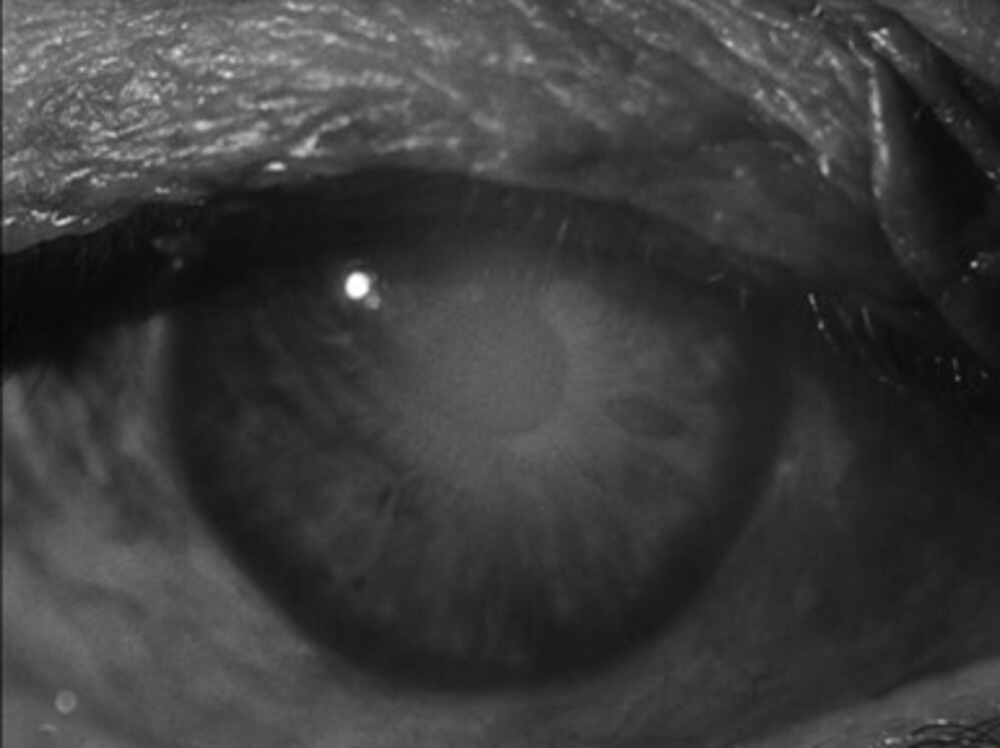
Beckett does not forego the heightened use of montage, however. Initially, his idea to begin Film was to capture separate pairs of individuals in the street’s exterior with each walking towards the camera, engaging in different types of perception, which was scrapped because of strobe effect (Lipman 1:00-1:08). It was replaced by what Schneider describes as “a huge menacing close-up of an eye” (85; see Figure 8). Keaton’s eye frames E’s pursuit of O as both the story’s prologue and epilogue, which Brater argues is as an “oblique reference” to Buñuel’s eye slashing in An Andalusian Dog (Beyond Minimalism 76).
The short’s first working title was The Eye, and although sight is a primary vehicle for perception, the two close-ups enclose the narration but are not subject to it, magnifying the montage between them and the central story. Similar to the sexual overtones that An Andalusian Dog produces by amplifying the Eisensteinean montage, here they expose the entirety Film to a psychic energy capable of surfacing “inner feelings, desires and thoughts of a character,” as Antoine-Dunne understands of the cinematic figure (“Introduction” 7).
In the same 1935 lecture I cite above, Breton elevates the metaphor as Surrealism’s ultimate instrument for deriving meaning, stating there is “one tool only, capable of boring deeper and deeper, and that is the image, and among all type of images, metaphor” (Manifestoes 268). Buñuel achieves integration in his montage use, as proven by the success of the extended metaphor behind An Andalusian Dog to take shape and be discerned. Decades later in Film, an inverse operation occurs. The prologue, epilogue, and narrative do not unify and facilitate the short feature’s meaning. Because of the thematic discontinuity Keaton’s persona introduces in his role, their montage remains fractured.
Although objective chance conceptualizes how desire is made visible, the potential metaphor Keaton’s eye offers, repeated from prologue to epilogue, does not deepen the chase narrative. Rather, it suggests a cyclical pattern in which the flight from self-perception is never-ending and destabilizes the finality inherent to a chase narrative’s linear sequence, which the spectator of Film is also led to believe has reached its conclusion. These factors call attention to Surrealism’s structural transformation where the montage is softened while the preeminence of the metaphor as the primary channel of significance is also challenged. This resonates with Beckett’s surrealist translations from 1932 and, particularly, how many would engage with Surrealism as its philosophies and ideologies weakened, opening the opportunity for new creative possibilities.
Beckett’s Surrealist Androgyne
Comparable to An Andalusian Dog, Film also articulates the surrealist androgyne. In their version, Buñuel and Dalí distort Freud’s concept of the polymorphously perverse disposition, which asserts that culture and convention repress the innate and untamed sexuality of children. They idealize it as a pre-historic condition that escapes the sexual limitations civilization imposes (López, “Film, Freud, and Paranoia” 40-42). For the Spanish surrealists, the androgyne is connected to an uninhibited state of freedom and liberty. During the early days of cinema, Keaton embodied this same function, what Buñuel would refer to in his 1927 essay as “The Buster Keaton School: American style: vitality, a cinematic essence, a shortage of culture, and fledgling traditions” (An Unspeakable Betrayal 111).
The pursuit of an artistic terrain untouched by culture and tradition motivated the two Spaniards to turn towards cinema and away from poetry that drove the Spanish avant-garde in the 1920s (López, “Film, Freud, and Paranoia” 39). Decades later, Beckett’s own embrace of cinema despite his naivety in the medium, which he recognized, invokes a similar attempt to return to an era of open experimentation of cinema’s unique qualities. It inspires his engagement with Berkeley and achieves its ultimate token in Keaton’s casting.
E’s tenacious pursuit reflects Batcheff’s own, suggesting that E eroticizes O whose effort to conceal themself progresses into a gradual loss of his male gender toward the genderless, androgynous state. Like Buñuel and Dalí’s interpretation of the polymorphously perverse disposition, part of O’s goal of androgyny is sexual self-sufficiency as they try to evade E’s penetrative gaze, which guides the camera. The difference between O’s and E’s eyesight supports this: the blurriness of the former depicts the dreamscape in contrast to E’s crisp representation of conscious reality (see Figures 9 and 10). O’s vision of the dream world resists categorization, definition, representation, and, ultimately, referentiality, all of which gender inscribes upon the individual (Albright 122-123).12
As long as the chase is ongoing, O’s aspiration for androgyny is limited to a state of flux, indicative of a process that Steinbock conceptualizes as “shimmering.” O is subject to an oscillation between forms, operating through the dialectical extremes of dream – reality, humor – terror, and stillness – motion. They are forever “emergent” (8-9), and, thus, do not unify the gradients within which they find themself. They only cease to shimmer when E successfully perceives O, who is assimilated into E’s masculine form.
In effect, Beckett produces two different types of shots across the same imagery, made evident by this change in viewpoints. Across his work, Buñuel is capable of creating double images, filming “reality and dream through the same lens,” as Havard affirms (“Luis Buñuel Objects” 61). Beckett inherits both dimensions from the surrealist filmmaker and introduces them into his cinema, choosing to distinguish instead of synthesizing them. The presence of dream and reality subverts any opportunity for unreality to properly become established or to be sustained. It renders Beckett’s attempt at displaying Berkeleyan philosophy impossible and displaces his ontological questions. If Film reveals the fragmented self, the “search for non-being” never could truly exist (Beckett, Film: Complete Scenario 11).
Amid his inability to produce unreality, Beckett unknowingly resorts to the dichotomy of dream and reality, which he will return to in his Night and Dreams (1983). In the teleplay, the despair of Dreamer contrasts the comfort his Dreamt Self receives from the hands that enter from outside the picture, exposing Dreamer’s alienation and suffering. Film previews this division: the chase narrative and O’s androgyny undermine harmonious unification of the fragmented self, which E and O represent.
When E crosses the angle of immunity, O transforms from the androgynous state and merges with E – the self is no longer divided. Yet, the reconciliation of their respective dimensions of reality and dream, which produces surreality, fails despite their apparent consolidation. The return of the “menacing” close-up of Keaton’s eye reminds us that whatever respite gained via their assimilation is temporary. E and O are left to an unending loop in which the self constantly seeks agreement but is unable to transcend. Beckett generates failed surreality, marking Surrealism’s reimagining, as well as his subjective interest centered around the breakdown of expression.
“Beauty, Power, and Strangeness of Image”
Upon the release of Film, Beckett was aware of his critiques, conceptual shortcomings, and how his cinema had transformed into something beyond what he had at first intended. In a September 1964 letter to Schneider, he reflects on this, inadvertently echoing the surrealist undertones Film exhibits:
After the first [screening] I was not too happy, after the second I felt it really was something. Not quite in the way intended, but as sheer beauty, power and strangeness of image. The problem of the double vision for example is not really solved, but the attempt to solve it has given the film a plastic value which it would not have otherwise. In other words and generally speaking, from having been troubled by a certain failure to communicate fully by purely visual means the basic intention, I now begin to feel that this is unimportant and that the images obtained probably gain in force what they lose as ideograms and that the whole idea behind the film, while sufficiently expressed for those so minded, has been chiefly of value on the formal and structural level. (631)
The motive behind his original turn to cinema, art’s fixity in the instant of its perception, ends in failure as perception is not eluded. Instead, it cedes to an unexpected “power and strangeness of image,” produced by “the problem of the double vision,” which remains unresolved under Beckett’s attempted mediation of Berkeley (631).
Beckett’s letter underscores the multiple half-lives of Film and the uncertain reception ithas since received. At first, it was largely misunderstood because of its uncomfortable place between commercial and experimental cinema (Van Wert 180), before being largely pushed to the margins as a complement to criticism of his literature (Bouchard 121). Yet, the present wave of academic interest in Film over the last two decades is promising. It arrives opportunely in conjunction with the 100th anniversary of the Manifesto of Surrealism, when revaluating Surrealism’s presence has never been more crucial to understanding its lasting impact. This is particularly true of the period following its forced dissolution when its future was most doubtful. Although Film may stand as an outlier to a canonical understanding of world cinema, its dialogue with Surrealism’s preeminent filmmaker, Luis Buñuel, clarifies how Surrealism persisted beyond its revolutionary period in artists not formally of the movement. Both structurally and thematically, the short revisits key features of Surrealism’s peak, reconfiguring them according to Beckett’s subjective interests and reflecting the collapse of the vitality that once had sustained the movement.
Endnotes
1 This essay stems from research conducted as a doctoral student at the University of Pennsylvania, which began as a part of the seminar “Wet the Ropes: Splicing Philosophy and Literature” taught by Jean-Michel Rabaté. I would like to thank him for his guidance as I developed this article.
2 For example, in a May 5, 1935 letter he comments on Spanish Ultraist founder and literary critic Guillermo de Torre. See The Letters of Samuel Beckett: 1929–1940, edited by Martha Dow Fehsenfeld and Lois More Overbeck, Cambridge UP, 2009, pp. 264–66.
3 Note the strangeness that Fernández and Garre García describe as a product of Beckett’s engagement with the act of translating to the letter he writes to Alan Schneider upon the release of Film, which I include at the conclusion of this article.
4 In the production of An Andalusian Dog, Buñuel will recall that he and Dalí “used a kind of automatic writing” (My Last Breath 105). He explains: “Our only rule was very simple: No idea or image that might lend itself to a rational explanation of any kind would be accepted. We had to open all doors to the irrational and keep only those images that surprised us, without trying to explain why” (104).
5 I use “Surrealism” to describe the movement and revolutionary period of the avant-garde, whose peak spanned the 1920s and 1930s. “Surrealist aesthetics” refers to the characteristics that emerge following this period, but still reflect aspects of its sensibilities.
6 Brater’s body of research offers an example, consistently citing the reference between the two. See “The Thinking Eye in Beckett’s Film,” Modern Language Quarterly, vol. 36, no. 2, 1975, pp. 166–76, pp. 168–69; Beyond Minimalism: Beckett’s Late Style in the Theater. Oxford UP, 1987, pp. 76–78; and “Beckett’s Shades of the Color Gray,” Samuel Beckett Today / Aujourd’hui, vol. 22, 2010, pp. 109–18.
7 See López (“Una imposible inocencia”) for his discussion on Buñuel’s inversion of his masterplot in Death in the Garden (1956).
8 It is notable the resemblance between McMullan’s language describing the experience of mid-to-late century Europe and Blanchot’s account of Surrealism at this time.
9 I will address Beckett’s desire for unreality shortly.
10 These translations of Buster Keaton Takes a Walk are mine.
11 This same argument should also consider Keaton a chance object of Beckett himself.
12 From this point, I will use third-person pronouns to refer to O; I refine Albright who claims that O loses their masculinity becoming feminized and motivating their androgynous turn as they hide from the penetrative gaze. For Albright, O’s eyesight functions as a figure of the ghost world.
Works Cited
Albright, Daniel. Beckett and Aesthetics. Cambridge UP, 2003.
Allen, Rupert C. “A Commentary on Lorca’s El paseo de Buster Keaton.” Hispanófila, no. 48, 1973, pp. 29–36.
Antoine-Dunne, Jean. “Beckett, Eisenstein and the Image: Making an Inside an Outside.” The Montage Principle, edited by Jean Antoine-Dunne and Paula Quigley, Brill, 2004, pp. 193–206.
---. “Introduction.” The Montage Principle: Eisenstein in New Cultural and Critical Contexts, edited by Jean Antoine-Dunne and Paula Quigley, Brill, 2004, pp. 1–7.
Ardoin, Paul. “Beckett’s Film, ‘which could only have been played by Buster Keaton.’” Angelaki, vol. 20, no. 4, 2015, pp. 9–21.
Aub, Max. Buñuel. Todas las conversaciones. Edited by Jordi Xifra, Prensas Universitarias de Zaragoza, 2020.
Beckett, Samuel. Film: Complete Scenario, Illustrations, Production Shots. Grove Press, 1969.
---. The Letters of Samuel Beckett: 1929–1940. Edited by Martha Dow Fehsenfeld and Lois More Overbeck, Cambridge UP, 2014.
---. The Letters of Samuel Beckett: 1957–1965. Edited by Martha Dow Fehsenfeld and Lois More Overbeck, Cambridge UP, 2014.
---. Film. Directed by Alan Schneider, produced by UCLA Film & Television Archive and Evergreen Theater Incorporated, Milestone Films, 2015. Alexander Street, https://video.alexanderstreet.com/watch/film.
Bertetto, Paolo. Il Cinema d'Avanguardia, 1910-1930. Marsilio Editori, 1983.
Blakeston, Oswell. "Paris, Shorts and Longs." Close Up, Aug. 1929, pp. 143-144.
Blanchot, Maurice. “Reflections on Surrealism.” The Work of Fire, translated by Charlotte Mandell, edited by Werner Hamacher and David E. Wellbery, Stanford UP, 1995, pp. 85–97.
Bouchard, Norma. “FILM IN CONTEXT(S).” Samuel Beckett Today / Aujourd’hui, vol. 7, 1998, pp. 121–34.
Brater, Enoch. “The Thinking Eye in Beckett’s Film.” Modern Language Quarterly, vol. 36, no. 2, 1975, pp. 166–76.
---. Beyond Minimalism: Beckett’s Late Style in the Theater. Oxford UP, 1987.
---. “Beckett’s Shades of the Color Gray.” Samuel Beckett Today / Aujourd’hui, vol. 22, 2010, pp. 109–18.
Breton, André. Manifestoes of Surrealism. Translated by Richard Seaver and Helen R. Lane, The U of Michigan P, 1969.
Buñuel, Luis. My Last Breath. Translated by Abigail Israel, Fontana Paperbacks, 1985.
---. An Unspeakable Betrayal: Selected Writings of Luis Buñuel. Translated by Garret White, U of California P, 2000.
Buñuel, Luis, and Salvador Dalí. “An Andalusian Dog (Un Chien Andalou).” This Quarter, vol. 5, no. 1, Sept. 1932, pp. 157–64.
---. An Andalusian Dog (Un Chien andalou). Films Media Group, 1929. Films On Demand, https://fod.infobase.com/PortalPlaylists.aspx?wID=98110&xtid=57010.
Carnero, Guillermo. "Del subconsciente al objeto en la mirada surrealista: un viaje de ida y vuelta." Turia Revista Cultural, no. 28-29, 1994, pp. 160-170.
“Cinema: Festivalities.” Time, 24 Sept. 1965, https://time.com/archive/6628228/cinema-festivalities.
Deleuze, Gilles. “The Greatest Irish Film (Beckett’s Film).” Essays Critical and Clinical, University of Minnesota P, 1997, pp. 23–30.
Drouzy, Maurice. Luis Buñuel, architecte du rêve. Lherminier, 1978.
Eisenstein, Sergei. The Film Sense. Translated and edited by Jay Leyda, Meridian Books, 1957.
Federman, Raymond. “Review of Film, by Evergreen Theatre, Alan Schneider, and Boris Kaufman.” Film Quarterly, vol. 20, no. 2, Winter 1966–1967, pp. 46–51.
Friedman, Alan Warren. Surreal Beckett: Samuel Beckett, James Joyce, and Surrealism. Routledge, 2018.
García Lorca, Federico. El paseo de Buster Keaton [Buster Keaton Takes a Walk]. Biblioteca Virtual Miguel de Cervantes, 2022, EPUB file.
Germoni, Karine, and Pascale Sardin. “‘Scarcely Disfigured’: Beckett’s Surrealist Translations.” Modernism/modernity, vol. 18, no. 4, 2011, pp. 739–58.
Havard, Robert G. “Lorca’s Buster Keaton.” Bulletin of Hispanic Studies, vol. 54, no. 1, 1977, pp. 13–20.
——. “Luis Buñuel: Objects and Phantoms. The Montage of Viridiana.” Luis Buñuel: A Symposium, edited by M. A. Rees, Trinity & All Saints’ College, 1983, pp. 59-87.
Jeffery, Lucy. Transdisciplinary Beckett: Visual Arts, Music, and the Creative Process. ibidem Press, 2021.
Keaton, Buster, with Charles Samuels. My Wonderful World of Slapstick. Doubleday, 1960.
Knowlson, James. Damned to Fame: The Life of Samuel Beckett. Simon & Schuster, 1996.
Lastra, James. “Buñuel, Bataille, and Buster, or, the Surrealist Life of Things.” Critical Quarterly, vol. 51, no. 2, 2009, pp. 24–40.
Leyda, Jay. Eisenstein 2: A Premature Celebration of Eisenstein’s Centenary. Translated by Alan Y. Upchurch, Seagull Books Calcutta, 1985.
Lipman, Ross. Notfilm. Milestone Films, 2015.
López, Ignacio Javier. “Film, Freud, and Paranoia: Dalí and the Representation of Male Desire in An Andalusian Dog.” Diacritics, vol. 31, no. 2, 2001, pp. 38–52.
——. “Una imposible inocencia: La mort en ce jardin (1956) de Luis Buñuel.” Bulletin of Hispanic Studies, vol. 98, no. 5, 2021, pp. 471-490.
——. “Viridiana: Experiencia y desorden.” Bulletin of Spanish Visual Studies, 2024, pp. 205–230.
Metz, Christian. “‘Identification, Mirror’ and ‘The Passion for Perceiving.’” Defining Cinema, edited by Peter Lehman, Rutgers UP, 1997, pp. 171–189.
Malt, Johanna. Obscure Objects of Desire: Surrealism, Fetishism, and Politics. Oxford UP, 2004.
Marcus, Laura. The Tenth Muse: Writing about Cinema in the Modernist Period. Oxford UP, 2007.
McMullan, Anna. Performing Embodiment in Samuel Beckett’s Drama. Routledge, 2010.
Paraskeva, Anthony. Samuel Beckett and Cinema. Bloomsbury Academic, 2020.
Perlmutter, Ruth. “Beckett’s Film and Beckett and Film.” Journal of Modern Literature, vol. 6, no. 1, 1977, pp. 87–96.
Russell, Dominique. "Buñuel: The Gag, the Auteur." Canadian Journal of Film Studies, vol. 18, no. 2, 2009, pp. 45-65.
Sánchez Vidal, Agustín. Buñuel, Lorca, Dalí: El enigma sin fin. Editorial Planeta, 1996.
Schneider, Alan. “On Directing Film.” Film: Complete Scenario, Illustrations, Production Shots, by Samuel Beckett, Grove Press, 1969, pp. 63–94.
Scott, Biljana. "Picturing Irony: The Subversive Power of Photography." Visual Communication, vol. 3, no. 1, 2004, pp. 31–59.
Stam, Robert. “The Dialogics of Adaptation.” Film Adaptation, edited by James Naremore, Rutgers UP, 2000, pp. 54–76.
Steinbock, Eliza. Shimmering Images: Trans Cinema, Embodiment, and the Aesthetics of Change. Duke University Press, 2019.
Talens, Jenaro. The Branded Eye: Buñuel’s “Un Chien andalou.” Translated by Giulia Colaizzi, U of Minnesota P, 1993.
Telotte, J. P. “The Cinematic Gaze and Kuttner’s Man with a Movie Camera.” Extrapolation, vol. 59, no. 3, 2018, pp. 235–48.
Van Wert, William F. “‘To Be Is to Be Perceived’... Time and Point of View in Samuel Beckett’s FILM.” Literature/Film Quarterly, vol. 8, no. 2, 1980, pp. 133–140.