VOL. 54, NO. 3
Akira Kurosawa’s Dodes’ka-den and the Moral Space of Noh
Thomas L. Cooksey (Armstrong State University)
Drama is something that happens, Noh is someone that happens.
—Paul Claudel (Komparu 8)
Attention, attention must be finally paid to such a person.
—Arthur Miller (195)
Akira Kurosawa’s 1970 film Dodes’ka-den baffled the critics, losing the 44th annual Academy Awards (1972) for Best Foreign Language film to De Sica’s The Garden of the Finzi-Continis (Richie 184-194, Prince 251-260, Yoshimoto 334-343). Seemingly a return to the grim social realism of Drunken Angel (1948), Stray Dog (1949), The Lower Depths (1957), and High and Low (1963) (Prince 253), Dodes’ka-den, Kurosawa’s first venture into color, was disconcertingly bright and cheerful. As he told Donald Richie, “had I directed this film in a serious manner … it would have been unbearably depressing. ‘Make it bright, light, endearing’ he told my staff” (Richie, Films 185). Nevertheless, the critics found the bright colors, cheerful music, and the mixture of comedy and tragedy disturbing and incoherent. Stephen Prince complained of a retreat from the issues of contemporary Japan into a “tiny room of the imagination” (260). Noël Burch found the movie, “ideologically conservative” (321), while Audie Bock, a “plea for the poor and handicapped,” but “remote” and “out of touch” (21). More recently, Brent Strang described Dodes’ka-den as “Cinema of Cruelty”: “So very fine is the line between imagination and madness; hope and fancy only seem light and wonderful, while they mask a desperation that refuses to let in the Real” (35), while Donald Richie saw a hymn to the power of the imagination in a hopeless world (193).
Dodes’ka-den adapts and weaves together eight stories from the collection Kisetsu no nai machi (The Town without Seasons) by Yamamoto Shugoro, who had also authored Sanjuro (1962) and Red Beard (1965). Set in a modern shantytown isolated from the main city by a drainage ditch, the movie features scenes from the lives of the inhabitants, unified by the figure of Rokuchan, a fourteen years old boy, obsessively motoring an imaginary trolley around the town, chanting “Do-DES’Ka-DEN, Do-DES’Ka-DEN,” the course of his trolley route mapping the boundaries of this marginal world, an almost post-apocalyptic landscape, framing and linking the eight narratives as he passes by (see Figure 1).
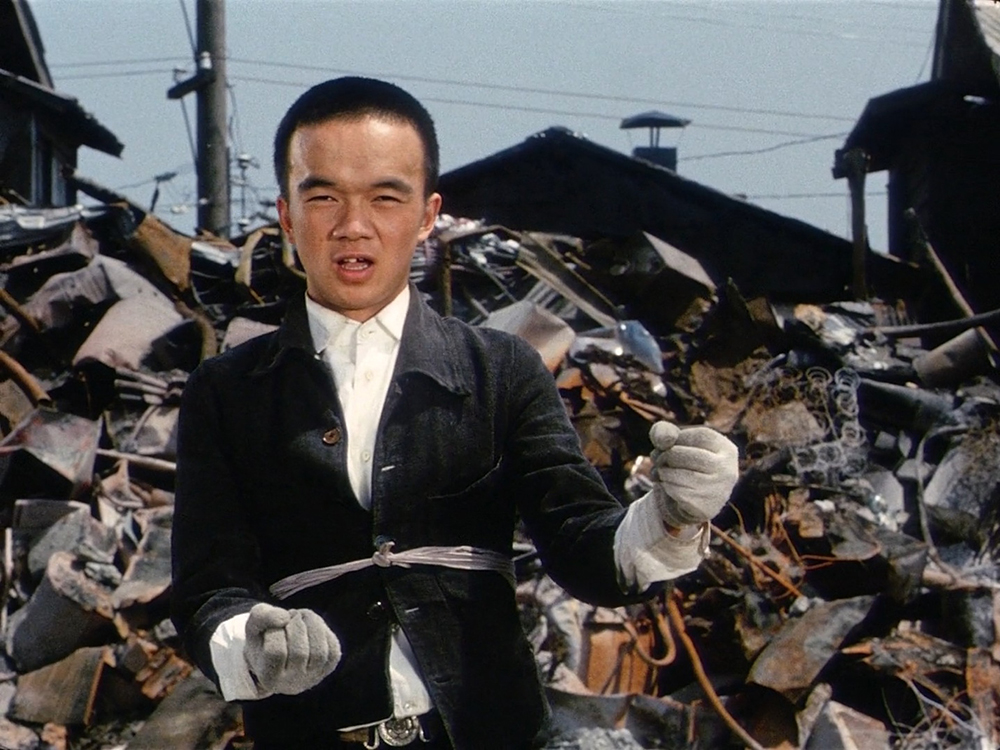
The first narrative features Rokuchan and his mother, who runs a tempura shop on the edge of the slum. The second centers on Mr. Tanba, an elderly chase work silversmith. A wise man, he is the only inhabitant of the shantytown on speaking terms with Rokuchan.1 The third highlights the drunken day laborers Masuda and Hatsuan, their long suffering wives, and their compatriot Hornet Kichi. The fourth is about Mr. Shima, a business man, courtly and cheerful, despite severe facial spasms, a bad limp, and a shrewish wife, bigger than him. The fifth revolves around Ryotaro the hair brush maker, his unfaithful and pregnant wife, and their five children, probably fathered by others. The sixth observes Katsuko, a seventeen year old girl who “gives the impression of a middle-aged woman who has lived a hard life” (Dodes 232). She lives with her aunt and dissolute uncle, supporting them by making paper flowers, her only hint of happiness the attention of Okabe, a sake-shop delivery boy her own age. The seventh examines Mr. Hei, living separate from the others, silent with unblinking “glassy eyes and mask-like face,” spiritually and emotionally dead (Dodes 25). He will be joined by his estranged wife Ocho, who seeks reconciliation. Finally, the eighth concerns an unnamed beggar and his six-year-old son. Known simply as Father and Son, they live in a derelict Citroën or under a bridge, fantasizing about the magnificent house they will one day build.
Much of the criticism of Dodes’ka-den reflects a tendency to read the movie through western eyes, coupled with a superficial understanding of Japanese cultural conventions.3 The apparent contradictions in Dodes’ka-den resolve when we realize that Kurosawa is deploying the elements of Japanese classical Noh Theater.4 Kurosawa’s explicit appeal to Noh in movies such as Men Who Tread on the Tiger’s Tail (1945) and later Throne of Blood (1957) and Ran (1985) is of course well known (Richie 115-124; McDonald 125-144). “I was attracted by the Noh,” Kurosawa explains in his autobiography, “because of the admiration I felt for its uniqueness, part of which may be that its form of expression is so far removed from that of film” (Something 147-48). Speaking of Throne of Blood in an interview with Donald Richie, Kurosawa says, “I decided upon the techniques of Noh, because in Noh style and story are one. I wanted to use the way Noh actors have of moving their bodies, the way they have of walking, and the general composition which the Noh stage provides” (Cardullo 15). The adaptation of movies such as Rashōmon, Throne of Blood, or Ran begins with traditional materials, preserving the look of the original while casting the story in largely naturalistic terms. We do not need to appreciate the subtleties of the Noh and Buddhism to enjoy Toshirō Mifune brandishing a sword. Dodes’ka-den does something different. Beginning with naturalistic stories, it casts them in terms of the narrative conventions, rhythms, and colors of Noh, at the same time preserving the appearance of naturalism. To those who perceive what Kurasawa is doing, the movie takes on a ritual and spiritual dimension. Far from rendering the movie “out of touch,” “remote,” “ideologically conservative,” or even “Cinema of Cruelty,” Kurosawa seeks the opposite, what Suh describes in her discussion of Yōjirō Takita’s 2008 Oscar winning Departures (Okuribitu) as “a deep reverence and appreciation for this very life with all its vicissitudes and as affirmation of the self with all of its karmic limitations.”5
This does not represent a retreat from the social commitments of realism; rather, Kurosawa’s “colorful fairy tale” evokes the moral world of Buddhism that saturates Noh, its ritualized exploration of trauma, and its call for compassion. He transforms the liminal world of the shantytown into the ritual space of Noh, transforming the realist narrative into Buddhist allegory (hōben, “expedient” or “skillful means,” the Buddhist practice of teaching, according to the needs and capacity of the student (see Pye; cf. Hick 119-136)). In creating this sacramental structure, Noh inscribes a human form (a fiction) onto the chaotic flow of the world, humanizing it. “[I]t is the Noh as performing art that establishes its artistic prestige and it is Noh as ritual art that establishes its religious power” (Pilgrim 54; see also Grapard).
“If you devote yourself fully to Noh and gain something good from this,” Kurosawa told an interviewer, “it will emerge naturally in your film” (193). The stories that compose Dodes’ka-den construct a Noh cycle, evoking a moral order that seeks understanding and compassion. In this essay I examine the influence of Noh in Dodes’ka-den from four aspects: how the setting recreates the structure of the Noh theatrical space; how the stories reflect the characters, subjects, and progression of a Noh cycle; how the movie deploys the characteristic jo-ha-kyū tempo of Noh; and how Kurosawa draws on the color palette of Noh for his first color film.
Noh Theatrical Space
The traditional Noh theatrical space comprises three parts. The first consists of the so called “mirror room” (kagami noma) to the left of the audience, where the actor adjusts his costume and prepares. Next the actor travels down a bridge (hashigakari) to the main stage, symbolic of the transition from the spiritual to the material world. The main stage is where the action takes place, a chorus to the right, the jiutai. Painted on the back of the stage, the mirror board (kagami-ita), is the image of an old and twisted pine tree (a reference to the Yogō Pine in Nara, signifying of both the origins of theater and the mortal juxtaposed to the eternal (Serper 17). The overall effect projects the aura of a sacred place over the main stage. In front, separating the main stage from the audience is a pebble moat (shirasu, literally “sand bar”). Thus the movie opens with Rokuchan chanting the Nichiren Buddhist Nam-Myōhō Renge Kyō with his mother in their shop on the edge of the junkyard, the walls and windows covered with trolley pictures drawn by children, in effect the “mirror room.” Donning his black motorman’s uniform, he proceeds to an empty lot amid the trash, inspecting his “subjective” trolley car, “objectively” non-existent (Dodes 11, 13). Imitating the sound of the wheels against the track, Rokuchan shuffles down the invisible tracks along a narrow path through the mountains of trash and across a drainage ditch that separates the junkyard from the modern city, the journey down the hashigakari. Arriving at the shanty town, he stops at the home of Mr. Tanba who inquires after Rokuchan’s mother, the trolley, and if he is saying his prayers. Rokuchan returns to the imaginary trolley and continues on his route. In this un-natural natural setting, we can see the elements of the Noh space, a “chorus” of women gossiping around the village faucet. All are separated from the “real” world by the drainage ditch which corresponds to the shirasu. On a hill behind the village, next to Mr. Hei’s shack, stands a barren tree, an ironic allusion to the pine tree painted on the back board, but also reminiscent of trees after the atomic blast in Hiroshima.
In Buddhist terms, we see the relationship between Being and Non-Being: “Being might be said to represent an external manifestation that can be seen with the eyes,” wrote the Noh playwright Zeami. “Non-Being can be said to represent the hidden, fundamental readiness of mind that signifies the vessel of all art [since a vessel itself is empty]. It is the fundamental Non-Being that gives rise to the outward sense of Being [in the Noh]” (Zeami 118.9). While an ancient theatrical tradition, Noh represents a living art form that dramatizes a “yearning for a complete epiphany of the Divine” (Ishii 43). Even in its abstract, aestheticized, unrealistic form it remains grounded in a realistic present. “It is ritual art,” writes Richard Pilgrim, “as long as it breaks into and through the ethos of daily life and evokes/presents a sacred world for its audience” (54). He adds, “the ritual forms can be seen as a ‘body’ of actional (bodily) orderings into which authentic participants, actor and audience alike, pour themselves, in faith, and by which participants are led into the appropriate experience”(55). The miraculous manifests not the other or the transcendent, but an engagement with the everyday.
Noh Cycle
The traditional Noh performance consisted of a cycle of five plays, prefaced on festive occasions by the Okina, and interspersed with farcical Kyōgen plays (Brown, 21-2, Komparu 33-41, Keene 21, Inoura 107-125), a theatrical experience of up to eight plays. It is not hard to map this cycle onto the eight stories of Dodes’ka-den. Looking back to Shinto, Okina signifies both the ritual dance marking the arrival of the god, and the mask of a cheerful old man, Okina: Hakushiki-jō (see Figures 2 and 3).
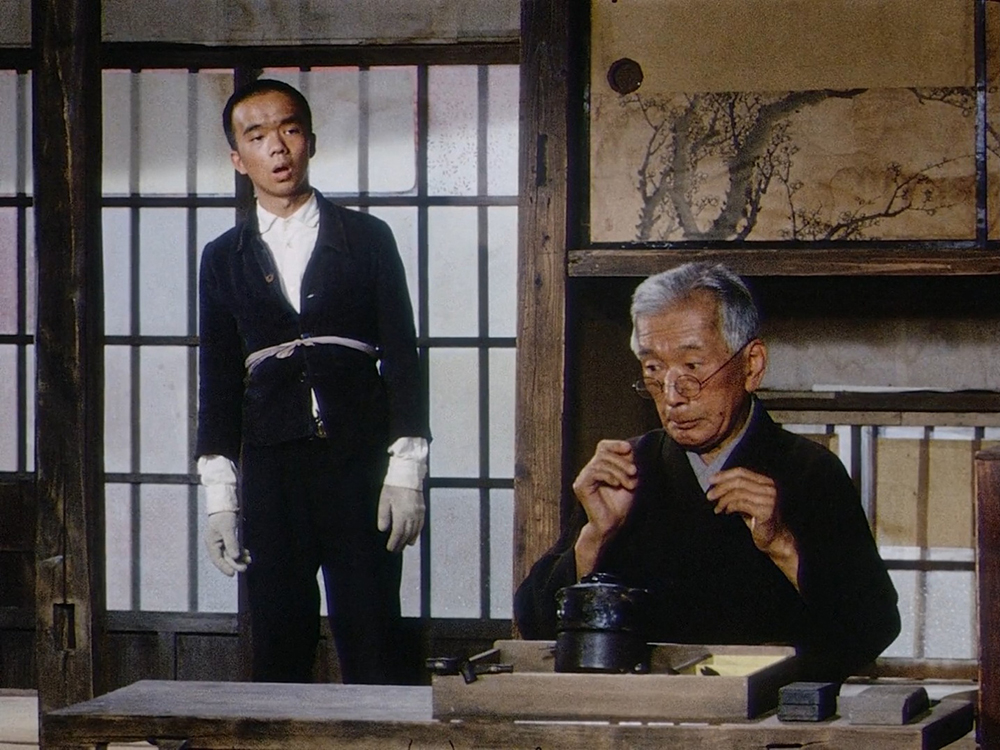
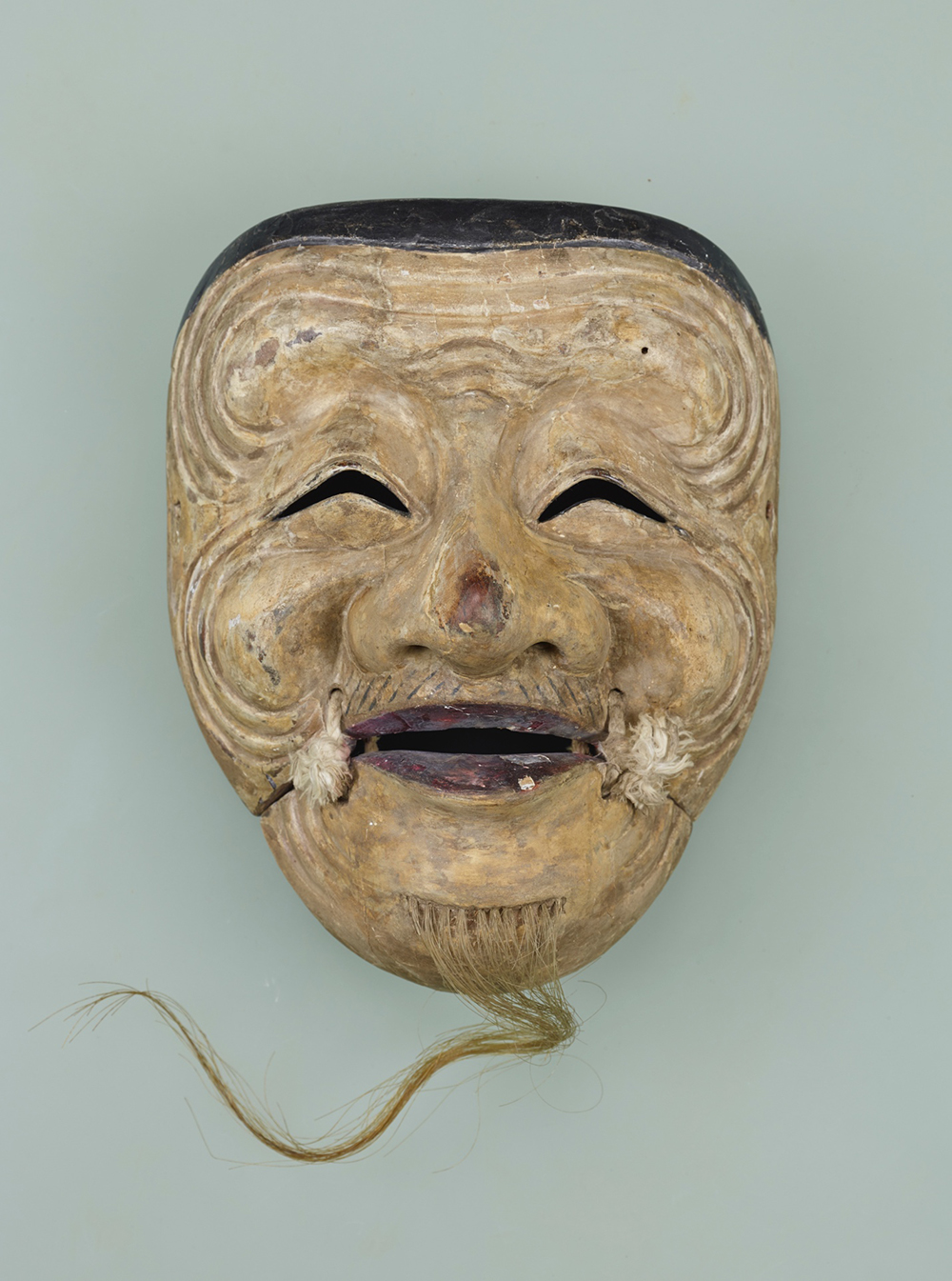
In highly stylized performance (Shikisanban ritual), a young unmasked actor emerges from the Mirror Room and travels down the bridge to the main stage, where he will don the mask of the old man (Zeami 223-25). Symbolically, the god takes on a material earthly manifestation, the sacred present within the mundane. “Okina opens with the meaningless but portentous syllables of the god’s utterance,” writes Donald Keene; “the actor, like a medium, pronounces a language he himself cannot comprehend” (Keene, Nō 13). Rokuchan’s strained chant “Do-DES’ Ka-DEN” and shuffling trolley walk suggest a parody of the Noh actor. At the same time, this treatment remains within the bounds of a realistic plausibility, becoming Kurosawa’s version of the Okina.
To digress briefly, while Rokuchan embodying a god is at first not obvious, closer examination is instructive. In the published script, Kurosawa describes him as having “a flat-crowned head and a meek face like those statues of the god Jizo that you see along the road in the country” (6). Jizo, the Japanese version of Kṣitigarbha, a principle bodhisattva in Mahayana Buddhism, had vowed not to enter Buddhahood before the salvation of those in hell. In addition, the evocation of Jizo also points to his role as guardian of children and “water babies [mizuko],” a euphemism for the victims of miscarriage, infanticide and abortion (Bays 38, 39-43). The brush maker Ryo, himself physically resembling a Jizo figure, lovingly protects, comforts, and nurtures his five children. More darkly, when Katsuko’s aunt realizes that she is pregnant, she wonders, “[w]hich will it be? Shall we let her have it, or shall we have her get rid of it” (Dodes 92). In a final scene Father is shown putting a box of Son’s ashes into a hole he has dug in a neglected cemetery. He says, “[t]he pool is finished,” then fantasizing a great white tile swimming pool surrounded by evergreen trees (Dodes 93,4). In a sad irony Son has become a literal water baby.
Broadly, the five categories and sequence of Noh include: “god plays” (kami noh); “warrior plays” (shuramono); “woman plays” (kazuramono, literally “wig plays”); “miscellaneous plays” (zatsumono), typically about madness (kyōranmono), vengeful ghosts (onryōmono), or “present plays” (gezaimono); and finally, “demon plays” (oni noh), also called “end play” (kiri noh). Interspersing these are farcical Kyōgen plays, exemplifying the Baktinian carnivalesque with their comic inversion of high and low.
The episodes featuring Mr. Tanba suggest “god plays” (kami noh). Compassionate and imperturbable, he represents a figure of wisdom, seeking harmony and peace, and like the god, not complacent to the suffering of others. When a burglar tries to rob him, Mr. Tanba directs him to his money, apologizing that he doesn’t have very much, and advising him to come through the front door next time. Later, when the police bring the captured burglar back to Mr. Tanba, he denies remembering anything about a robbery (shades of Hugo’s Bishop Myriel from Les Misérables). On a different occasion a visiting friend bemoans his loneliness since the death of his wife and children, expressing a wish to die. In an act of “skillful means” (hōben), Tanba offers him a packet of poison, which the man immediately swallows. Reflecting, the man says that he is happy when he dreams of his wife and children. “Then you must have a very happy time in your dreams every night,” says Mr. Tanba. He adds, “In other words, while you are still alive, those people are still alive too. Do you really think it’s right for you to kill yourself, and thus kill those people as well?” Acknowledging the truth of this, the panicked man begs for an antidote. Mr. Tanba explains that the packet was simply a digestive powder (Dodes 57). Later, when the town approaches Father about his sick son, Mr. Tanba is there, wallet in hand, ready to help in any way possible (Dodes 76). Finally, it is only Mr. Tanba who accompanies Father to the cemetery with the ashes of Son. Like the god, he is always present to offer comfort to those who are open to it.
In Noh, “warrior plays” typically involve the ghost of a slain samurai, seeking release from his bad karma, obsessed with vengeance and the “pathos of the hero in defeat” (Komparu 34). While Dodes’ka-den does not feature a soldier, at least so identified, the character Hornet Kichi is the most pugnacious, his nickname indicative of his personality. Early when Mr. Hei ignores him, Kichi becomes angry and shouts at him. Hei turns and stares at him with his dead glassy eyes, then continues to walk on. “Them ain’t the eyes of nobody that’s live! They give me the creeps,” Kichi tells the others present (Dodes 26). More relevant, one rainy evening, Kichi, while “crazy-drunk,” brandishes a Japanese sword, screaming, chasing people, and chopping at doors, windows, and posts. He is approached by Mr. Tanba, carrying an umbrella. After a brief exchange, Kichi drops the sword and goes quietly home to bed. Later Kichi explains that Mr. Tanba had asked him, “Shall I help you? I just thought I should take over for a while, as it seems like an awfully lot of work for one man.” Kichi adds, ‘he just took the stuffing out of me” (Dodes 54). Many Noh plays feature a literal or symbolic encounter with a ghost from the past. Though never fully explained, Kichi’s initial behavior suggests one suffering from the ghosts of PTSD, perhaps as a veteran of the Second World War or a survivor of the bombardment of Japan. His discomfiture with Mr. Hei’s eyes hints at some past traumatic experience (see Caruth, especially 25-56; c.f. Kruger). One way or the other, he is like the Noh warriors, fighting the ghosts of past combats. The scenario with a sword-wielding warrior in the rain also suggests the ghosts of Kurosawa’s earlier samurai movies, featuring Toshirō Mifune. In a sense both Kichi and Kurosawa are responding to the ghosts of past defeats.
“Woman plays” (kazuramomno) traditionally centered on the ghosts of women languishing from unrequited love or pining for the return of an absent lover. Also within this category are plays featuring the spirits of plants or inanimate objects (Brown 21; see also Shively). Both of these pertain to the downtrodden Katsuko, whose circumstances have reduced her to a virtual ghost. Her uncle (her aunt’s husband) berates her: “You don’t lead an anthropological existence. Not even a zoological existence. You’re no more than a botanical mass!” (Dodes 23). The only affection in her otherwise loveless life comes from the delivery boy Okabe, though she is too depressed to reciprocate. One night, exhausted by her flower making, she falls asleep on a veritable field of red paper flowers. The scene hints at an ironic echo of a scene in Kurosawa’s 1946 No Regrets for Our Youth, showing Setsuko Hara (of Ozu fame) innocently stretched out in a field of flowers, before the onset of reality. The idyll of the one contrasts sharply with the other, when Katsuko’s body is overshadowed by her uncle, the literal foreshadowing of her rape and subsequent pregnancy. Her response to her trauma, we learn indirectly, is not to report her uncle, but to stab Okabe with a butcher’s knife. (In the spirit of decorum characteristic of Noh, in contrast with Kabuki, such violent actions only occur off scene.) Suspected by the police, her uncle flees. Later, the recovered Okabe encounters Katsuko on the road, asking her why she had stabbed him. “I don’t know how to say it right,” she explains. “I don’t understand exactly myself. It is just when I decided that I wanted to die…the only thing that I was afraid of was that you would forget me…and when I thought you would forget me as soon as I died…I was scared” (Dodes 92).
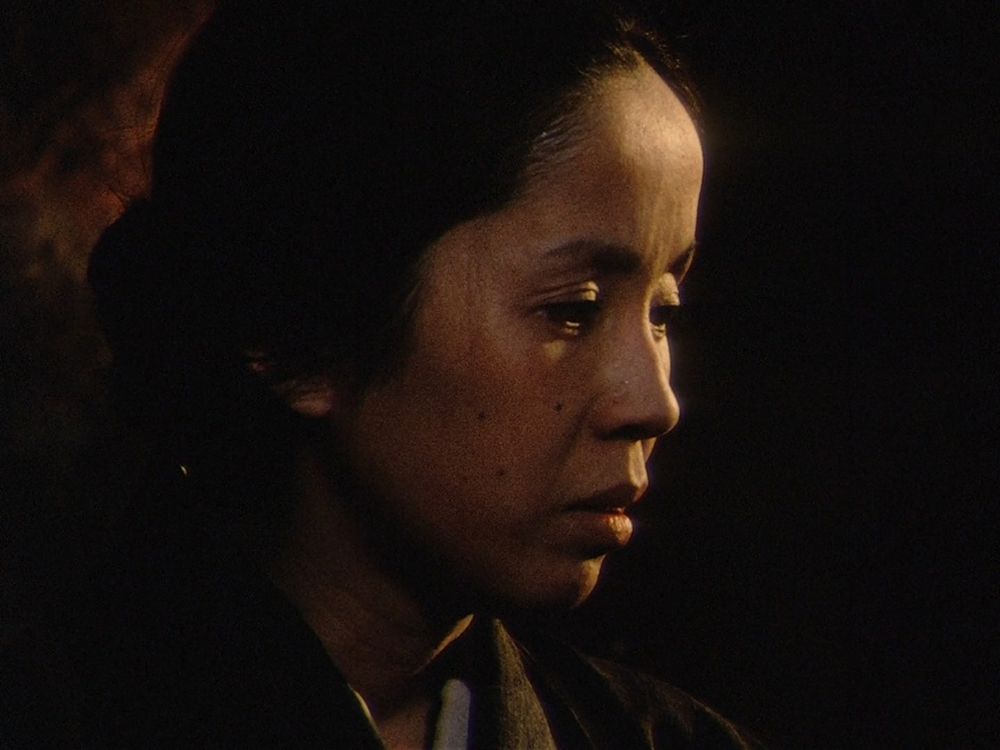
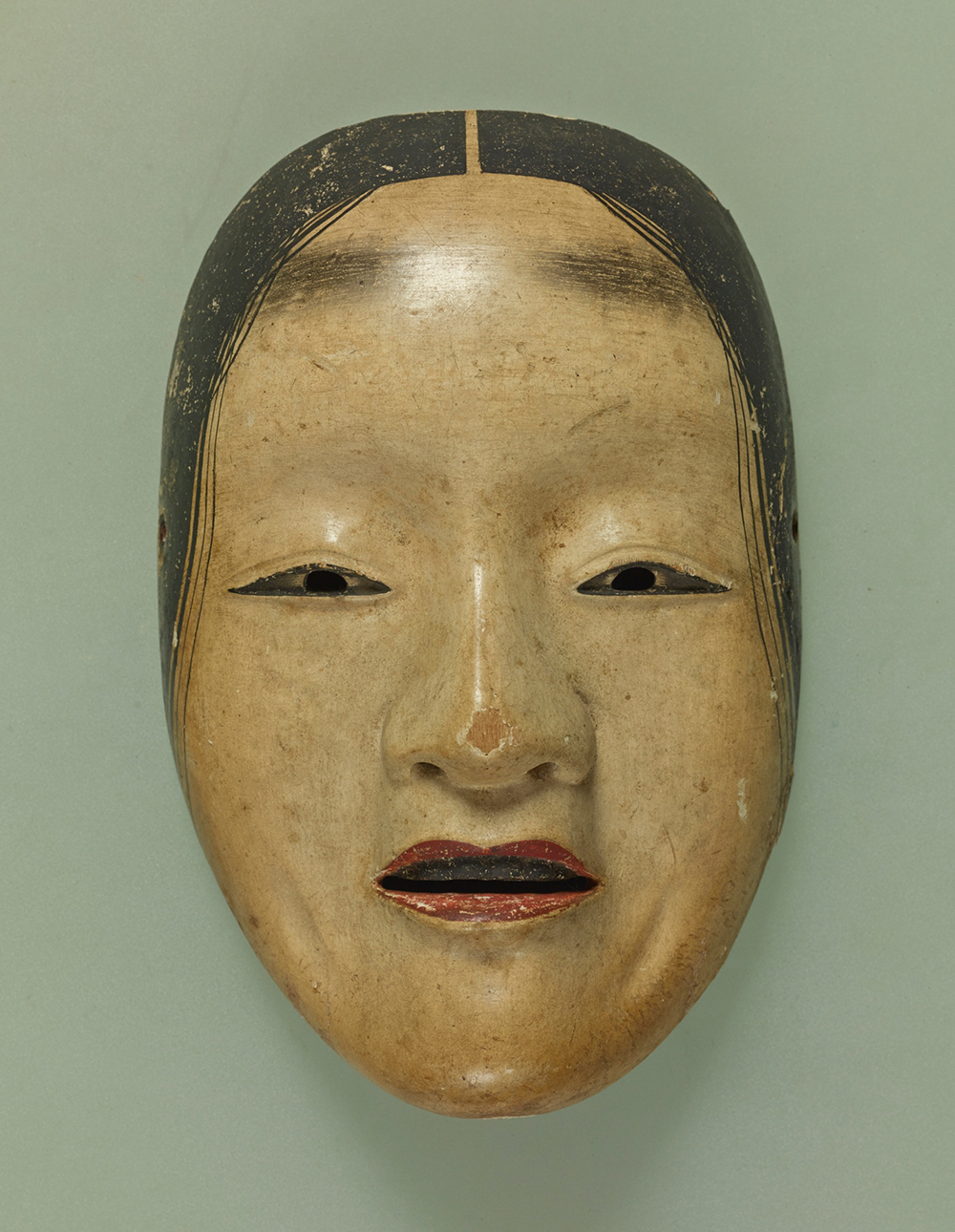
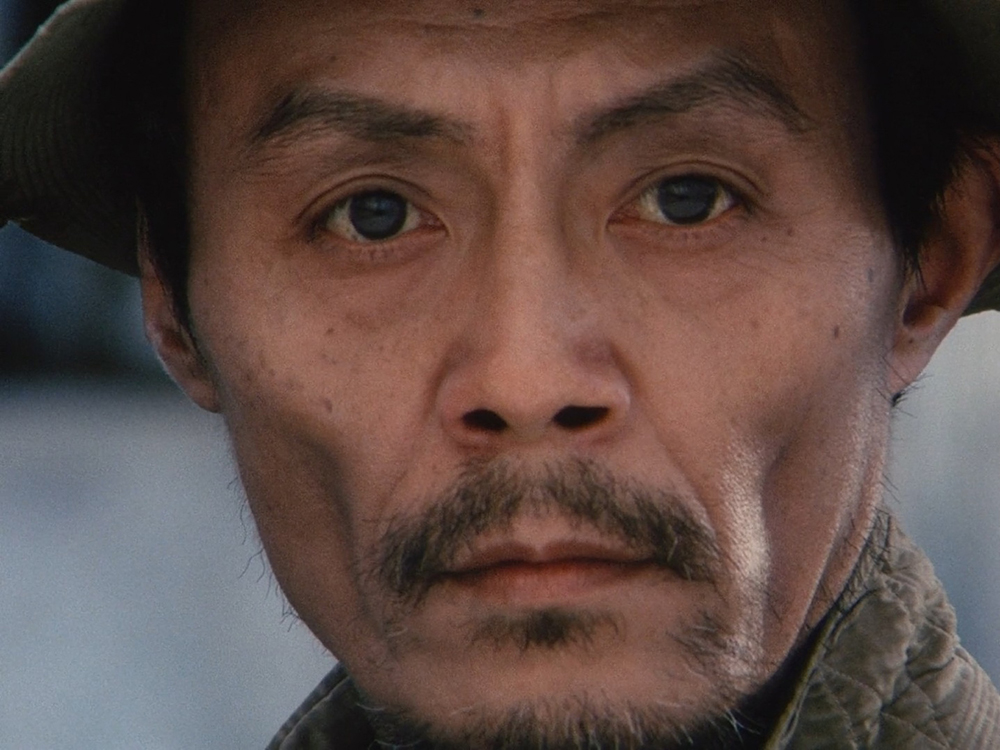
The next category of Noh play is typically about mad people (kyōranmono) or vengeful ghosts (onryōmono), the consequence of love, jealousy, or yearning (Brown 21). Clinically, while Katsuko’s profound depression leads to her violent act and Father is delusional, the story of Mr. Hei and his wife Ocho exemplify madness in their narrative. I have already mentioned Hei’s glassy, death-like stare and Hornet Kichi’s response to him. One of the town women confesses that one night she approached Hei’s shack with the intention of seducing him. She is frightened, however, when she hears him moaning in his sleep, and he suddenly sits up, saying “Ocho,” the only time he speaks in the movie (Dodes 30). Some days later a mysterious woman between the ages of forty and fifty quietly approaches Hei’s shack. Never named, over several days she tries to engage Hei, help him, and eventually beg his forgiveness. We infer that this is his wife Ocho and that she had sexually betrayed him. “Something animal-like deep inside of me just went wild, and there was nothing I could do to tame it…It was definitely not because I liked him better than you or anything like that” (Dodes 74). Throughout, Hei remains silent and emotionless, not even acknowledging her presence. In the end, she gathers her belongings and leaves the shack, her eyes beginning to take on the glassiness of Hei’s. Stopping to contemplate the tree outside the shack, she wonders what kind of tree it is, but concludes, “Once it’s dead, it doesn’t matter what kind of tree it was” (Dodes 83). It is not hard to see Hei as a vengeful ghost, driven mad by his jealousy and betrayal. In a similar fashion, his refusal to forgive Ocho torments her, beginning to drive her mad as well. It is a tragic madness that leaves both spiritually wounded, reduced to the behavior of automatons. Their fixed expressions resemble traditional Noh masks. In the reddish twilight of Hei’s shack, her sad face emerges from the gloom like the Onna: Shiro-Shakumi or the Yase-onna Noh masks (see Figures 4 and 5), the tragic face of a once beautiful dead woman (see Udaka 30, 36). Similarly, Hei’s face with the deathlike stare that disconcerts Hornet Kichi, suggests the Onryo: Kawazu or Ayakashi-otoko masks, the ghost of a dead man or the deranged and vengeful warrior reduced to beggar status (see Figures 6 and 7).
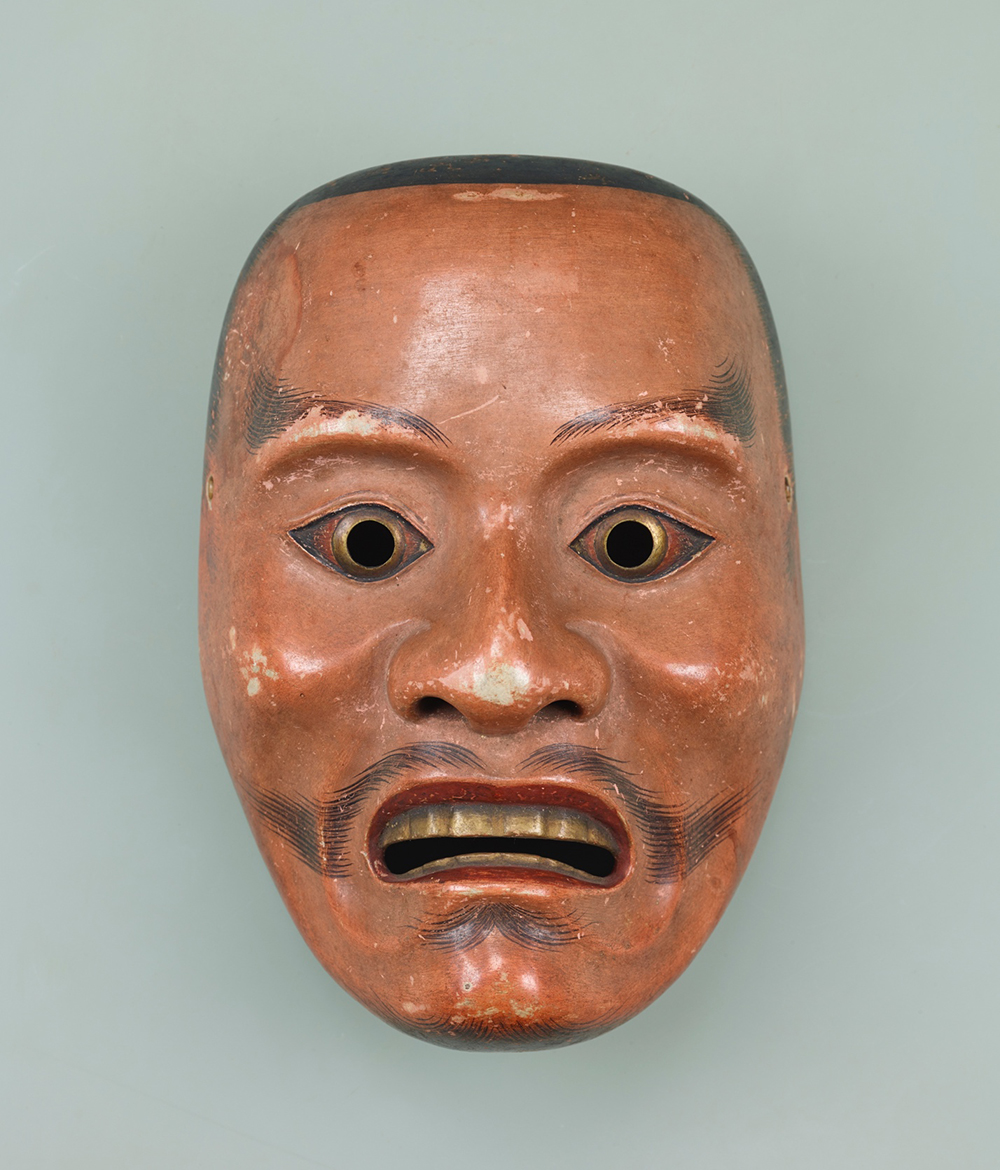
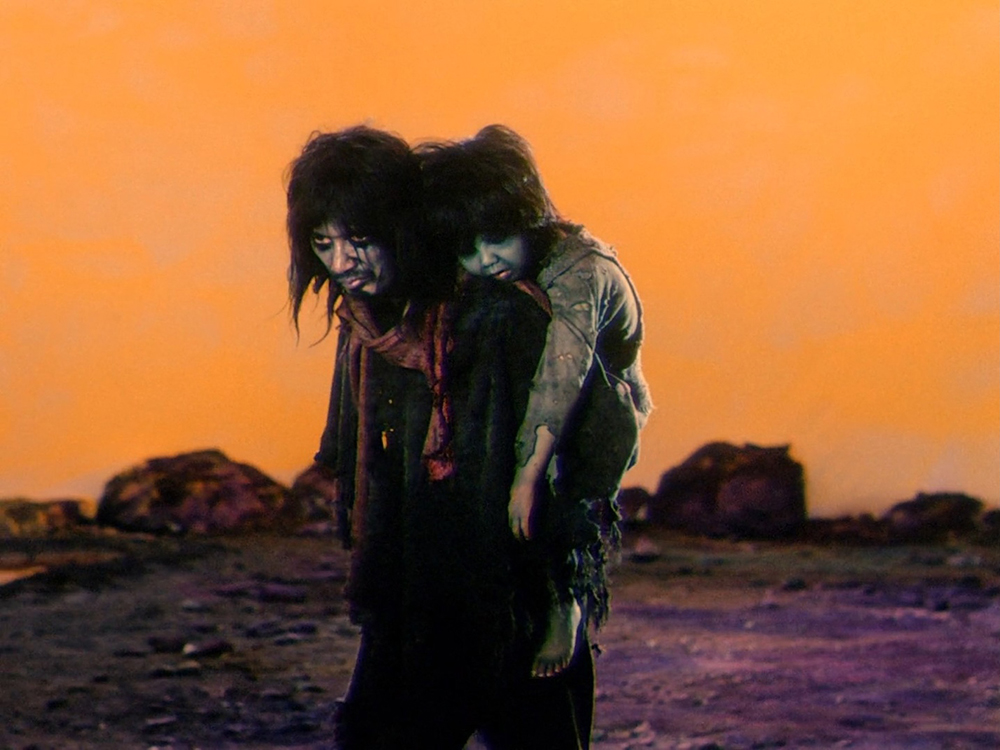
The “demon play” (Oni Noh), often the most dramatic, features a human with the heart of a demon or a demon with a human heart, the symbol or embodiment of evil or horror. The story of the Father and Son is the saddest. Anonymous, we know nothing of their background, aside from the fact that Father’s fantasy is informed by what might seem an unexpected knowledge of architecture and cultural matters. He speaks “quietly with a quiet hint of dignity” (Dodes 26). The designation of the reserved Father as a demon is not incongruent. In creating a demon, Zeami suggests the actor avoids presenting him as wild. He should give “a certain softness to his motions,” a concept he terms “Delicacy within Strength” (Zeami 144). Bays distinguishes a “hot” anger, lashing out against others, and a “cold” anger, turned inwardly (172). While not hostile in any way, Father is uncomfortable with other people, supported only by the efforts of his uncanny son who makes the rounds begging at local restaurants.9 Father sustains himself with the fantasy that they will build a great hilltop mansion, imagining it a piece at a time. While always calm, Father’s obsession possesses him to a degree that will cost the life of Son. In a sense his fantasy house is the demon that haunts and destroys him. Imagining the gate, Father observes, “[t]he gate of a house is like a man’s face. Because, you see, you look at a man’s face and you can tell what his personality is like” (Dodes 37). With long ragged hair and beard, Father’s face gives pause. When both fall sick from food poisoning, his face becomes increasingly more startling in the dim light, first greenish and subsequently a dark purple, resembling the Noh mask of a demon, such as the Kawazu-onryo mask of a spirit, evoking weakness and misery (Udaka 116). Haunted by his figurative demons, he has unintentionally causes the death of his son (see Figures 8 and 9). As with the cases of Kichi and Katsuko, the story of Father and Son also suggests an ironic allusion to earlier Kurosawa, specifically High and Low (1963), a crime thriller starring Mifune as an industrialist manufacturer who must sell his dream mansion on a hill overlooking a slum in order to ransom the kidnapped son of his chauffeur, his car a Citroën (c.f. Richie 259).
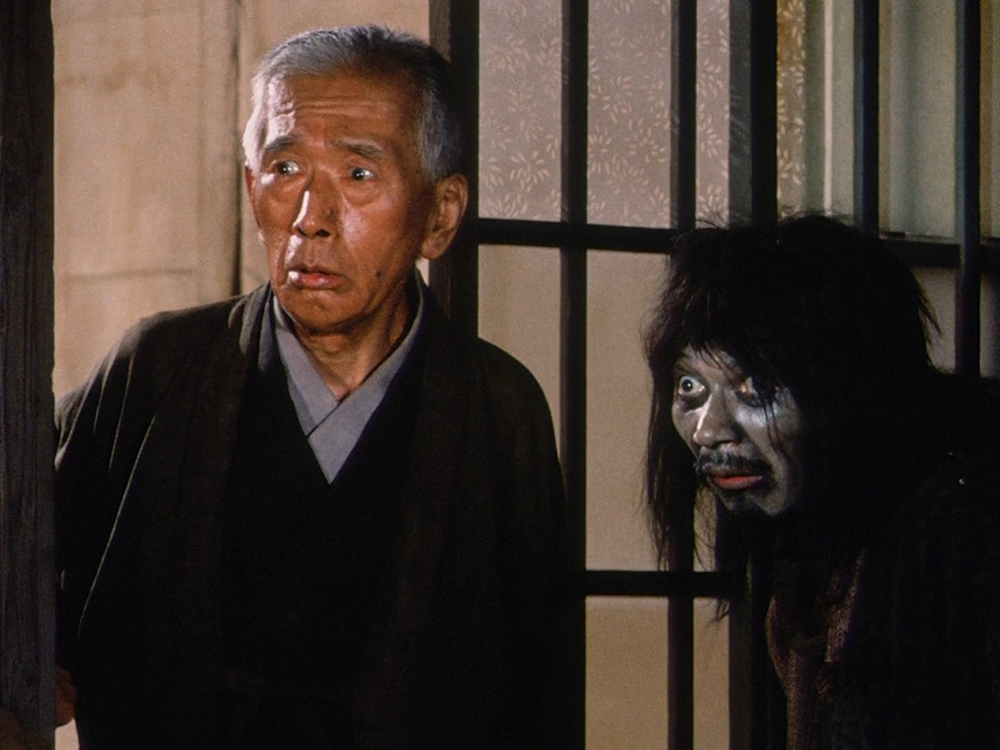
Interspersing and balancing these accounts of sad, desperate, and haunted people are the farcical Kyōgen. I will not go into detail other than to say that the stories of Ryo and his children, Masuda, Hatsuan and their wives, and Mr. Shima and his wife offer near universal comic motifs: the large shrewish wife and the small meek husband, or the drunken workers, who decide to swap wives, but in their inebriation are uncertain where to go. Ryo may be the cuckolded husband, but he remains loving and cheerful, diligently counting each bristle in the hair brushes he makes. Mr. Shima, with his grotesque ticks and imposing wife, wrestles a coworker to the floor who dares criticize her rudeness. Masuda and Hatsuan remain supportive husbands even in their drunken buffoonery.
Tempo
The influence of the Noh can be found in the structure and tempo of Dodes’ka-den. The structure of a good screenplay, Kurosawa writes, is like that of a symphony, possessing three or four movements with different tempos. Alternatively, he suggests the three-part structure of the Noh play: “jo (introduction), ha (destruction) and kyū (haste)” (Something 193). Originally related to the dance tempi, the jo-ha-kyū progression of introduction-development-climax became a central aesthetic principle in Noh, informing the program and sequence of plays, the development within each play, and even vocalization and choreography (Zeami 83-87, 137-140). Jo designates a slow, stately introduction or exposition. God plays were designated jo. The warrior, woman and madman plays were classed as ha because of their quickening development, complications or denouement Finally, kyū involves rapid motion related to climax or resolution, and thus was applied to demon plays (Keene 21, Zeami 20n9). This external rhythm corresponds to the psychological progression in the audience of anticipation-delight-fascination and the natural progression of birth-development-rapid extinction (Thornhill 73). From a Buddhist perspective the jo-ha-kyū within Noh points to the identity of the natural world and our perception of it (Thornhill 75). The goal is to achieve a sense of fulfillment in the audience and to achieve “melancholy elegance” (Zeami 138).
Mitsuhiro Yoshimoto suggests that Dodes’ka-den falls into three main parts and a coda (336). In this we see the overarching jo-ha-kyū progression. I would argue that the coda is part of the kyū. Thus scenes 1-14 (pp. 6-28) correspond to the jo, introducing the various characters, culminating when Father proposes to plan a dream house: “…we must consider the future and design a house with you and your children and your grandchildren in mind” (28). Scenes 15-47 (pp. 28-50) correspond to the ha, developing the plots and introducing complications. Thus Mr. Hei’s wife Ocho arrives; Masuda and Hatsuan’s plan to exchange wives is set in motion; Father begins fantasizing the details of their dream house, settling on its gate; and the burglar robs Mr. Tanba. Next, scenes 48-90 (pp. 50-91), relate to the kyū , resulting in the climax and resolution of the various stories: Mr Tanba deals with Hornet Kichi, the suicidal friend, and the police and burglar; Masuda’s and Hatsuan’s plan collapses; Katsuko’s rape, pregnancy, attempted murder of Okabe, and the absconding of her uncle occur; Mr. Shima defends his wife, wrestling one of his guest to the floor; Ryo’s defends his children; Ocho confesses to Hei and expresses final despair; and Father and Son’s house takes shape, followed by their food poisoning and the death of Son. Finally, what might be interpreted as a coda scenes 91-95 (pp. 91-94), can be read as part of the kyū, a final resolution that closes circles, a sort of return to normal: the chorus notes that Masuda and Hatsuan are coming out of their own homes; Katsuko tries to explain her actions to Okabe; Father buries Son; Mr. Shima returns home from work; and Rokuchan returns home to his mother.
These parts are framed by Rokuchan’s recurrent appearances, marking a sort of gate or preface to each: The first (jo) of course is introductory, when Rokuchan leaves home on his route, visiting Mr. Tanba,in scenes 1-7 (pp. 6-17). In the second (ha), he is motoring along, in scenes 15 and 16 (p. 28), in front of a series of suns, night skies, and passing under a rainbow in the rain, signifying the passage of many days and the persistence of the same, the rainbow a sort of gate, like the multi-colored curtain on the mirror room. He next appears in the rain, an open umbrella strapped to his back, in scene 48 (p. 50), suggesting the approach of stormy weather and our entry into the kyū. The final encounter with Rokuchan shows him at night, a lamp strapped to his stomach, returning to the imaginary trolley garage and his home, in scenes 96-98 (pp. 95-98). In addition, the encounter with the painter in scene 43 (p. 44) can be read as part of the ha, Rokuchan interacting within the action.
Color
As I have already mentioned, Dodes’ka-den represents Kurosawa’s first venture into color, and many allude to his bright palette. Here, he draws heavily on his background as a painter, color-coordinating the scenes and the backgrounds, and even painting the ground. The effect is to highlight the atmosphere and to abstract and heighten the symbolic intensity of the scene (Yoshimoto 341, Kurosawa, Autobiography 88; see also Holden-Moses). While the motif of a red sun is a veritable cliché in Japanese art, Kurosawa’s suns range from the subdued hazy suns of Monet to the bright dramatic suns of van Gogh, as well as to the nightmarish red, orange, and yellow streaked skies in Edvard Munch (see Figure 10).
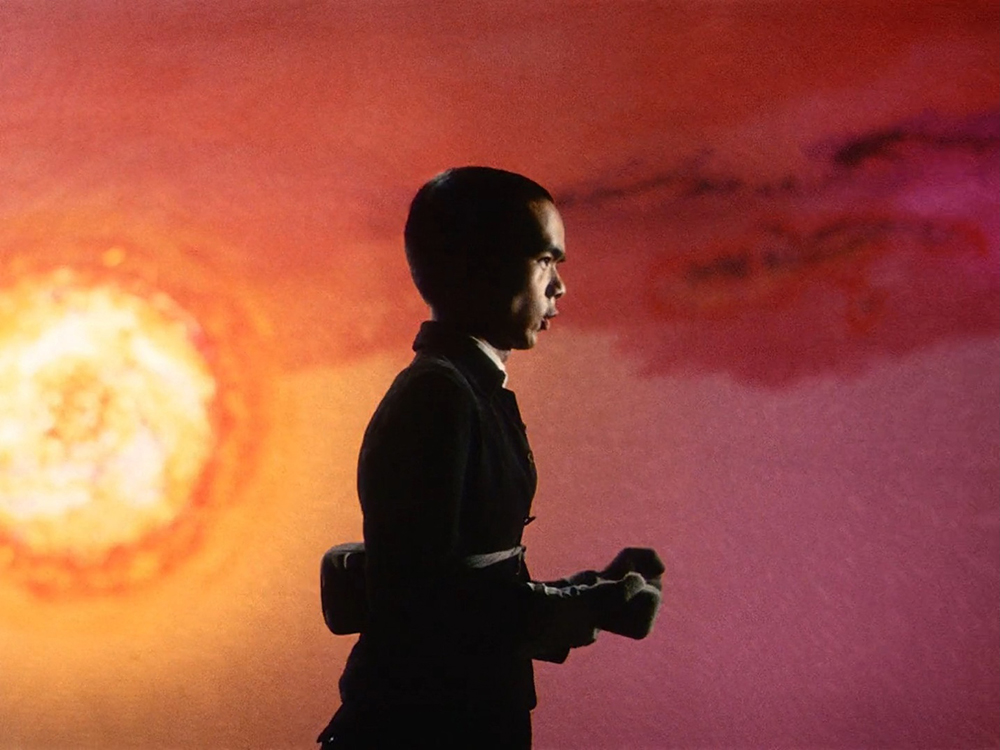
Raúl Álvarez Gómez briefly alludes to the use of color in Dodes’ka-den, finding a mellowed continuation of the sensibility with baroque painting from the earlier black and white films, the effect creating a formal tension (127). Similarly, Mitsuhiro Yoshimoto sees in Kurosawa’s use of color a defamiliarization of the relationship between image and referent. The effect is to create an overwhelming sense of presence that collapses the temporal difference between past and present (342). What Yoshimoto describes is akin to the Buddhist apprehension of “suchness” (tathātā or nyoze), or the “as-it-is-ness.” In other words, the use of color both evokes and draws attention to its illusory nature, eliciting a dynamic and non-dualist relationship between observers and observed (Stone 195, Okumura 95-97). It is an effect resonant with Buddhist cosmology and Noh aesthetics: “It is religious ritual art to the degree that it genuinely embodies a living mythos and evokes religious experience,” writes Richard Pilgrim (54).
Kurosawa’s use of color is most evident in the jo-ha-kyū progression which has corresponding color designations. Thus the jo is represented by white, signifying transparency or no color; ha by bright primary colors: red, yellow, and blue; and kyū, mixed colors: black, purple, and green (Komparu 133). In Noh performances, these might relate to costumes or projections onto the curtain or the placement of performers on the stage. The god plays obviously favor white. The warrior, woman, and madman plays highlight red, yellow, and blue, commensurate with their dignity and nobility. The demon plays deploy mixed somber shades of black, purple or green. While both Rokuchan and Mr. Tanba are dressed in black, as is Mr. Shima, it is over a white shirt, giving a white edge around the black. In Noh costuming a white under-kimono signifies a character of high dignity (Keene, Nō 66), a designation appropriate to their characters. Masuda and Hatsuan as well as Hornet Kichi exemplify the high spirited warrior type, the first dressed in yellow vest and head band, the second in bright blue jacket over red pants. Their wives are similarly attired, as are the doors and walls of their shacks. This contributes to the joke when they exchange wives but cannot keep the colors straight. As we move down the types of play, the primary colors start to become more drab or mixed. Katsuko wears a faded checked yellow skirt and violet sweeter, underlying her relation to the ha of the woman play, but at the same time her ambiguous and down-trodden condition. In turn, as I mentioned, she falls asleep on bed of bright red artificial flowers, part of this progression. Mr. Hei is dressed in dark colors, suggesting his shift to the insane or even demonic, though there is a rust-red light in the interior of his shack. Ocho arrives with a gray coat over a dark blue kimono and dark red obi with a white under-kimono. The color combinations point to the complexity of her character, a mixture of ha and kyū. Father and Son are dressed in black rags with no white under-layer, though Father does wear a faded dark red scarf around his neck.
A color progression also corresponds to transitions of state of mind across the narrative. When we first encounter Hornet Kichi, he is dressed in a bright blue jacket over a bright red sash, carrying a red plastic wash basin. Later, when brandishing a sword “crazy drunk,” he is wearing dark clothes and a black neck cloth. The shift in colors underlines his shift in state of mind from warrior to demon, from ha to kyū. The jo-ha-kyū color progression also charts the mental decline in the Father-Son story from something divine, to tepidly heroic, to the demonic. The most dramatic shift from ha to kyū is signified by the lurid shades of green and purples when Father and Son are suffering from food poisoning. Relevantly, Donald Richie notes that the images of Father’s fantasy house shift from white to pink, and then soft purple, though he does not make a connection with Noh (194).
Conclusions
In an interview, Kurosawa observed that just as Noh elements borrowed by Kabuki must become Kabuki, so borrowed elements from Noh and Kabuki in film must become pure cinema (quoted Serper 24). In the end this also applies to Dodes’ka-den. It is a work of pure cinema; nevertheless, as Kurosawa said, “If you devote yourself fully to Noh and gain something good from this … it will emerge naturally in your films” (Something 193). In this way, the structure, rhythm, and color of the Noh transform these naturalistic stories of poverty, sadness, and desperation into a sacred space that transforms the modern world into spiritual theater. Keiko McDonald’s comments on the use of Noh in Kurosawa’s Ran are relevant, finding in its conclusion, “a mood of calm detachment, of religious and philosophical awakening to the mutability of human existence (mujo) – and to the need for stoic acceptance of fate, even as man strives for enlightenment in a cruelly inhuman world” (144). Rokuchan’s obsessive circumnavigation of this space allows Kurosawa, far from being remote, to direct our gaze on the inhabitants in a way that grants them individuality and dignity, the evocation of a Buddhist “suchness” that would be lost in a conventional social realist treatment. His characters may not necessarily be complex or multidimensional, as some critics have complained; nevertheless, they are vividly drawn and memorable. They are more than social abstractions or statistics, sad blurs briefly glimpsed from a fast passing bullet train. They are whole people with stories, with color, observed from the human pace of a clattering trolley. Rokuchan’s eccentric trek and invisible trolley puts those forgotten or unseen of the margin into the center of a ritual space. It may signify a tale told by an idiot, but it is a sound and fury signifying everything. .
Endnotes
1 Aside from his mother and Mr. Tanba, the only other person Rokuchan speaks to is a painter who has inadvertently set up his easel on the imaginary tracks. It might be compared to the fictional encounter between a young Kurosawa and van Gogh (played by Martin Scorsese), in Dreams (1990). “I drive myself like a locomotive” the artist quips (222)—as opposed to a mere trolley.
2 For consistency, I have used the transliteration Noh throughout. Mitsuhiro Yoshimoto notes that there are problems with the scene count in the published script (427n5). I therefore cite the script (Kurosawa, Dodes’Ka-den, 1971) by page number, parenthetically as (Dodes). I also follow its transliteration of the Japanese names.
3 Le Quoc Hieu offers a valuable discussion of the problem of translation, adaptation, and context.
4 The essential draft of this paper was completed before the author encountered Ronald S. Green’s valuable article on Noh in Kurosawa’s Ikiru. Green shows that Kurosawa subtly deploys elements of Noh in the naturalistic story of a man coming to grips with his terminal illness to evoke the moral ethos of Pureland and Zen Buddhism. I argue that Dodes’ka-den stages an entire Noh cycle in a naturalistic frame. We both believe that an appreciation of Noh enhances our appreciation of Kurosawa’s ostensibly realistic films.
5 Suh, 120. While writing from a Christian context, theologian Sallie McFague’s distinction between an objectifying, “arrogant eye” and a “loving eye,” non-sentimental, but attentive to the particularity of the other that reverences its reality, is cogent (30-36); see also Elizabeth A. Johnson, 44.
6 The Okina: Hakushiki-jō Noh mask image is used from Wikimedia Commons and is public domain.
7 The Shakumi-onna Noh mask image is used from Wikimedia Commons and is public domain.
8 The Ayakashi-otoko Noh mask image is used from Wikimedia Commons and is public domain.
9 Son embodies the figure of the uncanny or ghost child, most famously exemplified in Natsume Sōseki’s Ten Nights’ Dreaming, a work admired by Kurosawa, in which a haunted man carries a blind child on his back, who taunts him as a murderer (13-16). Susan Napier sees in the recurrent figure of the uncanny child in modern Japanese culture as symbolic of alienation (113-116), while Jessica Balanzategui, looking at J-horror, sees an expression of anxiety (155-184).
Works Cited
Balanzategui, Jessica. The Uncanny Child in Transnational Cinema: Ghosts of Futurity at the Turn of the Twenty-first Century. Amsterdam UP, 2018.
Bays, Jan Chozen. Jizo Bodhisattva: Guardian of Children, Travelers, and Other Voyagers. Shambhala, 2003.
Bock, Audie. “The Moralistic Cinema of Kurosawa.” Kurosawa: Perceptions on Life; An Anthology of Essays. Ed. Kevin K.W. Chang. Honolulu Academy of Arts, 1991, pp. 16-23.
Brandon, James R., editor. No and Kyōgen in the Contemporary World. U of Hawai’i P, 1997.
Brown, Steven T. Theatricalities of Power: The Cultural Politics of Noh. Stanford UP, 2001.
Burch, Noël. To the Distant Observer: Form and Meaning in the Japanese Cinema. London: Scholar P, 1979.
Cardullo, Bert, editor. Akira Kurosawa: Interviews. U P of Mississippi, 2008.
Caruth, Cathy. Unclaimed Experience: Trauma, Narrative, and History. Johns Hopkins UP, 1996.
Frédéric, Louis. Buddhism: Flammarion Iconographic Guides. Paris: Flammarion, 1995.
Gómez, Raúl Álvarez. “Claves de la Pintura Barroca en el cine en Blanco y Negro de Akira Kurosawa.” Revista Cientifica de Cine y Fotocinema, no. 16, 2018, pp. 127-151.
Goodwin, James. Akira Kurosawa and Intertextual Cinema. Johns Hopkins UP, 1994.
Grapard, Allan G. “Flying Mountains and Walkers of Emptiness: Toward a Definition of Sacred Space in Japanese Religions.” History of Religions, vol. 21, no. 3, 1982, pp. 195-221.
Green, Ronald S. “Zeami’s Buddhism and Noh in Kurosawa’s Ikiru.” Journal of Religion & Film, vol. 28, no. 2, 2024, article 4, pp. 1-43.
Hick, John. Disputed Questions in Theology and the Philosophy of Religion. Yale UP, 1993.
Hieu, Le Quoc. “East-West Rewriting and Recontextualization: Approaching Rashōmon (Akira Kurosawa) and its Afterlives from Adaptation Theory.” Asian Cinema, vol. 33, no. 1, 2022, pp. 55-79.
Holden-Moses, Philip. “Kurosawa’s Palette: Abstraction, Art and Mnemonics in Dodes-Ka-Den.” Bulletin of Foreign Languages 16 (1995): 61-68.
Inoura, Yoshinobu and Toshio Kawatake. The Traditional Theater of Japan. New York: Weatherhill, 1981.
Ishii, Mikiko. “The Noh Theater: Mirror, Mask, and Madness.” Comparative Drama, vol. 28, no. 1, 1994, pp. 43-66.
Johnson, Elizabeth A. Ask the Beasts: Darwin and the God of Love. Bloomsbury, 2014.
Kinder, Marsha. “Throne of Blood: A Morality Dance.” Literature/Film Quarterly, vol. 5, no. 4, 1977,pp. 338-345.
Komparu, Kunio. The Noh Theater: Principles and Perspectives. New York: Weatherhill/Tankosha, 1983.
Kruger, Marie. “Trauma and the Visual Arts.” Trauma and Literature, edited by J. Roger Kurtz, Cambridge UP, 2018, pp. 255-269.
Kurosawa, Akira. Dodes’ka-den. The Complete Works of Akira Kurosawa.Vol. 1, Tokyo: Kinema Jumpo, 1971.
_____, dir. Dodes’ka-den. 1970. Criterion Collection, 2009. DVD.
_____. Something Like an Autobiography. Translated by Audie E. Bock, Vintage-Random House, 1983.
LaFleur, William R. The Karma of Words: Buddhism and the Literary Arts in Medieval Japan. U of California P, 1983.
Looser, Thomas D. Visioning Eternity: Aesthetics, Politics, and History in the Early Modern Noh Theater. Cornell UP, 2008.
McDonald, Keiko I. Japanese Classical Theater in Films. Cranbury, NJ: Associated UP, 1994.
McFague, Sallie. Super, Natural Christians: How We Should Love Nature. Minneapolis: Fortress P, 1997.
Miller, Arthur. Collected Plays: 1944-1961. Library of America, 2006.
Napier, Susan J. The Fantastic in Modern Japanese Literature: The Subversion of Modernity. Routledge, 1996.
Pilgrim, Richard B. “The Japanese Noh Drama in Ritual Perspective.” The Eastern Buddhist, vol. 22, no. 1, 1989, pp. 54-70.
Prince, Stephen. The Warrior’s Camera: The Cinema of Akira Kurosawa. Revised and expanded, Princeton UP, 1999.
Pye, Michael. Skillful Means: A Concept in Mahayana Buddhism. 2nd ed., Routledge, 2003.
Richie, Donald. The Films of Akira Kurosawa. 3rd ed., U of California P, 1996.
Serper, Zvika. “The Bloodied Sacred Pine Tree: A Dialectical Depiction of Death in Kurosawa’s Throne of Blood and Ran.” Journal of Film and Video, vol. 52, no. 2, 2000, pp. 13-27.
Shively, Donald H. “Buddhahood for the Nonsentient: A Theme in Nō Plays.” Harvard Journal of Asiatic Studies, vol. 20, no. 1/2, 1957, pp. 135-161.
Shizuteru, Ueda. “The Place of Man in the Noh Play.” The Eastern Buddhist, vol. 25, no. 2, 1992, pp. 59-88.
Sōseki, Natsume. Ten Nights Dreaming and The Cat’s Grave. Translated by Matt Treyvaud, Dover Publications, 2015.
Strang, Brent. “Beyond Genre and Logos: A Cinema of Cruelty in Dodes’ka-den and Titus.” Cinephile, vol. 4, no. 1, 2008, pp. 29-35.
Stone, Jacqueline I. Original Enlightenment and the Transformation of Medieval Japanese Buddhism. U of Hawai’i P, 1999.
Strick, Philip. “Dodeskaden.” Perspectives on Akira Kurosawa, edited by James Goodwin, New York: G.K. Macmillan, 1994, pp. 18586.
Suh, Sharon A. Silver Screen Buddha: Buddhism in Asian and Western Film. Bloomsbury, 2015.
Thornhill, Arthur H. Six Circles, One Dewdrop: The Religio-Aesthetic World of Komparu Zenchiku. Princeton: Princeton UP, 1993.
Tyler, Royall. “Buddhism in Noh.” Japanese Journal of Religious Studies, vol. 14, no. 1, 1987, pp. 19-52.
Yoshimoto, Mitsuhiro. Kurosawa: Film Studies and Japanese Cinema. Duke UP, 2000.
Zeami, Motokiyo. On the Art of the Nō Drama: The Major Treatises of Zeami. Translated by J. Thomas Rimer and Yamazaki Masakazu, , Princeton UP, 1984.