VOL. 54, NO. 3
Adapting the Academy: The Communal Turn in Adaptation Studies
Gracie Bain, Kristen Figgins, James Fleury, Julie Grossman, Kathryn J. McClain, Seda Öz, and Rebecca E. Raddatz (Adaptation Today)
Introduction
If you’ve ever had the pleasure of attending an adaptation-focused event, whether hosted by the Association of Adaptation Studies, the Literature/Film Association, or a slate of panels at any regional or national conference, you’ve no doubt experienced the warmth, collegiality, and hospitality of adaptation studies. For the founders of Adaptation Today, the community of adaptation was so vital and necessary that we felt a call to share the experience: for those who were not able to attend in-person conferences, for those who were just beginning to become interested in adaptation, and for those who needed connection between those in-person events.
At first, in November 2023, Adaptation Today was just a listserv moderated by Kristen Figgins. Today, it has expanded to include a slew of pedagogical resources, solicited and peer-reviewed by James Fleury and Kathryn McClain; mentoring resources, coordinated by Julie Grossman and Seda Öz; and a podcast, produced and edited by Gracie Bain and Rebecca Raddatz. In 2025, we also welcomed a social media editor, Cat Champney.
This article is far more than a simple account of our goings-on; it is also a formal call for a communal turn in adaptation studies. While Adaptation Today is certainly a product that has been enjoyed by a particular community, what we have learned over the past three years is that Adaptation Today is most fruitful when conceptualized as a digital meeting space. More specifically, we see it as an active, ongoing site of construction, where a community is built one podcast episode or mentoring workshop or lesson plan or listserv email at a time. What follows is a discussion not only of what Adaptation Today has accomplished, but also of how the ethos behind this project reflects a broader need for the articulation of academia’s hidden curriculum: the relational and professional practices that are often not given voice but are tacitly necessary for a discipline’s survival. Therefore, we hope as you read, you will be inspired not only to enjoy the content that our editors and contributors have lovingly crafted for you, but also to become a participant in this communal call to action.
Mentoring
When the Adaptation Today “Mentorship Program” was launched in 2024 by Julie Grossman and Seda Öz, the editors’ main concern was to respond to a structural problem in the field. Scholars in our field know that adaptation studies is intellectually robust, yet the know-how that affects entry into the field remains vague and unevenly distributed. Significant skills, such as positioning oneself as an adaptation scholar, entering ongoing conversations, finding collaborators, and imagining a sustainable scholarly life, are learned through proximity rather than formal training. Of course, there are specific initiatives in the humanities, such as the MLA’s Connected Academics project , funded by the Mellon Foundation and including Georgetown University, Arizona State University, and the Humanities Research Institute of the University of California (Ortiz). The Society for Cinema and Media Studies (SCMS) offers a vibrant mentorship program, including one-on-one (virtual and in-person) meetings among graduate students and early-career and established scholars. While our mentoring program aligns with these recent efforts in the public humanities, which treat mentoring and collaborative project-building as means to make scholarly worlds more accessible to early-career learners, it distinguishes itself through its focus on adaptation and audience reach, regardless of affiliation or location. Another distinctive feature of Adaptation Today is its operating model, which has extremely limited funding, bringing its own challenges, details of which will be discussed shortly.
From the beginning, this meant rethinking mentorship not as a one-way transfer of expertise, but as a communal practice that relies on volunteering. It is well known that “[a] strategy for developing a successful mentoring program is creating a community of practice among faculty members to provide support, create dialogue, exchange best practices, and hopefully, create a process of collective learning in a community of practice” (Lari and Barton 1). Designed with these principles in mind, our first workshop, “Building Professional Pathways in Adaptation Studies,” addressed pragmatic questions such as how to frame one’s profile as an adaptation scholar, navigate journals, and prepare for pre-completion book contracts. Moreover, it asked participants to analyze the field’s own infrastructures by watching senior scholars and editors, such as Thomas Leitch, Julie Grossman, R. Barton Palmer, and Lina Aboujieb, as they shared their accounts of how those structures came into being.
As the program developed, we broadened its scope. The second workshop, “Adaptation Studies Today: Theories, Methods, and New Directions,” treated adaptation as a critical and creative public practice. We heard from Kim Waale, an installation artist who thinks through adaptation in terms of material and visual practices; Liam Burke on “everyday” popular-culture adaptations; and Gracie Bain on podcasting as public scholarship. The workshop imagined adaptation studies within a broader public humanities ecology that includes classrooms, studios, domestic spaces, and digital platforms. The following event, “Musical Adaptation in Practice: Film, Theater, and the Creative Process” (see Figure 1), extended this thread by bringing in practitioners whose work is not necessarily cataloged under Adaptation Studies, but who still practice adaptation as a process of interpretation and collaborative world-building. In dialogue with digital humanities pedagogy more broadly, and with our own pedagogy team in Adaptation Today, which emphasizes experimental, project-based work and cross-media skill-building, these sessions served as laboratories for their participants.
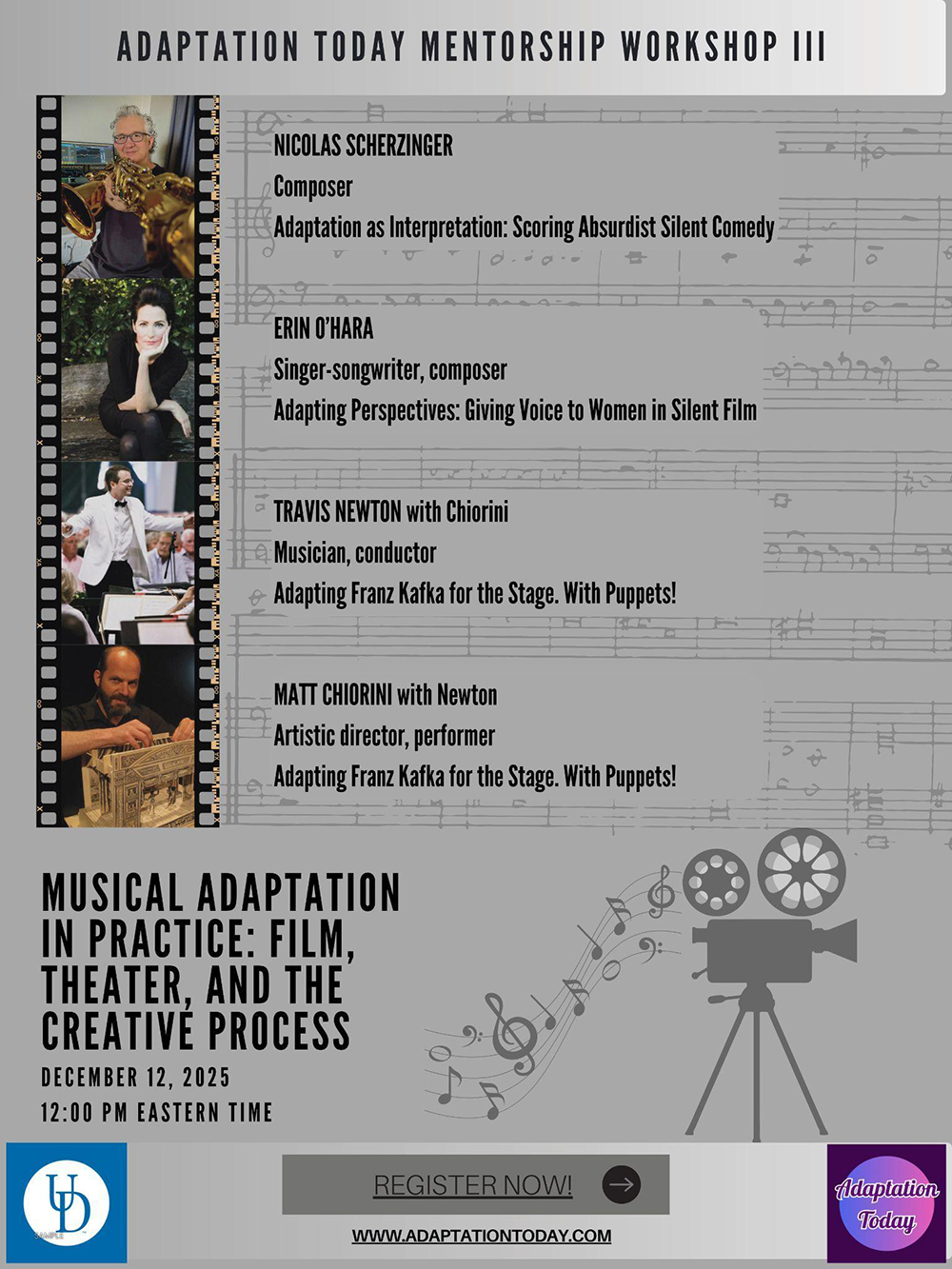
One of the outcomes of this pedagogical reorientation is “Pitch Your Colleague,” an initiative that emerged directly from participant feedback requesting opportunities to work together and develop ideas and projects. Inspired by “pitch-a-friend” events, the series asks scholars to introduce a colleague to the adaptation community, foreground each other’s working styles, collaborative dispositions, and capacities for generosity, and invite others to find areas of collaboration. In this way, the event aims to unsettle individualistic narratives of merit that dominate academic culture and to model a public-humanities ethos in which scholarly value is relational and co-produced.
This evolution also taught us something about the limits and possibilities of digital community-building. As Adaptation Today grew, participants requested mentored project labs, reverse-mentoring formats, and practice clinics. This generated conversations about the demand for this kind of program and the challenge of sustaining it with a small editorial team, limited time, and no funding. Given limited resources, we have chosen to grow selectively, as mimicking big-scale projects is not feasible without institutionalizing the project. While institutionalizing is not impossible, doing so poses its own limitations and restrictions, the details of which exceed the scope of this paper. For these reasons, the mentorship program has become a site of experimentation, testing various forms of scholarly organization that are possible when resources are limited but commitment and mutual accountability remain high.
Perhaps the most unexpected development has been the way mentorship and collaboration have become functionally inseparable within the program. Workshops, initially framed as demystifying the profession, now operate as spaces where participants collectively learn and test out new forms of adaptation scholarship. That is why the Adaptation Today “Mentorship Program” operates under the assumption that mentorship is not a discrete task but an ongoing, adaptive practice capable of challenging the hierarchical, gate-kept pathways through which many scholars enter adaptation studies.
Pedagogy
As showcased by the 2024 joint conference between the Literature/Film Association and the Association of Adaptation Studies, appropriately titled “Adaptation In and Out of the Classroom,” adaptation scholars often bring their innovative ideas into their teaching. During our review of that event on the podcast, Seda Öz noted that the international conference itself became a space to share diverse teaching experiences, even as those same scholars often “[did] not necessarily claim the pedagogy of adaptation as part of [their] scholarship, even though [they had] been teaching adaptation over and over again” (“LFA/AAS Roundtable” 19:57-20:13). In fact, many scholars teach adapted works, create adaptation-inspired assignments, and use adaptation studies texts such as Linda Hutcheon’s A Theory of Adaptation or Julie Sanders’s Adaptation and Appropriation for classroom content each semester. At Adaptation Today, we wanted to create a dedicated space for such valuable pedagogical work, so we have welcomed public scholarship submissions on pedagogical approaches to adaptation. These submissions have been impressive in their depth, scope, and innovation, and they continue to showcase the value of adaptation as a teaching lens and tool. Our goal is not only to showcase this work but also to inspire other teachers in their own classroom settings.
During this initial period of growth and reimagination, the Pedagogy Team at Adaptation Today has curated a collection of peer-reviewed resources for teaching adaptation, including blog posts, syllabi, assignments, and lesson plans. The “What I Learned Teaching Adaptation Today” blog allows educators to share their classroom experiences. Whereas Brooke Allan Carlson focuses on teaching both the original Sir Gawain and the Green Knight poem and a recent film adaptation, Matthew Ari Elfenbein reflects on how to introduce a Nineteen Eighty-Four adaptation to students unfamiliar with related network materials. Published syllabi have also showcased a variety of adaptation courses. Eleni Palis explores adaptation through archiving and videographic criticism, Stephanie Couey presents a “cafeteria-style” approach to studying fairy tales on a global scale, and Carmen Pérez Ríu focuses on cinematic adaptations of English literature and adaptation theory. While the syllabi provide an overview of classes, we have also collected individual assignments with instructions and contexts from those educators: two adaptation exercises using Don Quijote de la Mancha (by Laura Muñoz) and a review assignment of a Shakespeare adaptation (by Edel Semple). Finally, we have published lesson plans that provide detailed guidance on teaching specific topics and texts (see Figure 2). For example, T.A. Morris uses two versions of a 1911 silent film adaptation of Dante’s Inferno to show how adaptation can function not only between different media but also within the same medium, while Rachel M. Hartnett’s lesson plan engages with Lin-Manuel Miranda’s Broadway musical Hamilton: An American Musical as an adaptation of American histories and myths. We continue to seek submissions for additional pedagogical resources, and we hope that readers will review the current materials for inspiration in their classrooms.
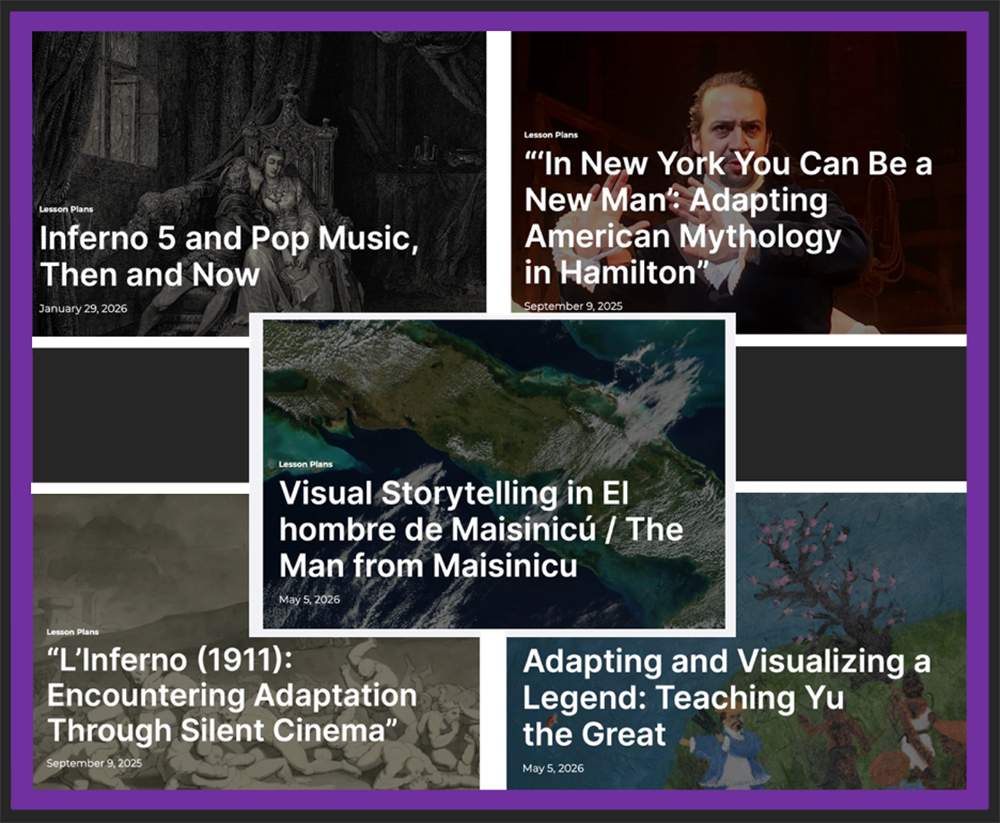
Within that aim, Adaptation Today has planned several expansions of our discussions on adaptation studies and pedagogy over the next year through specific themes and overlaps. First, we are excited about recent calls for engaging pedagogical resources on diverse topics. In addition to a CFP on adaptation and music from 2025, themed calls throughout 2026 have included adaptation and comics, adaptations around the world, and adaptation and video games. Building upon topics explored in previous submissions, such as discussions of Hamilton’s musicality and lyrics or international adaptations in syllabi examples, these calls have inspired additional content from scholars with unique discussions from their own classroom spaces. Among these new themed publications are Beth Coggeshall’s lesson plan “ Inferno 5 and Pop Music, Then and Now” and Min Ji Kang’s assignment ideas on K-pop and remixing practices, titled “K-pop, Hip-hop, and R&B: Black, Asian, and American Cultural Interactions.” For the remaining themed CFPs, we anticipate excellent submissions on topics such as remediation strategies across film and comics, transnational and transcultural rewritings, and video game narratives on streaming and social media platforms.
During our pedagogy podcast episode for Adaptation Today, we shared that we continue to encourage educators to submit their specific plans for particular adaptations, their general plans for broader cultural discussions in connection with adaptations, and their moments of “bravery” to allow students agency in the classroom through learning about adaptation studies as well as creating their own adaptations via creative assignments (“Pedagogy and Adaptation” 29:22-30:30). As Thomas Leitch argues in Engagements with Adaptation (2025), a text focused on adaptation scholarship within the classroom, “The marginalization of adaptation studies gives it the power to question assumptions about literary studies and cinema studies that these more established disciplines tend to avoid. (Think of adaptation scholars as students wising off from the back of the classroom)” (4). Here at Adaptation Today, we agree with this approach because we want to share as many brave “back of the classroom” ideas with fellow teachers for creative learning environments as possible.
Podcast
As our founding editor Kristen Figgins said in the second episode of the Adaptation Today podcast: “That’s [...] always been the vision for it is that this [Adaptation Today] is going to be a community, a resource by adaptation scholars for adaptation scholars to create a place of community and connection between conferences and also a place where new scholars can come into adaptation” (“Meet Your Editor: Kristen Figgins” 22:00-22:18). Academia can be an isolating space, especially for newcomers. Where do I start? What spaces are available to share knowledge and experience? How can I be a part of this community if I don’t have the funding to travel to conferences? These are some of the questions we ask ourselves as we start our journey into adaptation studies. Accessing relevant materials can be difficult, even if one knows where to start, because they’re hidden behind a paywall. Additionally, new scholars are often at a loss on how to be involved or intimidated at the prospect of taking up space in an already established community. Focusing on accessibility and community-building, the Adaptation Today podcast was first released for free in May 2024. With an episode published monthly (most of the time), it has featured more than twelve episodes to date. As of September 2025, the podcast has been downloaded over 1,000 times.
Understanding the need to adapt to new technology, the podcast embraces the idea that “adaptation is potential” (“Trailer” 00:40-00:42). The academy, in general, is under pressure to evolve and address increasing demands for accessibility. Adaptation studies, in particular, must foreground the production of innovative models as a field that prioritizes the analysis of new media. In addition to prioritizing approachable media forms, adaptation scholars emphasize popular culture. As such, our work matters to those outside of the academy and should be easily accessible. It is in this spirit that we call the podcast the point of reference for “anyone interested in learning more about adaptation and how to study it” (“AAS Conference” 00:18-00:25). In line with this, one of the goals of the podcast, and the Adaptation Today project, is to open the curtains. Therefore, the podcast features episodes dedicated to roundtables with participants and organizers of major adaptation conferences. This provides an opportunity to keep up to date with new developments for those unable to attend due to financial reasons or other constraints. We have episodes covering the 2024 and 2025 Literature/Film Association/Association of Adaptation Studies conferences. These episodes are aimed at both a general audience and the academic community. This coverage offers insights into the organizational aspects of conferences and summarizes research foci that emerged at the events.
Continuing with our goal of the podcast as an accessible introduction to adaptation studies, it also features theme-focused episodes, such as “Adaptation and Authenticity,” “Adaptation and Franchise,” “Adaptation and Trauma Studies,” “Pedagogy and Adaptation,” and “Adaptation in Turkish Literature, Cinema and Media.” These episodes include chats with both well-established and early-career adaptation scholars in order to represent the variety of voices present in our community. Additionally, the podcast has an entire episode devoted to publishing in adaptation-themed journals, such as Literature/Film Quarterly and Adaptation. Academic publishing can often feel intimidating and unclear, so we interviewed some of the editors of those journals to alleviate these tensions.
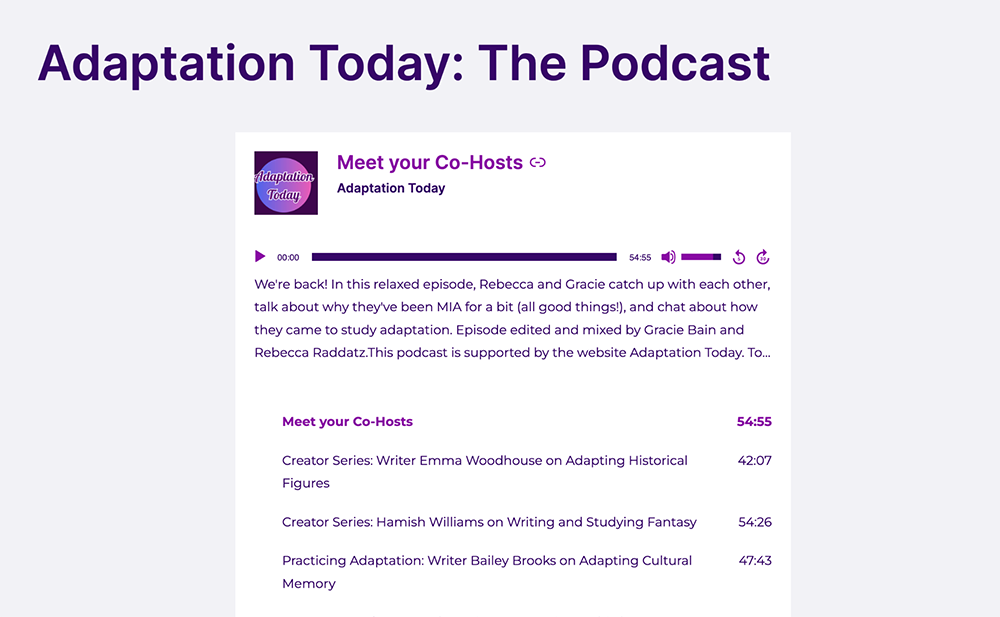
As Adaptation Today and the podcast expand, we will continue to foreground access and community across disciplinary and academic borders. With this goal in mind, the podcast has just launched its newest series (see Figure 3). These episodes aim to contribute to the conversation surrounding the relationship between theorizing and practicing adaptation. The upcoming episodes, therefore, feature conversations with various practitioners of adaptation. Some of these conversations are with creators who also conduct adaptation studies, but many are not. These conversations are often the most informative as they push us beyond disciplinary boundaries. For example, in our interview with Hamish Williams, we learned that classical reception studies and adaptation studies are (perhaps reluctant) siblings. In his children’s fantasy series Tales from Basthinia, Williams gestures towards Tolkien’s Middle-earth. In another creator episode, the hosts successfully convince Bailey Brooks that she is engaging in adaptation when she writes fiction set in historical Oklahoma, interweaving the cultural memory of events like the Greenwood Massacre into her text. The podcast builds a space for mutual learning and growing impulses: for the hosts, the guests, and the listeners. Our hope is that expanding the conversation to include creators will broaden the scope of how we conceptualize and practice adaptation criticism.
The creation of the podcast was, much like the rest of our resources, a practice in adaptation. All of the work is done in-house, meaning our cohosts are hosts, audio editors, interviewers, and producers. Although our cohosts had some familiarity with audio editing before creating this podcast, both had to adapt their existing editing knowledge to this genre. Podcasts take time to plan, record, and edit. Producing and editing a podcast is a labor of love, but it is still labor. Balancing the demands of hours of audio editing, moderating, accommodating guests, and even just the hosts’ seven-hour time difference has been a learning experience.
The communality of adaptation is, in this way, at the very center of the podcast. Guests, listeners, and hosts adapt to each other, practically and in their theoretical discussions. In doing so, it remains an open space. Whether you’re a listener, a guest, an expert, or a newcomer, the Adaptation Today podcast is the space to discuss all things adaptation.
Conclusion
Throughout this article, we formally call for a communal turn in adaptation studies—a call that adaptation studies had been informally answering long before Adaptation Today was founded. We strongly believe in the ethos discussed in Building Communities in Academia: “No one can make it alone, without help from others” (Aarnikoivu and Le 15). Academia has long been a place of silos, and adaptation studies has always distinguished itself from more niche disciplines as a meeting place, a convergence point, and a site of synthesis. In any group of adaptation scholars, there will be not only many literary and film scholars but also who study comic books, illustration, game theory, theme parks, music and sound, postal stamps, science, history, and so much more. The very foundation of adaptation studies is in collaboration, acceptance, and curiosity.
Adaptation Today, therefore, is not interested in calling for a communal turn in the sense of asking for collaboration or openness. Instead, we’re interested in the practicalities of connection, community, and even coalition-building. Other fields have noted the pragmatic problems facing especially interdisciplinary Early Career Researchers (ECRs), such as the difficulties of staying current with research across multiple fields of study or maintaining communication with colleagues, the absence of shared language, and the struggle of relationship building (Kadykalo et al.). Most of these concerns are not valued within traditional academia and, therefore, often not addressed explicitly during graduate work or beyond. Adaptation studies faces the additional challenge of being a relatively new discipline, still working to develop its own theoretical foundations. Adaptation Today is a resource to fill those gaps: to create opportunities for communication and collaboration where they might not exist between conferences, to allow for the development of a shared language in public spaces, and to create productive and meaningful relationships among scholars in this dynamic field.
Throughout our work, then, you will hear common themes: first, that our editorial team is excited and grateful for the work that is being done in our interdisciplinary, collaborative field. Each stage of our community-building is shaped by the joy of being able to share what is being done, connecting scholars, practitioners, mentors, teachers, and researchers at their own levels of enthusiasm. Second, you will hear that all our teams face real, practical challenges in their work that are actionable by the broader adaptation studies community. Our pedagogy team needs submissions (that you probably have lying around in an unfinished state). Both our pedagogy team and mentoring team are building big initiatives with very limited resources. Our podcast team, which is perhaps the best-funded of our projects, is also arguably our most labor-intensive.
Despite the challenges we face, the third theme emerging from our reflection is that collaboration, mutual accountability, and community are not just “worth it” in the sense of personal enrichment or reward, but also that they are vital to the success of our field—as ECRs navigate job markets, as we develop courses focused partially or wholly on adaptation, and as we seek to expand our understanding of what adaptation studies can become.
Works Cited
“AAS Conference: Time and Space in Adaptation - Roundtable.” Adaptation Today, 30 Aug. 2024, https://player.captivate.fm/episode/94f0bac9-3369-4dc9-92c0-df46788fb6e7/.
Aarnikoivu, Melina, and Ai Tam Le. Building Communities in Academia. First edition, Emerald Publishing Limited, 2024. EBSCOhost, research.ebsco.com/linkprocessor/plink?id=8fbc02a3-dba5-36d0-977c-a54bf75b2d1c.
“Adaptation and Pedagogy.” Adaptation Today, 31 Oct. 2024, https://open.spotify.com/episode/4sFKtM1nYIhIoFvnCkFrwV?si=f85de1bd307a4f85.
“Building Professional Pathways in Adaptation Studies.” YouTube, YouTube, 19 Nov. 2024, www.youtube.com/watch?v=NPhX54dG2Ss.
Carlson, Brooke Allan. “Feeling Gawain, or What I Learned Teaching Adaptation Today.” Adaptation Today, 25 Apr. 2025, https://adaptationtoday.com/2025/04/25/feeling-gawain-or-what-i-learned-teaching-adaptation-today/.
“CFPs for Pedagogical Publications.” Adaptation Today, 4 Sept. 2025, https://adaptationtoday.com/resources/pedagogical-resources/pedagogy/.
Connected Academics – A Modern Language Association Initiative, connect.mla.hcommons.org/. Accessed 21 Feb. 2026.
Couey, Stephanie. “Modern Fairy Tale: Contemporary Retellings of ‘Once Upon a Time.’” Adaptation Today, 10 Oct. 2024, https://adaptationtoday.com/2024/10/10/modern-fairy-tale-contemporary-retellings-of-once-upon-a-time/.
Elfenbein, Matthew Ari. “Using Nineteen Eighty-Four to Adapt Experience in the Classroom.” Adaptation Today, 11 Feb. 2025, https://adaptationtoday.com/2025/02/11/using-nineteen-eighty-four-to-adapt-experience-in-the-classroom/.
Hartnett, Rachel M. “‘In New York You Can Be a New Man’: Adapting American Mythology in Hamilton.” Adaptation Today, 9 Sept. 2025, https://adaptationtoday.com/2025/09/09/in-new-york-you-can-be-a-new-man-adapting-american-mythology-in-hamilton/.
Hutcheon, Linda, with Siobhan O’Flynn. A Theory of Adaptation. 2nd ed., Routledge, 2013.
Kadykalo, Andrew N., et al. “Co-Envisioning an Academia That Fully Embraces and Supports Early Career Researchers in Interdisciplinary Social-Ecological Research.” Ecology & Society, vol. 31, no. 1, Feb. 2026, pp. 1–19. EBSCOhost, https://doi-org.libprxy.muw.edu/10.5751/ES-16694-310117.
Lari, Pooneh, and Denise H. Barton. “Building communities of practice through Faculty Mentorship Programs.” International Journal of Adult Vocational Education and Technology, vol. 8, no. 4, 1 Oct. 2017, pp. 1–12, https://doi.org/10.4018/ijavet.2017100101.
Leitch, Thomas. Engagements with Adaptation. Routledge, 2025.
“LFA/AAS Roundtable.” Adaptation Today, 31 May 2024, https://open.spotify.com/episode/1hhk9czURHL3tIiYvJsUZZ?si=de49bff17073489d.
“Meet Your Editor: Kristen Figgins.” Adaptation Today, 30 June 2024, https://player.captivate.fm/episode/62c3ca93-cec4-41a7-9f73-e8cbf0878894/.
Morris, T.A. “L’Inferno (1911): Encountering Adaptation Through Silent Cinema.” Adaptation Today, 9 Sept. 2025, https://adaptationtoday.com/2025/09/09/linferno-1911-encountering-adaptation-through-silent-cinema/.
Muñoz, Laura. “Adaptation Exercise.” Adaptation Today, 3 Feb. 2025, https://adaptationtoday.com/2025/02/03/adaptation-exercise/.
—. “Audiovisual Adaptation Project.” Adaptation Today, 4 Feb. 2025, https://adaptationtoday.com/2025/02/04/audiovisual-adaptation-project/.
Ortiz, Ricardo L. “Introduction: Public Humanities AS/and Comparatist Practice.” Post45, 4 June 2021, post45.org/2019/07/introduction-public-humanities-as-and-comparatist-practice/#footnote_2_10687.
Palis, Eleni. “Adaptation, Archives, and Digital Remix Culture.” Adaptation Today, 10 Oct. 2024, https://adaptationtoday.com/2024/10/10/adaptation-archives-and-digital-remix-culture/.
Pérez Ríu, Carmen. “Literatures in English and Film.” Adaptation Today, 10 Oct. 2024, https://adaptationtoday.com/2024/10/10/literatures-in-english-and-film/.
Sanders, Julie. Adaptation and Appropriation. 2nd ed., Routledge, 2016.
Semple, Edel. “Review a Shakespeare Adaptation.” Adaptation Today, 4 Feb. 2025, https://adaptationtoday.com/2025/02/04/review-a-shakespeare-adaptation/.
“Theories, Methods, and New Directions.” YouTube, YouTube, 16 June 2025, www.youtube.com/watch?v=kPrfRC2o_yg&list=PLPv081P6dvZik62GnAcNHv7jhoFSsNPHX.
“Trailer: Welcome to Adaptation Today.” Adaptation Today, 26 March 2024, https://player.captivate.fm/episode/8472e2b9-1eee-4eb2-a763-ea124113157d/.