VOL. 54, NO. 2
Originality meets Adaptation: Creating Female Characters within Adaptations of The Thirty-Nine Steps
Annie Nissen
John Buchan’s The Thirty-Nine Steps, published in 1915, offers an intriguing opportunity for adaptation and adaptation studies as the novel lacks any kind of notable female character and women are only mentioned in passing. Any addition of women within the framework of adaptation would therefore be original as well as reflective of the time of the film’s creation. Bearing this in mind, the female characters that are included within the adaptations offer a lot of substance for analysis, especially in view of realist theories of film which maintain that films mirror the social conditions and desires of the time in which they are made. This is particularly the case for Siegfried Kracauer’s theories surrounding the function of film and its ability to record or reveal the “collective dispositions or tendencies” of a nation “at certain stages of its development” (From Caligari to Hitler 8). Taking a closer look at the representation of women on screen in adaptations of The Thirty-Nine Steps, as well as their relationship with Richard Hannay as the male protagonist, will thereby illustrate the moods and sentiments of the times when they were created.
Kracauer believed that cinema as a medium was “particularly equipped to promote the redemption of physical reality” with film “effectively assist[ing] us in discovering the material world with its psychophysical correspondences” (Theory of Film 300). Kracauer’s theories have often been considered provocative and problematic in the past. However, more recent studies have sought to overturn previous (mis)conceptions of his work (see, for example, Gertrude Koch, Jeeshan Gazi and Miriam Hansen). Hansen suggests that:
Kracauer understood the cinema as a symptomatic element within a larger heuristic framework aimed at understanding modernity and its developmental tendencies. While this framework was grounded in a philosophy, if not a theology, of history, it translated into a programmatic attempt to understand contemporary cultural phenomena in relation to the social and economic conditions that gave rise to them and to which they were thought to respond. (3)
Rather than merely focusing on the recorded and reflective element of film’s relationship with society, it is about the interconnectedness of different elements and conditions exposed by film that allow insights into cultural systems. The purpose of film within this discussion is to discern in how far the newly created female characters are emblematic of the social conditions and perceived reality of the time the films were created.
In view of adaptations, Kracauer stated that they “make sense only when the content of the novel is firmly rooted in objective reality, not in mental or spiritual experience” (qtd. in Andrews 121). Accordingly, The Thirty-Nine Steps would ideally lend itself to adaptation due to its realist environment and visually dramatic man-on-the-run adventure narrative. Made over a period of time and under the same name, there are four British adaptations of Buchan’s novel to date.1 The first, and most well-known, was directed by Alfred Hitchcock in 1935, with a screenplay by Charles Bennett in collaboration with Hitchcock and produced by the Gaumont British Picture Corporation.2 The Rank Organisation produced a new adaptation in 1959, which was directed by Ralph Thomas and written by Frank Harvey. Another adaptation by the Rank Organisation followed in 1978, directed by Don Sharp and written by Michael Robson. The latest adaptation to date, was a BBC production from 2008 directed by James Hawes and written by Lizzie Mickery. These four adaptations offer an engaging basis for theoretical analysis in terms of their representation of women in relation to the time they were created, as well as showing how the female characterizations have evolved over the span of several decades.
Considering the time of Kracauer’s critical writing largely mirrors Hitchcock’s time as a filmmaker, it is hardly surprising that he references Hitchcock within his study of cinema:
what distinguishes him from the rest of film directors is not primarily his superior know-how but, more, his unrivalled flair for psychophysical correspondences. Nobody is so completely at home in the dim border region where inner and outer events intermingle and fuse with each other. This implies, for one thing, a perfect command of how physical data may be induced to yield their possible meanings. Hitchcock literally thinks in terms of suggestive environmental material. (Theory of Film 277)
Kracauer’s regard for Hitchcock as a director and his discernible storytelling is here especially linked to his inclusion of “suggestive environmental material,” implying the way that his films are adapted to the Zeitgeist. Though Kracauer also goes on to suggest that “Hitchcock thrillers lack deeper meaning, … they comprise a host of virtually significant, if embryonic, stories” (277).
Hitchcock himself had cited Buchan as an influence long before he worked on The 39 Steps, having read the book shortly after its release.3 Despite this, Hitchcock as well as Bennett encouraged the notion that the film was a “loose” adaptation and “more or less a screen original” (Chapman 72). Whereas women are noticeably absent in Buchan’s novel, in the 1935 film version, women are literally everywhere from the onset, as seen in the music hall, filled with women and men, both participating in the action.4
Overall, the most notable divergence from the novel is the inclusion of the female characters that Hannay (Robert Donat) encounters along the way and the introduction of a romance. Mark Glancy explains these plot additions as nearly “unavoidable cinematic conventions,” though goes on to insist, that there is more substance to these than just including them as “thin and meaningless romantic sub-plot,” as they build on a “significant aspect of the novel, using a Freudian understanding of the character’s psychological state and particularly his sexuality” (16). As such, it can be reasoned that other than as a necessity for cinema to portray both genders and also add romance where it is lacking, it validates itself in this case when delving deeper into the psychological aspects of the source material. Although the physical absence of women within the novel itself is conspicuous, especially from a modern vantage point, this is not necessarily reflective of Buchan’s own views towards women or of his other works. Nathan Waddell argues that Buchan saw women through an “equitable lens” and within his literary representation “women are treated as imaginatively as Buchan’s men. His women are frequently powerful figures” (4).
In Hitchcock’s film, set in the 1930s, male characters from the novel have been turned into women, such as the agent known as “Annabella Smith” (Lucie Mannheim) who invites herself back to Hannay’s flat. Though her words and mannerism may easily be mistaken for sexual advances, the rather cold and dismissive responses made by Hannay show his lack of interest in her, yet nevertheless he allows her to accompany him. A role reversal seems to be taking place between Annabella and Hannay, as he assumes the domestic part and cooks a meal while she partly relates her information to him, which he disbelieves. After all suggestions of a sexual nature are forgotten, she nevertheless stumbles in on him in the middle of the night, collapsing over his lower body in a phallic pose with a knife stuck in her back. Not only does this symbolize the impotence and thus helplessness of Hannay, but also the end of his passivity and disbelief.
The main female addition in this adaptation is the introduction of Pamela, who, reluctantly at first, helps Hannay through his adventure. Pamela comes across as a progressive character for her time, appearing as self-sufficient and assured from the very beginning. She does not hesitate to denounce Hannay to the police after he kisses her as a subterfuge on the train (see Figure 1). Her political involvement, only accounted for through her presence at the debate, also shows these traits. R. Barton Palmer suggests that the character provides a “vital source of dramatic tension” that is of “equal if not greater importance than its much-remarked double-pursuit” (96). Overall, she seems to act the part of a modern woman and could also be recognized as a role model for 1930s women.
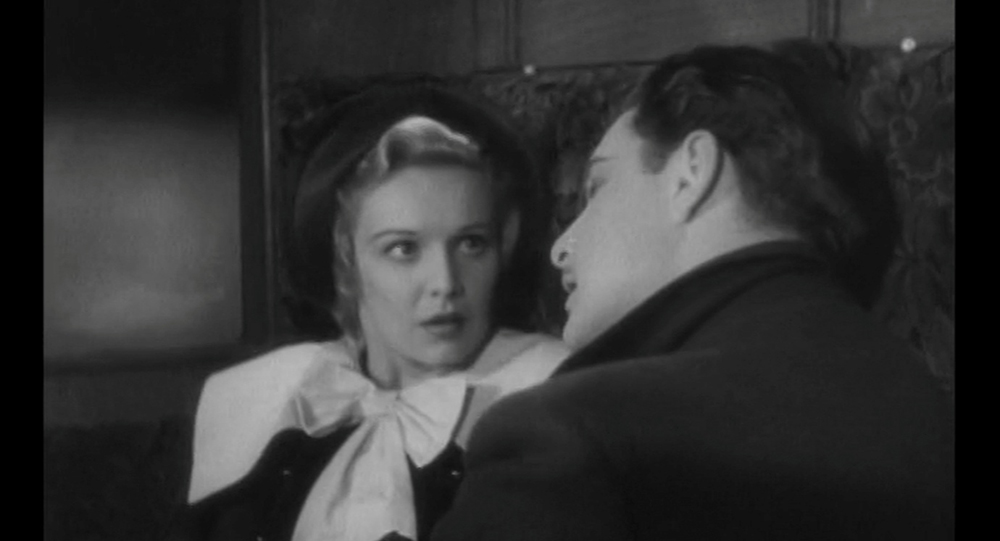
Played by Madeleine Carroll, the character of Pamela is seen as the “the prototypical Hitchcock blonde.” Sue Harper classes Carroll among the emerging young actresses of the 1930s, who counterbalanced the effect of the ladylike actresses of the time. She characterizes these girls, as
Wholesome Sensible Girls who projected an air of competence and energy, and had the forthright manner of a socially emergent group. Equipped with a brisk verbal delivery, their gaze was direct and unambiguous. Their textual effect is bracing, and they are clearly intended to evoke confidence in a new social order. The dense population and the intensity of the Wholesome Girl group were designed to give the audience confidence in modernity – to let them see that women could be spirited and pure at the same time. (24)
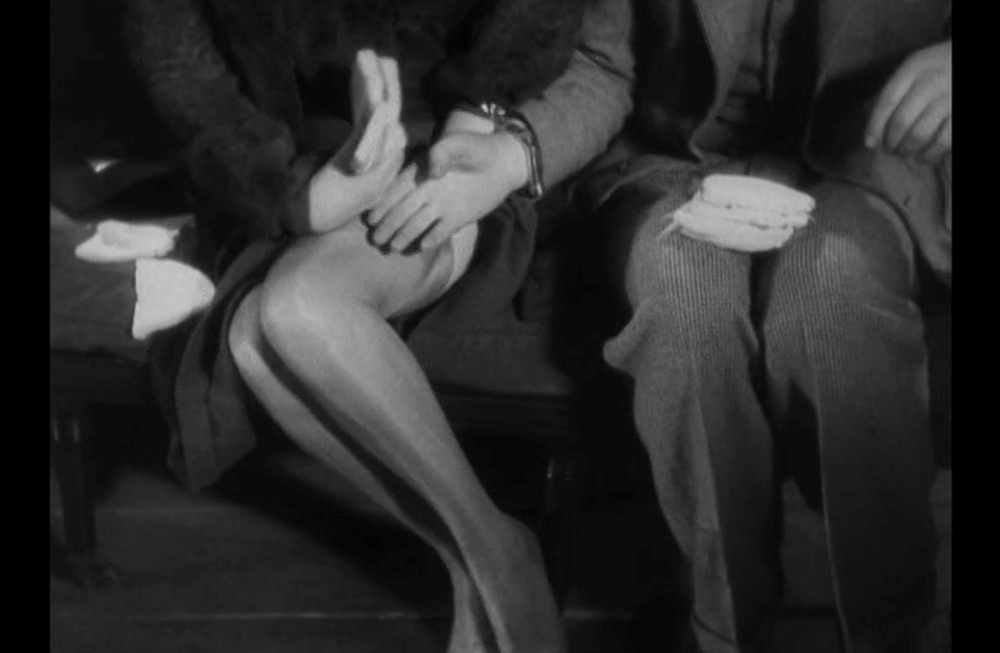
This idea of the “Wholesome Girl” can be further established through the character itself who seems less afraid of Hannay murdering her, than of spending the night at the hotel with him. Though filled with sexual innuendos – the handcuffs, the double bed and the removal of Pamela’s wet stockings (see Figure 2), their whole interaction at the hotel arguably lacks chemistry, mainly due to Hannay’s sexual passivity. In contrast, Glancy argues that this is “a surprisingly sexy film” having “escaped the scorn of the censors” despite “its bedroom scenes, double entendres and moments of fetishistic revelation – ranging from the handcuffed couple in bed together to the film’s almost obsessive interest in women’s clothing” (7).5
The changing attitudes towards women, along with the film’s “obsessive interest in women’s clothing,” can also be viewed symbolically through the salesmen who share a compartment on Hannay’s train as they, full of innuendo, demonstrate the latest fashions in women’s underwear. This scene lightens the mood of the adaptation, and its humorous note is carried further by Hannay. Even when he drags, carries and shoves Pamela across the Scottish moors, a sense of wittiness on both sides is upheld as she struggles against him whilst he tries to convince her of his dangerousness so that she might follow more willingly.
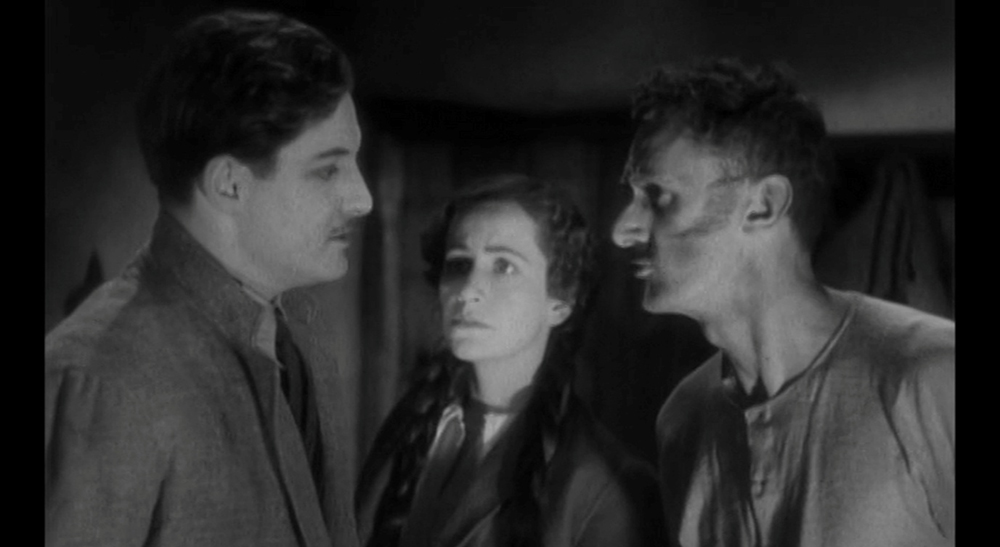
Another intriguing female character addition Hannay encounters along the way, standing in contrast to the confident Pamela, is the crofter’s wife Margaret (Peggy Ashcroft). Her position as the suppressed woman in a loveless marriage is immediately made apparent by Hannay’s assumption that she is the crofter’s daughter rather than his wife. She nevertheless becomes an asset to Hannay as she defies her husband (John Laurie), for which she will later pay, and actively helps Hannay to escape (see Figure 3). In this case, the woman though dominated by her much older husband, acts against the restraints put on her by society through marriage and chooses to trust her instincts by being assertive.
Harper points out that, “all the female stereotypes in 1930s cinema question stable gender definitions, and invest them with debates about generation and class; they then return the audience reinvigorated to the mental landscape of the status quo” (28). With regard to Hitchcock’s adaptation, all the female roles start out fairly stereotypically: Annabella is the femme fatale, Pamela, the bookish spinster, and Margaret is the suppressed wife. Within minutes, all of these definitions are thrown overboard and need to be reassessed. Transferring this to 1930s society can be seen as shaking up notions of gender roles, even if this might only be restricted to the screen at that time. Kracauer points out, that:
films of a nation reflect its mentality in a more direct way than any other artistic medium for two reasons: First, films are never the product of an individual ... Second, films address themselves, and appeal, to the anonymous multitude. Popular films – or to be more precise, popular screen motifs – can therefore be supposed to satisfy existing mass desires. (The Mass Ornament 5)
The satisfaction of mass desires in this case appears to be mainly reflected within the relationship between Pamela and Hannay as exemplified previously. Similar to Glancy, Palmer further posits the argument that even as the addition of the character intentionally delivers the “viewers with a customary form of cinematic pleasure: a romance from which sparks (erotic and otherwise) continually fly,” it is still in keeping with “the novelist’s avowed aesthetic” (96).6
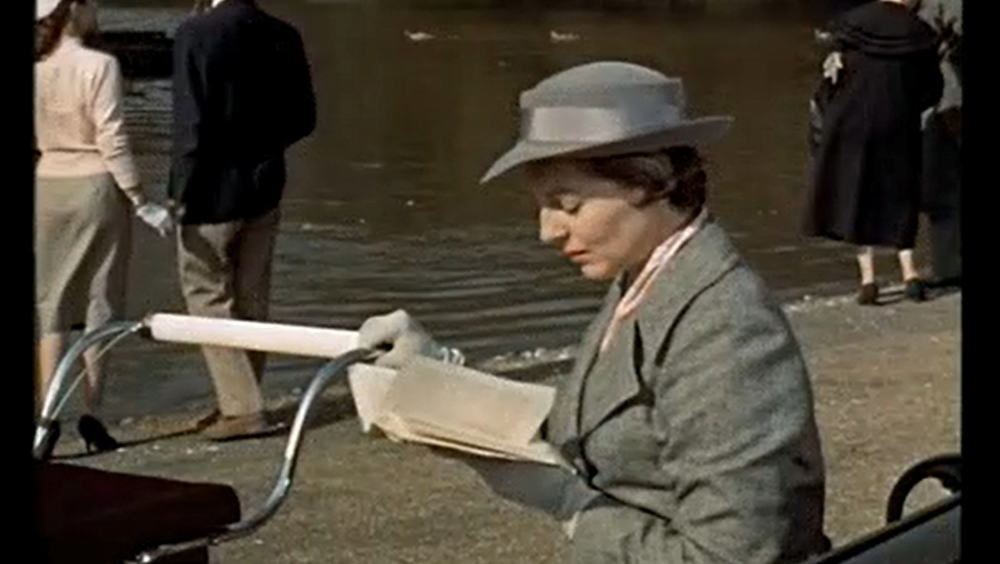
Although the 1959 adaptation appears to be following Hitchcock’s film version rather than Buchan’s novel, it provides a contemporary setting and there are also several key differences, especially in the way women are represented. The introduction of the female agent “Nannie Robinson” (Faith Brook) takes place in a different setting. She is first spotted in a park by Hannay (Kenneth More), who mistakes her for a real nanny because of her pram (see Figure 4). When she is hit by a car and Hannay discovers a gun instead of a baby in the pram, he realizes that something is amiss and proceeds to take action by locating her again. Though the next steps share the same premise as Hitchcock’s film, it is made clear that their encounter at the theatre and her request to go home with him are based on his curiosity and her desire to recover her belongings which are in the flat. No sexual motivation is involved. Her death, also caused by a knife in her back during Hannay’s absence from the room, carries no explicit sexual undercurrents. A certain female stereo-typicality in her character could also be assigned to her known code name “Nannie” which quite clearly for the time is gender related and appears to diminish her importance as a spy to some extent.
During his escape, Hannay encounters a further female character, Nellie (Brenda de Banzie), a spiritualist woman who served four years in prison on charges of witchcraft (see Figure 5).7 While her husband (Reginald Beckwith) does the cooking and seems subservient to his wife, she advances on Hannay sexually by inviting him to hide out at their place. Through this, she further insinuates that their marriage is open enough for a third party to be involved and that her husband has not minded a similar previous arrangement. Nevertheless, Hannay declines but lets her take charge of the situation as she plans his getaway for him. Marion Gibson suggests that the characters of Nellie and Hannay are actually quite similar, as “both have transgressed, fallen indeed into the role of the villain, but both can live quite comfortably with that and even laugh it off” (151). Although Hannay’s transgression is incidental, there is nevertheless a certain kind of affinity between the characters. On Hannay’s departure, he even gives her a kiss and receives several in return, her parting words being that “there’s plenty more, where that came from.” The whole character of Nellie stands in stark contrast to Margaret, her meek counterpart in Hitchcock’s adaptation. Nellie represents a dominant individual woman, who is not sexually repressive and knows exactly what she wants. According to Harper, a character like this was not untypical for the 1950s, but usually the types of female “eccentrics were all neutralized by their age, which confers absurdity onto their desires” (99). This is indeed the case with Nellie, who is just past middle age and is certainly supposed to appear older than Hannay, an issue which will shortly be discussed further.
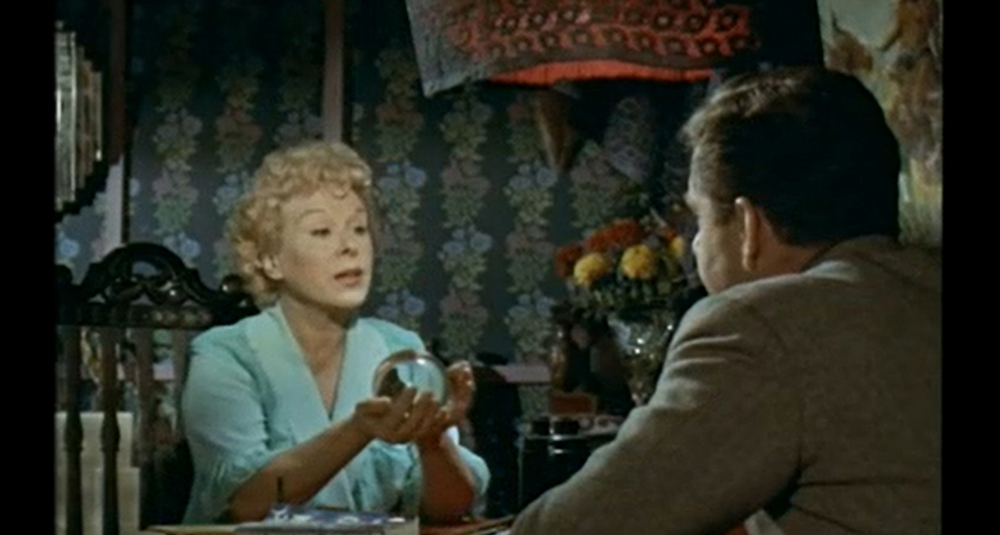
Though the changing pattern of gender representation in the British Film industry during the 1950s and the particular interest in female aspirations and behavior can be made apparent through the representation of these two women, female stereotypes were still “quite rigorously constructed in the 1950s, and room to manoeuvre was minimal” (Harper 97). This can be exemplified through the main female lead of Miss Fisher (Taina Elg), who can be basically seen as the “Pamela” of the 1959 version, though she does differ in various and essential ways. Before seeing her and kissing her in the same pattern as that of the Hitchcock film (see Figure 6), Hannay hears about her through a group of chattering schoolgirls on the train who are discussing their netball coach Miss Fisher and the question of her attractiveness towards men. This already sets the precedent for the appearance of Miss Fisher and Hannay’s interest in her is apparent, as he listens attentively to the girls. Their next meeting takes place at the girls’ school itself, in which Hannay is here mistaken for a biologist who has come to lecture to the girls. The entire relationship between Hannay and Fisher, including their capture, escape and also ultimate solution, is adapted from Hitchcock’s The 39 Steps but with characteristic differences.
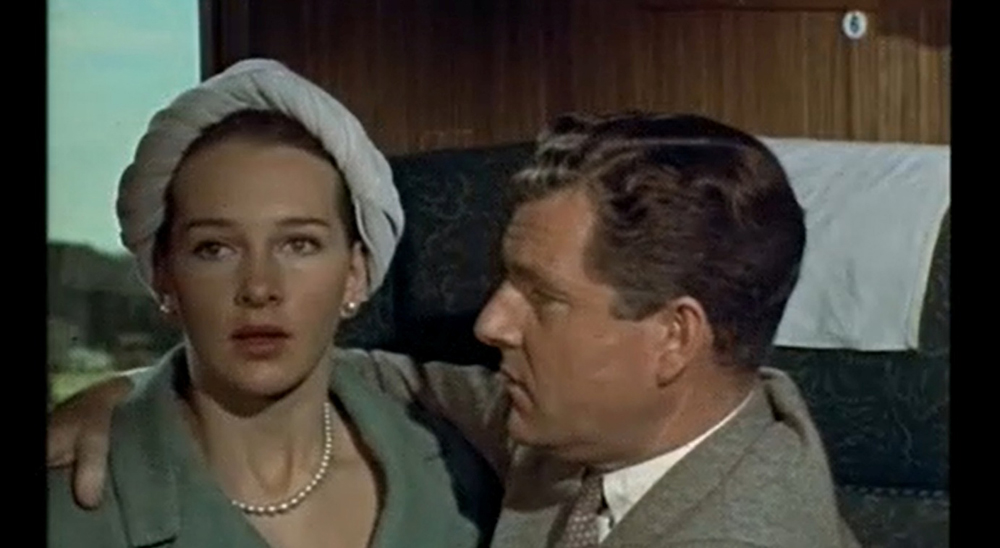
One of the main alterations is the way in which Hannay addresses his female companion, which although only a small detail, is still relevant. Her first name is not revealed, and as “Miss Fisher” she remains less personal to the viewer. Hannay never refers to her in feminist terms, often calling her “chump,” which arguably also masculinizes her. Most frequently, he calls her “Fish,” which changes the relationship between them, as he is the only one to call her that. This lack of a sexual gaze on her character is noticeable not only through her clothes, but especially by the way that her hair is covered by a scarf for the most part until they reach the hotel. Through this she seems to be much less represented as a woman than maybe possible.
In contrast to Hitchcock’s Pamela, Miss Fisher has a much more passive role, as she follows Hannay with barely a struggle and appears more helpless in the situation than Pamela. According to the time the film was made however, she has been given a profession which makes her in some instances more dependable than Pamela seemed to be. In other instances, even though it follows Hitchcock’s adaptation aesthetically and nearly rigidly, there is also more apparent sexual insinuation, especially when Hannay and Miss Fisher pose as a couple in the hotel.
The age difference between Hannay and Miss Fisher on screen is also very apparent, though seemingly invisible to the narrative. However, both Nannie Robinson and Nellie appear much closer in age to this 1959 Hannay than Miss Fisher, yet both are dismissed as possible romantic partners right from the start. This is particularly the case with Nellie, where Hannay acts in a rather dismissive way towards her advances which are set up to be viewed in the light of a greater age gap than the actual five years between the actors. This actually shows the preference given to the much younger woman, where the credibility of their romance with regard to age is never even questioned. Although there is an age gap of sixteen years between the actors Kenneth More and Taina Elg, it does not seem to be an issue in any way as far as their onscreen future is concerned, unlike the obstacle it proved to be between the crofter and his wife in Hitchcock’s adaptation, where the actors were only separated by a ten-year age gap in reality. However, the conclusion of the film, with regards to Hannay’s and Miss Fisher’s romance, goes one step further than the 1935 version by not only leaving the couple as they take each other’s hand, but by then showing them after that, walking together arm-in-arm and thus leaving little doubt as to their relationship.
The 1978 film The Thirty Nine Steps, set in 1914, is widely different from the previous two adaptations and in some degree could be credited as being closer to the novel, as it foregrounds the political and spy controversy.8 It also lacks the presence of women who, when at all, only appear marginalized in this version, making it seem closer to Buchan’s original. However, one of the liberties taken here is that the women’s vote is featured through a political demonstration outside a parliament building (see Figure 7). The raising of this topic could also be related to the time of the film’s making, as this was a decade where not only theoretical advances in feminism were made, but also many improvements for the everyday lives of women, such as the Equal Pay Act or Sex Discrimination Act. Nevertheless, in a contemporary review of the film, Martyn Auty points out that the demonstration is “peopled by women as cardboard as their placards” (249).
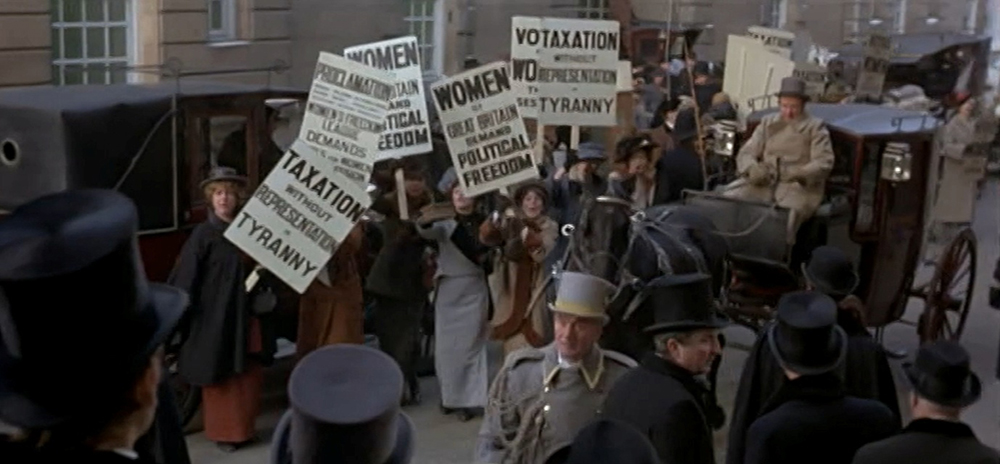
Harper points to general instability of female representation in the 1970s and that the lives of women on screen had never before “appeared so truncated or their pleasures so perfunctory” (137-8). Alex Mackenzie (Karen Dotrice) who has the only notable—though still minor—female part in this adaptation, could be characterized with regard to this; Her whole construction of identity seems to be lacking, and her addition to this adaptation seems to be more as an accessory in a male dominated world. Hannay (Robert Powell) first encounters her during his escape, when he runs into a shooting party and is invited back to the country home of the host David Hamilton (Miles Anderson), later revealed to be Alex’s fiancé. However, before that is established, it is made clear to the audience that Hannay has an interest in her as he tells her she is “breath-taking.” Alex appears to be drawn to him too and immediately believes in Hannay’s innocence. When the couple encounter him again at the soiree in the hotel, she convinces her fiancé to help him further, though by this time Hamilton has noticed her interest in Hannay. After the couple have helped Hannay escape from the German spies, Alex accompanies him to collect Scudder’s notebook, while Hamilton stays at home. On their return, Hannay discovers that Hamilton has been shot and the two of them barely manage to escape. Remarkably, after this, not a word is lost about Alex’s fiancé being killed. The only indication of it having happened or affecting her is in her attire: a black mourning dress symbolizing the loss. Throughout the former episodes Alex, though essential in shielding Hannay from the police as well as the foreign spies, stays passive and reserved. She remains even more so for the final scenes of this adaptation, as she is taken hostage and Hannay must come to her rescue. This deviates greatly from the presentation of the self-sufficient woman at Hannay’s side, not only with regard to the former two adaptations, but also the 2008 adaptation. In all these cases, the women manage to put up a fight—even if this involves Hannay—and free themselves from confinement.
In the penultimate scene of the 1978 film, both Hannay and Alex are seen together walking arm-in-arm through a garden (see Figure 8). Their light clothes and their soundless laughter and talk accompanied by the music, indicates the blossoming romance between them. Alex’s fiancé seems long forgotten and, in this instance, it appears that the hero wins at the end of the day, also by getting the girl despite the initial obstacle. Overall, this adaptation refrains from reflecting the social and political developments of the decade in which it was made. Notably in the character of Alex the opportunity has been missed to show the feminist advancement of the period, which thereby appears in regression compared to the other adaptations and their creation of female characters. However, this could have been for commercial reasons; as Harper points out, “the British film industry of the 1970s was in no condition to respond to the changes in women’s lives and consciousness. This was not because of ill-will, but because of penury and cultural decline” (127).
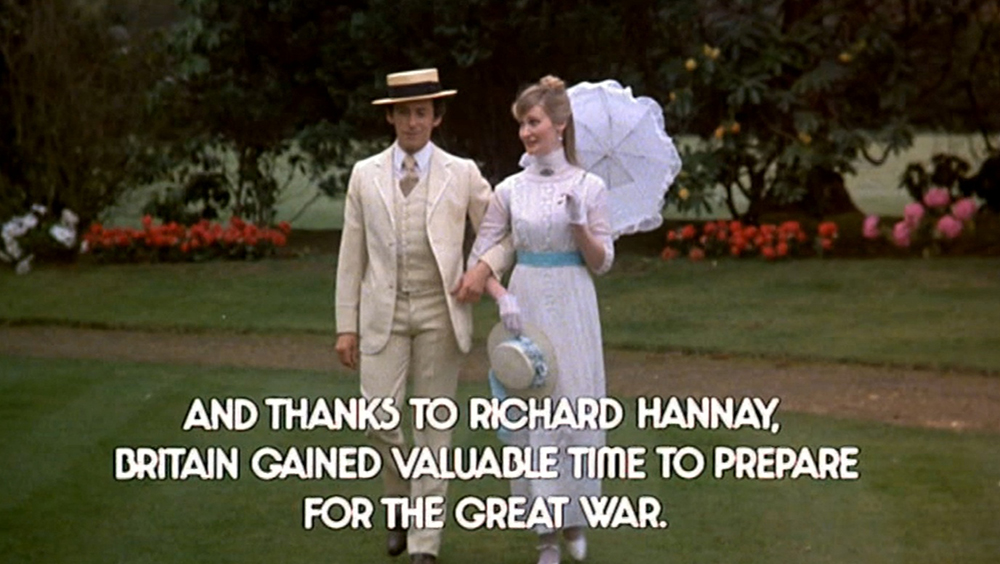
With regard to Kracauer, who points out that “what films reflect are not so much explicit credos as psychological dispositions—those deep layers of collective mentality which extend more or less below the dimension of consciousness” (From Caligari to Hitler 6), the film’s ending shows a kind of natural order in a mass mentality. The dashing hero has undoubtedly earned the right to take home the girl, who in this case submissively passes from the one man—who through his death, no longer proves an obstacle—onto the next, who through his rescue—not only of her, but of the British nation—has proved his worth. Arguably this scenario was inevitable from the first meeting between Hannay and Alex as their mutual interest became apparent for the audience who could subconsciously register her as a type of reward for Hannay’s struggles.
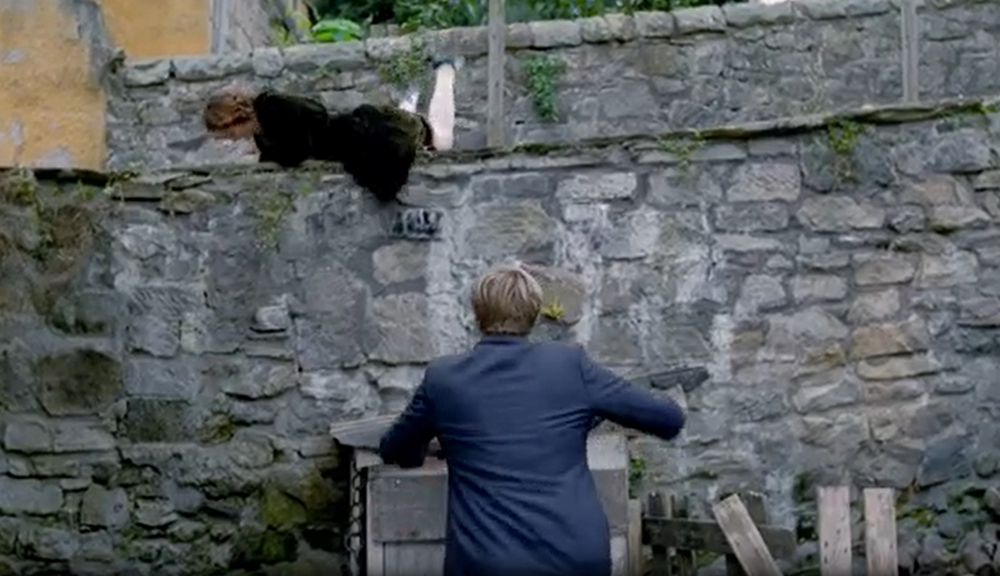
The most recent adaptation of Buchan’s novel, made by the BBC in 2008, again differs from its predecessors in many ways. The most distinct is the overtly active role that women are assigned to in this version. Victoria (Lydia Leonard), who Hannay (Rupert Penry-Jones) encounters quite early in the film, is not the innocent woman picked up on the way as initially assumed, but is herself active in the Secret Service. However, before either Hannay or the audience knows of this, her actions indicate that she is meant to be progressive and independent. Whilst Hannay hesitates, she hitches up her skirts before climbing over a wall (see Figure 9), and also unlocks both their handcuffs and a door with the help of her hairpin. Overall, Hannay appears to be more passive when she is around and lets her take over the steering wheel, literally.
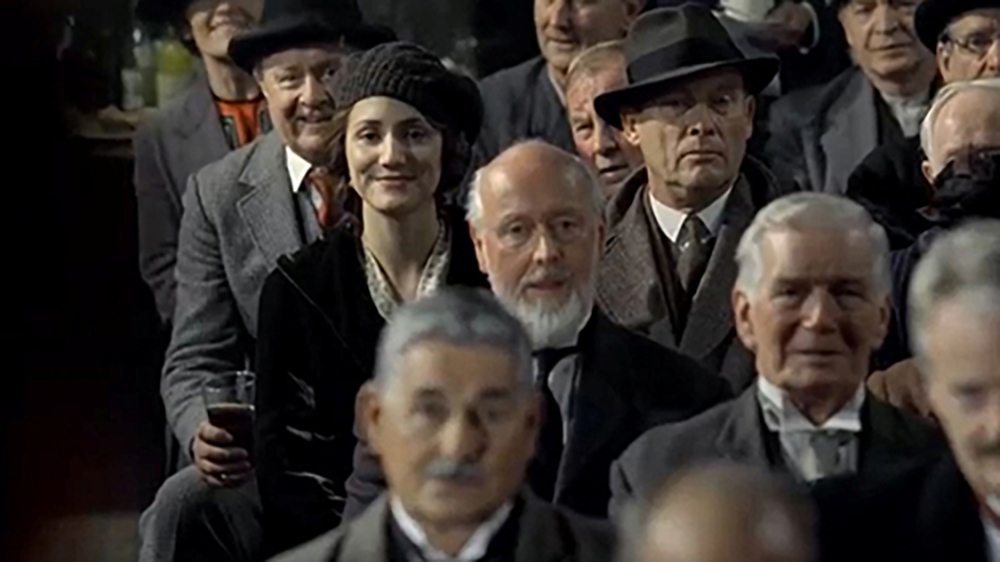
Feminist issues are raised throughout this adaptation, mainly through the fact that Victoria is part of the suffragette movement. One of the most notable instances of this is at the political meeting (see Figure 10) where she asks Hannay during the political debate where he stands on women; Hannay replies to much laughter and applause, that “as a rule I tend not to stand on women.” Another occurrence at the meeting is that Victoria’s brother Harry (Patrick Kennedy) only addresses the assembly as “gentlemen.” The entire meeting is set to show the mindset of 1915 and thus compare it to today’s presumed progress and equality.
The film does not have many other feminine figures to whom Victoria can be compared. A minor character is the maid who helps Hannay initially escape his apartment as he appeals to her romantic nature. This shows the naive nature of the maid, but also her arousal to action instead of taking on a passive role. Passivity and femininity are also attributes that could be ascribed to Victoria’s brother Harry, who appears to take on the role of a woman because he does and says as he is told, rather than asking questions.
The scene at the hotel, which is a repeat of Hitchcock’s adaptation, is here more sexually explicit. They undress in front of each other, obviously looking while pretending not to do so and as such showing their attraction more overtly than any other couple in the previous adaptations of The Thirty-Nine Steps. The final climax of this is reached when they are back in the country house where Victoria comes to his bedroom and they kiss. Hannay’s reaction to her suggestion that she could stay the night, prompts her to ask if she has shocked him. Though he replies that he is rather “flattered and honored,” she ends up leaving the room after all. Here, propriety is upheld, though more on the part of Hannay who acts as the gallant gentleman whereas she compromises herself by the suggestion.
In the adaptation overall, Victoria stands out amongst the men, not only through her capability to take action, but also through her mental capacity as it is revealed that she has a photographic memory, which is genetically inherited. Although her uncle has the same talent, he is portrayed as a weaker character, not only through his involvement with the enemy spies, but also in his general disposition. Her character is shrouded in mystery, which through her revelation as an agent is temporarily lifted, but reappears through her faked death and the promise to Hannay through Harry, that he will see her again after the war.
Kracauer believed that “the technique, the story content, and the evolution of the films of a nation are fully understandable only in relation to the actual psychological pattern of this nation” (From Caligari to Hitler 5). Considering this, particularly in view of the latest adaptation, this evolution is especially palpable. The proactive figure of Victoria is more recognizable in view of modern expectations with the need to show that women are quite capable of entirely taking the lead over men. Victoria does arguably prove to be the most developed character in this adaptation, even over Hannay whose life—though largely unknown—is less shrouded in mystery. As such, the deeper psychological desire to see an active independent woman is apparent, especially in a film set in a time where women are still ascribed stereotypical roles and where issues, such as the women’s role, are treated with ridicule as exemplified in the political meeting. The triumph of a strong woman over more passive men in such a case, is then all the more gratifying from a modern vantage point (though Hitchcock’s version still holds its own appeal).
The female characters within all the adaptations of The Thirty-Nine Steps, though often appearing minor, show the social structures of their time of making, both in terms of positive and negative connotations. Overall, their comparative analysis reveals a wider demonstration of the still-existing stereotyping of women onscreen over the decades. As the latest adaptation includes the most progressive female character yet, it will be intriguing to see how future adaptations will approach the matter, and whether its predecessors will be looked to for inspiration or dismissed as outdated.
Although Kracauer has received criticism for being a medium-specific critic, his argument that “each medium has a specific nature which invites certain kinds of communications while obstructing others” (Theory of Film 3) can be considered reasonable in view of novels and films. Both invite certain types of conjectures and assumptions to be made, which are related not only to the time in which they are made, but also to the socio-political contexts in which they are perceived. Consequently, identifying clear social objectives and ideologies will always be a problematic—though not entirely unattainable—feat.
Endnotes
1 Although there have been numerous British and American radio adaptations since the 1930s, only a few adaptations for other media exist aside from these four films.
2 The Internet Movie Database (IMDb) does not include Hitchcock as contributing writer but lists Ian Hay for dialogue.
3 Buchan’s influence on Hitchcock is discussed further by Jocelyn Camp where she argues that North by Northwest is actually closer to Buchan’s novel than The 39 Steps.
4 Two of the adaptations of The Thirty-Nine Steps, from 1935 and 1959, feature marginal show acts similar to, if not actually, “The Tiller Girls.” In a 1927 essay, Kracauer put forth his theories on the “mass ornament” via the example of ‘The Tiller Girls,’ arguing that “the structure of the mass ornament reflects that of the entire contemporary situation” and goes on to demonstrate this by the synchronized movements of the mass dancing group which acts not only as a distraction but also as a symbol for society (The Mass Ornament 78).
5 Chapman includes details regarding the censorship from both the British Board of Film Classification (BBFC) and the Production Code within his formal and narrative analysis of the film (74-5, 88-9).
6 Buchan was also present at the film’s premiere and Hitchcock recalls being very flattered by Buchan commenting on the film improving his novel (Chapman 76-7).
7 Marion Gibson analyzes the character of Nellie in view of her characterization as a witch-figure, arguing that she is a "trailblazer for 1960s counterculture” (145).
8 This is perhaps also reflective within the title, as it is the only adaptation to spell the numbers similar to the novel though without hyphenation. The film was followed by an ITV spin-off series starring Powell in 1988. Entitled Hannay, it was not directly adapted from the novels.
Works Cited
“The 39 Steps (1935).” IMDb, www.imdb.com/title/tt0026029/. Accessed 12 October 2025.
Andrews, Dudley. The Major Film Theories: An Introduction. Oxford UP, 1976.
Auty, Martyn. “The Thirty-Nine Steps.” Monthly Film Bulletin, vol. 45, no. 528, 1978, p. 249. ProQuest, https://www.proquest.com/magazines/thirty-nine-steps/docview/1305840940/se-2. Accessed 12 October 2025.
Buchan, John. The Thirty-Nine Steps. 1915. Penguin Books, 2004.
Camp, Jocelyn. “John Buchan and Alfred Hitchcock.” Literature/Film Quarterly, vol. 6, no. 3, 1978, pp. 230–40.
Chapman, James. Hitchcock and the Spy Film. I. B. Tauris & Company, 2018.
Gazi, Jeeshan. “Redeeming Kracauer’s Theory of Film: An Examination of the Importance of Material Aesthetics.” SubStance, vol. 45, no. 1, 2016, pp. 66–80.
Gibson, Marion. “Kissing the Medium: The Spiritualist-Witch as Counterculture Heroine in The Thirty-Nine Steps (1959).” Neo-Victorian Villains: Adaptations and Transformations in Popular Culture, edited by Benjamin Poore, Brill, 2017, pp. 145-59.
Glancy, Mark. The 39 Steps: A British Film Guide. I.B. Tauris, 2003.
Hansen, Miriam. Cinema and Experience: Siegfried Kracauer, Walter Benjamin, and Theodor W. Adorno. U of California P, 2011.
Harper, Sue. Women in British Cinema: Mad, Bad and Dangerous to Know. Continuum, 2000.
Hawes, James, director. The 39 Steps. BBC, 2008.
Hitchcock, Alfred, director. The 39 Steps. British Gaumont Picture Organizations, 1935.
Koch, Gertrud. “A curious realism: redeeming Kracauer’s film theory through Whitehead’s process philosophy.” Screen, vol. 61, no. 2, 2020, pp. 280–7.
Kracauer, Siegfried. From Caligari to Hitler: A Psychological History of the German Film. Princeton UP, 1947.
---. The Mass Ornament: Weimar Essays. Cambridge UP, 1995.
---. Theory of Film: The Redemption of Physical Reality. 1960. Princeton UP, 1997.
Palmer, R. Barton. “Secret Agent: Coming in from the Cold, Maugham Style.” Hitchcock at the Source: The Auteur As Adapter, edited by R. Barton Palmer and David Boyd, SUNY P, 2011, 89-102.
Sharp, Don, director. The Thirty Nine Steps. Rank Organisation, 1978.
Thomas, Ralph, director. The 39 Steps. Rank Organisation, 1959.
Waddell, Nathan. Modern John Buchan: A Critical Introduction. Cambridge Scholars Publishing, 2020.