VOL. 54, NO. 2
Domestic Stagecraft: Tehranizing Arthur Miller in Asghar Farhadi’s The Salesman (2016)
Ali Salami (University of Tehran, Iran)
1) Introduction: Problem, claim, stakes
Asghar Farhadi is one of the most internationally visible contemporary Iranian auteurs, a filmmaker whose work has been recognized with two Academy Awards for Best Foreign Language Film (A Separation in 2012; The Salesman in 2017). The Salesman (2016) follows Emad and Rana, a married couple performing in a Tehran production of Arthur Miller’s Death of a Salesman, whose domestic life begins to echo the play’s pressures after a home invasion in their new apartment. This coupling of theatrical performance and apartment-scale crisis provides the practical ground for the argument that follows.
Adaptation studies often default to shock/recognition and to fidelity as a tacit metric, treating films as mirrors that either approximate or betray their source (Leitch 64, 76). I begin instead with space and intermediality: how domestic space functions as an ethical apparatus that organizes looking, memory, and judgment in Death of a Salesman and in Farhadi’s The Salesman.
Miller’s opening directions in Death of a Salesman shift spectatorship from civic to intimate, placing the family home under the visual pressure of encroaching urbanity: “and over it we see the apartment buildings.” That pressure is not background; the play scripts permeability, letting temporal planes and viewing positions interpenetrate. Hence the rule and its suspension: “Whenever the action is in the present the actors observe the imaginary wall-lines… but in the scenes of the past these boundaries are broken, and characters enter or leave a room by stepping ‘through’ a wall onto the forestage” (Miller, Death 12).
Where fidelity asks what a film “keeps,” an intermedial frame asks how such boundary rules, walls, rooms, thresholds, become the very content an adaptation must translate. My claim is that The Salesman achieves situational equivalence: functionally analogous staging under Iranian constraints. In doing so, it engineers apartment realism that re-sites Miller’s tragedy within domestic spectatorship.
The textual warrant lies in Miller’s house. Urban density appears as sensory coercion: “maddening! Smell the stink from that apartment house!” Inside and outside collapse; neighbors’ proximity becomes an intrusive agent. A Tehran apartment readily restages this antagonism without importing American iconography. Equally crucial, the play teaches us to see from within the household: “On Willy’s last line, Biff and Happy raise themselves up in their beds, listening.” Spectatorship is domestic and partial, overhearing from adjacent rooms (Miller, Death 18).
On screen, this becomes a relay from stage to camera to corridor. Farhadi recasts it as doorframes, offscreen voices, and threshold shots. The result is not fidelity to plot but fidelity to the house as an ethics of view.
Methodologically and historically, a spatial-ethical, intermedial lens clarifies what an adaptation transfers when overt sexual or violent display cannot be replicated: it transfers ways of looking and of being made to look. Miller gives this an explicit ethical inflection in Linda’s charge: “Attention, attention must be finally paid to such a person” (Miller, Death 56). The appeal is a directive to look, to accord regard within the family’s proximate sphere. Under regulatory constraints on intimacy, the mode of seeing, what is seen, heard, and inferred at thresholds, becomes the principal convertible across media and cultures. When an Iranian film finds formal solutions for care, shame, injury, or restitution inside the apartment, it is not “less” faithful to Miller; it is faithful to the play’s staging of ethical spectatorship as domestic obligation. Because that obligation is unevenly distributed across masculine dignity and feminized care, the analysis also treats these constrained domestic vantage points as a politics of gender: who is allowed to look, who must absorb, and who is protected from being seen.
The play’s scenography already models the theory-to-method path. The forestage is a liminal zone, “the locale of all Willy’s imaginings and of his city scenes,” a strip that doubles as backyard and mental screen (Miller, Death 12). This is intermedial in the strong sense: a material border that toggles memory, fantasy, and present. Sound seals the relay: as Willy enters with his cases, “The flute plays on. He hears but is not aware of it,” signaling that the sensory environment exceeds character consciousness while instructing audience attention (12). Together these cues yield a method: track how the house, through doors, walls, and audible but unseen sources, mediates evidence, testimony, and proof.
Accordingly, the article proceeds from theory (Hutcheon’s process/product/reception; Leitch’s critique of fidelity) to method (shot-scale threshold analysis), then to three cases (collapse and relocation; rehearsal and dressing-room bleed; the climactic apartment confrontation), and closes with implications for adaptation under constraint. The wager is this: by following the house’s rules, imaginary wall-lines, forestage breaches, domestic listeners, we can specify what The Salesman translates. It is not one-to-one scenes; it is a spatial ethics of witnessing that must, and does, thrive indoors.
2) Frameworks: Adaptation, intermediality, regulation
To move beyond fidelity as a tacit metric, I treat adaptation as a problem of spatial ethics and media translation rather than textual sameness. As Bortolotti and Hutcheon argue, fidelity is a reductive evaluative discourse; an adaptation’s “success” should not be measured by proximity to a source (444–46). Hutcheon’s formulation, “a derivation that is not derivative… its own palimpsestic thing” (28), shifts attention from one-to-one replication to transferable functions of form and spectatorship.
Miller’s opening stage picture scripts the adaptive task: the Loman home sits beneath a “solid vault of apartment houses,” staging domestic life under urban pressure (Miller 12). Equally crucial is the rule that governs how time and space appear. In the present, “the actors observe the imaginary wall-lines;” in the past, “these boundaries are broken,” with entries “through” walls to the forestage (Miller 12). An intermedial reading treats these wall-rules and threshold breaches as content a film must translate, not incidental technicalities.
Miller’s own accounts of the play frame it as an experiment in interior space rather than straightforward realism. In interviews and notebook commentary he recalls that his first working title was The Inside of His Head, at one point imagining a proscenium shaped like a skull, with the characters moving “inside” Willy’s mind (Miller, “Walking”; Lahr 99). That fantasy survives in the spatial grammar he describes in the Collected Plays introduction, where the play’s “eye” is said to “revolve from within Willy’s head,” binding “two undulating lines … the past webbed to the present” and “explod[ing] the watch and the calendar” as ordinary temporal scaffolding (Miller, Collected Plays 31–32). Precisely because its meanings are carried by this shifting spatial-temporal structure rather than by declarative thesis speeches, Miller calls Death of a Salesman “a slippery play to categorize,” refusing stable placement as either social realism or pure expressionism (Miller, Collected Plays 33). Read alongside my focus on thresholds, offscreen sound, and domestic vantage, these self-descriptions authorize treating the work as already an intermedial project, a stage-space designed as the inside of a head. A Tehran apartment film that reassigns those interior cuts and bleed-throughs to corridors, doorframes, and neighboring units is not merely localizing the story; it is translating Miller’s own “inside of his head” dramaturgy into another architecture and medium.
Critics have long read this scenography through Miller’s uneasy negotiation with modern stage form. Brian Parker stresses how Death of a Salesman hovers between realist and expressionist procedures, arguing that the play’s very hesitancy of technique and “apportioning [of] realism and expressionism” produces much of its dramatic energy (41). Later critics, such as Leonard Moss and Steven R. Centola, underscore Miller’s debt to German Expressionism: the looming “apartment houses,” expressionistic lighting and music, and the violation of wall-lines frame the Lomans in a cityscape that presses psychologically on the domestic interior, rather than remaining a neutral background (Miller, Death 11–12; Centola). At the same time, Miller repeatedly disavows pure expressionism in his own commentary, insisting on a recognizable social world even as the play’s structure and staging puncture realistic continuity; Arthur Oberg’s account of Miller’s “search for style” tracks this tension between expressionist pressure and realist detail as central to the play’s dramaturgy (Oberg). That tension also feeds the generic controversy. Harold Bloom recalls Eric Bentley’s famous complaint that in Salesman “the genres of tragedy and social drama destroyed one another,” a judgment subsequent critics both contest and refine by arguing that Willy’s ordinariness intensifies rather than cancels the play’s tragic reach (Bloom 12). Stephen A. Marino’s work on Miller’s colloquial poetics likewise shows how seemingly everyday speech carries both social critique and tragic weight, making the language itself a medium where realism and a modernized tragic idiom intersect (Marino). Read through this critical history, Farhadi’s film is not merely “realistic” updating but a Tehran apartment re-staging of Miller’s domestically anchored stage picture: the film inherits and reworks the same negotiation between expressionist encroachment, realist detail, and a drama suspended between tragedy and social critique.
Hutcheon’s process/product/reception triad centers reception (28). In Death of a Salesman, reception is scripted as environmental shift: “The apartment houses are fading out… leaves… Music insinuates itself” (Miller 27). A filmic apartment can produce an equivalent reorientation through altered light, corridor depth, and offscreen sound. The point is not motif replication but the transfer of spectator labor: the viewer feels the scene change and recalibrates where and how to look.
The adaptation/appropriation distinction clarifies what I call “Tehranizing” Salesman. Sanders notes that appropriation sustains engagement while often adopting a posture of critique (21). Miller’s text licenses localized reinscription by tying identity to place: “I’m the New England man. I’m vital in New England” (Death 14). A Tehran apartment, with neighbors, stairwells, and adjacent halls, offers a functionally equivalent social coordinate system for credit, shame, and restitution. Under this view, relocation is faithful when it preserves the work that place performs in producing status and obligation (Habibi et al. 236–37; Goharipour 165).
Intermediality shows how this functional fidelity operates. Rajewsky defines it as relations and interferences between media (64). In Death of a Salesman, recurrent devices puncture the present: Uncle Ben arrives as a cue, “Ben’s music is heard,” toggling attention and time before his survey of the house (Miller, Death 44). Adultery returns as displaced sound, “Off left, The Woman laughs,” so desire intrudes without appearing (113). A film can translate these operations parametrically through recurring timbres, threshold framings, and motivated offscreen laughter. Viewers experience the bleed between Emad’s stage rehearsal and home rather than having it explained (Farhadi, Salesman).
The play’s ethic of performance ties these devices to social currency. Willy catechizes success as dramaturgy: “the man who makes an appearance… Be liked” (Miller, Death 33). Apartment realism tightens this economy to hallways, kitchens, and doorways where being looked at and overheard converge. A functionally faithful screen version charges those domestic sightlines so that recognition and judgment unfold inside the home.
Objects also signal across media. In Boston, intimacy is indexed by a gift, “thanks for the stockings,” then cross-faded into Linda’s repair: “the kitchen table brightens… mending a pair of her silk stockings” (Miller, Death 39). Stockings are a transmedium index of debt and concealment. Under Iranian constraints on depicting intimacy, the index can be displaced to a cosmetic, towel, or broken latch, without losing its semiotic load. What is adapted is not the prop but its role in a chain of seeing and knowing.
Reception is ethical. Linda converts looking into obligation: “So attention must be paid” (Miller, Death 56). Stage directions position the household as first audience, “Biff and Happy… in their beds, listening,” so domestic witness becomes primary (18). An apartment camera stationed at doorframes and corridors inherits this spectatorial logic, turning intrafamilial regard (or refusal) into the principal court of appeal when public display is restricted (Moore 6–9; Mulvey 11–12).
Regulation matters not as a straitjacket but as a shaping condition that aligns with the play’s indirectness (Moghimi 76–79, 91–93). Naficy records the industry’s “no-touching rule between males and females,” among other strictures governing bodies, intimacy, and interiors (97). Salesman already registers crisis environmentally, “the woods are burning, boys,” inviting spatial and sonic solutions a Tehran apartment can supply (Miller, Death 107). Even the ethics of use and discard arrives as close-framed rebuke: “You can’t eat the orange and throw the peel away” (82). The play’s obliqueness furnishes tractable equivalents under censorship.
Film history has already tested how Miller’s domestic stagecraft migrates to the screen. In his account of Columbia’s handling of the 1951 adaptation (and its suppressed prologue, Career of a Salesman), Kevin Kerrane shows how the studio worked to domesticate the play’s social charge by insisting that Willy was not “the ‘modern’ salesman” and that the story was not “anti-American” (280). That framing clarifies the feature’s drift toward psychologizing reduction, the very move Miller rejected when he refused to let Willy read as merely “a nut,” as though “Lear had never had real political power but merely imagined he was king” (Kerrane 282). Later television versions in 1966 and 1985, Moody notes, correct some of these problems by cleaving more closely to Miller’s stage grammar (14). Volker Schlöndorff’s 1985 telefilm, built on Michael Rudman’s Broadway production and starring Dustin Hoffman, goes further by making the Lomans’ apartment an explicitly theatrical mind-space. Rahmani and Gerrits argue that its “contaminated film’s eye” folds Willy’s muddled memories into an ostensibly external camera, so that domestic rooms, doors, and backdrops continually register the uncertainty of what counts as diegetic reality (Rahmani and Gerrits).
The kitchen becomes, in Schlöndorff’s words, “an exhibit of Americana,” furnished almost only with a refrigerator and lit non-naturalistically, while painted backdrops and the looming “solid vault of apartment houses” echo the play’s roots in German Expressionism and keep the house in Miller’s “quotation marks,” as Miller himself put it (qtd. in Rahmani and Gerrits). By reconfiguring mise-en-scène so that office doors open onto Willy’s yard, or Uncle Ben steps through dazzling light into cramped interiors, the film turns domestic space into a fragmented memory environment: the apartment is less a realistic home than an unstable container of Willy’s past. Situating Farhadi’s Tehran apartment within this tradition clarifies that The Salesman is not the first attempt to relocate Miller’s hybrid of realism and expressionism into screen space; it is the first to let a fully inhabited, censor-regulated apartment complex perform that same work of staging crisis at the junction of memory and domestic enclosure.
Methodologically, the aim is to inventory transferable devices and their audience effects. Miller’s cueing offers a blueprint: “A single trumpet note jars the ear. The light of green leaves stains the house,” compressing sonic and chromatic instruction into a scene switch (Miller 109). Leitch is right that “fidelity itself, even as a goal, is the exception” (142). Rather than track sameness, I track situational equivalence: intermedial operations, music cues, offscreen voices, threshold blocking, that make spectators work in intimate space. This is fidelity to function, not iconography, a palimpsestic adaptation that is “second without being secondary” (Hutcheon 28).
3) Corpus & method
The primary corpus is Asghar Farhadi’s The Salesman (2016), treated as a micro-archive of subtitle-indexed cues for entrances and exits, doors and thresholds, and offscreen sound. Arthur Miller’s Death of a Salesman anchors intertextual functions at the level of staging rules and sensory cues. The film is read through a curated archive of moments that instruct perception, while the play supplies the spatial grammar and cueing logic that guide selection.
The prologue ties urban precarity to domestic relocation: “WOMAN: Get out! The building’s collapsing!” so that the apartment becomes the stage on which ethical looking is reorganized (The Salesman 00:00:20). Miller supplies the intertext: the Loman home sits within “a solid vault of apartment houses around the small, fragile-seeming home,” modeling urban pressure as the condition of household spectatorship (Miller 17). Reading these openings together foregrounds how urban force, rather than plot motifs, organizes vantage, evidence, and judgment.
The subtitle archive targets cues that govern perception, sounds from beyond the frame, threshold commands, mirror prompts, so the focus falls on what audiences infer rather than what characters declare. Offscreen adjacency is central: “No, that was next door” converts mislocalized noise into a spatial fact of walls and neighbors (The Salesman 00:09:16). Miller encodes the same lesson by cueing hearing as a frame for consciousness: “The flute plays on. He hears but is not aware of it,” distinguishing what is sonically present from what is narratively legible (Miller 18). The archive privileges such moments, allowing us to describe and roughly quantify how sound and space instruct spectatorship. In Hutcheon’s terms, the emphasis falls on operations of reception over iconographic overlap, “second without being secondary” (28).
I code three recurrent operators: thresholds and doors, mirrors, and offstage/onscreen bleed. Thresholds are logged whenever entry is negotiated by locks, intercoms, or commands; for instance, “I came out of the bathroom, buzzed the door open and went back in” compresses the relay between private and public into a single action (The Salesman 00:42:05). Mirrors are coded when reflection reorients a scene’s authority: “Look in the mirror!” shifts a moment from verbal justification to embodied self-exposure (The Salesman 00:05:16). Bleed events align with Miller’s rule: “Whenever the action is in the present the actors observe the imaginary wall-lines… but in the scenes of the past these boundaries are broken” (Miller 18). On screen, this appears as corridor framings, doorframe crossings, and shifts in diegetic and non-diegetic sound. Each instance is stored with time offset (film), page number (play), participants, and co-occurring cues (laughter, footfalls, appliance hum). Operational definitions and totals appear in Appendix A (Table A1).
Guided by Miller’s spatial grammar, scenes are segmented at cue-driven transitions rather than at dialogue changes. Where the play designates a liminal strip, “the forward area serves as the back yard as well as the locale of all Willy’s imaginings and of his city scenes,” I locate filmic analogues in hallway shots that double as passage and as a stage for memory, suspicion, or negotiation (Miller 18). The segmentation thus follows shifts in spatial and sensory organization, not merely changes of topic.
Shot by shot, the analysis tracks how thresholds and cues reassign the viewer’s place: doors opening without revealing who stands behind them, calls traveling down stairwells, reflections replacing frontal address. Each shot is annotated for entry/exit geometry, camera position (inside versus outside a room), and sound origin (in frame versus across a boundary). A command at the line of access, “Why did she open the door?,” counts as both dialogue and a spatial operation that compels reframing (The Salesman 01:43:29).
This method compares functions rather than icons. Does a cue force the audience to relocate itself? Does a threshold produce testimony or concealment? Does a reflective surface transfer authority from speech to image? A descriptive module informed by Bordwell refines the inventory (shot scale, blocking paths, narration schema), but the core remains that urban pressure and domestic cueing structure spectatorship in both texts. As Bordwell notes, studying filmic norms is “an exercise in extrapolation,” charting “the range of constructional options” across periods and traditions (27–28). Elleström makes the intermedial corollary: meaning arises from patterned “material, sensorial, spatiotemporal and semiotic” operations across media (16). The present method operationalizes those patterns at the level of thresholds, mirrors, and offscreen sound in apartment-scale cinema.
The micro-archive logged 47 threshold/door events, 19 mirror-coded reframings, and 33 offscreen-voice cues across three focal sequences (see Appendix A, Table A1). Sixty-one percent of threshold/door events coincide with explicit power negotiation (entry refusal, delayed admission, doorframe interrogation); 68% of mirror reframings precede status recalibration; 55% of offscreen-voice cues redirect attention from the staged action to adjacent units. These descriptive tallies are not offered as exhaustive statistics but as supporting evidence for a close-reading claim: domestic stagecraft—doors, corridors, and offscreen sound—materially organizes spectatorship and judgment. In Bordwell’s terms, “Narration … is the very force that conjures the fabula into being;” thresholds and cues are constitutive, not ornamental (110–11).
4) Collapse & relocation: founding the domestic proscenium
Farhadi inaugurates ethical spectatorship with a spatial rupture that drives both plot and audience indoors. The opening evacuation, “WOMAN: Get out! The building’s collapsing!,” converts shared urban risk into the logic of flight and crowd movement, dislodging characters from street to refuge and then to a new flat where looking is reorganized by walls, doors, and neighbors (The Salesman 00:00:00–00:02:00; see Figure 1). Read alongside scholarship on Iranian spectatorship and spatial constraint, this funneling converts public spectacle into domestic surveillance: the apartment becomes proscenium, and intrafamilial regard becomes the principal court of appeal (Rezaie). Crisis is translated into mandate, “We have to evacuate the building,” so the home to come is framed as the consequence of structural failure rather than as mere décor (The Salesman 00:01:52).
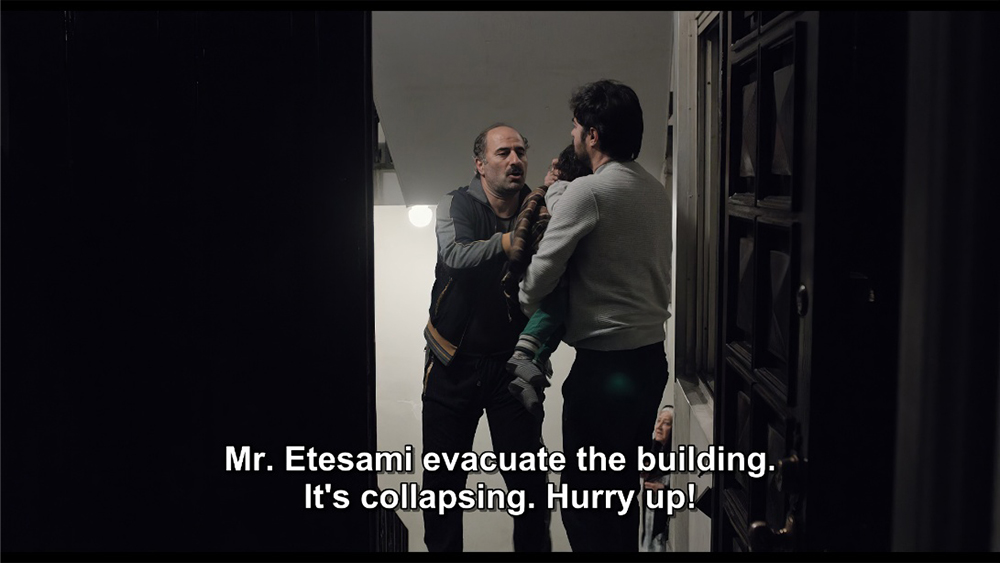
The apartment is born as a moral stage, charged with the residue of public danger and tasked with hosting testimony, suspicion, and care at household scale (see Figure 2).
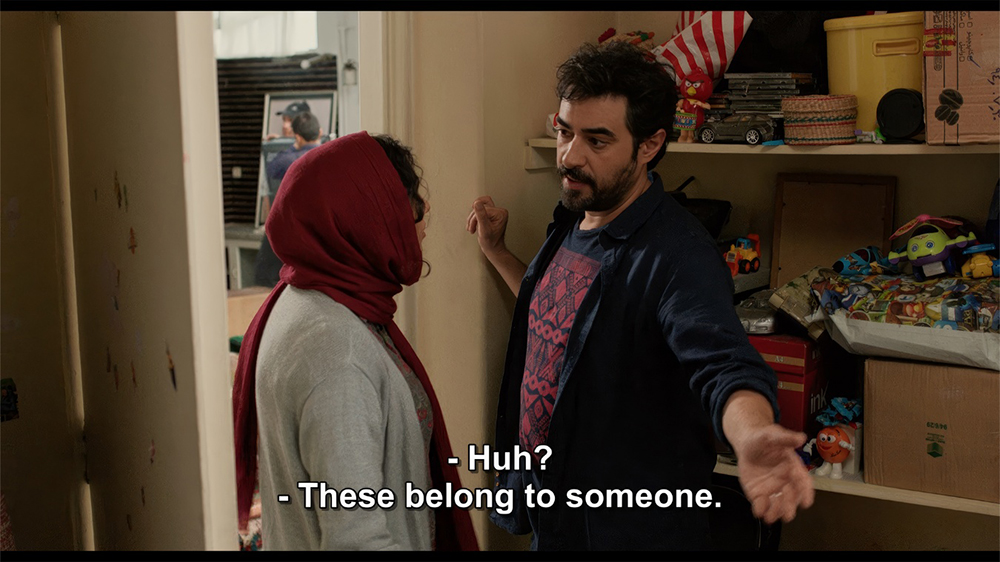
Because relocation is compelled, the dwelling bears the stress-marks of haste and adjacency; the film reframes these as spectatorial conditions. The script pivots to the banal instruments of habitation, keys, doors, intercoms, anchoring practicalities that become ethical thresholds: “Where’s the apartment key?” (The Salesman 00:27:57). The line cues a regime in which access and refusal matter, as the camera learns to wait at doorframes and listen through walls. Miller builds an equivalent optics into the Lomans’ house, which the audience first sees as a besieged enclosure: “a solid vault of apartment houses around the small, fragile-seeming home” (Death of a Salesman 11).
If Farhadi’s corridor shots train us to treat the threshold as an ethical checkpoint, Miller literalizes that training as stage-protocol: in the present, “the actors observe the imaginary wall-lines, entering the house only through its door,” while the past violates the rule as bodies step “through” walls (Death of a Salesman 12).
Willy’s exhausted return repeats the key-question as practice rather than dialogue—“He unlocks the door … He closes the door”—so that entry itself becomes a performed claim to privacy that the setting cannot secure (Death of a Salesman 12).
Neighbors seal the move as relation rather than backdrop: “We’ve just moved in. Could you let me in?,” a request that folds hospitality and surveillance into the same gesture (The Salesman 00:27:57). Miller’s neighborly adjacency is just as invasive, rendered as acoustic leakage and social proximity: “Can’t we do something about the walls? You sneeze in here, / and in my house hats blow off” (Death of a Salesman 42).
Like shot/reverse-shot as a learned “stylistic convention,” these access rituals become protocols that steer attention and judgment (Bordwell 60), until “home” reads less as refuge than as the exposed surface where a lifetime’s labor culminates in dispossession: “Work a lifetime to pay off a house. You finally own it, and there’s nobody to live in it” (Death of a Salesman 16).
Even when resolve falters, “but we look for an apartment today,” the trajectory remains inward, toward an interior where looking is regulated domestically rather than civically (The Salesman 00:52:11). By the time a pivotal confession arrives, “My wife and I moved into a new apartment,” the line functions less as exposition than as an index of the apartment’s narrative centrality; the flat is the arena (The Salesman 01:29:27).
Once installed, the film builds its ethics of spectatorship from diegetic noise and spatial misrecognition, repeatedly asking characters and viewers to correct where sounds come from and what they imply. Farhadi engineers ambiguity through focalization and shared knowledge gaps (Serrano). A tossed-off correction, “No, that was next door,” becomes the early tutorial in adjacency: meaning depends on which wall a sound crosses and who claims it (Vahdat 64–66; The Salesman 00:09:19). Later testimony amplifies the map, “We heard cries from upstairs… then we heard running on the stairs,” turning vertical and horizontal axes into lines of evidence (The Salesman 00:29:49). Viewers learn to work like residents: localize the source, infer the event, and accept sonic porosity as both resource and risk. Household hearing replaces the public’s panoramic view as moral labor, exactly the kind of labor Miller bakes into Death of a Salesman, where sound arrives before stable sight (“A melody is heard, played upon a flute” [Miller 11]) and where neighborly listening functions as emergency epistemology: “I heard some noise. I thought something happened,” Charley says, before naming the wall itself as the condition of misrecognition: “You sneeze in here, and in my house hats blow off” (Miller 42).
Even more sharply, Miller scripts sonic bleed as ethical scandal: “From the darkness is heard the laughter of a woman” beneath Linda’s assurances (Miller 38), and then “The Woman bursts out laughing, and Linda’s laughter blends in” (Miller 39), forcing the spectator to do what Farhadi’s apartment demands: separate sources, register contamination, and read sound as evidence that domestic boundaries are never merely architectural.
Thresholds and doors emerge as signature operators, converting movement into claims and refusals into scenes. The home is mediated by small mechanical acts, “buzzed the door open and went back in,” that relay public and private through a button, a corridor, and the pause of a half-open frame (The Salesman 00:39:08). In Theory, Culture & Society, Georg Simmel frames the door as a social technology of the limit: “separating and connecting are only two sides of precisely the same act” (7), and because it can be opened, its closure intensifies isolation beyond the “mute” wall, since “the door speaks” (7). In The Salesman this doubleness sharpens into cinematic ethics: doorways become thresholds where psychological tension and spatial transition converge, and everyday mechanisms mediate cultural and emotional boundaries. Hence the choreography of apertures acquires moral charge. “Leave the door open” instructs care and witness (The Salesman 00:33:33). Later, the imperative hardens into command, “Why should I? Open this door!,” and a request for entry becomes an ethical test that organizes blocking, camera placement, and the distribution of knowledge across a threshold (The Salesman 01:36:55). The apartment, like a proscenium, fixes the line across which bodies appear, vanish, and are judged.
Miller literalizes the same door-logic as theatrical law. When the action is “in the present,” actors must “enter[] the house only through its door,” as though realism itself were a discipline of thresholds; memory then violates that discipline by stepping “through” walls, turning the doorway into the sign of social legibility rather than mere architecture (Miller 12). The play’s first movement already makes entry a claim: Willy “unlocks the door” and then “closes the door,” a ritual of enclosure that tries to keep the world outside even as the staging insists the house is structurally porous (Miller 12). In the Boston episode, the door quite literally “speaks” as accusation: “Knocking is heard,” and The Woman demands, “Aren’t you going to answer the door?,” while Willy’s denial, “They’re knocking on the wrong door,” recasts threshold-management as moral misdirection (Miller 114). That pressure culminates in the play’s most brutal tutorial in access and refusal: Biff’s insistence (“Why didn’t you answer? I’ve been knocking for five minutes”) meets Willy’s flimsy alibi (“I was in the bathroom and had the door shut”), so that “answering” becomes an ethics of exposure rather than courtesy (Miller 118). Even Willy’s later disorientation condenses the threshold into pure command: “Open the door. / The washroom … the door … where’s the door?,” as if the capacity to locate an exit were inseparable from the capacity to keep a life narratively sealed (Miller 115).
This domestic proscenium also answers regulation. Naficy shows how constraints on the display of bodies and intimacy prompt “creative methods of using framing, composition, and lighting as veil,” effectively turning form into a figurative hijab (158). Doors, corridors, and reflective surfaces thus veil and reveal, allowing suggestion without exposure and proximity without transgression. More broadly, the apartment can be mobilized as a pressure instrument: “Parviz films inside the couple’s apartment, with frequent intrusive zoom-ins and claustrophobic framing,” making home an engine of surveillance rather than refuge (Naficy 234). The Salesman harnesses the same infrastructure, tight framings, blocked sightlines, offscreen voices, to translate conflict into the scale and ethics regulation permits. Spectacle is not abandoned but domesticized: the collapse motivates relocation; the apartment furnishes the means to stage consequence.
Every choice, who hears what, who controls which door, who is left at the threshold, reads as evidence because spectatorship has been re-sited as household work. The domestic proscenium is founded twice: first by evacuation’s shouted urgency, which forces the narrative indoors, and then by the film’s pedagogy in adjacency and access, which teaches us how to watch there (The Salesman 00:00:00, 00:09:19, 00:39:08). Farhadi’s camera, like his characters, learns to live with walls and, in learning, converts the apartment into a stage where seeing and being seen must answer to the ethics of the close.
5) Dressing rooms & rehearsal: intermedial bleed
Farhadi’s rehearsal and dressing-room passages, costume, mirror, call-cue, makeup, are not preliminaries but intermedial shuttles: they ferry judgment from stage to apartment, where it is adjudicated at household scale (see Figure 3).
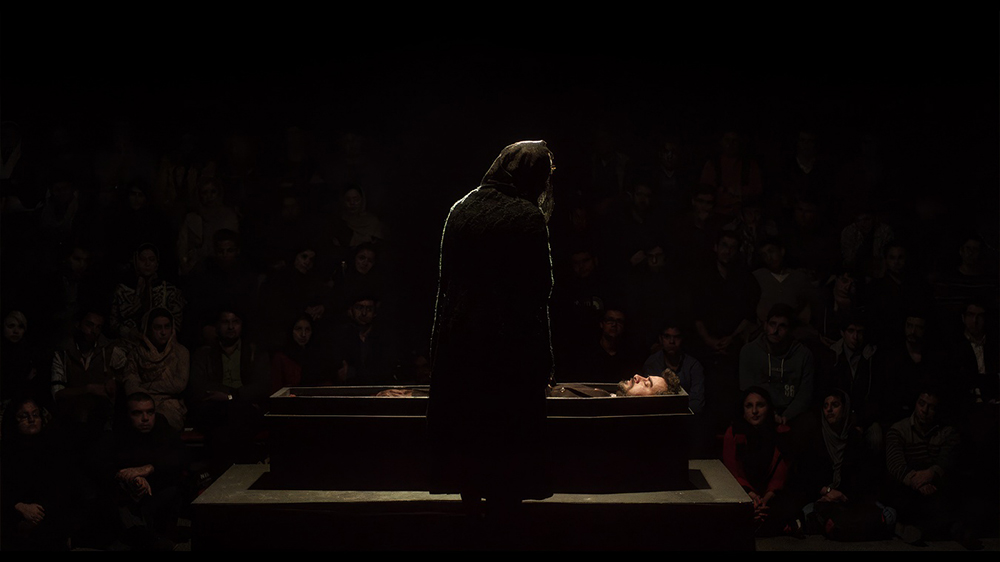
Miller anticipates this drift by giving the Loman home a liminality that denies privacy, “an air of the dream… rising out of reality” (Miller 12). The house is less sanctuary than antechamber to exhibition.
Farhadi radicalizes the inheritance. Architecture in The Salesman functions as a semiotic system “represented based on semantic purposes,” projecting psychology, ambiguity, and ethical dissonance. Corridors, mirrors, and dressing rooms mediate visible/hidden and appearance/judgment. Elleström helps name these repeatable shifters as media operations, patterned changes across “material, sensorial, spatiotemporal and semiotic” modalities (16). Hutcheon’s “second without being secondary” reframes the payoff: reception is coached across thresholds, not measured by plot sameness (28).
Miller models the bleed through sound: Uncle Ben arrives by cue, “Ben’s music is heard,” which re-times looking and listening (Miller 44). Farhadi’s muffled calls, bells, and buzzers perform the same function; a knock or shouted cue forces entry, refusal, or explanation that will be re-argued in the apartment. These are the film’s operational toggles; stage calls converted into domestic ethics.
The mirror is not neutral (see Figure 4).
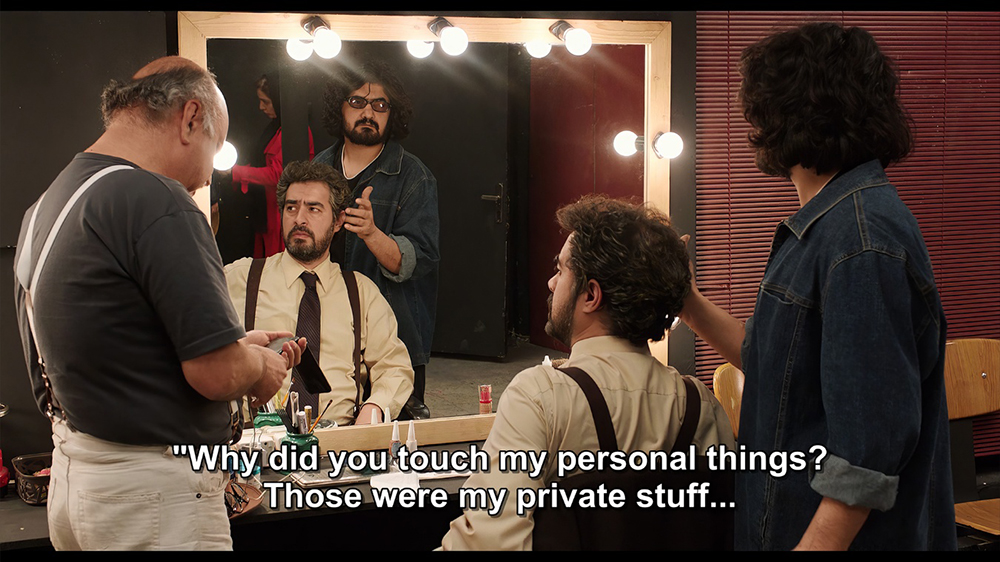
In Farhadi, it is a surface where self-presentation is negotiated under watch; in Miller, Biff’s “You—you gave her Mama’s stockings!” turns an intimate commodity into a reflective index that crosses rooms and returns as evidence (Miller 121). Cosmetics and costume in The Salesman inherit this role: what is donned backstage is read in kitchen, corridor, and bedroom mirror. Elleström’s “interferences” clarify the mechanism (16); Hutcheon’s reception-focus clarifies the task: spectators must recall where a sign first appeared and under which rules (28).
Offstage sound supplies another operator. Miller stains the present with displaced audio: “From the left, The Woman laughs,” carrying accusation without exhibition and obliging intrafamilial witnesses to judge what they cannot see (Miller 113). Farhadi amplifies these acoustics: calls and chatter leak through doors; a public line rebounds as private wound. The question is not that sound travels, but how it re-indexes responsibility, who owes explanation to whom inside the apartment.
Costume, finally, is an ethics of circulation. Miller catechizes success as a dramaturgy of surfaces and proximity: “They know me, boys, they know me” (Miller 31). Farhadi literalizes and redirects it: garments, makeup, posture are calibrated for recognition outside the house, then reread at home as grounds for suspicion or care. Function is preserved without iconographic duplication; appearance remains moral currency migrating between theatre and kitchen.
Miller’s domestic stage assigns the first audience role to family, “Biff and Happy… in their beds, listening,” so household eavesdropping becomes the ur-form of spectatorship (Miller 18). Farhadi extends this by installing diegetic viewers, spouses, neighbors, the camera, akin to the “positive and interactive viewer” shaped by Brechtian distancing and spatial composition (Fahimi Far et al. 2019). Blocked sightlines, overheard talk, and performances-within-performances render the apartment a recursive spectatorial space: the family watches, is watched, and is implicated.
Miller’s environmental scene switches give license to Farhadi’s bleed: “The apartment houses are fading out… leaves… Music insinuates itself” (Miller 27). Farhadi carries backstage noise and light across thresholds, so quarrels at home bear the theatre’s color and tempo, Hutcheon’s palimpsest made legible (28). In sum, the dressing room is not a detour but the hinge by which the ethics of theatrical seeing becomes the ethics of domestic judgment.
6) Apartment realism: thresholds, offscreen voices, and the final confrontation
In the climax, the apartment becomes the instrument of judgment: doors, corridors, and offscreen voices supply the grammar by which guilt, dignity, and repair are argued. Threshold control is the first principle. “Why should I? Open this door!” fixes the door as moral hinge, staging the confrontation as compelled crossings and refusals (The Salesman 01:38:26). Spectatorship turns household and partial; we watch like neighbors, hearing, inferring, taking sides from the wrong side of a barrier.
Humiliation arrives not through spectacle but through ordinary undressing. “Sit, and take off your shoes… The socks” renders the old man legible via minor removals at the doorway; chair, laces, and frame become agents of adjudication (The Salesman 01:38:34, 01:39:02; see Figure 5).
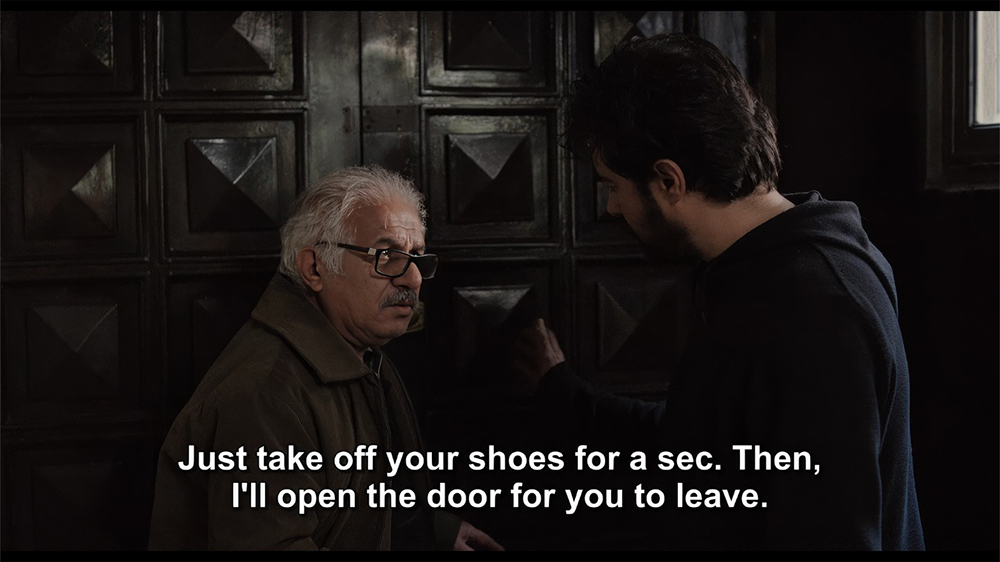
In humiliation research, the experience is often theorized as unjust devaluation under power asymmetry, paired with a felt inability to answer back, and frequently tied to the presence, or pressure, of an audience (Leidner et al. 2). Farhadi withholds the square yet preserves the interpersonal gaze, transposing humiliation into intimacy, quieter, no less absolute: a corridor ritual that stages what Harold Garfinkel calls a “status degradation ceremony,” communicative work in which a person’s “public identity” is “transformed into something looked on as lower” (Garfinkel 420).
Apartment realism replaces the crowd’s stare with the corridor’s hush, making harm legible in fabric friction, a paused lock, a stuttered plea. Miller’s “The door of your life is wide open!” is inverted: the closed door becomes the index of power, rerouting providence into the politics of a latch (Miller 132). Offscreen address recasts the encounter as performance before an imminent audience: “Don’t humiliate me in front of my family… My daughter’s getting married” grounds the plea in kinship and stage propriety (The Salesman 01:45:15, 01:45:25). The point is not that the apartment merely contains humiliation, but that it miniaturizes its public logic: honor is calibrated by who stands, or might stand, just beyond the door; vengeance moves from street to stairwell.
Sound completes space’s conversion into ethics. Panic turns physiological: “I’m claustrophobic. Please, open up… At least, turn on the light” (The Salesman 01:46:32–01:46:39). Light and air, not graphic display, become moral media; camera-to-threshold distance replaces ocular proof as the measure of cruelty. Elleström’s terms fit: the sequence modulates “material, sensorial, spatiotemporal and semiotic” channels, cueing judgment by constrained vision, strangled acoustics, and timed entrances rather than by revelation shots (Elleström 16).
When the door yields, the household forms a chorus (see Figure 6).
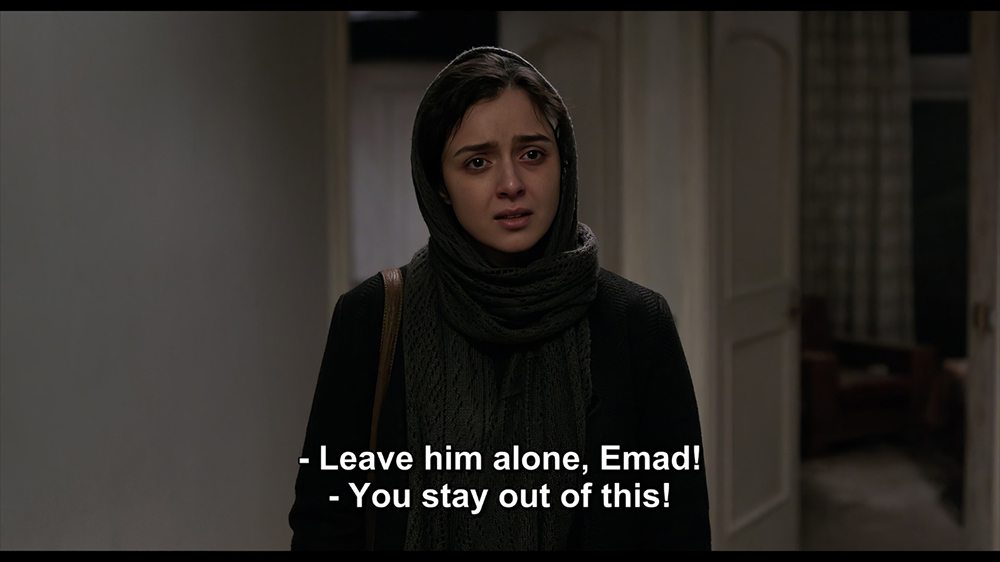
“That’s the ambulance? No, his family,” then, “Can you find a pulse? Is his heart beating?” Judgment is performed as overlapping voices, footfalls, instructions on a landing; acoustics do what a tribunal once did (The Salesman 01:51:26–01:51:37). Care literalizes as collective act: “Do a heart massage, till the ambulance arrives,” so punishment and first aid blur within the apartment’s narrow geometry (The Salesman 02:01:04).
Read against Miller, masculine dignity and providence refract through household honor. “I am not a dime a dozen!” clarifies Emad’s aim: to wring a confession as repair for a wounded domestic economy (Miller 132). Yet vengeance meets bodily frailty; Linda’s “A small man can be just as exhausted as a great man” finds its correlative in collapse (Miller 56). The apartment scale forces care and cruelty into the same frame: what might read as righteous exposure in public reads, at home, as a sick man’s panic staged among ordinary furniture (see Figure 7).
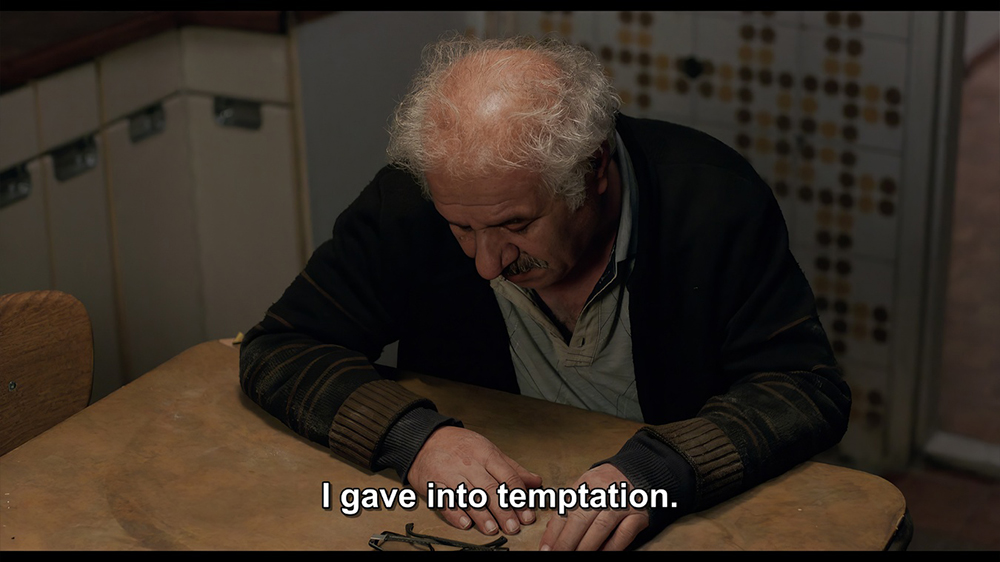
Farhadi intensifies the intermedial stitch by letting theatre bleed into the domestic present. “I made the last payment on the house, today… We’re free and clear” floats in at peak pressure (The Salesman 01:47:16–01:47:30), echoing the Requiem’s toll, “We’re free and clear” (Miller 144), now set against a locked door, a gasping elder, a stairwell family. The dream of clearance overlays a scene of entanglement, aligning reception across stage and apartment.
The climax is also a regulatory solution. As Naficy shows, post-revolution filmmakers “developed creative methods of using framing, composition, and lighting as veil,” staging intimacy and conflict within limits (Naficy 124). Darkened thresholds, withheld sight, proximate sound are precisely such veils, permitting proximity without transgression and delivering ethical shock via thresholds. Substitutes and mediations offset “no touching” rules (Naficy 124); Farhadi’s locked door, muffled pleas, and family chorus transmit intimacy, shame, and restitution without violating representation.
Charley’s mercy, “Nobody dast blame this man,” tests the aftermath but finds no purchase on these surfaces (Miller 138). The apartment remembers acts, not verdicts: a scuffed sock, a key, a door. By forcing the decisive choice at a threshold, in half-light, under breath, to offscreen rhythms, the film realizes apartment realism’s consequence: spectatorship reduced to the intimate, where every inch of corridor is an ethics and every closed door remembers who closed it. Thus, Miller’s tragic providence is converted into a Tehran-specific ledger of honor, care, and restitution, written in doorways, heard through walls.
7) Situational equivalence in practice
Read together, the film’s founding spatial breach, its temporal convulsions, and its sensorial excess show how The Salesman translates Death of a Salesman at the level of function, not icon, what I call situational equivalence.
Miller already defines the house as a switchboard between lived space and imagined scene: “the forward area serves as the back yard as well as the locale of all Willy’s imaginings and of his city scenes” (Miller 12). Farhadi inherits this double duty by making doors and corridors do forestage work. Stage-side urgency becomes domestic protocol, “Hurry up. The doors open in five minutes,” so logistics of performance are naturalized as ethics of household access (The Salesman 00:27:25). In both texts, space operates attention; apartment thresholds translate Miller’s imaginary wall-lines.
Temporal convulsion, Miller’s practice of shifting time by environmental change, finds a domestic analogue. “The apartment houses are fading out… leaves… Music insinuates itself” trains spectators to read time through light and sound (Miller 27). Farhadi imports this logic at apartment scale: “Careful with the ceiling light… Turn out the light” makes illumination, not a flashback marker, toggle moral register (The Salesman 00:20:02; 00:34:14). Fidelity here means preserving spectator labor, recalibrating looking and listening as the environment turns.
Sensorial excess, overlapping calls, offscreen voices, edge-of-frame textures, maps onto Miller’s insistence that social value is how one is seen and heard. “They know me… up and down New England” equates worth with recognizability (Miller 31). In Tehran’s apartment grid, recognizability becomes audibility and adjacency: family, neighbors, stairwells supply the chorus, and the decisive audience is the household, “His family is on the way,” whose judgment precedes the state (The Salesman 01:47:38). The spectator’s stance is domesticated: overhear, localize, weigh a plea through a door.
These mechanisms answer the fidelity trap Leitch identifies. Rather than replay iconography, the film preserves functions that force spectatorship to work indoors (Leitch 142). Spatial breach becomes control over entry and exit. Miller already anchors value in the home’s economy, “Work a lifetime to pay off a house…” (Miller 15). Farhadi updates the tally with keys and latches, “Lock the door and take the key,” and with queries that turn doors into evidence: “Why did she open the door?” (The Salesman 01:46:27; 01:41:34). The apartment is not a container but the ledger, its thresholds the line items, continually annotated by witness statements (“When Mr. Alimoradi opened the door… He’ll leave with his family… If you talk to his family, it’s over between us”: The Salesman 00:51:22; 01:49:24; 01:52:07).
Time, likewise, is made rather than given. Miller’s music/foliage cues make scene changes felt; Farhadi’s domestic cues do the same. Born of collapse and relocation, apartment time is porous, interruptible by doorbells and stairwell shouts, urban pressure rewritten at corridor scale.
With sensorial excess, the film escalates what the play seeds: Willy’s catechism of being seen and “liked” becomes a hallway ethics of being heard and answered (Miller 31). Messages ricochet between rooms; judgment accrues by accumulation, not decree, each utterance repositioning relations across a threshold (The Salesman 00:51:22; 01:49:24; 01:52:07).
Framed this way, “Tehranizing Miller” aligns with Sanders’s appropriation: accountable to local conditions, not a betrayal (Sanders 21). As Naficy shows, post-revolution filmmakers “developed creative methods of using framing, composition, and lighting as veil,” devising substitutes to offset “no touching” rules (157). Farhadi’s apartment realism is exactly such a method: thresholds, partial light, and proximate sound perform the veil; door control and offscreen address perform the substitute. The equivalence is situational twice over, keyed to Iranian regulation and faithful to Miller’s situational ethics.
If fidelity tempts us to measure sameness, situational equivalence measures spectator work. In Miller, the house doubles as yard and mind; in Farhadi, the apartment doubles as stage and tribunal (Miller 12). In Miller, time breaks with environment; in Farhadi, with lights, calls, and doors (Miller 27; The Salesman 00:20:02; 00:34:14). In Miller, value is “being known”; in Farhadi, it is being answerable in a hallway (Miller 31; The Salesman 01:47:38). Across these relays, the film stays faithful to how the play organizes seeing and judging, and to where such organization can be shown: a functional translation that keeps spectatorship intimate, ethical, and inescapably at home.
8) Counterarguments & limits
Objection 1: “It’s just fidelity.”
If Farhadi’s film looks “close” to Miller in its domestic focus, one might argue that the analysis merely redescribes fidelity. But what appears as sameness is better understood as functional transfer. Leitch cautions that fidelity as a default metric mistakes a narrow benchmark for a theory of adaptation; in his terms, fidelity is the exception, not the rule (142). Hutcheon likewise re-anchors evaluation in process and reception, urging us to track what spectators are asked to do rather than what objects recur (28). On this view, the apartment in The Salesman is not a reproduced icon from Death of a Salesman; it is the translated operator of spectatorship. Miller’s stage directions already make the house a device that toggles regimes of seeing: present action respects “imaginary wall-lines,” while past scenes “break” them by stepping “through” walls (Miller 12). Farhadi’s thresholds, offscreen voices, and corridor framings perform the same labor under different constraints, exemplifying situational equivalence rather than fidelity-as-sameness.
Objection 2: “You’re over-reading censorship.”
A skeptic might claim that doors, partial light, and offscreen address are simply Farhadi’s stylistic choices, not regulatory accommodations. Yet Naficy documents the post-revolution industry’s systematic masking and oversight practices, from “no touching” rules to the use of framing, composition, and lighting as veils that both conceal and reveal, showing how filmmakers engineered formal substitutes for prohibited displays (157–59). Read against that archive of solutions, the film’s reliance on thresholds and proximate sound is legible as more than personal style: it is a historically available repertoire of indirection.
The climax, a locked door, withheld sight, and family voices compressing in a stairwell, aligns closely with that recorded repertoire, enabling intimacy, shame, and restitution to register without violating codes. Intermedial evidence, how cues operate and relocate spectatorship, and the regulatory record, how bodies, interiors, and contact are governed, thus converge as mutually reinforcing explanations rather than competing ones.
9) Limits and Transferability
This study analyzes a single urban-apartment film; its mechanisms—spatial breach, temporal convulsion, sensorial excess—are demonstrated in that locale. The framework risks overfitting if applied uncritically elsewhere. Two tests follow.
First, intra-director: do Farhadi’s other urban films mobilize doors, offscreen sound, and corridor sightlines as ethical operators to comparable effect, or does the repertoire shift with setting and genre? Second, cross-regime: in cinemas under different representational constraints, do apartment-scale mechanisms still translate stage ethics into domestic spectatorship, or do other substitutes, such as public institutional interiors, assume the mediating role?
Because adaptation here is framed as operation rather than icon, negative results are as instructive as confirmations: they mark the boundary conditions of “Tehranizing Miller” as an appropriation accountable to local constraint (Sanders; Naficy). The claim is deliberately modest: The Salesman shows how a regulated cinema can translate Miller’s house-bound ethics of looking into a contemporary apartment without falling into the fidelity trap. The next step is to test where, and why, that translation travels or fails to (Leitch 142; Hutcheon 28; Naficy 157–59).
10) Conclusion: Contributions & future work
This article argues that situational equivalence and apartment realism explain how The Salesman translates Death of a Salesman at the level of function, not icon. Rather than measuring sameness, I track what the film makes spectators do: reorient perception after spatial breach, negotiate meaning through temporal convulsion, and render judgment amid sensorial excess. In Miller, the house is a switchboard routing present and past, public and private, through staging rules; in Farhadi, the apartment inherits that work through thresholds, door control, and offscreen address. The result is an intermedial relay that preserves the play’s ethics of looking under Iranian constraints while avoiding the fidelity trap (Leitch). Read through Hutcheon’s process/product/reception model, the emphasis shifts from replicated motifs to coached reception; read with Sanders and Naficy, “Tehranizing Miller” registers as an appropriation accountable to local representational protocols rather than as deviation from an ideal source.
Methodologically, the payoffs are twofold. First, coding thresholds, doors, mirrors, and on/off-axis sound operationalizes intermedial analysis at shot scale: doors become devices, not décor; offscreen voices become cues, not conveniences. Second, coupling micro-analysis with regulatory history accounts for recurrence and ethical charge: translation under constraint reallocates spectacle to domestic optics and acoustics rather than curtailing ambition.
The comparative horizon is wide. Within Farhadi’s oeuvre, one can test transferability: do stairwells, buzzers, and corridors continue to adjudicate conflict and care, or do other interiors, offices, clinics, schools, assume the mediating role? Across stage-to-Tehran adaptations, future work can inventory how rehearsal paraphernalia migrate into apartments and whether analogues to Miller’s stockings, cosmetics, towels, latches, operate as transmedium indices of intimacy. Cross-regime comparison adds a counterpoint: in less regulated cinemas, does spectatorship remain domesticated, or does ethical judgment drift back to civic panoramas (streets, courts, hospitals)? Negative findings matter as much as confirmations, marking where situational equivalence activates and where iconographic fidelity reasserts itself.
Two extensions follow. A Bordwell-inflected poetics can refine the inventory by charting shot scale, blocking paths, and narration schemas across the three mechanisms, modeling how viewers are positioned to infer, doubt, and decide. A paratextual reception study, programs, advisories, reviews, subtitling, can gauge how institutions pre-cue audience labor differently for stage and screen. Together, these paths keep focus where adaptation under constraint actually lives: in the work of spectatorship.
In The Salesman, that work is household work, performed in doorways, timed by offscreen voices, and remembered by walls.
Appendix A
Table A1. Operators, operational definitions, and descriptive totals (n)
Operator |
Operational definition (coding rule) |
Total (n) |
Threshold/ door event |
Any cue in which a door, threshold, corridor, stairwell, or entry point organizes access, withholding, or passage and thereby calibrates vantage, evidence, or risk. |
47 |
Mirror-coded reframing |
Any reflection shot or mirror-mediated framing that repositions viewpoint, redirects attention, or reframes what counts as knowable within the scene. |
19 |
Offscreen-voice cue |
Any diegetic voice or salient sound from offscreen that redirects attention, inference, or moral orientation, including cues that arrive before the source is shown. |
33 |
Works Cited
Bloom, Harold, editor. Arthur Miller’s Death of a Salesman. Updated ed., Chelsea House, 2007.
Bordwell, David. Poetics of Cinema. Routledge, 2008.
Bortolotti, Gary R., and Linda Hutcheon. “On the Origin of Adaptations: Rethinking Fidelity Discourse and ‘Success’ Biologically.” New Literary History, vol. 38, no. 3, 2007, pp. 443–58. https://doi.org/10.1353/nlh.2007.0038.
Centola, Steven R. “Family Values in Death of a Salesman.” Arthur Miller’s Death of a Salesman, edited by Harold Bloom, Chelsea House, 2007, pp. 29–41.
Elleström, Lars. “The Modalities of Media: A Model for Understanding Intermedial Relations.” Media Borders, Multimodality and Intermediality, edited by Lars Elleström, Palgrave Macmillan, 2010, pp. 11–48.
Fahimi Far, Asghar, et al. “Distancing Effect and Identification of the Audience in the Film The Salesman by Asghar Farhadi and Based on the Views of Bertolt Brecht.” Journal of Dramatic Arts, vol. 26, 2019, pp. 93–124.
Garfinkel, Harold. “Conditions of Successful Degradation Ceremonies.” American Journal of Sociology, vol. 61, no. 5, 1956, pp. 420–424. https://doi.org/10.1086/221800.
Goharipour, Hamed. “Narratives of a Lost Space: A Semiotic Analysis of Central Courtyards in Iranian Cinema.” Frontiers of Architectural Research, vol. 8, no. 2, 2019, pp. 164–74. https://doi.org/10.1016/j.foar.2019.01.004.
Habibi, Mohsen, et al. “Reflection of Urban Space in Iranian Cinema: A Review of the Last Two Decades.” Cities, vol. 50, 2016, pp. 228–38. https://doi.org/10.1016/j.cities.2015.07.005.
Hutcheon, Linda. A Theory of Adaptation. Routledge, 2006.
Kerrane, Kevin. “Arthur Miller vs. Columbia Pictures: The Strange Case of Career of a Salesman.” The Journal of American Culture, vol. 27, no. 3, 2004, pp. 280–89, https://doi.org/10.1111/j.1537-4726.2004.00136.x.
Lahr, John. “Arthur Miller and the Making of Willy Loman.” The New Yorker, 18 Jan. 1999, www.newyorker.com/magazine/1999/01/25/arthur-miller-and-the-making-of-willy-loman. Accessed 27 Nov. 2025
Leidner, Bernhard, Hammad Sheikh, and Jeremy Ginges. “Affective Dimensions of Intergroup Humiliation.” PLOS ONE, vol. 7, no. 9, 2012, e46375. https://doi.org/10.1371/journal.pone.0046375.
Leitch, Thomas M. “Adaptation Studies at a Crossroads.” Adaptation, vol. 1, no. 1, 2008, pp. 63–77. https://doi.org/10.1093/adaptation/apm005.
---. Film Adaptation and Its Discontents: From Gone with the Wind to The Passion of the Christ. Johns Hopkins UP, 2007.
Marino, Stephen A. Arthur Miller’s Language: “The Poetic in the Colloquial.” 1997. Fordham University, PhD dissertation.
Miller, Arthur. Death of a Salesman: Certain Private Conversations in Two Acts and a Requiem. Penguin, 1998.
---. “Introduction.” Arthur Miller’s Collected Plays, Viking Press, 1957, pp. 3–39.
---. “Walking with Arthur Miller.” Interview by John Lahr, The New Yorker, 1 Mar. 2012, www.newyorker.com/books/page-turner/walking-with-arthur-miller. Accessed 27 Nov. 2025.
Moghimi, Habib. “Politics of Othering and Censorship in Iranian Cinema: A Butlerian Analysis of Foreclosure.” Middle East Journal of Culture and Communication, vol. 18, no. 1, 2025, pp. 76–100. https://doi.org/10.1163/18739865-01801001.
Moody, Charles Christopher. "The 1951 Filmed Version of Death of a Salesman: A Study of the Thematic Development of the Film as a Result of the Adaptation of the Play." Master's thesis, Auburn University at Montgomery, 1990. (https://digitalarchives.aum.edu/sites/default/files/2023-12/Thesis_001_Moody.pdf)
Moore, Lindsey C. “Women in a Widening Frame: (Cross-)Cultural Projection, Spectatorship, and Iranian Cinema.” Camera Obscura, vol. 20, no. 2, 2005, pp. 1–33. https://doi.org/10.1215/02705346-20-2_59-1.
Mulvey, Laura. “Visual Pleasure and Narrative Cinema.” Screen, vol. 16, no. 3, 1975, pp. 6–18. https://doi.org/10.1093/screen/16.3.6.
Naficy, Hamid. A Social History of Iranian Cinema, Volume 4: The Globalizing Era, 1984–2010.. Duke UP, 2012.
Oberg, Arthur. “‘Death of a Salesman’ and Arthur Miller’s Search for Style.” Criticism, vol. 9, no. 4, 1967, pp. 303–11.
Parker, Brian. “Point of View in Arthur Miller’s Death of a Salesman.” University of Toronto Quarterly, vol. 35, no. 2, 1966, pp. 144–57. https://doi.org/10.3138/utq.35.2.144.
Rahmani, Razieh, and Jeroen Gerrits. “The Contaminated Film’s Eye in Schlöndorff’s Death of a Salesman.” Literature/Film Quarterly, vol. 52, no. 4, Fall 2024, lfq.salisbury.edu/_issues/52_4/the_contaminated_films_eye_in_schlondorffs_death_of_a_salesman.html. Accessed 27 Nov. 2025.
Rajewsky, Irina O. “Intermediality, Intertextuality, and Remediation: A Literary Perspective on Intermediality.” Intermédialités / Intermediality, no. 6, 2005, pp. 43–64. https://doi.org/10.7202/1005505ar.
Rezaie, Niayesh. “Asghar Farhadi’s The Salesman: A Border-Crossing Adaptation in a Border-Blocking Time.” Literature/Film Quarterly, vol. 46, no. 4, 2018, lfq.salisbury.edu/_issues/46_4/asghar_farhadis_the_salesman_adaptation.html. Accessed 27 Nov. 2025.
Rodríguez Serrano, Aarón. “Structures in Crisis: A Narrative Approach to Asghar Farhadi’s Films.” Iranian Studies, vol. 53, nos. 5–6, 2020, pp. 911–24. https://doi.org/10.1080/00210862.2020.1730160.
Sanders, Julie. Adaptation and Appropriation. Routledge, 2006.
Simmel, Georg. “Bridge and Door.” Theory, Culture & Society, vol. 11, no. 1, 1994, pp. 5–10. https://doi.org/10.1177/026327694011001002.
The Salesman [Forushande]. Directed by Asghar Farhadi, performances by Shahab Hosseini and Taraneh Alidoosti, Memento Films Production, ARTE France Cinéma, and Asghar Farhadi Production, 2016.
Vahdat, Vahid. “Architectural Filth and the Heroic Passivism of Farhadi’s Salesman.” Interiority, vol. 4, no. 1, 2021, pp. 63–78. https://doi.org/10.7454/in.v4i1.115.