VOL. 54, NO. 2
Adapting Identity, Femininity, and Status in the Soundtrack of EMMA. (2020)
Amelia Fisher
Published in 1815 Emma is Jane Austen’s final ante-mortem work. It is notorious for the difficulty it presents in translating the titular character from book to screen (Vandenberg). The novel has an omniscient narrator, but is largely from Emma’s perspective, with a few small interjections from other characters. Emma’s perspective gives us an insight into her thought processes, humanizing her often cruel, and thoughtless actions. The novel follows Emma as she befriends the orphan Harriet Smith, whose parentage is unknown. Emma views herself as a matchmaker but does not aim to marry herself. The result of this is a chaotic mixture of proposals, miscommunication, and Emma discovering that her words and actions have real-world consequences, as the novel progresses. Ultimately, Harriet after many ill-advised relationship endeavors, championed by Emma, ends up with the original man she intended to marry, Mr. Martin, and Emma marries family friend Mr. Knightley.
There is a consensus that the loss of Emma’s inner voice in film adaptations makes it particularly hard to translate her “decent but self absorbed and manipulative” nature (Dick 281). Successful adaptations of this novel are credited with humanizing Emma; something that is often done through the musical soundtrack (Vandenberg). Crucially, the non-diegetic soundtrack of the 2020 adaptation privileges Emma’s point-of-view and dialogue above all else, allowing the audience an insight into Emma’s internal world, much like the use of Emma’s perspective in the novel. This also allows the adaptation to build on the idea that Emma is the center of society, whilst also giving space for internal thought. The orchestration of the soundtrack further develops the ideas of status presented throughout EMMA. (de Wilde).When being interviewed by Focus Features, Isobel Waller-Bridge discusses her “Peter and the Wolf” approach to orchestration, insofar as each character is assigned an instrument within the soundtrack (Waller-Bridge). Emma is assigned the harp and operatic vocals, whilst Harriet Smith is assigned a “folky violin.”
So far, adaptation has made up a key part of the 21st century economic capital of cinema, with the top three grossing films from cinematic franchises being adapted from either novels or comics (White 11). This suggests that there is a sense of pleasure in the remembrance or recognition of a text, but importantly there is a need for a sense of novelty in order to remain pleasurable (Hutcheon and O’Flynn 4). The sense of novelty can come from many sources, but when discussing the adaptation of classic literature, it often includes the addition of contemporary ideals within a historical backdrop (86, 152-153). There can also be a reliance on a cultural memory of the work, rather than using the text itself, thereby creating a complex relationship between adaptation and original (122). This is something which is often a central issue of adaptation study discourses, with intertextual and non-chronological frameworks being offered as ways to discuss these texts (Aragay and López 201-202; Carroll 1; Cartmell and Whelehan 4, 7; Hutcheon and O’Flynn 12).
Despite the varied discourse surrounding both issues of adaptation and film musicology in their respective fields, there has been relatively little scholarship bringing the areas together, considering the role of the musical soundtrack in relation to issues of adaptation. Natalie Vandenberg points towards Glenn Jellenick’s definition of the musical score as a “parallel text” of adaptation in her own analysis of EMMA. This concept draws on the established idea in film musicology that the soundtrack can communicate complex concepts, therefore it has a strong conative power to support and develop the visual narrative of the film (Gorbman 30). The soundtrack can draw on external intertextualities and create meaning which is independent from the outside world, through internal patterning and structuring (Cohen 105, 108). Due to the soundtrack’s integral role in connoting nuanced ideas, a key area of scholarship is issues of gender within the sonic space of film, with scholars such as Heather Laing pointing towards the problematic relationship between women and music within a patriarchal society (7). She argues that there has been an adoption of Romantic ideas of femininity within the film score, which ultimately result in a restrictive position for female characters (10). This most commonly perpetuates ideas of gender which are reductive and outdated, ensuring that society’s conceptualization of what is acceptable stays stagnant.
A key facet of feminist film musicology is the criticism of the gaze, with the soundtrack being integral to this (Buhler 366-367). In general, the gaze in film can be split into two categories: the active, which is assigned as male; and the passive, which is assigned as female (Mulvey 440, 442). This categorization particularly acknowledges the sexual imbalance between men and women that is present in a patriarchal society. Laura Mulvey argues that the darkness of the cinema promotes voyeurism, therefore because the man is active, he is projecting his fantasy of “woman” onto the female body, making the woman the “to-be-looked-at,” creating them into a sexual object (Mulvey 442). This leads to the trope in classical Hollywood of assigning the woman’s theme as the love theme, suggesting she does not exist outside of her objective as the love interest for the male hero (Buhler 367). This both objectifies women and asserts masculine control, placing the audience in the role of the man gazing at the woman (367). Ultimately, the soundtrack draws on real-world gender frameworks and intertextualities to connote ideas within the film to support and develop the narrative. Intertextuality is also an important issue within adaptation studies, therefore the consideration of the musical soundtrack as playing an integral role in the adaptation process is key to understanding the whole filmic text. It is important to note that these frameworks have been problematized due to their binary nature and assumption of heterosexuality. Robert Rushing for example presents an interesting framing of the “gaze” in terms of homosexuality (160). But their application to this film still creates some interesting results, due in part to the relationships within the film–they fall under a heterosexual framing. This article explores the relationship between adaptation and the characterization of identity, tracing how it relates to scoring practices in the contemporary heritage film by exploring three key scenes in de Wilde’s 2020 adaptation of Emma: the opening scene; the introduction of Mr. Knightley; and the ball at the Crown Inn.
Emma and Opera
The soundtrack for EMMA. places the female lead at the center of the auditory experience of the film. This is something that is apparent from the opening scene, with the silencing of the operatic vocals the first time Emma speaks, establishing the general orchestration for the rest of the film: when Emma has dialogue, there is no music (Vandenburg). Natalie Vandenburg explores this by highlighting that Emma’s emotional experience is privileged above others in the musical soundtrack of this film, for example in the dinner party that follows the Weston’s wedding, everyone but Emma is enjoying the conversation, however it is her boredom that is highlighted through the minor key and slower tempo. This is a key parameter to highlight in the soundtrack of this adaptation as the prioritization of a woman’s point-of-view musically has a long and problematic history in Hollywood (Laing 7-10). Emma is assigned two instruments, much like the other key characters in the film to develop her characterization, hers being the harp and operatic vocals. Waller-Bridge particularly wanted to use opera to “exaggerate Emma’s vanity and privilege from the very first moment we meet her” (Waller-Bridge). The idea of using opera to create a sense of class was a common phenomenon in cinema of the 1980s and 1990s (Citron 63). Despite a rising lack of detailed knowledge around individual operas in public discourse, the idea of opera to promote privilege and class has prevailed into contemporary culture. This means that there can be little question around the intention of the use of opera in this case: Waller-Bridge intends to highlight Emma’s position musically, therefore also highlighting that she is at the center of society. This is done not only through the choice of opera, but also by sonically privileging her point-of-view. Arguably, in part due to the increasing lack of generalized knowledge around individual operas, the lyrics for the non-diegetic instances of it in this film are newly composed pastiches, rather than drawing on already famous arias. This allows them to be a signifier of privilege without an expectation for the audience to understand the intertextualities of each reference. Despite this, a translation of the lyrics which accompany the opening scene of the film do provide some further insight into Emma’s characterization.
The opening scene of EMMA. implies a robotic sensibility to Emma’s character: she has woken up at dawn to pick flowers, walking in time with a ticking clock-like sound in the non-diegetic soundtrack. Moreover, she is followed by servants who are ready to bend to her every whim, including standing in a bush because it provides Emma with the best lighting for choosing her flowers. Visually, Emma is central to society and seemingly has no interest in the difficulty she is putting others in; there is a significant lack of empathy, something that will later become her undoing as it starts to affect her relationships with other characters. It is at this point we hear the first operatic utterance, which gives the audience an auditory confirmation of her privilege. A translation of the lyrics further solidifies this, as seen in figure 1.
“Come to me beautiful flowers,
How beautiful you are
As you wish, oh my perfect one
This world is mine
This world is mine
This world is yours
⎬
⎭
La, la, la, la, la
All the flowers envy you”
Initially, the lyrics could be seen as a surface level description of the scene, discussing Emma’s flower picking, alternatively the male vocal singing “oh my perfect one” could be interpreted as an unrelated declaration of love. But here it might be more appropriate to highlight the self-centered nature of the soprano lyrics, with the female voice representing Emma’s internal thoughts: a declaration of “this world is mine”, as well as asking the flowers to come to her. Therefore, instead of this being read as a declaration of love, or a simple description of the visual actions of what is happening on screen, Emma’s self-centered characterization is being highlighted, which is an aspect of her character that is particularly difficult to translate (Dick 281, 284). If we take the flowers as referring to the women of Highbury, the fictional village where the novel is set, then these lyrics are suggesting that everyone else is jealous of Emma. The soundtrack privileges Emma, these lyrics are her point-of-view, with the male vocal representing those around her who actively feed into this narrative. As Emma walks down the corridor of Hartfield at the end of the sequence, the title of the film fades onto the screen accompanied by the continued use of opera. Emma walks through the middle of her name, which is stylized with a period at the end, further cementing her as central to society, as well as the narrative.
As well as operatic vocals, Emma is also assigned the harp, an instrument which can be heard accompanying the vocals in this scene (Waller-Bridge). In Regency England, the Errad Grecian Harp was a popular status symbol and arbiter of femininity, alongside the piano (Poulopoulos 170, 223). For many, the harp showcased a refined upbringing, further cementing ideas of privilege (202). Much like the piano, it was a heavily feminized instrument, being an acceptable way to showcase aspects of the female body without becoming scandalous (170). Given that we first hear the harp accompanying the operatic singing at the start of the film, whilst Emma is picking flowers, this could show her status of ideal “femininity,” or more importantly that she believes she has achieved the ideal if we consider the soundtrack as being centered around her.
While this sense of entitlement and privilege in the opening scene both visually and sonically contrasts with the idea that Emma must be humanized to be successfully translated from book to screen, presenting her character in this way immediately communicates her flaws to the audience. This makes Emma’s emotional development paramount to her humanization as the story continues. By intrinsically linking Emma to this aspect of her character through the soundtrack, it sets up the sonic space of this film as a key facet of the adaptation process – the soundtrack here is adding the third person narrative information that can often be lost in novel to screen adaptations (Vandenberg). In positioning the soundtrack as a key facet of Emma herself, it allows for another form of communication, ensuring that the musical non-diegetic soundtrack creates a space for her internal thoughts, highlighting her lack of awareness for others at the start of the film, and her thoughts of her place in society. Moreover, by making use of a pastiche of Italian opera, discussing arguably trivial concepts such as flowers, rather than an already existing work with intertextualities of its own, this adds a light, playfulness to the soundtrack, helping to communicate the humorous elements of the novel which are key to Austen’s work (Harewood House Trust 18). Whilst on the surface by highlighting her lack of awareness might dehumanize her, the very act of showcasing these humanizes Emma, as they are flaws, something which becomes apparent as the film progresses and she develops more complex emotions, with the soundtrack appropriately responding to this.
Adapting Love: Mr. Knightley’s theme
Discussion of representations of gender in the film soundtrack tends to focus on femininity and the often-restrictive position of female characters. But as Haworth argues, the soundtrack can be just as restrictive for male characters (119). Throughout EMMA. Mr. Knightley is characterized as the sensible, masculine, if slightly eccentric eventual love interest for the titular character. He would rather walk across fields to Hartfield than take a carriage, and he often comments on the impact of Emma’s actions towards other people, but supports Mr. Martin in his proposal to Harriet, as well as standing up for Miss Bates, who has fallen on hard times (de Wilde). This characterization is also supported by the soundtrack, with his assigned instrument being the French horn, an instrument which Waller-Bridge describes as “noble” (Waller-Bridge). Aside from the composer’s opinion about the instrument, horns have long been associated with the military and hunting (Ratner 18). This not only places Mr. Knightley in a limiting masculine space, by drawing on the intertextual semiology of the French horn, but also like Emma, he firmly establishes his status in society–he is at the top. During the Regency period, sports such as fox and deer hunting were still reserved for the landed elite, it was not until the end of the nineteenth century that the sports would democratize to include farmers, among others (de Belin 142). However, today they are still viewed as both exclusive and elite (142). This means that the use of the horn and its association to hunting still allows it to signal Mr. Knightley’s status at the top of society. Despite this association to hunting, the initial introduction to Mr. Knightley’s theme does not have the fanfare-like quality that we might expect, it has a much slower tempo, with a more lyrical feeling to it, as seen in example 1. 1
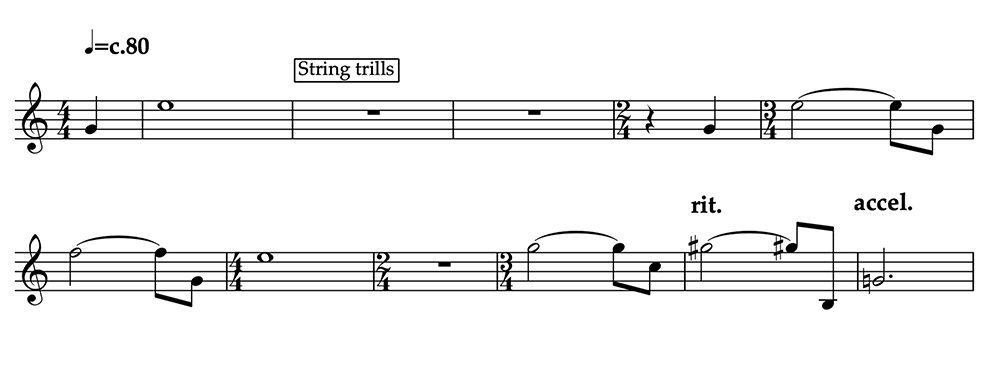
As seen in example 1, there are generally large leaps between pitches, with use of ties to lengthen the duration of many of the notes. This theme stands in a stark disparity to the music already heard at the point in the film it first appears. Prior to this, much of the non-diegetic music has made use of shorter durations, with a “busier” texture, in that multiple instruments can be heard at once interweaved together. By contrast, when Mr. Knightley’s theme is first heard there is only the French horn playing the melody, alongside a string accompaniment. This signals that whilst Mr. Knightley’s theme belongs to the non-diegetic space of the film, he is outside of Emma’s influence, musically foreshadowing him as one of the only people in Emma’s life who can hold her accountable for her actions. However, the large leaps and sparse texture of the theme continue a sense of irony and playfulness that is key to translating Austen’s work (Harewood House Trust 40). In part this sense of lightness comes from taking a stereotypical musical representation of masculinity, the French horn, and combining it with the non-fanfare like intervallic leaps and a lack of militaristic rhythm and virtuosity (Ratner 16). Therefore, this satirizes what might initially be taken as a “heavy-handed” approach to signaling a male character, instead by undermining it with non-militaristic characteristics it semiotically implies the “Austen” lightness. But this theme falls into, as Vandenburg defines it, the “beautiful” style of the film. She argues that the soundtrack for EMMA. can be categorized into two: an “ornamental” style which is closely matched with the onscreen action and may result in a comedic effect; and a “beautiful” style which is more lyrical and focused on the overall emotional tone of a scene (Vandenberg). She argues that the second half of the film is where the “beautiful” style takes over from the previous “ornamental” one, in part to showcase Emma’s more serious emotions. Narratively, it would make sense that Mr. Knightley’s theme falls under the “beautiful” style of the second half of the film, as it is not until this point that Emma starts to realize the depth of her feelings for him. Therefore, we are given a snapshot of his theme in the first half of the film, which interrupts the musical stylization thus far. This highlights him as a character that can comment on Emma’s behavior, but also denotes Mr. Knightley as a potential love interest, creating this into a form of love theme for the adaptation. However, because the non-diegetic soundtrack, as discussed is from the point-of-view of Emma, we will not hear this theme again until Emma starts to explore more complex emotions in the second half of the film. This is summarized in table 1.
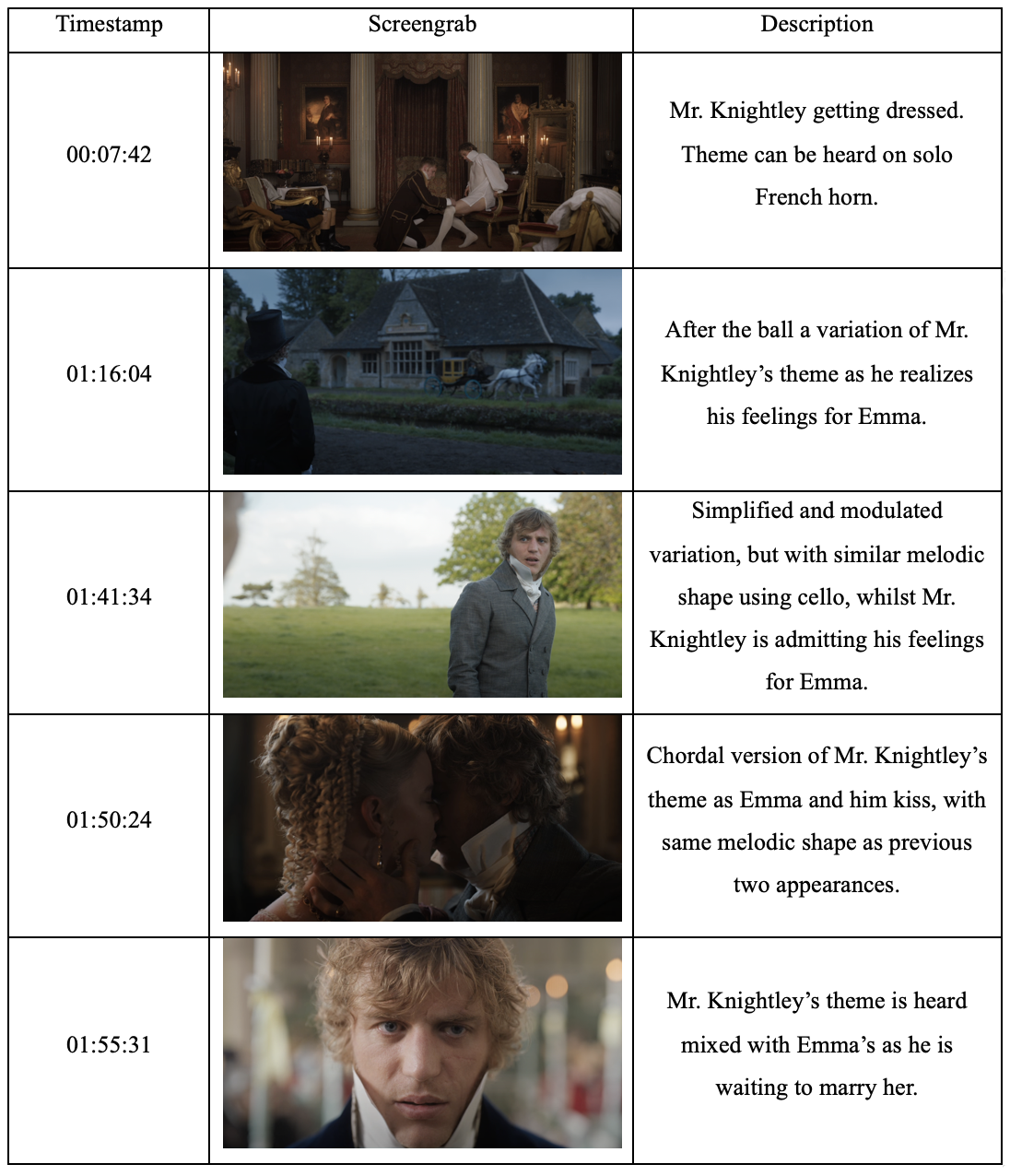
As seen in table 1, whilst this theme is labelled as the “Mr. Knightley” theme in the soundtrack album, every time except from its first appearance it relates to Emma and Mr. Knightley’s relationship, therefore suggesting it can also be considered as a love theme in this film. All other iterations are found in the second half of the film, arguably highlighting Emma’s control over the non-diegetic narrative space of the soundtrack. The connection between Mr. Knightley and the love theme is unexpected, as often when a love theme is also a character theme it belongs to a woman, which brings about questions around whether she exists outside of her relationship with the male hero (Buhler 366-367). Additionally, there is an expectation that a film is viewed from a male-dominated point-of-view. When the audience is introduced to Mr. Knightley it is through a “getting dressed” sequence, which includes multiple shots of the character in various stages of undress. Such sequences are frequently used in heritage film and television, such as when Mr. Darcy is having a bath in the first episode of the 1995 BBC television adaptation of Pride and Prejudice (Davis and Langton). Interestingly in both adaptations the “getting dressed” sequence is new material, neither having similar scenes in their respective novels. It is a commonly noted phenomenon that adaptations add new material for entertainment purposes (Aragay and López 206-207). In this television adaptation of Pride and Prejudice the creators of the adaptation went to great pains to place Mr. Darcy, and at times Mr. Bingley, in the position of the “to-be-looked-at,” rather than Elizabeth (Hopkins 112; Mulvey 442). By placing new material into the adaptation, this adds to the entertainment for a female, heteronormative audience, something which is done by focusing on a female rather than male gaze. Therefore, if we are operating in a space of subverted expectation of a male gaze, then the thematic representation of love could also be subverted, by using the male rather than female theme. But to ensure that Mr. Knightley is not just restricted to the role of love interest, his theme is amalgamated with Emma’s during the wedding scene at the end of the film, suggesting a sense of coming together, as seen in table 1. Again, this is also found in other contemporary heritage films, such as Joe Wright’s 2005 film adaptation of Pride & Prejudice in the “Your Hands are Cold” sequence (Wright; Marianelli and Thibaudet). This cue from Pride & Prejudice brings together multiple musical ideas from across the film to create the romantic culmination where Mr. Darcy proposes to Elizabeth, after fixing his mistakes and saving another of the Bennett sisters from scandal.
As a result of this, the “Mr. Knightley” musical material has three modes of signification: a feminization of a male character; an increasing male dominant perspective; and an equitable relationship between two characters. Firstly, this cue being used as a love theme could conform to traditional ideas of the Woman’s picture, wherein the male character would be feminized to appeal to a female audience (Doane, 96-97). Music in film is generally considered to be the most feminized (or at least the most “emotional”) aspect of the medium, so using the theme to showcase love, something a woman’s theme would typically do, along with the expectation of a feminized male in a film aimed at a female audience, would suggest this as a plausible reading (Buhler, 367). But the appearance of the male theme as the love theme could also serve to show how Mr. Knightly brings Emma into the socially acceptable role of wife by the end of the film. With this reading, Mr. Knightley is originally introduced to the audience through a female gaze, but as the film progresses, and therefore the use of the theme increases, the soundtrack changes from the initial “ornamental” style, which firmly highlights Emma’s point-of-view, to the “beautiful” style (Vandenberg). Whilst this does allow Emma to explore more complex emotions, it is stylistically similar to Mr. Knightley’s theme, potentially subduing Emma into a character that is more acceptable to society. However, this reading ignores a key feature of the final scene: the placement of the titular character’s theme. Whilst there is an initial clear statement of Mr. Knightly’s theme at the start of the wedding scene, it becomes interweaved with the “ornamental” style of Emma’s theme, both coming together to create one whole love theme, representing an equitable relationship, with the union of two individuals.
Ultimately, music plays a key role in the adaptation of Mr. Knightley, and more specifically his relationship to Emma throughout this film. Much like with Emma’s characterization, the musical soundtrack for Mr. Knightley draws on the intertextualities of the French horn to adapt ideas around his status. But the content of the theme itself points towards the more subtle aspects of his character, such as his place as one of the few that can hold Emma accountable for her actions, as well as placing him in a more feminized position, allowing the film to be viewed through a female, rather than male gaze. Not only is this important to the characterization of Mr. Knightley, but it allows one of the key aspects of novelistic expression to be retained – the novel is largely from the point-of-view of Emma, therefore, placing the female gaze at such a high level of importance allows this aspect to be preserved.
Harriet and Folk
In contrast to the high-status instrumentation, with strong links to traditional ideas of “masculinity” and “femininity,” Harriet is assigned a “folky” violin (Waller-Bridge). Cecil Sharp, a key figure in the late-nineteenth century English folk revival described folk music “as song that has been created by the common people [..] who have never been brought into close enough contact with educated persons to be influenced” (Keegan-Phipps and Winters 490). Associating Harriet with a folk violin sound immediately places her in a lower class than Emma, when compared to the traditionally high status given to opera and the harp. Vandenberg argues that because their music comes from two different social classes this is a way to musically highlight that Emma is in fact helping Harriet to navigate the upper-class world she is part of. A key part of the novel is that Emma is helping her best friend to find an appropriate husband from the upper classes, despite Harriet being an orphan with no known parentage until the end of the story. Emma brings Harriet into the upper-class world, therefore the use of opera and folk music to characterize these women adapts the class difference from novel to screen (Vandenberg).
The ball at the Crown Inn is a key scene that makes use of folk music to highlight Harriet’s class difference. There is a mixture of diegetic and non-diegetic music throughout this scene to accompany the dances and further develop the relationships between characters, as the soundtrack prepares to move from Vandenberg’s “ornamental,” into the “beautiful” style of the latter half of the film. The scene can be broadly divided up into three sections: the opening when Harriet is on the sidelines not dancing; Mr. Knightley asking Harriet to join him for the next dance; and Harriet joining in with the dancing. This can be seen in table 2.
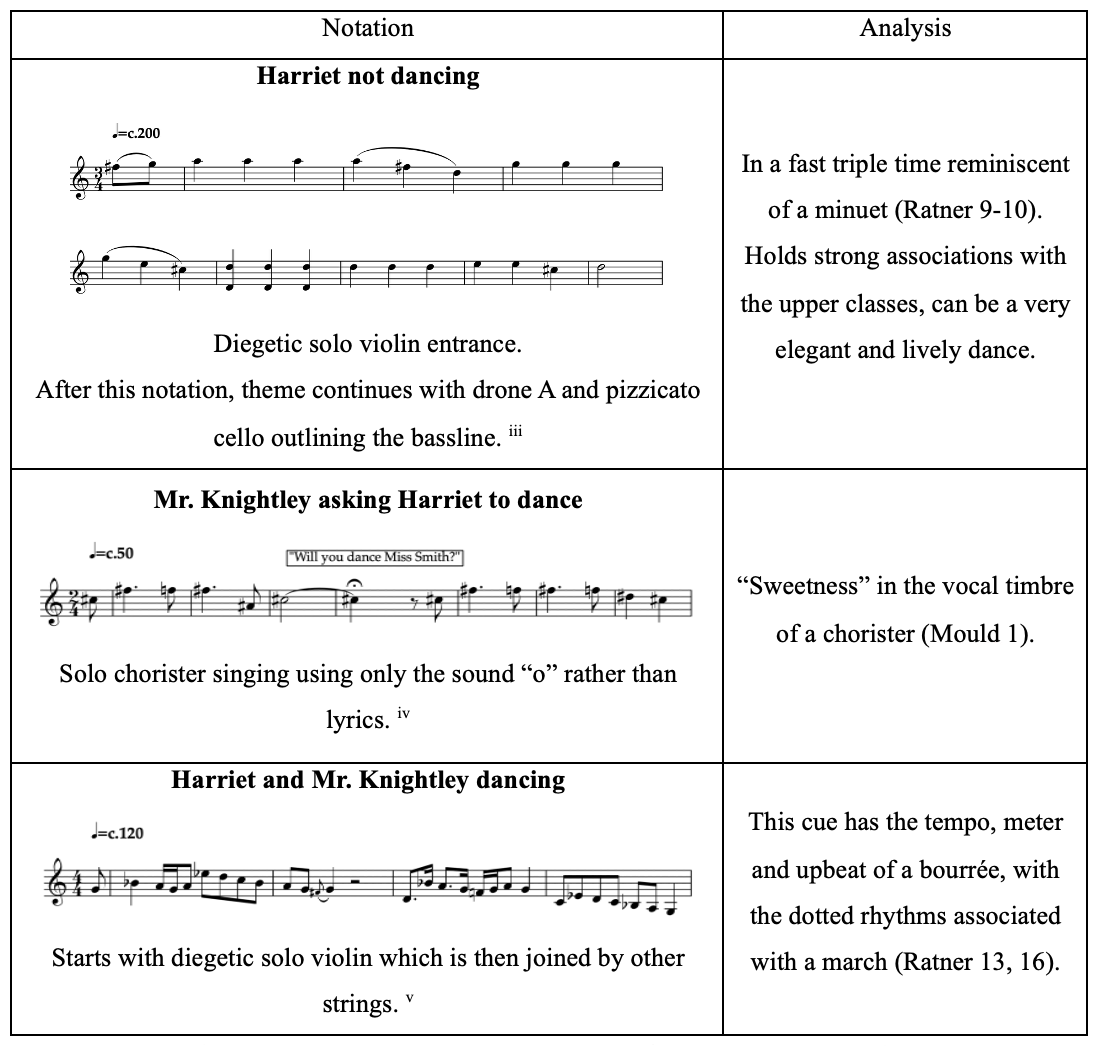
Towards the start of this scene when Harriet is not dancing there is a solo diegetic violin playing a fast triple meter melody that is reminiscent of a minuet. This is a dance that is considered to belong to the high style, holding strong associations to the upper classes (Ratner 9). Whilst there are “folk” elements such as double stopping using open strings, the minuet is very light and elegant in style, highlighting some of the preferred characteristics of upper-class women (Jacobsen; Poulopoulos 202). This musically highlights that Harriet does not belong by using a dance style that is socially above her, both visually and audibly showing her exclusion from the upper classes, despite Emma’s friendship. Visually, Harriet is separate, whilst everyone is dancing and having fun. There is a significant change in the musical soundtrack when Mr. Knightley notices Harriet on the sideline of the dancing. He comes over to ask her for the next dance. Here is where there is a shift from diegetic to non-diegetic music; a sustained and lyrical treble voice is heard, alongside a high C drone on the violin as the cue develops. Traditionally, treble voices are seen to depict a sense of purity and sweetness as they are young boys, therefore are considered to be closer to God and able to bring His light to adults, due to being younger, having spent less time as part of the world, where there is sin (Day 810). From this reading, Mr. Knightley is Harriet’s savior, an upper-class gentleman bringing her into their world. Here as Vandenberg argues he is acting in a similar way to Emma, helping Harriet to navigate upper-class society. As Harriet starts to dance with Mr. Knightley the music once again transitions into the diegetic space, becoming reminiscent of both a bourrée and a march, with the duple meter and upbeat associated with the former and the dotted rhythms associated with the latter; importantly these are two styles which do typically cross over (Ratner 16). The bourrée is generally associated with a “middle style” dance, a class which Harriet belongs to, whilst the more strident march elements of this cue musically represent Mr. Knightley, connoting ideas of masculinity as well as calling back to his instrument, the French horn, which is also a typical march instrument. But this acts as a reminder that Mr. Knightley has the authority to allow Harriet to join in with the upper classes and is not something she can do herself. Visually Harriet is unaware of these connotations, she is having fun dancing meaning the soundtrack is in a sense “winking” at the audience pointing them towards the issue of class in a lighthearted way as the character is still enjoying herself. Harriet is further singled out from the upper-class society she is surrounded by due to her association with the violin. During the nineteenth century, the instruments that were considered appropriate for women and girls to play were few and far between, being restricted to piano, harp, guitar, and voice (Powell 242). The violin, however, was not considered acceptably “feminine” due to its need to contort the posture and its associations with notions of virtuosity, which juxtaposed ideal female characteristics (241). This choice of instrumentation marks Harriet as being unable to conform to the upper-class feminine ideals in the same way as other characters, such as Emma.
Throughout this scene, folk dances are used to represent both how Harriet is included and excluded from society, to add to this the violin is used throughout this scene, further suggesting that she is in a world that she does not completely belong in. But if we consider that the first folk revival was criticized for its adherence to Sharp’s “construct of folk” then this undermines the view that Emma is helping Harriet to navigate upper-class society (Keegan-Phipps and Winters 490-491; Vandenberg). During this revival of English folk, many classical musicians and professional composers were involved in collecting, arranging and performing the works, with much of this coming as a reaction from the educated elite who perceived a bias for orchestral German Romanticism and popular concert hall music (Keegan-Phipps and Winters 491-492). This means that Harriet’s musical representation can be viewed as an embodiment of the English folk tradition. By highlighting that Harriet was excluded from a dance that made use of the “high” style in the form of a minuet but is invited to dance by someone who belongs to the upper classes, this illustrates the importance of music in adapting the status of individual characters, and the narrative importance it has overall. Additionally, Harriet’s “authentic” musical expression comes from a tradition that was controlled by the elite; therefore, the folk music that is used to represent her exists today because it was deemed acceptable by the upper classes, intertextually highlighting the impact Emma has on Harriet.
Once again music is a key parameter in the translation of the story of Emma from book to film (Austen). The choice to musically showcase Harriet using specifically a “folky” violin sonically marks her out from the other characters as belonging to a lower social status – even the character who is also an orphan, Jane, maintains a strong connection to the piano, linking her to the upper echelons of society. The use of folk to illustrate Harriet allows the film to bring in the intertextual history of English folk music, portraying both Harriet’s differing social status and the control Emma has over her in the novel without needing to use dialogue. Ultimately, EMMA. uses music as an additional, significant layer in its adaptative strategies. Whilst Vandenberg suggests that it allows for an additional layer to the narrative in terms of Emma’s internal thoughts, a broader application is possible by terming the musical score as an adaptive tool, allowing the adaptation to explore multiple intertextualities, retaining important novelistic expression, whilst drawing on contemporary ideologies more widely.
Conclusion
Overall, the musical soundtrack in de Wilde’s adaptation of Emma acts as a key facet in the adaptation of the novel. The use of a “Peter and the Wolf” approach to orchestration, wherein the characters are assigned instruments that represent them allows Emma’s privilege and her link with traditional ideas of nineteenth century femininity to be immediately established by using operatic vocals and the harp (Waller-Bridge; Poulopoulos 170, 223). It also marks Harriet out as belonging to a lower social class, being controlled by the upper classes through her association with “folky” violin, whilst Mr. Knightley is presented through the lens of a competing discourse of both a masculine upper-class hero, as well as a feminized love interest, and a gatekeeper of society (Doane 96-97; Ratner 16). From the opening scene, Emma is linked to the non-diegetic soundtrack, using it as a tool to highlight her privilege and self-centered nature. In this way, the soundtrack sets Emma up for her journey of emotional development as the film progresses by highlighting her robotic and unfeeling nature and the need for these to change.
This is where the soundtrack is initially used as part of the adaptation process. This illustrates how the soundtracks of adaptations may subvert the expectation of a restrictive position for the female lead, as here it is intrinsically linked to the titular character, placing Emma above everyone else as it privileges her point of view (Laing 10; Vandenberg). The soundtrack is being used to translate the more difficult aspects of Emma’s character in a way that would otherwise be lost without the musical space in the film. The use of intertextuality to translate Mr. Knightley in the musical soundtrack allows the film to be viewed through a female, rather than male lens, permitting aspects of novelistic expression, such as the importance of Emma’s perspective, to be retained. Furthermore, the use of “folky” violin to musically showcase Harriet allows the semiotic intertextualities of this to impact the characterization of her, ultimately highlighting her differing social status from the other characters and the control that she is under (Keegan-Phipps and Winters 490-491). Crucially, this highlights the importance of the musical soundtrack to the adaptation of identity in EMMA. allowing nuanced ideas of femininity, status, and characterization to be explored in ways that might otherwise be lost in novel-to-film adaptations. The soundtrack is able to carefully balance the line between communicating complex issues but manages to achieve this in a relatively lighthearted way, by satirizing stereotypes and highlighting issues such as class musically, whilst visually a character is enjoying themselves. This can be understood as a similar approach to that of Austen herself whose “creative play with perspective allows us to see what we could not before,” whilst in turn retaining important aspects of novelistic expression (Harewood House Trust 40). Not only does this have significance to this adaptation of Emma, but it also shows the importance of considering the soundtrack as part of the adaptation process more broadly. The soundtrack has a unique ability to communicate ideas without visual constraint, allowing it to draw on external and internal meaning, thereby creating it as a “tool” of adaptation, highlighting its importance in the adaptation process.
Endnotes
1 Musical examples are intended to add further detail; the ability to read western classical notation is not necessary to understanding the arguments presented. Links to audio examples of each notated example will be provided.
2 Audio of “Mr. Knightley” theme, as shown in example 1, transcribed by author. Mr Knightley | First Iteration of the theme
3 Audio of “Harriet Not Dancing,” as shown in table 2, transcribed by author. Harriet Not Dancing
4 Audio of “Mr. Knightley Asking Harriet to Dance,” as shown in table 2, transcribed by author.Mr Knightley asking Harriet to Dance
5 Audio of “Harriet and Mr. Knightley dancing”, as shown in table 2, transcribed by author. Harriet and Mr Knightley Dancing
Works Cited
Aragay, Mireia and Gemma López. “Inf(l)ecting Pride and Prejudice: Dialogism, Intertextuality, and Adaptation.” Books in Motion: Adaptation, Intertextuality, Authorship, edited by Mireia Aragay, Editions Rodopi, 2005, pp. 201-219.
Austen, Jane. Emma. 1815. Chiltern, 2019.
Buhler, James. “Gender, Sexuality, and the Soundtrack.” The Oxford Handbook of Film Music Studies, edited by David Neumeyer, Oxford UP, 2014, pp. 366-382.
Carroll, Rachel, editor. Adaptation in Contemporary Culture: Textual Infidelities. Continuum, 2009.
Cartmell, Deborah and Imelda Whelehan, editors. Adaptations: From Text to Screen, Screen to Text. Routledge, 1999.
Citron, Marcia J. Opera on screen. Yale UP, 2000.
Cohen, Annabel J. “Film Music from the Perspective of Cognitive Science.” The Oxford Handbook of Film Music Studies, edited by David Neumeyer, Oxford UP, 2014, pp. 96-130.
Day, Timothy. “Cultural History and a Singing Style: ‘The English Cathedral Tradition.’” The Oxford Handbook of Singing, edited by Graham F. Welch, et al., Oxford UP, 2019, pp. 805-822. University of Huddersfield Library Access.
de Belin, Mandy. From the Deer to the Fox: The Hunting Transition and the Landscape, 1600-1850. U of Hertfordshire P, 2013, http://ebookcentral.proquest.com/lib/hud/detail.action?docID=1370601.
Dick, Bernard. The Anatomy of Film. Palgrave Macmillian, 2010.
Doane, Mary A. The Desire to Desire: The Women’s Films of the 1940s. Indiana UP, 1987.
EMMA. Directed by Autumn de Wilde, Perfect Working Pictures; Working Title Films; Blueprint Pictures; Focus Features; Universal Pictures, 2020.
“Episode 1.” Pride and Prejudice. Directed by Simon Langton, 1995.
Exhibition Programme for Austen & Turner: A Country House Encounter. 2 May-19 Oct 2025, Harewood House Trust & Centre for Eighteenth Century Studies, University of York.
Gorbman, Claudia. Unheard Melodies: Narrative Film Music. BFI Publishing, London; Indiana UP, 1987.
Jacobsen, Colin. “7 Tips for Classical Violinists to Unlock Their Inner Fiddler.” The Strad, 16 August 2019, https://www.thestrad.com/playing-hub/7-tips-for-classical-violinists-to-unlock-their-inner-fiddler/9350.article. Accessed 12th October 2025.
Haworth, Catherine. "Introduction: Gender, Sexuality, and the Soundtrack." Music, sound and the moving image, vol. 6, no. 2, 2012, pp. 113–135.
Hopkins, Lisa. “Mr. Darcy’s Body: Privileging the Female Gaze.” Jane Austen in Hollywood, edited by Linda Troost and S. Greenfield, The UP of Kentucky, 1998, pp. 111-121.
Hutcheon, Linda, and Siobhan O'Flynn. A theory of adaptation. Routledge, 2013.
Laing, Heather. The Gendered Score: Music in 1940s Melodrama and the Woman’s Film. Ashgate, 2007.
Keegan-Phipps, Simon and T. Winters. “Contemporary English Folk Music and the Folk Industry.” The Oxford Handbook of Music Revival, edited by Caroline Bithell and Juniper Hill, Oxford UP, 2014, pp. 489-509. https://doi-org.libaccess.hud.ac.uk/10.1093/oxfordhb/9780199765034.013.003.
“Lyric video to Emma 2020 opening theme.” YouTube, uploaded by Ryota Arai, 13 June 2020, https://www.youtube.com/watch?v=wRMTPdQB2_Q. Accessed 12 October 2025.
Marianelli, Dario and Jean-Yves Thibaudet. “Your Hands Are Cold.” Pride & Prejudice: Original Soundtrack (15th Anniversary Edition), UMG Recordings, 2020.
Mulvey, Laura. “Visual Pleasure and Narrative Cinema.” Feminisms: An Anthology of Literary Theory and Criticism, edited by Robyn R. Warhol, and Diane Price Herndl, Rutgers UP, 1997, pp. 438-448.
Pride & Prejudice. Directed by Joe Wright, StudioCanal; Working Title Films; Scion Films; Universal Pictures; United International Pictures; Mars Distribution; Focus Features, 2005.
Poulopoulos, Panagiotis. The Erard Grecian Harp in Regency England. Boydell & Brewer Ltd, 2023, https://doi.org/10.2307/jj.3643589.
Powell, Bella. “Notions of Virtuosity, Female Accomplishment and the Violin as Forbidden Instrument in Early-Mid Nineteenth-Century England.” The Routledge Handbook of Women’s Work in Music, edited by Rhiannon Mathias, Routledge, 2022, pp. 241-249.
Ratner, Leonard G. Classic Music: Expression, Form, and Style. Schirmer Books, 1980.
Rushing, Robert A. “Gentlemen Prefer Hercules: Desire | Identification | Beefcake.” Camera Obscura: Feminism, Culture, and Media Studies, vol. 23, no. 3, 2008, pp. 159-191, https://doi.org/10.1215/02705346-2008-011.
Vandenberg, Natalie. “Let the Music do the Talking: Intertextuality and Emotion in the Soundtrack of Emma.” Persuasions: Jane Austen Journal On-Line, vol. 42, no. 1, 2021, https://jasna.org/publications-2/persuasions-online/vol-42-no-1/vandenberg/. Accessed 12 October 2025.
Waller-Bridge, Isobel. “The Music of the Heart: EMMA.'s Joyous Score- A Q&A with composer Isobel Waller-Bridge.” Focus Features, by Focus News. 26 February 2020, https://www.focusfeatures.com/article/interview_composer_isobel-waller-bridge. Accessed 12 October 2025.
Waller-Bridge, Isobel, and David Schweitzer. “Emma Woodhouse.” EMMA. (Original Motion Picture Soundtrack), Focus Features; Back Lot Music, 2020.
---. “Mr. Knightley.” EMMA. (Original Motion Picture Soundtrack), Focus Features; Back Lot Music, 2020.
White, Daniel. The music of Harry Potter and the Lord of the Rings. Routledge, 2024.