VOL. 54, NO. 1
The Lens of Twitter: Authorship and Adaptation in Zola (2020)
Jennifer Cintron (University of Illinois, Urbana-Champaigne)
From its inception as a messaging platform in 2006, Twitter has undergone numerous transformations in the social media landscape, culminating in its rebranding as X in the 2020s. Due to these changes, Twitter has become a space for historical analysis, and its integration with cinema is now in a fixed state, ready for analysis. One of its contributions is as the platform that produced the conditions and the source material for what would become the 2020 film Zola. Setting the stage for a Twitter adaptation, Robert Stam considers in “Beyond Fidelity: The Dialogics of Adaption” that we must be “rooted in the contextual and intertextual history” which produced the media we wish to engage with (Stam 87). Recounting the contextual history of Twitter and the intertextual ways it has intersected with cinema is a valuable contribution, as films continue to grapple with how to display and interact with social media.
This article examines the 2020 film Zolaand its journey through adaptation and the intertextuality and intersectionality that are produced in the final product. In doing so, three rhetorical moves will be made. The first is to understand the formal characteristics of Twitter and how they emphasize authorial identity in the social media space. The second is that these identity characteristics are distinctly embedded in intersectional understandings of race and gender. Because of the focus on an author’s reliability, rather than the aesthetic quality of their words, a system of adaptation emerges that values narrative relatability. This leads to examining Zola as a product of a specific social media lineage and broadening the borders of what media is possible to adapt, and how a thoughtful film might look as a result.
I. THE FORMAL CHARACTERISTICS OF TWITTER
Studying Twitter’s development in 2015, understanding how the platform worked is the first criterion for understanding the messaging of Zola and how its story unfolded. From Twitter’s inception, users were allowed to make public posts of 140 characters at a time. While other guidelines have changed on the platform, all tweets were held to this length limitation. In response to this, users created threads where they would comment on their own tweets multiple times in a row. This threading allowed them to tell more elaborate and chronological stories, allowing users to craft complete narratives. Users pushed past tweeting for the sake of immediacy and created threads that would capture audiences and achieve worldwide readership.
Among the first and most popular of these threads was authored by A’Ziah King, a Black Detroit waitress and stripper. This thread is now known as the #Story in popular discourse and raised the stakes of storytelling on Twitter. King, the self-proclaimed inventor of the Twitter thread, strung together 147 successive tweets about a trip she took to Florida with a new friend, Jessica Swiatkowski. From King’s recollection, the two met and decided to take a trip to spend 48 hours dancing at various clubs. While King was familiar with the stripping industry, she grew increasingly apprehensive of the trip and revealed that Swiatkowski was trying to trap her in a prostitution ring. King escaped Florida, and once back home, decides to tweet out her story.
King’s story was relayed as a first-person experience. She used her personal account, attaching her name and picture to each tweet throughout the thread. Because of this level of authenticity, readers immediately gravitated towards her thread. Twitter, as the recording platform, forced her to distill the most essential facts into her narrative. Because each of King’s tweets could only contain 140 characters, she had to move the story at a rapid pace. Beyond this, conversing in the Twitter space relied on a variety of slang, abbreviations, and emojis to convey even more information. While many readers in 2015 would have been familiar with these meanings, these authorial choices embed a specific cultural moment into each narrative beat of the #Story.
The understanding of audience, authenticity, and platform is demonstrated from the very first tweet of the #Story. King’s first tweet reads: “Y’all wanna hear a story about why me & this bitch here fell out?????????? It’s kind of long but full of suspense” (King). Alongside the words, King attached four pictures of herself and Swiatkowski posing for pictures (See Figure 1). Her words read as though she is having a conversation with close friends, as she addresses her followers on the platform with “y’all.” As evidence of a friendship, the photos also help build a level of authenticity to her words:
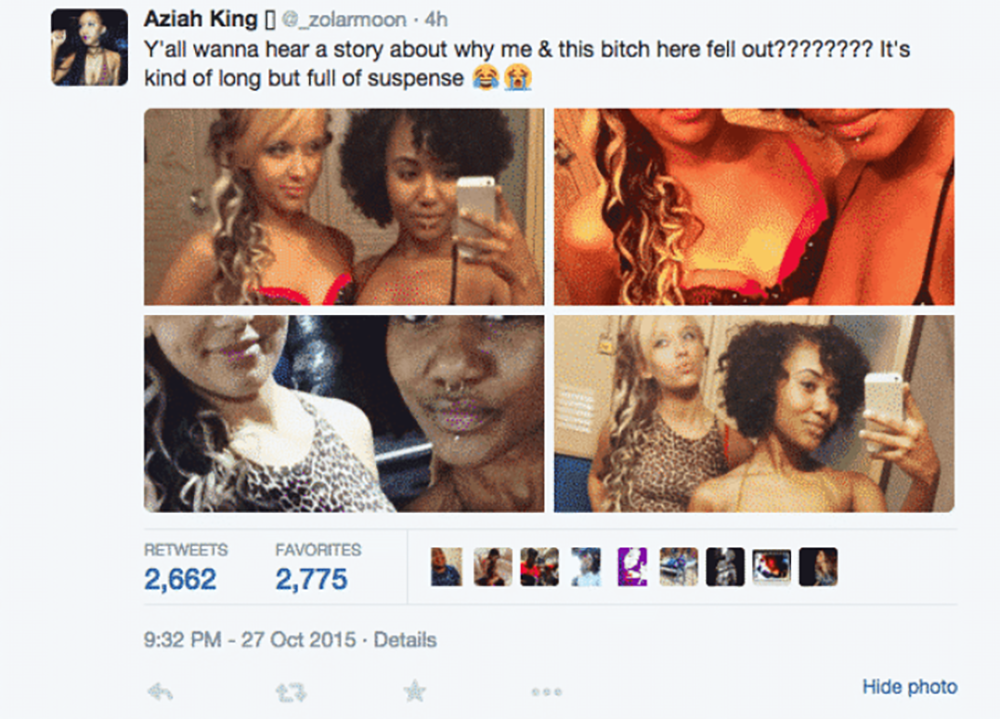
Over the next two hours, as timestamps on the original tweets indicate, King’s story was spun out for people to keep refreshing and reading. Continuing to tweet at such a rapid pace suggests that King was aware of the immediacy of her writing. She did not pause, garnering a huge audience that included even celebrity readers such as rapper Missy Elliot, who tweeted, “That Zola story wild, ended up reading the whole thing like I was watching a movie on Twitter” (Dewey). Elliot was not alone in this cinematic assessment; King was soon approached for the rights to her Twitter thread so that it could be adapted for the big screen. Unlike any adaptation before it, the filmmakers would be working with tweets as source material, turning King’s exhilarating story into a narrative for an even wider audience. Due to this unique source material, this article aims to develop a theoretical framework for understanding the film.
Beginning in the social media space, a user can choose to disclose any level of information they want. They can stay anonymous or disclose a range of private information; they can interact with a private circle or maintain a public profile. Because Twitter is so intrinsic to how King’s identity was visualized in 2015, the dimensions of Twitter must be fully understood beyond just journalists fact-checking popular tweets. Ruth Page’s incisive book Stories and Social Media: Identities and Interaction states, “unlike Facebook, where privacy protocols are widely applied, only 7 percent of Twitter accounts are private” (94). The platform itself stood apart in the 2010s from other social media options because there was a “default assumption of public communication” for users (94). The default setting for all users was to be aware that they were posting for anyone in the world to see.
Turning to Twitter to tell a story is a deliberate act of public performance. As Page concludes, the choice of Twitter relies on the user’s recognition that they will not receive high levels of reciprocal conversation. Instead, they will be on display for those scrolling through the platform. For Page, “the norms for tellability in Twitter suggest that it is a front stage environment, where the public, professional identity of the tweeter is of greater importance” (116). Replies could take place through comments, retweets, reposts, or, as illustrated above, in magazines and news coverage. None of these options offers the same degree of conversational reciprocity; instead, “the stories told in tweets are embedded in a wider discourse, which makes use of linking as a strategy for disseminating news and amplifying a tweeter’s identity” (Page 116). Twitter becomes a stage for all users to craft their profile and the identity they want to project into the world. Authenticity can be one of the tenets of this performance, but it is not a requirement for the user.
II. THE PERFORMANCE OF IDENTITY ON TWITTER
Alongside this “frontstage” persona, the intersectionality of Twitter can and should be considered in relation to King’s story. It is worth highlighting that Black users, such as King, often interacted with the platform in different ways. This could go so far as to enter a distinct cultural space known as “Black Twitter.” In “From the Blackhand Side: Twitter as a Cultural Conversation,” André Brock zeroes in on how Black users tweet on the platform. Specifically, Brock notes that there is “a formulation of Black Twitter as a ‘social public;’ a community constructed through their use of social media” (Brock 530). Making the inference that Brock’s Black Twitter is the exact audience that King wrote for is a leap based only on user ethnicity and cannot be taken to a full conclusion. What it does signal is that on Twitter, there are racial identifiers that users can consciously add to their profiles. With these signifiers, a user can identify other profiles as well and build an online community. While there is no quantifiable measure of identifiers, Brock is clear that “the ‘publicness’ of Black Twitter will return to the audience most involved: Black folk” (Brock 456).
King’s #Story is not only an example of the thread; she becomes embedded within the context of both her race and gender as a part of the performance of her account. Maya Winfrey and Elizabeth Stinson’s “Pulses from the Multitude: Virtuosity and the Black Feminist Discourse” contends that without such accentuated performance, stories such as King’s would not receive their proper acknowledgement. Winfrey and Stinson highlight that the posts are “social life to be mined for surplus value,” particularly when the author is identifiable as a woman of color (Stinson 217). Although their own research focuses on Facebook, where posts are more likely to be private, users are still expected to offer some form of entertainment or edification of their lived experiences, as they have chosen to post on social media.
Once a Black woman, like King, has been identified, whether by markers familiar to Black Twitter users or because she attached photos of herself to her thread, a new layer of labor is added to her post. Regardless of her original intent, the social media space requires a performance and some importance for the reader. Winfrey and Stinson continue: as “virtuosity becomes labor for the masses. It’s a produced performance, part of the culture industry, that has a certain affective attachment in its mediatization” (Stinson 219). So, King can be understood as a performer stepping onto the Twitter platform. Because she is a young Black woman, she was going to be perceived within the confines of her identity labels and the performative expectations outlined here. Whether these labels are accurate or not, and whether they conform to harmful stereotypes, did not matter to the average reader. Rather, the audience demanded that the #Story be easily consumed and labelled.
To restore value to King’s words, we must acknowledge the labor involved in telling her story to a wide audience. The conclusive throughline of the performer/frontstage logic is that King’s online identity is merely an adaptation of her own, a performance that she is consciously putting on to entertain a reader. Twitter, of all the platforms available in 2015, is a space of deliberate performance, and one that clearly highlights the race and gender of a tweet’s author. When choosing to adapt her experience for Twitter, King made narrative choices that appealed to a wide audience, setting her up for the massive following and readership she achieved. This interpolation of intersectionality and performance also shaped the mainstream reception of the #Story.
As a result of her virality, King underwent a thorough vetting by both thread readers and journalists, all of whom sought to uncover the truth behind her narrative. Because of the rapid popularity King had acquired, critical reception of her thread was aimed at ascertaining how much of it could be true. While debunking stories on social media has become increasingly prevalent since 2015, King was subjected to a rigorous standard of fact-checking for trying to entertain. Caitlin Dewey’s 2015 Washington Post article entitled “The True Story Behind ‘Zola’, the Epic Twitter Story Too Crazy to be Real” is completely dedicated to interrogating King’s #Story. In the article, Dewey conducts interviews with all the story’s major players, as well as police officers who investigated the case (Dewey). She questions the authenticity of the facts, uncovering whether Twitter users have been tricked, and if King’s story was too good to be true. Despite these inquiries, “The Post was able to verify large portions of [King’s] tale” (Dewey).
Because The Post was published contemporaneously with King’s thread, it becomes an important historical artifact to understand the mainstream reception of King as an author. The objective of the article was to conduct a fact check and ensure that everyone was entertained by a true story. Such a motive does not acknowledge that King’s experience recounts her escape from becoming a victim of sex trafficking. It does not question the potential harm that she may have experienced living through the events or recounting them for an audience. While spoofs, parodies, and impostors are not hard to find on Twitter, they did not reflect the account being discussed here. It is true that Twitter did not force users to maintain truthful identities on their profiles, but King was and continued to be an identifiable figure with a public profile. A call for fact-checking the author, despite the trauma she had endured, was a side effect of the story gaining popularity on Twitter. However, mainstreaming the investigation, rather than the author’s situation, reveals the identity politics at play.
Dewey’s article is not alone in its response; Rolling Stone published a similar article at the time, also featuring the sensational title “Zola Tells All: The Real Story Behind the Greatest Stripper Saga Ever Tweeted.” Author David Kushner presents himself as discussing only verifiable facts, thereby dispelling any notion that King wants to trick or mislead her audience. It centers around the luridness of the story, discerning how someone could fall into such a situation. But it is here that King can say, “I made people who probably wouldn’t want to hear a sex trafficking story want to be a part of it...because it was entertaining” (qtd. In Kushner). She acknowledges that the dehumanization of her experience was partially due to keeping people engaged with her tweets. And, that the continual conversation also refuses to engage with her personal feelings about what occurred. Such a dehumanization is shaped by the medium of Twitter and the entertainment that a public user might feel they owe to their audience.
The crux of the #Story’s 2015 reception sits at the long-standing critical problem of believability in American society. In this case, it intersects with both gender and race, forcing a young Black woman to produce evidence of a lived trauma. Twitter is not unique in this regard, as Saidiya Hartman’s “The Anarchy of Colored Girls Assembled in a Riotous Manner” illustrates the problem with placing value on such evidence. Hartman illuminates a history that cannot fully exist; there are not enough documents surrounding people of color to appease white standards. What occurs is speculation, a “statistical portrait of the young women” which is built from interviews and case files (Hartman 486). This is not the standard to which The Washington Post or Rolling Stone held King to, as they interviewed police officers and reviewed call logs to find evidence of the truth. Hartman supersedes white modes of archiving to create her own narratives.
To be emphatic, it is a white mode of investigation here for both Hartman and King. Hartman found that “the reporters were most interested in what happened to the white girls” in the formation of their history (Hartman 486). King also felt that she received the level of interrogation she did “since I’m Black and I’m saying this is what happened…it’s like, ‘How true is that? Are you sure?’” (qtd. in Dickson). The #Story’s original fact-checking pushback was meant to interrogate King herself, as the identity of a tweet author is inextricably tied to their messages on the platform. King continues, “because [being questioned] doesn’t typically happen to women who don’t look like me…if a white girl says this is what she experienced” then she is believed (qtd. in Dickson). Although King’s primary goal might have been to entertain her followers or share an event that had happened, the platform also revealed her identity. Because she is a Black woman, the level of interrogation that she received felt targeted because of a racial bias for a mainstream readership.
III. THE INTENTIONAL ADAPTATION
In 2020, King’s story would finally come to theaters as Zola,directed by Janicza Bravo, a Black filmmaker. Bravo was aware of the thread and wanted to adapt the story for a visual medium. In an interview with The New York Times’ Jenna Wortham, Bravo acknowledged the parallels between her own identity and King’s and pushed the conversation forward by saying that she wanted to do justice to King as an author and performer. She said, “I’m the best director for this because when I read that story, I was like, this is a traumatized woman who used the power of the pen and the power of her humor to recontextualize that which changed her” (qtd. In Wortham 32). Bravo’s interpretation relies on an innate understanding of King’s authorial choices, which are a direct result of writing on Twitter. And this dedication to preserving the authorial voice was shared by co-writer Jeremy O. Harris, a Black playwright who gained popularity from his Broadway show, The Slave Play (2018). Both collaborators continue to be involved in preserving Black identity in creative media, with Zola being a crucial work within their respective canons.
When interviewed by The AV Club’s staff writer Cameron Sheetz, both Bravo and Harris were able to discuss the source material’s impact on their vision of the film. Sheetz observes that the writers are “clearly enamored with King as a person and a storyteller” (Sheetz). Moreover, he finds that “Zola is the stylish vessel for her hallowed words,” showing that the co-writers’ priorities lie in preserving authorship and performance. Even though a Twitter thread is limited by its character count restraints, Bravo and Harris still treated the thread as “scripture,” and their loyalty to King is at the core of this adaptation (Sheetz). As such, it is an adaptation of not just words, but of the author's persona when the words run out. Whether implicitly or explicitly, the creative team understood Twitter as a performance space and chose to highlight the careful crafting of its style for public consumption.
Alongside their dedication to narrative fidelity, the intersectionality of the creative team also shines in contrast to a significant moment that initially set production back. In 2016, the production rights to King’s #Story were initially in the hands of White filmmaker James Franco (McNary). Belaboring an argument on the quality (or qualities) such a creative direction could have potentially imposed on the final film adaptation is beyond the scope of this paper. However, it is worth noting that the switch from a White man to a Black woman as filmmaker emphasizes the care that Bravo’s own interpretation has. As Zach-Cheney Rice wrote in a think piece about the production in 2016: “When stories about Black women, told by Black women and made popular by Black Twitter—a community dominated by Black women—gain national attention, white men become the profiteers” (Cheney-Rice). This profit-driven motive would have potentially seen Franco sensationalize King’s story even further and remove even more of her agency as an author. In sum, Bravo as a director is worth fully acknowledging.
Upon examining the result, the film changes little from the thread’s narrative. Filmic counterparts Zola (King) and Stefani (Swiatkowski) meet by kismet and decide to go to Florida together to dance. Their weekend does indeed take a turn for the worse, as they go from stripping to staying in a hotel room with Stefani working as a prostitute. Zola is unable to leave and fears for her safety, while Stefani is framed as a willing participant in the spiraling chaos. Finally, after a night of countless traumas, Zola escapes back home to never speak with Stefani again. There are no detours from the original thread; in fact, the Twitter narrative is emphasized throughout this production. The film features Zola’s constant voice-over narration, highlighting her interpretation of events as the lens for the audience. By making this decision, Zola itself seems to reflect an awareness of the performative context of King’s work and directly responds to the history of its source material.
Robert Stam asks the age-old questions of adaptation: “Who tells the story in the novel vis-à-vis in the film? Who focalizes the story—that is, who sees within the story?” These questions take on a new and clear meaning when adapting this first-person narrative for Bravo (Stam 84). Zola is the only answer. She is our narrator, and she is our protagonist. The screenwriters have taken King’s perspective and her words and given them a character to transmit everything to the audience. This is immediately evident from the creative decisions made in the film’s first moments. As the film opens, it displays two intertitle cards, highlighting the written thread in this visual medium. These intertitle cards are both entirely black backgrounds with white writing in a font that bears a striking resemblance to Twitter’s own San Francisco/Roboto. The first card reads “On October 27, 2015 @_zolarmoon tweeted the following in 148 tweets” (See Figure 2). Informing the audience of the thread ensures that everyone is aware that the filmmakers are directly engaging with the source material, thereby enhancing the authenticity of the adaptation. Further, they are engaging with the communal understanding of Twitter as a platform. Not only is Zola our trusted narrator on this journey, but, significantly, she has evolved from the figure of @_zolarmoon, or A’ziah King.
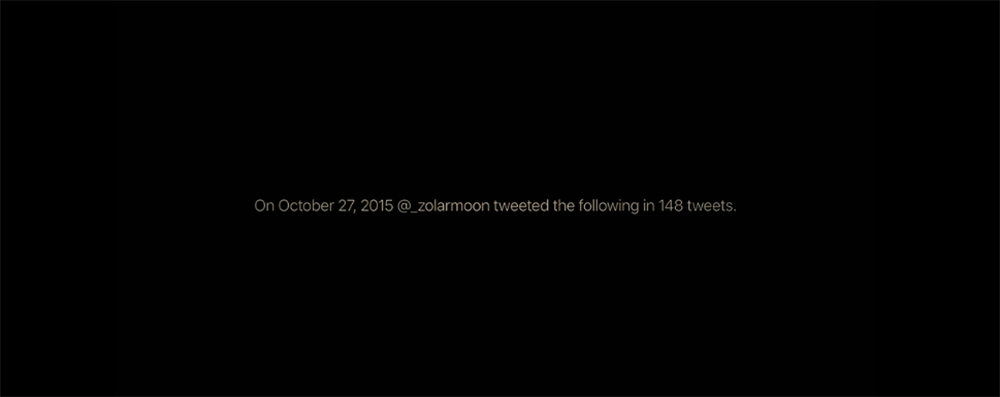
As the first title card highlighted authorship, the second card builds on the contextual reception of the original thread. The card reads: “Most of what follows is true.”This builds on the continued conversation about King’s believability as the author of this narrative. Bravo herself recalls the emphasis that was placed on this as “almost every article that existed at the time had questioned the validity of A’Ziah’s story” (qtd. in Sheetz). This second intertitle enables the film to draw attention to the fact-checking that has been conducted on this story since the tweets were released. Again, for Bravo, the reading audience “seemed to be so invested in whether or not what she was telling was true” (qtd. in Sheetz). Adding in the cards demonstrates that the historical context of the thread had a direct influence on the creative decisions of the film. Again, this intertextual bond is deeply rooted in King’s identity and the formation of performance on Twitter. Bravo states, “I assumed there was a portion of our audience that would show up from the jump, from the first frame, already questioning what this dynamic was between a Black and White woman” (qtd. in Sheetz). The narrative perspective in Zola chooses to invest in Zola as the protagonist fully and emphasizes her importance from the outset.
After these cards, the film continues with audio narration, featuring Taylor Paige as the titular Zola and Riley Keough as Stefani in a surreal, mirrored dressing room. The two are fixing their hair and makeup together, doing every action in sync as they prepare for a night out. They present a unified front as they brush their hair and fix their lipstick. Stefani is silent while Zola narrates for the audience, reciting verbatim the opening lines of the #Story as they appear on Twitter. Zola stares out from the screen and asks the movie watcher, “You wanna hear a story about how me and this bitch here fell out? It’s kinda long, but it’s full of suspense.” These lines on Twitter signal the beginning of a performance, and in the film, they signal the rise of the curtain for these actors. While Stefani is clearly visible in the frame throughout the entire opening sequence, she does not acknowledge the words being spoken. This is a moment just for Zola to greet her viewers, allowing Zola to take the mantle from King as the narrator of the events.
Emphasizing the narrator and the protagonist, as Zola does, is an essential foundation for addressing the racial bias that King felt and that Bravo is aware of. This is not just a creative move; it is also a feature of the film being an adaptation. Stam highlights that “adaptations, then, can take an activist stance towards their source novels, inserting them into a much broader intertextual dialogism” (Stam 81). Zola gaining control over the story is the priority of the film’s opening, aligning the audience with her. She is given the power to narrate and to address the audience as “y’all.” The activist stance of the film is to frame Zola as a reliable narrator and to give her the agency to define the limits of the story that is being told. Although Stefani is present from the outset as well, only one person speaks.
Zola’s perception throughout the film functions in the same way that an audience would expect a conventional film to unfold. Such a perspective follows many of the same traditional choices found in Hollywood films, as David Bordwell considers in Narration in the Fiction Film. “In our culture, the perceiver of a narrative film comes armed and active to the task. She or he takes as a central goal the carving out of an intelligible story,” and relies on narration to signal where to go (Bordwell 39). Zola is continually presented as comedy’s proverbial “straight man”—a role defined by keeping composure and highlighting eccentricities of the surrounding world. She remains the only stable character in an increasingly chaotic plot and becomes a touchstone for the audience to return to. Her reactions to events guide them along in their task of viewing the film. Her reliability in the movie becomes her central trait.
Zola’s narration is also continually linked to Twitter in subtle ways throughout the film, reminding audiences of the plot’s origins. The Twitter notification sound effect can be heard at the beginning of the film when the characters are being introduced. But it also recurs at various points in the film when Zola is talking. One dramatic example occurs at the midpoint of the film, when Stefani and Zola are dropped off at a hotel room to begin receiving clients. Zola is disgusted with the turn, as she views herself as a dancer, not a sex worker. She is furious at Stefani for putting them in this situation. In the original thread, King writes that she started yelling at Swiatkowski and said, “BITCH U GOT ME FUCKED UP!” (King). Zola yells this to Stefani verbatim, and in the silence that follows, the Twitter notification goes off in a non-diegetic sound effect. King’s words have literally become the dialogue that Bravo and Harris write, and they underscore the adaptation by recalling the platform. The moment becomes aesthetically aligned with the platform, reminding the viewer that this is coming from a place of frontstage performance.
Using King’s original writing is twofold: it builds an unshakable connection with the source material, and it also serves as metacommentary about the platform. The film’s visuals extend this idea, as the scene's framing is devoted to the level of anger that drove King to write in all caps. Zola stands at one end of the room, close to the door, preparing to leave and escape the situation. Stefani stands on the opposite side of the room with the hotel bed in the frame, visually aligned with the sexual purpose of the room. They are divided by a decorative pillar— literally separated in the frame into two separate boxes (See Figure 3). The two are unable to reconcile how the night has gone from dancing at strip clubs to this angry confrontation.
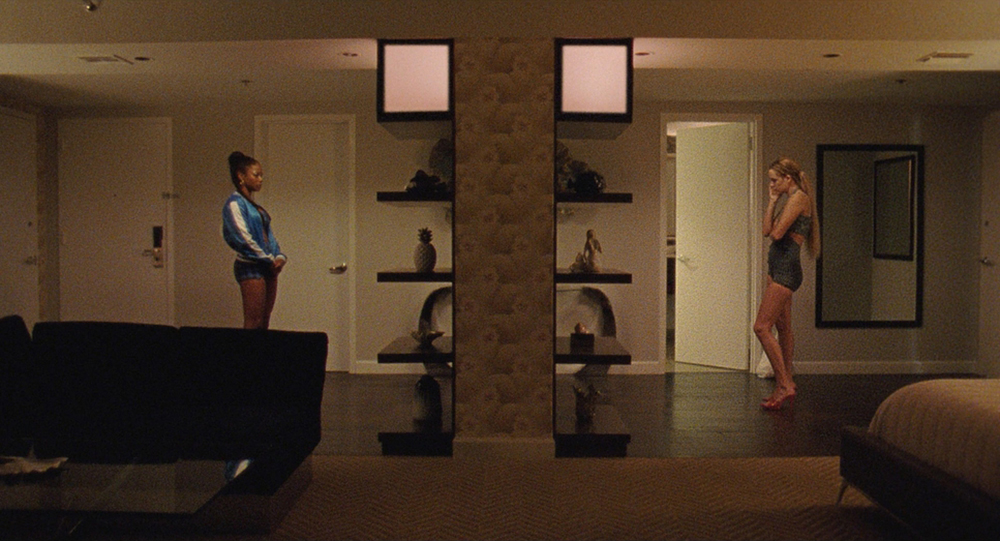
The shot holds on this formation, neither character moving, so that the Twitter notification can play. The narrative has frozen at this point of visual separation to remind the audience that this is King’s story, and Zola’s perspective. Zola very emphatically wants to exit the frame and end the night while Stefani wants to stay and receive clients as a sex worker. Here, the notification sound effect underscores Zola’s perspective which moves the audience and demands that Stefani has indeed gone too far with the night’s activities. Though Zola ends up staying because Stefani appeals to her sympathy by saying she’s scared to be alone in the room, Zola has made her position clear to the audience.
The next morning, one of their trip companions named X lets himself into the room and wakes Zola and Stefani to ask how their night was. The two women are on opposite sides of the bed, and X sits on Stefani’s side and pointedly asks them, “How much did you make last night?” This dialogue is again taken directly from King’s tweet, “how much u make last night” (King). And once again, the Twitter notification goes off, reminding the audience that this is a recount of true events, no matter how outlandish it may seem. The sound effect is not only aligned with the scene’s aesthetics, it is attached to the character of Zola. As the narrative lens, she is the character closest to the source material, and so closest to the tweets themselves. In the same scene, X asks Zola, “So, you think you can do my job better than me?” Again, the Twitter notification goes off. However, instead of signaling that this means a line was taken directly from King’s tweets, it provides a beat for Zola to respond “Yup” in non-diegetic voiceover, as if responding in her head. In this instance, the sound effect allows Zola to privately joke with the audience and emphasize her link to the original thread.
Zola’s voiceover narrations also imply that her thoughts are aligned with the tweets that were originally written. Her moment of escape in a stressful situation is on her mind, and it sounds like Twitter did. Zola clearly feels threatened in this scene, as she sits as far away from the other characters as possible. Her knees are drawn close to her chest, and she does not make eye contact with X. She remains silent when spoken to, instead observing the interaction between X and Stefani. Even when asked a question, the character’s voiceover response is for the audience’s benefit, rather than aloud to X. Her “yup” is sardonic and delivered deadpan, making a joke for the audience to lighten the mood. The humor brought forth and underscored by the notification sound effect aligns with Bravo’s earlier assertion that one of King’s defining authorial traits is “the power of her humor” (Wortham 32). King made jokes about her situation when retelling the story through tweets; Thus, Zola has the same connection with her audience.
If all of these aesthetic choices did not cement Zola’s position on the importance of centering its lead character as the honest and believable center of the film, Bravo clarifies one more time. As the film races towards the climax, and events become even more violent and depraved, Stefani finally addresses the audience directly. The moment before she decides to sleep with a group of men, she pauses and looks directly into the camera. This choice interrupts the rhythm of the scene, and grates against Zola’s more subtle voiceovers. Stefani parrots Zola’s own words in a mocking refrain, asking the viewer if they “want to hear the story about why me and this bitch fell out, it’s long but Imma speed it up.” Adding this moment to the film serves to reframe the 2015 response of how believable the story could possibly be. It also underscores Bravo’s concern about the tension that the audience might feel over the dynamic between a Black woman and a White woman. The film screeches to a halt so Stefani can have her say.
Stefani’s point of view is overly stylized from the moment she begins to recount her own version of events. In the background as she talks, film production sounds have been added. Someone yells “action” as she stands under visible studio lighting, emphasizing the production of her own perception. Keough’s performance as Stefani is also taken to a dramatic level, as her voice is measured and nearly monotone, as though she is reciting lines. She remains completely focused on the camera lens, unblinking, regardless of her movement or placement in the frame as she moves around. Here, Stefani is styled in a pink suit, with her hair pulled up into a tight bun, wardrobe choices that have never otherwise been associated with the character (See Figure 4).
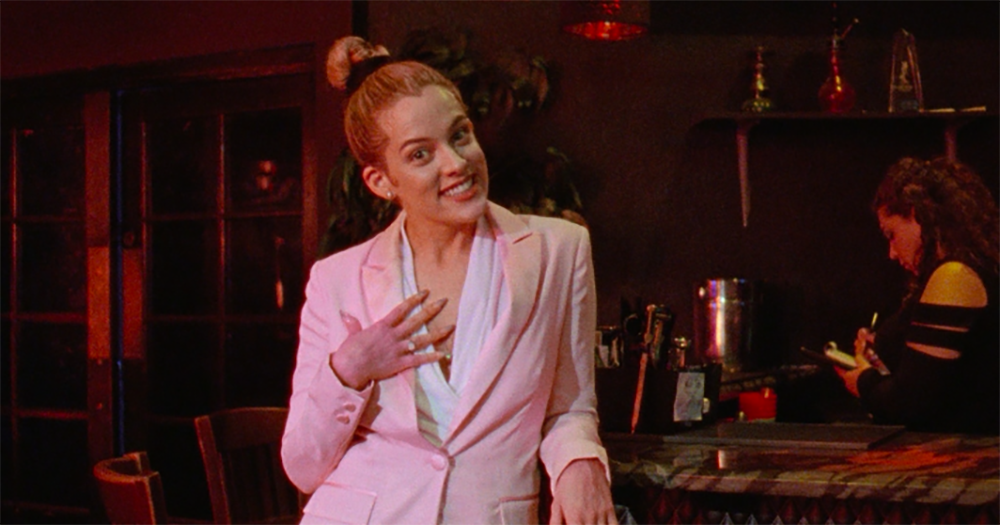
All of these choices highlight the fabrication that plays into Stefani’s perspective. The character is deliberately trying to portray an image of respectability and gain favor with an audience that has not previously had access to her inner thoughts. The film cues the audience explicitly and repeatedly that this deviation from Zola’s narrative cannot be trusted. The overt staging in comparison to the normal mode of film narration is disjointed and unsettling. Stefani’s demeanor is aggressive and off-putting, and far different from how she has acted in the rest of the film. The scene, at its core, is an antagonist trying to refute claims made against her and failing.
Scenes that have already been seen through Zola’s narrative lens are reviewed and accentuated in Stefani’s retelling of what has happened in the film. These choices demonstrate the character’s motivation to win over the audience. Zola’s validity as an author is under attack, and Stefani seeks to assert her power as a young, attractive White woman. Her race is the only defense she has for her actions, and a lot of the deeper racism of the character, of Stefani, kind of bubbles to the surface in this moment” (Sheetz). It has been demonstrated multiple times throughout this paper that being a Black woman is central to the historical reading and interpreting of King’s words. Stefani attempts to weaponize this against Zola, prioritizing racial stereotyping in her own narration. When recounting how they met, a scene that the audience has already witnessed, Stefani and Zola’s perspectives clash (See Figures 5 & 6). The color of Zola’s uniform changes between perspectives, as does her attitude. When Stefani introduces her, Zola is heavily aligned with Black stereotypes as she purses her lips and pats her weave; she has hay in her hair from an unknown source to signify her unkempt manners.
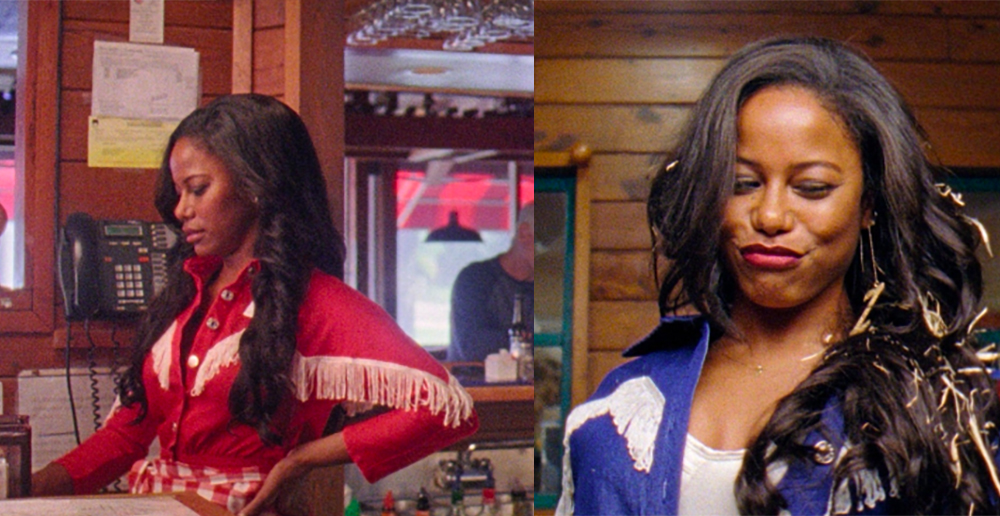
Stefani tells the audience, “This very ratchet and very Black woman comes to take our order,” prioritizing Zola’s race as the contributing factor for her presentation. She has a clear motivation for visualizing Zola in this way: she believes that the audience will align with her based on their subconscious, or conscious, racism. A White woman is recounting a Black woman’s actions through hyperextended stereotypes in her last ploy for believability. Stefani’s account exaggerated the potential biases that could have carried over from the #Story to Zola for both filmmakers and audience members.
Stefani’s sequence ends with it feeling deliberately false, and the character is portrayed as a calculated liar. Allowing her a chance to dispel Zola’s claims, and subsequently fail in her attempt, reinforces the audience’s perception of Zola as a reliable narrator. Moreover, the scene validates Zola’s version of events as trustworthy and vindicates her from any lingering doubts about believability. Stefani’s version of events is void of social media sound effects or other subtle stylistic choices which are attributed to Zola. She cannot connect with the audience, because although she is utilizing film style, the over-produced quality of her lens is inauthentic. Her transparent failure reinscribes that Zola is the rightful narrator of the story and the trustworthy viewpoint. After this attempt to claw back her reputation, the movie resumes its normal flow, and no characters confront the audience again. Zola is given back her story; the racist coup against Zola and King has failed once and for all.
When King’s Twitter thread was first posted, it was continually fact-checked and discussed in tandem with believability. This was directly due to two interlocking factors. The first is that Twitter was utilized by users as a platform for performance and entertainment. The second is that King’s identity as a Black woman on the platform was immediately identifiable, and so her posts were inseparable from her race and gender. While it must be emphasized that gender and race are not the qualifiers for what made someone a spectacle on Twitter, it is what made the discourse around King’s lived experiences uniquely problematic. The reception she received, and her feelings about it, are directly linked to having a young Black woman as author. In 2015, mainstream publications went out of their way to question her truthfulness and reliability without providing any context or consideration for her emotional well-being. Despite recounting a traumatic experience of sex work, the popularized response was that it was too unbelievable to be believed. The filmmakers were demonstrably aware of this and used all the tools of cinema to craft a response.
From the film’s opening moments, the audience is informed that Zola is based on a true story. The initial reception of King’s tweets blends into the aesthetic choices of the film and moves the story forward. Especially by emphasizing the limited perspective of King’s #Story and Zola’s narration of it, Zola reevaluates the view of Black women in society, both as authors and as people. The film acknowledges that Twitter was a performative space for injecting humor into King’s experience, and that it is essential to preserve King’s writing voice in the film. Identity and credibility penetrate every interaction in Zola, giving weight to the “ideological responses” that adaptations are capable of (Stam 87). Bravo captures a specific moment of Twitter and creates a rich world of historical context to validate King through her cinematic counterpart, Zola. Authorial identity is crucial to understanding the fidelity of social media adaptation.
Engaging with Zola without the historical context outlined in this article discounts the work King did on Twitter and how the #Story was received on Twitter in 2015. The core challenge of adapting Zola is not to retain fidelity to the thread’s details, but to preserve fidelity to King’s Twitter persona. It is integral to this film that King’s identity as a young Black woman is at the center. This case study stems from a very specific intertextual history that no longer exists. Twitter as a platform is now gone, and the work done in this paper captures the fleeting moment of the platform’s usage in the 2010s. It signals an archival contribution, but it also signals the potential that new media adaptations have for future films. By placing importance on the personality of a user, even something as brief as 140 characters can become a nuanced exploration of being a Black woman in America. Adaptation, in this case, has grown to encompass even the act of posting on social media.
Works Cited
Barker, Betsy, and A'Ziah King. “Check out the Full 'Zola' Twitter Thread Ahead of New Movie.” Don't Die Wondering, 21 July 2021, https://www.dontdiewondering.com/checkout-the-full-zola-twitter-thread-ahead-of-jaw-
dropping-new-movie/.
Bordwell, David. Narration in the Fiction Film. The University of Wisconsin Press, 1985.
Bravo, Janicza and Jeremy O. Harris. Zola. A24, 2020.
Brock, Andre. "From the Blackhand Side: Twitter as a Cultural Conversation." Journal of Broadcasting and Electronic Media, vol. 56, no. 4, Dec. 2012, pp. 529-549.
Cheney-Rice, Zak. “The Big Problem with James Franco's Twitter Epic ‘Zola’ Movie That Nobody Is Talking About.” Mic, 6 Feb. 2016, https://www.mic.com/articles/134543/the-big-problem-with-james-franco-s-twitter-epiczola-movie-that-nobody-is-talking-about.
Dewey, Caitlin. “The True Story behind 'Zola,' the Epic Twitter Story Too Crazy to Be Real.” The Washington Post, 02 Nov. 2015, https://www.washingtonpost.com/news/theintersect/wp/2015/11/02/the-true-storybehind-zola-the-epic-twitter-story-too-crazy-to-be-real/.
Dickson, EJ. “The Real-Life Zola on Storytelling, Sex Work, and Turning Trauma into Art.” Rolling Stone, 29 June 2021, https://www.rollingstone.com/tv-movies/tv-movie-features/real-life-zola-interview-aziah-king-1190728/.
Hartman, Saidiya. “The Anarchy of Colored Girls Assembled in a Riotous Manner.” South Atlantic Quarterly, vol. 117, no. 3, July 2018, pp. 465–90, https://doi.org/10.1215/00382876-6942093.
Kushner, David. “The Story behind the Greatest Stripper Saga Ever Tweeted.” Rolling Stone, 17 Nov. 2015, www.rollingstone.com/feature/zola-tells-all-the-real-story-behind-the-greatest-stripper-saga-ever-tweeted-73048/.
McNary, Dave. “James Franco to Direct 'Zola' Stripper Movie Based on Twitter Saga.” Variety, 5 Feb. 2016, https://variety.com/2016/film/news/james-franco-direct-zola-stripper-saga-1201697548/.
Page, Ruth E. Stories and Social Media: Identities and Interaction. Routledge, 2012, https://doi.org/10.4324/9780203148617
Scheetz, Cameron. “When Zola Becomes ‘@Stefani.’” The A.V. Club, 6 July 2021, www.avclub.com/when-zola-becomes-stefani-the-filmmakers-and-zola-h1847199103.
Stam, Robert. “Beyond Fidelity: The Dialogics of Adaptation.” Film and Literature: A n Introduction and Reader, Edited by Timothy Corrigan, Routledge, 2012, pp. 74–88.
Winfrey, Maya, and Elizabeth Stinson. “Pulses from the Multitude: Virtuosity and Black Feminist Discourse.” Women & P erformance, vol. 26, no. 2-3, 2016, pp. 208–221.
Wortham, Jenna. “An Unimaginable Trip.” New York Times, 20 June 2021, pp. 30–35. www.proquest.com/newspapers/june-20-2021-page32/docview/2555861285/se2?accountid=12846.