VOL.54, NO. 1
Reading Circular Ruins of Fiction and Twin Peaks Thirty Years Later
Maria M. Carrión (Emory University)
Editorial Note: Since Literature/Film Quarterly transitioned to a fully digital, open-access format in 2017, we have undertaken an ongoing initiative to resurface and celebrate significant scholarship from our print archives (1973-2016). María M. Carrión's “Twin Peaks and the Circular Ruins of Fiction: Figuring (Out) the Acts of Reading,” originally published in our 1993 Twin Peaks special issue, represents precisely the kind of intellectually adventurous, theoretically rich work that merits renewed attention.
The essay's sophisticated analysis of narrative complexity, viewer engagement, and the “acts of reading” feels remarkably prescient in our current media landscape, particularly following the 2017 Twin Peaks revival and the passing of David Lynch, at the age of 78, in January of 2025. Carrión's use of Borgesian labyrinths to illuminate Lynch's televisual storytelling anticipated many contemporary conversations about serialized narrative and audience interpretation.
We invited Professor Carrión, now Professor of Religion and Comparative Literature at Emory University, to reflect on this early work from her current scholarly vantage point. Her response is itself a meditation on circular narrative structures, East Asian visual culture, and the continuing resonance of Lynch's vision, and demonstrates the vitality of these ideas across three decades of media evolution.
~Ryan Conrath
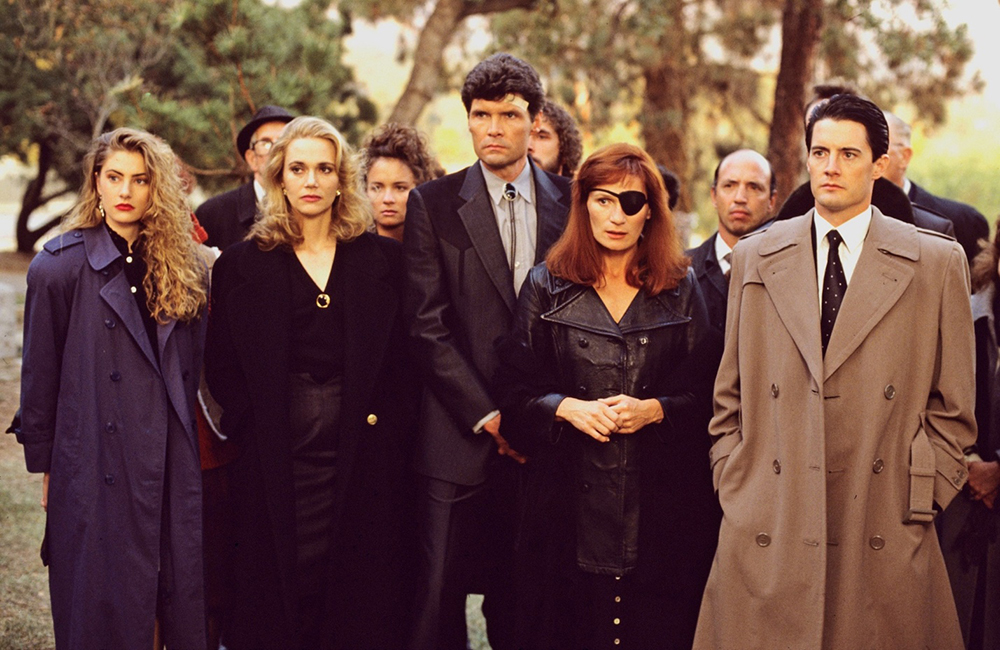
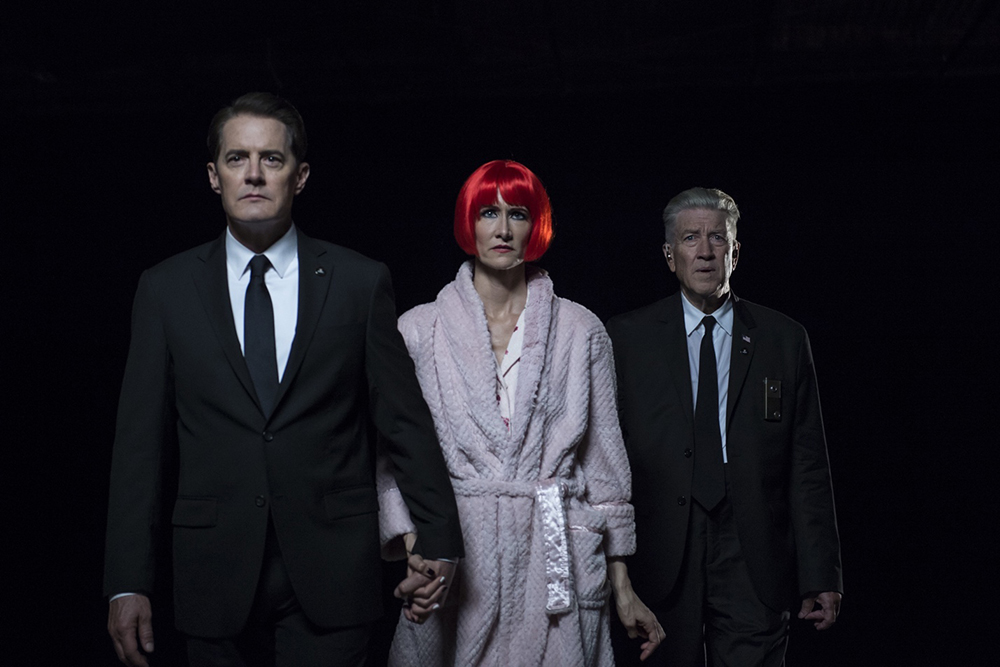
The more abstract a thing gets, the more varied the interpretations… but people still know inside what it is for them. - David Lynch, David Lean Lecture 2007
To Aurora, we still Peak Twin
I recently visited San Francisco’s Young Museum. In town to celebrate the union of a nephew and his beloved partner, I spent a day reconnecting with my two sons and daughter-in-law. The special exhibit on “The Art of Manga” brought upon me vibrant acts of reading a whole new world of aesthetics and print; it also revealed how my relationship with my sons was for the most part painted with various hues of Manga, as it was with brushstrokes of Animé and other reading delights. It was especially arduous for me to read how much I had resisted to engage these books. A generational difference, sure, I thought. At once, during that long and slow afternoon I learned quite a few things about the vast Manga universe: first, that as curator Nicole Coolidge Rousmaniere warned those entering the exhibit halls, it is a medium and not a genre. Second, that this medium is a worldwide phenomenon. And third, that many Manga stories and characters directly or indirectly touch on peoples and cultures of my own. As I let all this seep in, I felt something I had not experienced this intensely in a long time: the vital centrality of reading circular ruins of fiction the way Twin Peaks first activated in me and how, despite the (at times) exasperating dynamics of such ruins, they infallibly come to mean so much to me. Every time.
That afternoon I felt the frustration of reading in circles the way I remembered living through it in the early 1990s. Read, and wander. Read, and wander some more. Read. And wander. This time, some of these circles were physical and quite real like the weekly episodes and the seasons in David Lynch’s series, this time shaped by the museal rooms each named with one or two Manga author figures. Despite the chaotic deluge of information and pages, these rooms invited us to move through years and spaces as the pages in the books required: right-to-left, top-to-bottom. The rabbit hole of translation between East Asian languages (especially Japanese and Chinese) and English expanded the two-dimensional circles into a spiraling of the spectacle to which only those wanting to see could have access. The circular ruins of my own resistance to these texts sparked up many acts of reading Manga, as I remembered my reading Agent Cooper, and with him, trying to figure out vital riddles brought forth by the people and the landscapes of the town of Twin Peaks. That afternoon in San Francisco I saw circular ruins of fictions move once more in front of my very own eyes: Monkey D. Luffy and his pirate crew in search of the One Piece treasure, Sakura Mamiya and Rinne Roduko in search of the Circle of Reincarnation, and Gengoroh Tagame’s The Passion and other stories, in search of their own male gay Manga. They all spoke to me eloquently.
Several times I stood in a circle or another, yearning for a life where I could have connected with my sons had I not resorted to such resistance to read. Moreover, how could I, the author of “Twin Peaks and the Circular Ruins of Fiction. Figuring (out) the Acts of Reading,” a 1993 article about Jorge Luis Borges and Twin Peaks, remained so stubbornly blind to Manga, the phenomenon and the medium, to their fertile grounds for reading? How did the first two seasons of the series speak to me so clearly that, when I wove them with the teachings of Borges’ fictions, I was able to devise clues to read Medieval poesis and Psychoanalytic dualities, but not Manga?
I asked myself that question as I read in circles Gengoroh’s Christ Yakuza, and my own resistance to Manga found echoes in another source of loss: why do I not understand the fact that many readers resisted to read Twin Peaks’s circular ruins of fiction, and walked away thinking how arrogant the series was, or how futile it was to continue to watch once the killer of Laura Palmer was revealed? Back then, as the century turned, I felt that syntax was getting too complicated, and that it would all go dormant. I was wrong. Because art throws the arrow pointing to the long haul, to dwell in long-term memories. To mean something now, and perhaps the same a long time after the artistic object is created; or maybe, to mean something entirely different. Thirty years of reading Twin Peaks show many an explosion of its artistic kernels.
The 2017 revival of Twin Peaks brought about a third season with 18 new episodes, and a new wave of reception of the series following Lynch’s passing away in January of last year. Lynch and Frost returned to the drawing board almost three decades after their first experiment. Lynch had several movies and different artistic experiences in his bag, and with them, his writing circular ruins of fiction felt eerily the same as in the early 1990s — and nothing like it. The present turn of the Twin Peaks artistic screw, building on the earlier rounds of the circle, offers new opportunities for readers to revisit both the series and some of the studies published decades ago by Literature Film Quarterly and other interpretive venues, thus expanding Lynch’s legacy. In ways parallel to those of the Manga exhibit, meaning, staging pieces of that medium’s circular ruins of fiction and underscoring its media engagement and narrative complexity, to revisit both Twin Peaks and its various rounds of reception in this reprint today will generate new acts of reading. This, in turn, can lead to further understanding the profound impact of the Macondo that Twin Peaks came to be, its universes of meaning and significance. As Thomas Flight notes, looking back now we can see how the series revolutionized television in myriad ways: first network to tell a story beyond the lines of an individual episode, and the first one to focus on one single case.
Furthermore, each episode was a self-contained unit and, at the same time, a step in a larger story that spanned capitalism, false identifications, murder, fashion, vanities, and violence against women, among other matters. The collaborative duo formed by David Lynch and Mark Frost created the series and wrote/directed a few episodes in the first two seasons — some, together; others, separately. From the second episode in the first season, the series brought in several other writers and directors such as Caleb Deschanel, Tim Hunter, and Dianne Keaton. The result: a colorful palette of narrative and filmic perspectives.
For Flight, this variety show birthed the golden age of television; in fact, with its deeply strange and surreal drive, it left a palpable trace in titans such as The Sopranos, Lost, True Detective, Severance, and Who Killed Sara? — all of which are incomprehensible without the legacy of circular ruins of fiction forged by Twin Peaks. The greatest contribution these American television shows received from Twin Peaks is, as Flight acknowledges, that they do not aim so much to solve plot riddles, or murder mysteries, to find out who the killer is; rather, they focus on building a world that keeps wandering or, as I argued in my 1993 essay, on figuring out acts of reading circular ruins of fiction. In the end, these artistic pieces do not seek to close doors on meaning by finding the comfort brought about by the solution of that riddle or this crime or that problem, but to make film and television as it can be — namely, strange, absurd, and ahead of its time.
The first two seasons, produced and released between 1989 and 1991, alongside the 1992 feature film Twin Peaks: Fire Walk with Me, inspired many of us to write about this wondering, and uncannily so, foreboded their own rereading and rewriting as it would come to be almost 30 years later in the 2017 Twin Peaks. The Return. This third season, written and directed virtually solo by the Lynch-Frost duo, uncompromisingly opened doors to spectacular acts of reading, got out of network television by channeling the creative flow in the Showtime channel, and from there the full series jumped to DVD and streaming. The variety of audiovisual experiences offered by the series and the film in turn inspired varied and numerous rounds of reception. What follows is a sample of scholarly and pop interpretations of the series and the film; however, the bibliography about Twin Peaks is vast and continues to grow. In each one of these interpretive studies I find yet another instance of figuring (out) acts of reading Twin Peaks.
Shortly after the second season and the film, and twelve years before the third season, David Lavery edited a volume that set the basis for the scholarly readings of the series. Full of Secrets deployed feminist, postmodern, psychoanalytic, and semiotic theoretical frameworks, and underscored the series’ symbolism, genre hybridity, and radical critique of patriarchy and American culture. These essays were not merely thematic; rather, they dwelled in matters as they related to other questions, reaching conclusions worthy of the contradictory nature of representation characteristic of the series. For instance, Diane Stevenson traced how the series and the film represent family structures and domestic violence not to support patriarchy or aggression towards women, but to suggest a feminist interpretation of such structures and actions legible through the conventions of the fantastic that expose the repressed horrors that underlie American family ideologies. In contrast, Christy Desmet traces the insufferable presence of incest in the series, while Diana Hume George offered an enlightening view of the continuum of violence against women springing from domestic abuse, especially against those sexually active.
Other essays in the collection highlighted the series’ interpretive community, serial creativity, authorship and viewers, music, and postmodernism, among others. Two years later another contributor, Martha Nochimson, published The Passion of David Lynch, with one chapter devoted to the series and another one to the film. Structured with spiritual and feminist theoretical interpretive turns, “The Magician Longs to See: Twin Peaks” and “If You Are Falling in Space: Twin Peaks: Fire Walk with Me” continued the thread of feminist readings of the series, and argued that Twin Peaks resist patriarchal violence by mobilizing empathy towards Laura Palmer.
Twelve years later, Eric Hoffman and Dominick Grace published Approaching Twin Peaks, another collection of essays exploring the impact of the first two seasons and the film on American cinema, as well as their innovative use of horror and science-fiction among other matters. The methodological diversity of Full of Secrets and Approaching also characterized a third collection of essays by two authors, Julie Grossman and Will Scheibel. Their 2020 monograph Twin Peaks counted on the bonus of the 2017 release of the third season, Twin Peaks: The Return, which led them to dwell in further questions of authorship, literary-filmic questions such as genre and intertextuality, new angles on feminist critique by focusing on femme fatales, performance, adaptation, remediation and transmedia storytelling.
Given the profound insights of both the series and the film regarding the subconscious, it is not surprising to see that they have been the subject of repeated psychoanalytic studies, most of which focused on female characters. Shortly after the release of the second season, Nochimson explored the tangible presence of sexual brooding in the series, especially Cooper’s character, in “Desire under the Douglas Firs;” the study was reprinted in 1995 in Full of Secrets. In 2010 Rebecca Ann Barr read another wealth of desire and dread, focused on Laura Palmer through the theoretical lenses of phantasmagoria and abjection; the study revealed new turns of Twin Peak’s profound engagement with American Gothic literature and film. In 2007, Todd McGowan explored in depth the identification of the first two seasons and the film with the psychoanalytic category of the Object. In 2012 Justus Nieland explored the uncanny feminine presence emblematized in Laura Palmer as locus of simultaneous desire and dread; by virtue of this presence in a world “wrapped in plastic,” Nieland concluded, Lynch transformed television melodrama into an art of obsession and affect.
In the aftermath of the third season, the feminist lens of reception shifted to postfeminism and feminist discourse across generations, as shown in Rebecca Williams’ 2019 analysis of the representation of aging women, trauma, and nostalgia in the series and film. Almost a decade earlier, in 2010 Eric Wilson linked the aesthetics of the series to American Transcendentalism and Romanticism and interpreted it as an allegory of good and evil, both spiritual and ironic. Two years before The Return, Jason Mittel turned to television analysis and situated Twin Peaks as a precursor to contemporary serialized storytelling, its highly experimental narrative framework and viewer engagement foreboding the emergence of transmedia- and complex television.
***
As I look back and review these thirty years of reading, time and again I can only return to my 1993 mantra: living in the circular ruins of fiction thrives with continuous reading, some celebratory, some contradictory, some damning. Blooming by figuring out further readings, a triplet of gerunds that show the crucial role played by process in Lynch’s legacy. Growing by not resisting reading. Wandering, and wandering some more. Wandering and wondering. Especially in this day and age of fake news, false rhetoricity in media, political corruption, economic uncertainty, and general cultural shapeshifting. As Lynch said at the beginning of these pages, no matter how abstract or how much the resistance, we all know what is inside for each one of us.
Works Cited
Barr, Rebecca Ann. “The Gothic in David Lynch: Fantasmagoria and Abjection.” David Lynch in Theory, edited by François-Xavier Gleyzon, Litteraria Pragensia, 2010, 132-146.
Carrión, María M. “Twin Peaks and the Circular Ruins of Fiction. Figuring (Out) Acts of Reading.” Literature/Film Quarterly. vol. 21, no. 4, 1993, pp. 240-247.
Desmet, Christy. “The Canonization of Laura Palmer.” Full of Secrets: Critical Approaches to Twin Peaks, edited by David Lavery, Wayne State University Press, 1995, pp. 93-109.
Flight, Thomas. “Why David Lynch was such a brilliant artist.” YouTube, Uploaded by Thomas Flight, 18 Jan. 2025, https://www.youtube.com/watch?v=NB8XOZzOoA4&t=831s. Accessed 25 Oct. 2025.
Grossman, Julie, and Will Scheibel. Twin Peaks. Wayne State University Press, 2020. ProQuest Ebook Central, https://ebookcentral.proquest.com/lib/emory/detail.action?docID=5945544.
Hume George, Diana. “Lynching Women: A Feminist Reading of Twin Peaks.” Full of Secrets: Critical Approaches to Twin Peaks, edited by David Lavery, Wayne State University Press, 1995, pp. 70–93.
Lavery, David, editor. Full of Secrets: Critical Approaches to Twin Peaks. Wayne State University Press, 1995.
Lynch, David. “The David Lean Lecture.” BAFTA Picadilly, 20 Dec. 2007. https://www.bafta.org/stories/david-lynch-david-lean-lecture-2007/. Accessed 29 Oct. 2025.
McGowan, Todd. The Impossible David Lynch. Columbia University Press, 2007.
Mittell, Jason. Complex TV: The Poetics of Contemporary Television Storytelling. New York University Press, 2015.
Nieland, Justus. “Wrapped in Plastic.” David Lynch, University of Illinois Press, 2012, pp. 1-160.
Nochimson, Martha P. “Desire under the Douglas Firs. Entering the Body of Reality in Twin Peaks.” Film Quarterly. vol. 46, no. 2, 1992, pp. 22-34.
---. The Passion of David Lynch. Wild at Heart in Hollywood. University of Texas Press, 1997.
Stevenson, Diane. “Family Romance, Family Violence, and the Fantastic in Twin Peaks.” Full of Secrets: Critical Approaches to Twin Peaks, edited by David Lavery. Wayne State University Press, 1995, pp. 70–93.
Williams, Rebecca. “Postfeminism, Television, and Twin Peaks: The Return.” Feminist Media Studies. vol. 19, no. 7, 2019, pp. 930–946.
Wilson, Eric G. The Strange World of David Lynch: Transcendental Irony and the American Sublime. Continuum, 2007.