VOL. 54, NO. 1
Naked Shepherds in Love: Recent Adaptations of Pastoral
Wayne Batten (Montgomery Bell Academy)
Formosum pastor Corydon ardebat Alexim,
Delicias domini, nec, quid speraret, habebat
The shepherd Corydon adored beautiful Alexis,
His master’s pet, nor knew he what to hope.
—Virgil, Eclogue II 1
I am afraid it will not be found easy to improve the pastorals of antiquity, by any great addition or diversification.
—Samuel Johnson, Rambler 36
Anyone interested in the enduring vitality of pastoral may well begin with Virgil’s EclogueII, dating from 37 BCE, which continues to prompt imitation and arouse controversy.2 In Virgil’s world, contrasting that of his Greek model Theocritus, myth and tradition recede before a legal right to the enjoyment of property.3 The probability that the enslaved Alexis cannot express his own feelings imparts imaginative license (something, quid) for his working-class admirer to woo him through chaste song and promised gifts.4 Thus the ravishing images that constitute the poem itself are the fruits of Corydon’s effort to sublimate his ardor by means of his lyric expression, his visionary opposition to a forbidding master or owner enabled by proscriptive power.5 Virgil’s precedent can be traced in three essential aspects of subversive pastoral, which this essay will address sequentially: (1) the liminal or doubled vision, (2) the role of economics and labor, and, ultimately, (3) the repudiation of the dominus and corresponding power discourses. Among Eclogue II’s modern progeny, two successive and widely known examples are the films Midnight Cowboy (1969) and Brokeback Mountain (2005). In each instance, the resilient pastoral mode will prove fully equal to confronting the menace of whatever current power discourse may rise in opposition to pastoral pleasures.6 Pastoral, under this scrutiny, is distinguished by a peculiarly transgressive property that converts any opposition into a bracing target of the mode’s discursive play. Thus the homoerotic pastoral, ancient and modern, by defying conventions of class privilege, heteronormativity, and systemic homophobia, affords a template by which to assess the impact of any pastoral.7
1) The Liminal Vision
In his effort to assert a future for pastoral, Leo Marx makes a persuasive point that the shepherd, due to the demands of his work, was a liminal figure, one who moved between town and country, sophistication and rusticity.8 Through the shepherd swain’s vocational ability to see from two or more different perspectives, based on his experience in contrasting venues, his latent modernity emerges. Pastoral liminality is a variant of what Jacques Lacan terms the gaze, which waives confidence in a single vision: “I see only from one point, but in my existence I am looked at from all sides ” (Four Fundamental Concepts 72).9 By analogy, the conscious self or subject is in the position of a performer who knows that she or he is watched by an audience, but who can never actually see herself or himself in real time from the perspective of the audience. This gaze is felt by someone who looks as subject but who is simultaneously seen as an object by other subjects who constitute a collective.10 For Corydon, wooing Alexis entails an effort to see himself as others see him and thus approximate or mimic the gaze. He protests
nec sum adeo informis; nuper me in litore vidi,
cum placidum ventis staret mare. non ego Daphnin
iudice te metuam, se numquam fallit imago. (lines 24-26)
Nor am I so ugly; lately on the shore I saw myself
When the sea was unstirred by the wind. If you are judge,
I rival Daphnis, if the mirror never lies.
If Corydon be rusticus but not delusional, he is asserting that he could be a valid contender for Alexis under other circumstances. Moreover, the image glimpsed in the sea effectively reverses the roles of Corydon and Alexis. For a moment the desiring swain sees the desired but unattainable beloved in the water’s reflection. Thus Corydon experiences himself as both subject and object, as both viewer and performer in the Lacanian theatrical analogy.
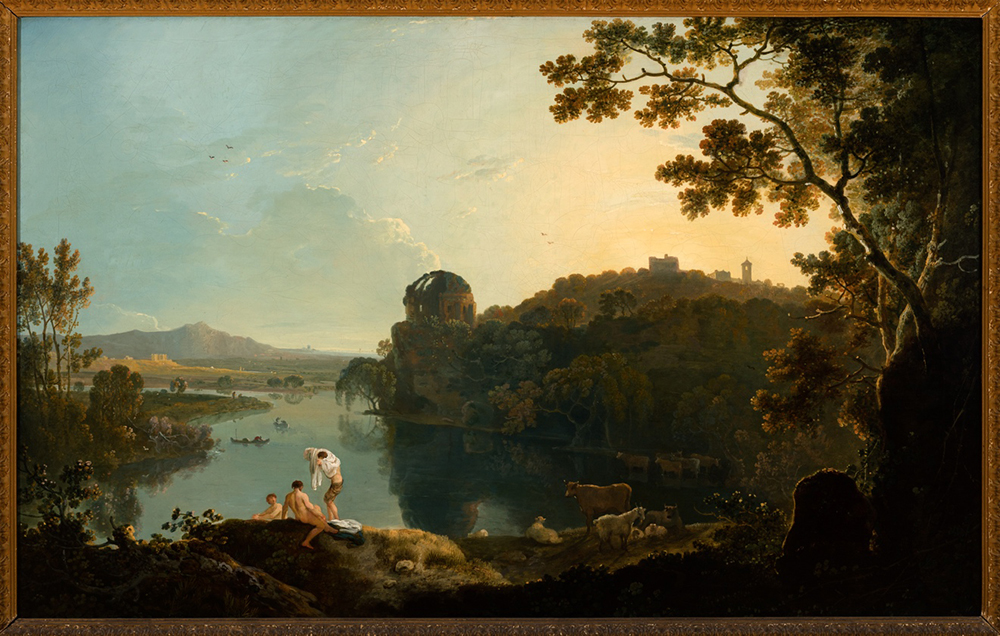
To elucidate the liminal or double pastoral gaze, recourse to a pastoral painting is condoned by another Lacanian analogy: “[The painter] gives something for the eye to feed on, but he invites the person to whom this picture is presented to lay down his [sic] gaze there as one lays down one’s weapons. This is the pacifying, Apollonian effect of painting” (Four Fundamental Concepts 101).11 Hence the viewer of a painting must adjust her or his role in the watching audience and assume the position of the one being seen onstage as well. A pertinent example of this function in pastoral art is Richard Wilson’s River Scene: Bathers and Cattle (1763-1765) (see Figure 1). Here the pastoral gaze operates on the viewer through a doubled and redoubled possibility that the painting refuses to circumscribe. On one hand, in the composition of the scene follows the classic circular template, leading the eye around the expanse of water. On the other hand, the highlight on the bathers’ bodies impishly draws the eye away from the circular route to create a mild tension between the natural scene and the highlighted fugitives from the ceiling of the Sistine Chapel. The second doubling of the pastoral gaze consists of whatever narrative is implied by this composition. What is going on here? Innocent al fresco bathing among shepherds or a sexual frolic discreetly conducted on the hidden side of the knoll that rises in the foreground? One bather watches another disrobe, while a third, fully naked, watches something of interest on the shore beneath him. Who polices the antics of this looking and of the painting’s gaze?
If any modern fiction constitutes an effort to implode the pastoral mode once and for all, Midnight Cowboy, both novel and movie, would seem to be a prime candidate. Joe Buck, the protagonist, leaves for in his quest to become a gigolo. Go east, young man, go east. This modern variant of pastoral presents the classic elements in updated but recognizable form: Joe’s aspiration to a better life as an urban sex worker, and three skewed variants of the pateriratus or patererrans. Joe’s literary antecedents are the comical rusticus figure (the rube in the big city) and Don Quixote, each capable of providing a distinct perspective that contests and eventually inverts any normalizing dismissal or judgment.12
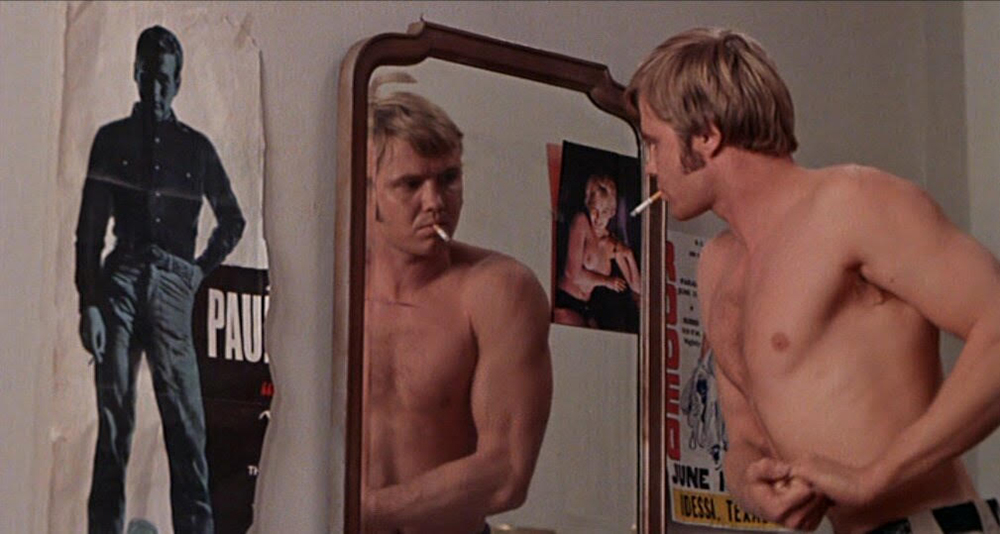
In projecting the double gaze of pastoral, Joe assimilates the method of his ancient predecessor. Perhaps by serendipity, Herlihy’s novel (1965), on which the film is based, postdates Lacan’s first published account of the mirror phase (1949).13 The liminal or doubled gaze here devolves, not from the calm sea but from the reflections of many mirrors. Here we see the virile ingénue examining his wares, with inspiration from two pin-up images (see Figure 2). Joe, more assiduously than Corydon before him, resorts to narcissistic contemplation as a locus of identity:
Joe knew he was no great shakes as a thinker and he knew that what thinking he did was best done looking in a mirror, and so his eyes cast about for something that would show him a reflection of himself. Just ahead was a store window. Ta- click ta-click ta-click ta-click, his boots said to the concrete, meaning power power power power, as he approached the window head on, and there was this new and yet familiar person coming at him, broad-shouldered, swaggering, cool and handsome. (Herlihy 9)14
After showering and shaving in his hotel room, Joe makes another appraisal: “And now, ready for that fresh look at himself, he would swing his eyes back onto the mirror as if some hidden interloper beyond the glass had suddenly called his name: Joe Buck!” (11). The reflexivity of Joe’s frequent mirroring is an effort to locate himself in the gaze, like Corydon to see himself as both desired and desiring. Moreover, the novel’s point of view distances us from Joe as focalizer, as he is unlikely to think of his boots speaking or to use the word interloper. Hence the narrator manages to convey both Joe’s sensibility and how it can be rendered into art by sophisticated representation, so that the reader easily distinguishes Joe’s subjectivity from the author’s skill in rendering it.
With the opening mise-en-scène of a blank drive-in movie screen in front of an expanse of typical western prairie, the movie evokes the conventional, constructed, media-driven aspect of the cowboy (or herder) figure, eventually to be reconstituted in this version of pastoral. The rhythm of first undermining but then restoring an image is established if the viewer realizes that the prairie stretching behind the blank screen is not absolute reality but just another photographic image. Transposed to cinema, pastoral gaze is detected in the sequence of images through which the camera’s eye sustains the illusion of objectivity. McGowan notes that the spectator of the movie invests himself in the filmic image but is “absent as perceived but present as perceiver” (28). Thus, the position of Joe as perceived entity is reversed in the movie’s audience, who observe without being seen. Visually, the movie, with Voight’s commanding presence, highlights rival expectations for Joe’s narrative: will he be humiliated and punished, or somehow prevail against the allied menace of cynicism and moral condemnation? Sympathy for the protagonist arises from recognizing his fundamental decency and obvious inadequacy, as well as the indifferent, exploitative or hostile environment he faces without comprehension.
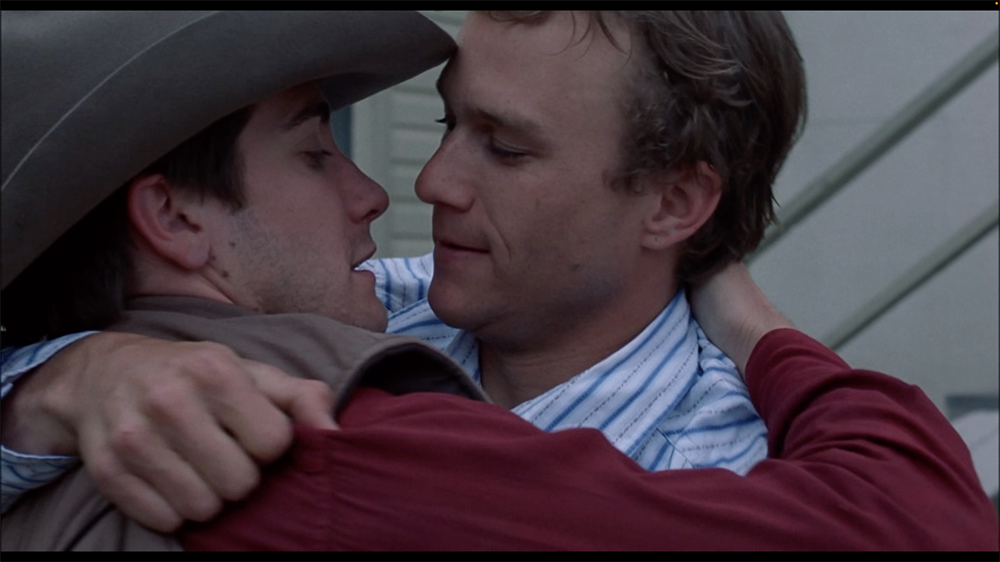
While Midnight Cowboy subjects the biggest apple to the pastoral gaze and suggests that the naïf Joe Buck is superior to an urban culture that has lost touch with such virtues as charity and humanity, Brokeback Mountain takes on the full heft of frontier myth and heteronormative masculine mystique, to achieve nothing less than tragic effect (see Figure 3).15 Jack Twist (Jake Gyllenhaal), a.k.a. “Rodeo,” is able to orient himself enough to retain his confidence within the homophobic territory of herding and summer range, even in the intolerant confines of Wyoming and Texas in the 1960s. Ennis Del Mar (Heath Ledger) becomes enamored with Jack but has difficulty facing down a hostile, intolerant culture, whose restrictions he has partly internalized in the form of his own homophobia and hyper masculinity.16
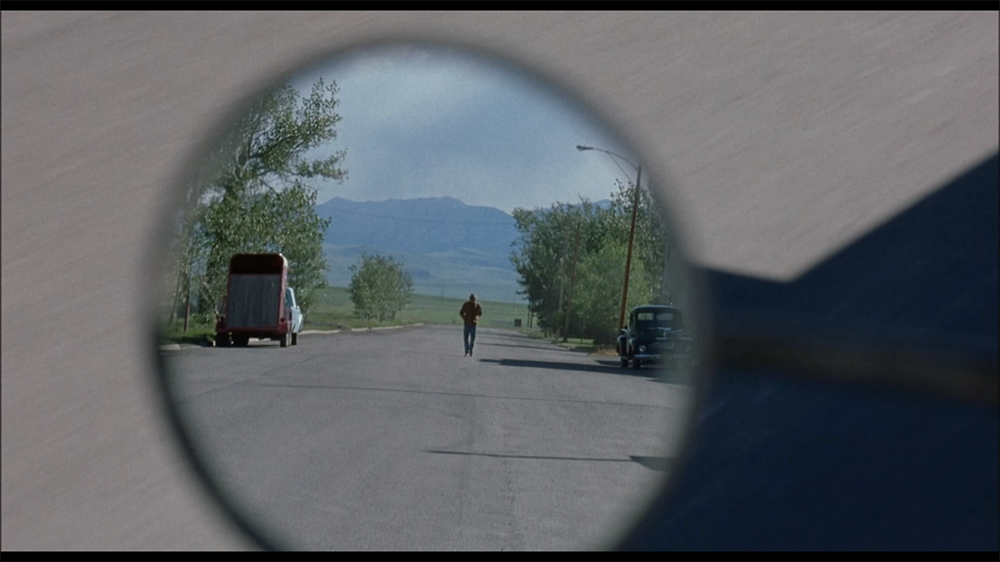
In cinematic technique, director Ang Lee has not overlooked the mirror as a means of establishing the pastoral double gaze. Mirroring here provides a degree of distance and reassurance to the heterosexual audience in tandem with validation to the homosexual. In an early scene not found in the short story, Jack looks lasciviously at the slouching figure of Ennis as seen in the rearview mirror of Jack’s stalled pickup truck. Rear view and pickup are appropriate for Jack’s vision. Later, Jack is shown in the foreground peeling potatoes for supper at the shepherds’ mountain camp while, in deep focus, Ennis squats nearby with his trousers lowered in order to wash his crotch. Gyllenhaal’s intense focus on his task in this frame makes palpable Jack’s care to avoid looking at Ennis. The pastoral double gaze is thus asserted by being so obviously averted. When the two men are parting after the early closing of their summer range, Jack sorrowfully watches, through the same truck’s rearview mirror, the lone, lanky figure of Ennis departing (see Figure 4). The pastoral potential is pictorially extended by the gorgeous landscape itself. Shortly after their first anal interlude in their shared tent, Ennis finds Jack reclining on the ground and viewing a vast landscape of mountain and forest. Nature is never spent. Jim Kitses notes, “In open range, feelings, gender, and sexuality cannot be fenced in or legislated. What is sinful or perverted or deviant in the natural world, the world of the sublime?” (25).
2) Economics and Labor
The economic factor that emerges in the possible enslavement and exploitation of Corydon and Alexis takes variant forms in modern adaptations. In Hegelian terms, both Corydon and the dominus, in contention for their object, Alexis, are trapped in a form of mutual dependency, which Corydon, addressing himself in the tone of a dominus,
ah, Corydon, Corydon, quae te dementia cepit?
semiputata tibi frondosa vitis in ulmo est.
quin tu aliquid saltem potius, quorum indiget usus,
viminibus mellique paras detexere iunco?
invenies alium, si te hic fastidit, Alexim. (lines 69-73)
Ah, Corydon, Corydon, what madness has gripped you?
Your vine is but half pruned on the leafy elm.
Nay, why not at least set about plaiting some thing your need calls for,
With twigs and pliant rushes?
You will find another Alexis, if this one scorns you.
No mere resort to handicraft to ease his frustration, Corydon points to useful activity, the wisdom of doing whatever one can. Corydon reminds himself that he may someday love another youth in some way and find a viable way of life within his own power.
For Joe Buck, this transition comes when, having left the less-than-golden West for the pavements of Manhattan, he is deflected to the golden tropics by his sidekick friend’s vision of Florida. Like Sancho Panza, whose prompting of his master provides ballast to Don Quixote’s inspired madness, Ratso Rizzo (Dustin Hoffman) coaches Joe in the means of survival on the streets and the downside of his career goal. At times,
in an extremity of hunger [Ratso] would arrange for Joe a fast five- or ten-dollar transaction in which little more was required of the cowboy than standing still for a few minutes with his trousers undone. But these unhappy conjunctions usually left Joe in a depressed and disturbed state of mind. He felt as though something invisible and dangerous had been exchanged. 17 (147-148)
Unlike Sancho Panza, however, Ratso introduces Joe to a pastoral vision of a better life beyond the city. “Without examining [Ratso’s] picture too carefully for probability, he had formed a kind of cartoon image of the two of them standing near the water saying here, fishy-fishy, at which point a pair of enormous finned creatures would jump into their arms precooked. A silly, happy thought, and he could smell the fish plain as day” (146). Nearing Miami, Joe evinces his altered pastoral sensibility: “There was this almost painful prettiness about the day, even the air was pungent with it, and he supposed it had all to do with being out of New York City” (213). Nearing journey’s end, Joe resolves to find a regular job, though he does not feel defeated: “he would goddam well do some seeking, and go on stubborn and hard-assed about it till the day he dies” (217). At this point, his concern with the gaze dissipates: “It occurred to him that he was doing some thinking without the aid of a mirror, and he wondered if that wasn’t some kind of an improvement” (217).
The economic factor of modern pastoral seen in Joe Buck’s frustrated quest reappears in Brokeback Mountain in three instances that thwart the lovers’ transition back and forth between the pastoral idyll and the society where they seek a livelihood. Thus Brokeback Mountain revisits the convention of pastoral interlude, especially familiar from Shakespeare’s As You Like It and A Winter’s Tale.18 The shepherds’ first summer together becomes an idyll that Jack and Ennis attempt to restore in their occasional escape from town and family to remote, putative fishing trips in the mountains. In this version, however, pastoral interlude fails to revise and reform conditions in the world of before-and-after. The first of these is the premature end of the two young shepherds’ work in summer range when an early snow, not atypical in Wyoming, and the foreman’s discovery that these “two deuces” have been having sex, send them packing. Ennis’s disappointment, both financial and emotional, contributes to the terror that causes him to become nauseated shortly after parting from Jack. The second economic drain is Ennis’s curtailed education, his poverty and consequent difficulty in taking time and money to reunite with Jack. Lastly, Jack’s financial insecurity makes him dependent on his belittling father-in-law. Work and marriage thus draw the lovers away from the pastoral setting where the love affair began and can be only sporadically approximated.
3) Repudiating the Pater Iratus
Both Herlihy and Proulx multiply the figure of the pater iratus, the descendant of Virgil’s dominus, whose patriarchal animus operates in conjunction with other menaces. Hate, however, can ultimately be repudiated if not eradicated.19 Having never known his biological father, the boy Joe briefly enjoys a male role model in Woodsy Niles, one of his grandmother’s many boyfriends, whose role is reduced to a brief mention in the film version: “. . . he showed Buck how to ride a horse and how to make a slingshot, and he taught him how to chew tobacco and how to smoke cigarettes, and a special way of holding his peter so that he could piss an arc higher than his own head” (18). For a time, Woodsy permits the boy to share this masculine joie de vivre.20 Soon after Joe is out conned in New York City by a high-priced sex worker, whom he mistakes for his first customer, he encounters a false father when Ratso Rizzo arranges a meeting with a man who Joe thinks will serve as a procurer, but who instead is a religious fanatic. Joe finds little advantage in the power of prayer extolled by Mr. O’Daniel. To this “fatherly man,” Joe can confess that “I’m no cowboy, but I am a first class fucker” (116). While the first of these erratic fathers is nostalgic and the second eccentric, the third, Townsend P. Locke, instigates a crisis in Joe’s moral development. Feeling cheated and misled, Joe in beating Locke realizes without using the term that he has been made a tool of Locke’s masochism: “Joe began to feel sick. . . . if further violence were to take place, it would clearly be against himself, but upon the body of Locke” (202).
Joe’s ordeal in the big city thus causes him to enact but not extol the madness of homophobia. His ambivalence is established proleptically in the novel, though not in the film. Before his sojourn to New York City, Joe has a casual “alliance” with Bobby Desmond:
For a brief period, perhaps a week or so . . . Bobby sought out Joe’s company: took him for rides in his car, stopped by the house now and then with a six-pack of beer. As it turned out, this young man merely wanted the experience of being used by Joe. . . . Joe, eager as always to oblige, gave the young man the experience he wanted. . . The persons, female and male alike, who were so eager to avail themselves of his splendid body never appeared to notice that it was inhabited by Joe Buck. (33)
In beating and robbing Locke, Joe in the novel is clearly motivated not by brutality but by determination to obtain the fifty dollars needed to buy bus tickets to Florida for himself and Ratso. In contrast, the movie obscures Joe’s motivation and instead lets the beating of Locke appear to be the result of sheer homophobic disgust tolerated by a mainstream audience.21
Despite his inarticulate introduction to such contorted expressions of masculine vitality as public fellatio and inadvertent sadism, Joe’s awakening to filial love unquestionably resists the pressure of urban depravity:
Nowadays [Joe Buck] had, in the person of Ratso Rizzo, someone who needed his presence in an urgent, almost frantic way that was a balm to something in him that had long been exposed and enflamed and itching to be soothed. God alone knew how or why, but he had actually somehow stumbled upon a creature who seemed to worship him (143).
In a significant departure from the novel, the film downplays Joe’s unselfish care for the ailing Ratso when Joe insists, over Ratso’s enervated demurral, on attempting to realize Ratso’s long cherished fantasy of escaping to sunny Florida. In this phase of the narrative, Joe encounters a helpful woman in the guise of his first satisfied female customer, who provides a glimpse of hope and success. The female guide figure will reappear in Brokeback Mountain.Eventually, Joe discards both his western clothing and his shopworn aspirations, but through his disillusionment he has attained something that is not an illusion. As he embraces Ratso Rizzo’s dead body beside him on the bus, we know Joe Buck, frightened but unmistakable there in the valley of the shadow of death.
Similar to the pattern in Midnight Cowboy, Brokeback Mountain presents three versions of the pater iratus, in whom the jouissance of the testosterone-driven master proves not only repulsive but also at times criminal. Early in their affair, Ennis relates to Jack a boyhood trauma caused by the murder and mutilation of a nearby rancher, Earl, who had dared to live openly with his male partner, Eric. Ennis remembers that his father insisted on showing him Earl’s corpse and suspects that his father may have done the deed himself as a lesson for the boy. Consequently, Ennis, unlike Jack, cannot envisage any but a dissociated, compartmentalized life. Moreover, Ennis’s laconic reserve recalls Lacan’s view of the phallus as symbolic of power and expression. The memory of the rancher’s mutilation not only brings castration anxiety to the fore but also explains the young cowboy’s difficulty in speaking. To speak is to appropriate the phallus and thus risk castration.22 An aspect of Jack’s seductive role is simply to get Ennis talking. The second irascible father is none other than Jack’s father-in-law, who relentlessly belittles Jack and contributes to the attenuation of Jack’s marriage.
The third invidious pater iratus is Jack’s father, as described in the short story: “Ennis recognized in him a not uncommon type with the hard need to be the stud duck in the pond” (281). As he stares at Ennis “with an angry, knowing expression” that implies intimation of Jack’s homosexual proclivities, this father in the penultimate scene in both story and film, cruelly reveals to Ennis that Jack had plans to restore the family’s derelict ranch with the help of “some ranch neighbor of his from down in Texas [who’s] goin a split up with his wife and come back here“ (282).23 As Father Baugh notes, Ennis proves himself to be fully capable of resisting this father’s final, brutal effort to destroy what he cannot control: the love that was bestowed upon his son. The helpful woman in this case is Jack’s bereaved mother, who assists Ennis in taking away the two shirts that he has found in Jack’s bedroom, blood-stained shirts retrieved from the first parting and quarrel of the amorous shepherds.
Another feature of both the short story and movie suggests that ambivalence is not confined to the narrative but rather extends to the authors’ and scriptwriters’ anxiety to secure a mainstream audience. The mirror’s distancing of the homoerotic gaze is amplified by a development that some will find puzzling and contradictory otherwise. Neither Ennis nor Jack is uneasy about his lover’s marriage and mention of occasional heterosexual diversions, possibly because these are seen as inevitable camouflage necessary to sustain both social and economic viability. For a modern audience, a taint of homoeroticism can be soothed by the mantra of bisexuality. Ennis is enraged to the extent of threatening murder, however, by the possibility that Jack’s trips to Mexico have the purpose of hiring male prostitutes. Jack’s escapades trigger Ennis’s intense homophobia and threaten to compromise the enchantment of pastoral love. During the final scene, where the script departs from and extends Proulx’s story. Ennis is willing to risk losing yet another job in order to attend his daughter’s wedding. Here in a trailer parked on the prairie well away from town, the homoerotic pastoral serves the heteronormative responsibilities of fatherhood. Instead, the short story ends with Ennis’s final thought affirming the contradiction than has besieged his life, an aporia through which the gaze has been dispassionately fixed upon him: “There was some open space between what he knew and what he tried to believe, but nothing could be done about it, and if you can’t fix it you’ve got to stand it” (285). If Ennis is not quite greater than his tragic fate, he is equal to it in his recognition or anagnorisis.
The doubled gaze of pastoral continues to engage its audience much as it did in Virgil’s Rome. Systems of power are subjected to scrutiny and revaluation by pastoral song. In Eclogue II enslavement or inferior status fails to silence Corydon, whose lyrics construct a discourse in opposition to the imperial juggernaut that exploited slaves for both labor and sexual gratification. With Midnight Cowboy, the rustic shepherd saddles the modern urban environment with the inspired madness of Don Quixote, on the path of reconstituting the mystique of machismo and Western frontier, each modified as Joe Buck learns to affirm his identity apart from these confining conventions in order to protect, nurture, and love someone by whom he is loved. In Brokeback Mountain, the protagonists Jack and Ennis are ensnared to varying degrees by their own internalized homophobia, while their mutual passion is normalized to some extent by their vigorous claims to bisexuality. Jack fundamentally resists the onus of self-condemnation, while Ennis belatedly adapts himself sufficiently to affirm a core element of his identity: his love for Jack. Ultimately, it may be difficult to discern where the ancient art of pastoral will lead next, but we can now more confidently identify whatever persistent perils the pastor’s rod and staff continue to hold at bay.
Endnotes
1 Translations are based on the Loeb Classical Library Edition. John Dryden translates: “Young Corydon, the unhappy shepherd swain, / The fair Alexis loved, but loved in vain.”
2 Annabel Patterson gives an extensive account of interpretations of Virgil’s Eclogues over centuries. Paul Alpers, following the tradition of seeing Eclogue II as an imitation of the third and eleventh Idylls of Theocritus, finds Corydon’s “inani” thrown to the hills and woods to be somehow as ridiculous as the pleas of the monster Polyphemus to the nymph Galatea (Loeb 11, What is Pastoral 296). Du Quesnay’s detailed analysis of Eclogue II as imitatio cautions that “the humorous side of the poem should not be overemphasized” (41). The most panicked reaction is that of Jerome L. Mazzano, who attempts to absolve Matthew Arnold’s “Thrysis” of any taint of homoeroticism arising from the inclusion of the name Corydon. Chris Mounsey surveys the closet pastoral elegy, whose “voluminous form . . . was regularly used to mask expression of same-sex desire” (602).
3 Roland Mayer argues, on the grounds that Virgil would not have relegated his shepherd singer to low status, that Corydon is not enslaved and really owns the 1,000 lambs of which he boasts to Alexis at line 21: “mille meae Siculis errant in montibus agnae” (My thousand lambs roam over the Sicilian hills). If so, he evidently is not quite rich enough to rival the master, probably the Iollas of line 57.
4 Pollini asserts that any freeborn puer delicatus (master’s pet) would likely be under the age of eighteen, though an enslaved boy or man entailed no age restriction (34). The poem implies that Alexis is probably enslaved as well as underage by modern standards.
5 Eleanor Leach observes that “Corydon is not only a rejected and despairing lover, but also a highly self-conscious pastoral singer. His invitation to Alexis is an invitation to join him in an ideal life that only the shepherd singer can enjoy” (427).
6 Gerald Turkel, writing from a legalistic perspective, explains: “Normalizing discourses, grounded in dominant institutions, rationality and science, combine with juridical categories and state power to form interlocking patterns of knowledge and control” (172) . . . . “patterns of controlled exclusion” result when “The meanings that discourse generates are the effects of discursive practices and must be seen as such” (175, 178). Foucault writes, “. . . there is no power relation without the correlative constitution of a field of knowledge, nor any knowledge that does not presuppose and constitute at the same time power relations” (Discipline 27). Pastoral’s transgressiveness would be, for Foucault, contingent upon its literary power: “Where there is power, there is resistance, and yet, or rather consequently, this resistance is never in a position of exteriority in relation to power” (History 95).
7 Apostol hypothesizes that “Corydon and the Eclogue in which he appears have become paradigmatic instances of the pastoral” (3).
8 “[The shepherds’] situation, in short, invited idealization as a via media between ways of life characteristic of opposite settings, each with its positive and negative features: in the town the amenities and constraints of a complex, organized social order, in the countryside the freedoms, pleasures, and hazards of unspoiled nature” (212). Apostol confirms Leo Marx’s view: “. . . Corydon cannot be a simple rustic as he claims, since he also occupies a second vantage point from which he can sincerely criticize his own rusticity and that of his fellow rustic denizens” (26).
9 Lacan adds a more abstract explanation to imply that the gaze is a type of aporia: “In our relation to things, in so far as this relation is constituted by the way of vision, and ordered in the figures of representation, something slips, passes, is transmitted, from stage to stage, and is always to some degree eluded in it—that is what we call the gaze” (73).
10 “. . . we are beings who are looked at, in the spectacle of the world. That which makes us consciousness institutes us by the same token as speculum mundi” (Four Fundamental Concepts 75).
11 Shackford notes the relevance of Netherlands genre painting, particularly Teniers, Jan Steen, and Brouwer. McGowan observes: “You think that you are looking at the painting from a safe distance, but the painting sees you—takes into account your presence as a spectator . . . . The subject apprehends the gaze indirectly, grasping the way it disrupts the image” (29, 36).
12 Fiore observes the picaresque tradition in Midnight Cowboy, where both Joe and Ratso are inspired and misled by “a deceitful mass media” (271).
13 “. . . the ‘mirror stage’ is of interest because it manifests the affective dynamism by which the subject primordially identifies with the visual gestalt of his own body. . . . the first effect of the imago [mirror image] that appears in human beings is that of the subject’s alienation. It is in the other that the subject first identifies himself and even experiences himself” (Écrits 92, 148). Gallop comments, “What is formed in the mirror stage will be the root source of later identification” (119). Identity, then, forms in distinction from the reflected image of oneself.
14 Subsequent page references to this novel and Annie Proulx’s short story “Brokeback Mountain” from Close Range will be cited parenthetically in the text. The movie of Midnight Cowboy retains many of the mirror scenes from the novel.
15 Keller and Jones observe the subversiveness of the film, “recognizing that there is a homosexual subtext or tension within homosocial bonds” (34). Moreover, “Jack and Ennis’s love reveals a radical possibility—that male bonding could evolve / devolve into desire” (34). Thus the film “does much for the visibility of same-sex desire, demonstrating that the love between two men can be moving and even tragic” (33). Kitses, Clover, and Nealon, for varying reasons, argue for the film’s tragic dimension.
16 Keller and Jones cite Annie Proulx on her theme of rural homophobia.
17 The film condenses these episodes into a single scene, where Joe is apparently fellated in a movie theater.
18 Empson expands on the manifestations of double plot, including the pastoral interlude, in Some Versions of Pastoral, pp. 53–86.
19 James Mellard notes that the forbidding father’s “is not the disinterested symbolic gaze of the benevolent patriarch who permits our oedipal (erotic, reproductive) desire but [is] the narcissistic drive to jouissance of the phallus or primordial father of Totem and Taboo, who arrogates all desire to himself” (396). Lacan’s term jouissance seems to denote an unrestricted, insatiable drive akin to testosterone poisoning. Maire Jaanus notes that it extends to “feelings of pleasure and unpleasure . . . outside of language” (52). Gallop explains, “. . . if jouissance is beyond the pleasure principle, it is not because it is beyond pleasure but because it is beyond principle” (113).
20 Woodsy Niles evinces Lacanian jouissance when he abandons Joe and leaves him bereft of a virile male role model.
21 Floyd asserts that the film, which was released less than a month before the historic turning point of the Stonewall Riot and won the Academy Award for Best Picture of 1969, is more homophobic than the book (114).
22 See Ellie Ragland-Sullivan on Lacanian language theory.
23 The short story twice conveys Ennis’s suspicion that Jack was beaten to death by assailants using a tire iron, as if to confirm Ennis’s father’s gruesome warning.
Works Cited
Alpers, Paul. “Convening and Convention in Pastoral Poetry.” New Literary History, vol. 14, no. 2, 1983, pp. 277-304.
---. “Empson on Pastoral.” New Literary History, vol. 10, no. 1, 1978, pp. 101-123.
---. What is Pastoral? U of Chicago P, 1996.
Apostol, Ricardo. “Urbanus es, Corydon: Ecocritiquing Town and Country in Eclogue 2.” Vergilius (1959-), vol. 61, 2015, pp. 3-28.
Baugh, Lloyd. “The Search for Meaning, the Struggle to Love: Ang Lee’s film Brokeback Mountain.” Gregorianum , vol. 90, no. 3, 2009, pp. 533-570.
Clover, Joshua, and Christopher Nealon. “Don’t Ask, Don’t Tell Me.” Film Quarterly , vol. 60, no. 3, 2007, pp. 62-67.
Dryden, John. “Pastoral II Alexis.” https://standardebooks.org/ebooks/virgil/the-eclogues/john-dryden/text/pastoral-2. Accessed 8 Jan. 2024.
Du Quesnay, Ian M. Lem. “From Polyphemus to Corydon: Virgil, Eclogue 2 and the Idylls of Theocritus.” Creative Imitation and Latin Literature, edited by David West and Tony Woodman, Cambridge UP, 1979, pp. 35-60.
Empson, William. Some Versions of Pastoral. Chatto and Windus, 1935.
Fiore, Robert L. “The Picaresque Tradition in Midnight Cowboy.” Literature/Film Quarterly, vol. 3, no. 3, 1975, pp. 270-276.
Floyd, Kevin. “Closing the (Heterosexual) Frontier: Midnight Cowboy as National Allegory.” Science & Society, vol. 65, no. 1, 2001, pp. 99-130.
Foucault, Michel. Discipline and Punish: The Birth of the Prison. Translated by Alan Sheridan, 2nd ed. Random House, 1995.
---. The History of Sexuality, Volume 1: An Introduction. Translated by Robert Hurley, Random House, 1990.
Gallop, Jane. “Beyond the Jouissance Principle.” Representations, no. 7, 1984, pp. 110-115.
---. “Lacan’s ‘Mirror Stage:’ Where to Begin.”SubStance, vol. 11/12, no. 4/1, 1982/1983, pp.118-128.
Herlihy, James Leo. Midnight Cowboy. 1965. Rosetta Books, 2016.
Jaanus, Maire. “Happiness and Madness.” Culture/Clinic, vol. 1, 2013, pp. 43-65.
Johnson, Samuel. Rambler “No. 36,” 21 July 1750. Project Gutenberg, https://www.gutenberg.org/files/43656/43656-h/43656-h.htm. Accessed 14 December 2024.
Keller, James R., and Anne Goodwyn Jones. “Brokeback Mountain: Masculinity and Manhood.” Studies in Popular Culture, vol. 30, no. 2, 2008, pp. 21-36.
Kitses, Jim. “All that Brokeback Allows.” Film Quarterly, vol. 60, no. 3, 2007, pp. 22-27.
Lacan, Jacques. Écrits. Translated by Bruce Fink in collaboration with Héloïse Fink and Russell Grigg, Norton, 2006.
---. The Four Fundamental Concepts of Psychoanalysis: The Seminar of Jacques Lacan Book 11. Edited by Jacques-Alain Miller, translated by Alan Sheridan, Norton, 1981.
Leach, Eleanor Windsor. “Nature and Art in Vergil’s Second Eclogue.” The American Journal of Philology, vol. 87, no. 4, 1966, pp. 427-445.
Lee, Ang, director. Brokeback Mountain. Universal Studios, 2006.
Marx, Leo. “Does Pastoralism Have a Future?” Studies in the History of Art, vol. 36, 1992, pp. 208-225.
Mayer, Roland. “The Civil Status of Corydon.” The mClassical Quarterly, vol. 33, no.1, 1983, pp. 298-300.
Mazzano, Jerome L. “Corydon in Matthew Arnold’s ‘Thyrsis.’” Victorian Poetry, vol. 1, no. 4, 1963, pp. 304-306.
McGowan, Todd. “Looking for the Gaze: Lacanian Film Theory and Its Vicissitudes.” Cinema Journal, vol. 42, no. 3, 2003, pp. 27-47.
Mellard, James M. “Lacan and the New Lacanians: Josephine Hurt’s Damage, Lacanian Tragedy, and the Ethics of Jouissance.” PMLA, vol. 113, no. 3, 1998, pp. 395-407.
Mounsey, Chris. “Persona, Elegy, and Desire.” Studies in English Literature 1500-1900, vol. 46, no. 3, 2006, pp. 601-618.
Patterson, Annabel. Pastoral and Ideology: Virgil to Valéry. U of California P, 1987.
Pollini, John. “The Warren Cup: Homoerotic Love and Symposial Rhetoric in Silver. The Art Bulletin, vol. 81, no. 1, 1999, pp. 21-52.
Proulx, Annie. “Brokeback Mountain.” Close Range: Wyoming Stories 1. Scribner, 1999, pp. 253-285.
Ragland-Sullivan, Ellie. “The Paternal Metaphor: A Lacanian Theory of Language.” Revue Internationale de Philosophie, vol. 46, no. 180, 1992, pp. 49-92.
Schlesinger, John, director. Midnight Cowboy. Metro-Goldwyn-Mayer Studios, 1969.
Shackford, Martha Hale. “A Definition of the Pastoral Idyll.” PMLA, vol.19, no. 4, 1904, pp. 583-592.
Turkel, Gerald. “Michel Foucault: Law, Power, and Knowledge.” Journal of Law and Society, vol. 17, no. 2, 1990, pp. 170-193.
Virgil. Eclogues Georgics Aeneid I-VI, Loeb Classical Library 63. Translated by H. Rushton Fairclough. Rev. ed., Harvard UP, 1935.