VOL. 54, NO. 1
Anarchy and Indigenous Life: Adaptation Strategies in Contemporary Documentary Filmmaking Through El Edén Subvertido (The Subverted Eden) and the Legacy of Mexican Social Reformer and American Prisoner Ricardo Flores Magón
Niels Barrezeele
Independent Scholar
Arturo Díaz Santana
Independent Filmmaker
Background
Arturo Díaz Santana (Mexico City, Mexico) is a film director and documentary maker, graduate of Hispanic Language and Literature from the Faculty of Philosophy and Literature and an alumnus of the Centro Universitario de Estudios Cinematográficos (CUEC), a branch of the National Autonomous University of Mexico (UNAM). The latter is renowned to have brought forth world-class talents, including: Alfonso Cuarón, director of (Roma (2018), Gravity (2013), and Children of Men (2006); cinematographer Emanuel Lubezki, who worked with Alejandro González Iñárritu on The Revenant (2015); and Terrence Malick on The Tree of Life (2011), to start with just a few references.
Beyond his filmmaking achievements, Santana is also an educator, imparting his expertise at various film schools such as Arte7 and universities. His approach is characterized by its DIY style, tedious research and investigation, and independent funding, with the help of a professional network of colleagues and production support within UNAM and the Mexican cinematography institute, IMCINE. I had the privilege of learning from Mr. Santana and served as a production assistant on El Edén Subvertido, a film that is deeply connected to my own professional journey in social work, education, documentary photography, humanitarian efforts, and activism. These experiences have profoundly influenced my understanding of documentary filmmaking and storytelling.
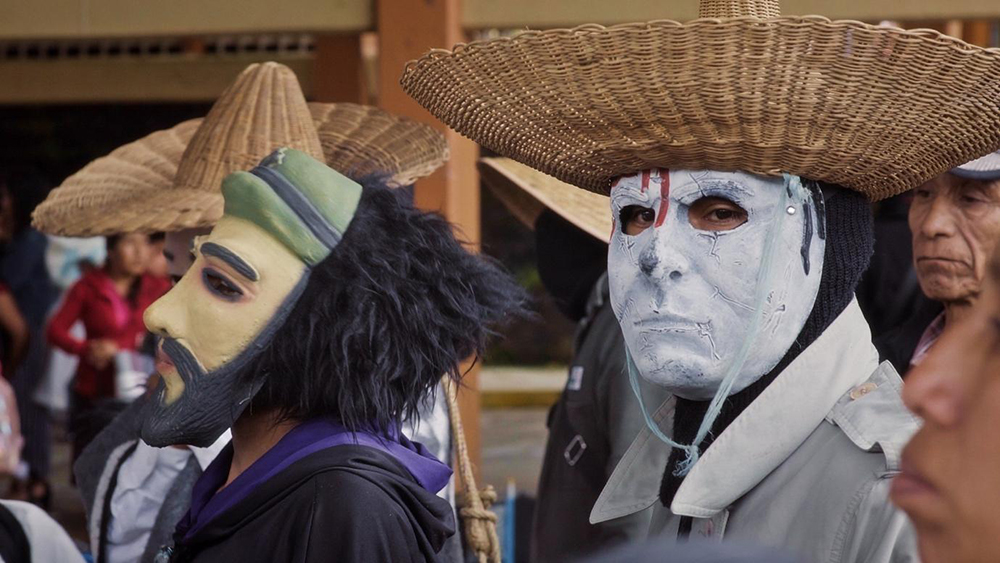
The interview with Arturo delves into the adaptation of philosophical and political legacy into a documentary, focusing on the Mazatec people's struggle in the region of Oaxaca, Mexico, more specifically in the hometown of social reformer and anarchist Ricardo Flores Magón, Eloxochitlan de Flores Magón, a historic figure who endured the end of his life in a Houston jail of American imperialists. What the viewers of this epic, yet serene, documentary witness is the struggle these inhabitants face, characterized by frictions between several clans in their thirst for power over the town hall and the community assembly, involving innocent families, children, and several assassinations. In the midst of it all, we witness fertile, spiritual, and prosperous land, a real garden of Eden, with indigenous communities sticking to their original languages, shamans and healers, and peasants living a hard-working but abundant and culturally rich life. A bit like Scorsese’s Killers of the Flower Moon, but then in a documentary form and in a region still “native” land, untouched by its northern neighbours.
The documentary combines testimonials, investigative journalism, some archive footage, and stunning cinematography to portray the Mazatec political and cultural context. It represents the importance of memory, consciousness, history, and the political thought of social reformer and anarchist Ricardo Flores Magón. The project faced challenges in balancing cultural sensitivity and accuracy, involving the community in the production process. The documentary aims to shed light on a region unfamiliar to many Mexicans but equally to educate globally, emphasizing the universal nature of political themes and the need for respectful representation of indigenous narratives and the right to live in peace.
Watch the English trailer, or a new Spanish trailer at https://vimeo.com/1111067420. El Edén Subvertido premiered in October 2025 at the DocsMX film festival, marking the start of a tour of international screenings.
Interview
Riobamba, Ecuador, December 2025. Translated into English from the interview conducted in Spanish.
Q: I would like to begin by sharing that I have long held a deep appreciation for Mexican cinema, an interest that eventually led me to study film production at Arte7 in Mexico City, where you taught. In fact, I previously wrote an essay on your documentary El Edén Subvertido (The Subverted Eden), drawing comparisons with Iñárritu’s Bardo — both of which I considered cathartic cinematic experiences as well as explorations of consciousness and the nature of reality (“Bardo”). That piece was written to help promote your documentary. In another essay for UN Today, I briefly examined Cuarón’s Roma alongside other works that portray Mexico’s social realities (“Photography”). I thought it was important to begin with this background.
The focus of your documentary El Edén Subvertido (The Subverted Eden), is the Mazatec people living in the town named after the social reformer and anarchist Ricardo Flores Magón. He’s a figure I came to know more deeply while working with you during the post-production phase a few years ago. His ideals could not be more relevant today; in that sense, they still resonate powerfully in the world we live in.
A: El Edén Subvertido… well, where to begin? It’s a story that has been in the making for six years. Imagine — I'm 45 now, and I started this project when I was 39. I’m only just now completing it, still working on the final details. Where would you like me to begin?
Q: Let’s start with the concept of adaptation. Linda Hutcheon describes adaptation as both repetition and creation — translations across media, cultures, and times. Your film is not a traditional adaptation of a novel or a play. Instead, it adapts memory, history, political thought, and lived experiences. How did this approach come about?
A: Laura Castellanos is a very important Mexican journalist who has spent her career addressing human rights in Mexico. She publishes widely in national newspapers and has also written major books on landmark cases. We met before she published her investigation for the magazine Gato Pardo. At the same time, I had decided to make a documentary about the same case, which later became Political Prisoners of Eloxochitlán de Flores Magón. That’s how I first got to know the story.
In Gato Pardo, Castellanos published an excellent six- or seven-page piece called The Battle of Oaxaca. Around the same time, I began working on the film. Through her and other sources, I gained a deeper understanding of the case and began shaping a cinematic narrative. My film is, in a way, an adaptation — my own treatment of this material, my attempt to give the story “head and legs.”
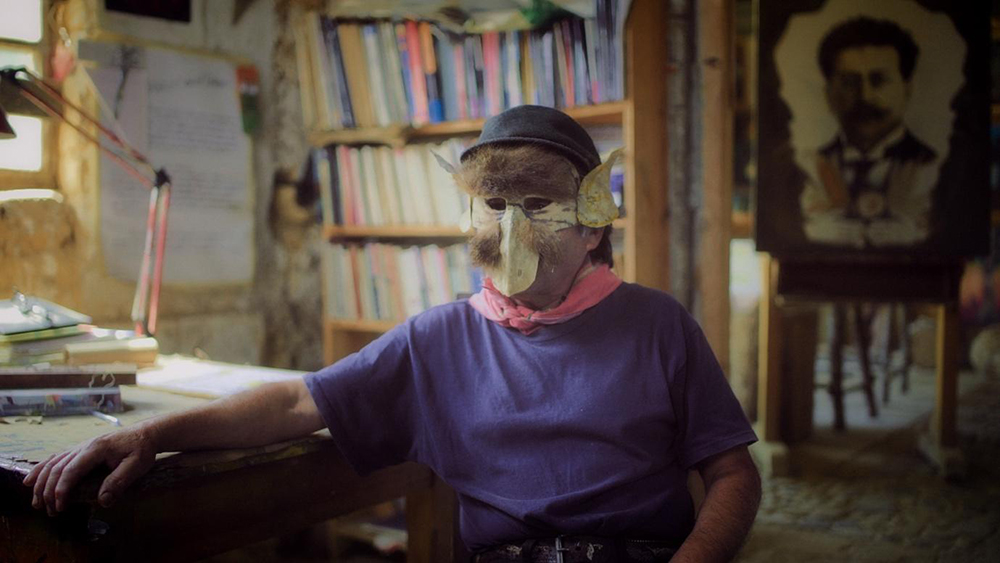
It’s important to underline that while Castellanos approached it with the tools of journalism, I approached it through cinematography. Her work influenced mine, but I also had personal reasons for working in that town, beyond the case of the political prisoners: I was drawn to the figure of Ricardo Flores Magón. Inevitably, these threads became intertwined, since it all unfolds in the town of his birth.
The story is heavy and delicate. It deals with broken families, political prisoners, assaults, and even assassinations. It’s emblematic of what happens in communities like Eloxochitlán de Flores Magón — places that are culturally rich, surrounded by natural beauty, yet marked by deep social rupture. The fragmentation and the lack of integration are central both in Castellanos’ reporting and in my film.
Indigenous life is complex. On the one hand, there is a strong will to preserve language and traditional systems of governance like the town assemblies. On the other hand, parts of the population are pulled toward Spanish, capitalism, and the structures of political parties. But political parties in Mexico are often monopolies, corporate in nature. This puts community organizations in a tense and often violent struggle with these larger forces.
So yes, it’s a national case, but also a profoundly human one. What I’ve tried to do with the film is show my perspective through personal testimonies, while also reflecting the broader political and social fractures that shape life in Mexico today.
Q: Thank you very much. You’ve shed light on adaptation as a process in El Edén Subvertido, and as a product — how it partly became an adaptation of journalist Laura Castellanos’ work, and finally an audiovisual creation blending politics, indigenous experience, and even geopolitics, considering that Flores Magón ended his days in an American prison. The film feels very synchronized with today’s world.
Its theme is universal once one understands its message. Such an ambitious project could educate audiences worldwide. Personally, it has impacted me greatly. To conclude, let me return to Hutcheon’s idea of adaptation in terms of ‘reception’: what do you see as the potential impact on the public — not just in Mexico, but also in Europe or the United States?
A: We can only speculate, Niels. I honestly don’t know. My earlier documentary, Rita, found its own way, and over time, the phenomenon of Rita grew beyond what I expected. El Edén Subvertido was made in the same spirit. In the best case, I hope it can also reach and resonate with audiences abroad. Before this film, the story it tells hadn’t really been presented on screen. As with Rita, we worked with honesty and good faith. Everything in the film — whether pleasant, difficult, or controversial — is truthful. That’s why I believe it is a valuable documentary.
It offers a glimpse of life in the Mazatec Sierra at the time we filmed — nothing more, nothing less — crafted with much reflection. So yes, I think it could be appreciated by international audiences. At the same time, it is a profoundly Mexican story, rooted in Mexican history and culture. I honestly don’t know whether Italians or French audiences, for example, will connect to it. But Mexico is a cultural universe, with extraordinary diversity: in Oaxaca alone, more than twenty languages are spoken. My aim is simply to offer a window into these realities. I’m not indigenous, and I’m not from Oaxaca, but I believe it’s important to speak about these issues, to generate discussion and new ideas.
Q: In that sense, the film lends itself to debate — not only after screenings in theaters, but also in festivals and universities. Ultimately, it reflects on consciousness and the philosophy of Ricardo Flores Magón. To cite one of his writings, Voluntary Slavery, “Nothing is as discouraging as a satisfied slave.” If people in the West — whether in Europe or the U.S., both regions in what I’d call a kind of “free fall” — reflect on this, they may see themselves in it. Much of the population lives like modern slaves in materialist boxes, under systems of technocratic expansion, censorship, and centralized control. That’s why I believe the film could open eyes and minds in that context.
A: For me, the personal connection is also essential. Flores Magón has always been a presence in my life. Since childhood, I’ve been close to the Flores Magón family. My mother is a sociologist, so social thought was part of our household. As one of the interviewees in the film says, “Magón was not just a person, he is a symbol.” He belongs to that rare lineage of revolutionary thinkers — like Che Guevara, Gandhi, or Magón himself — whose ideas transcend their own time.
The fact that he is not widely known is no accident; his ideas are dangerous because they invite rebellion. And the very act of making this film about Ricardo Flores Magón says something about me as an author: I am also helping to spread Magonist thought. In that sense, the film is an invitation. If you’re from France, Belgium, or anywhere else, you might hear the name and think, who is this wey? — and then look him up. The inspiring part is that, even a century after his death, his philosophy remains alive and urgent, as you mentioned.
Q: Thank you. And indeed, the launch of the film feels very relevant today.
A: We’ll see how it resonates with American and European audiences and beyond — let’s see what happens! Like Rita, El Edén Subvertido speaks about “the last ones,” which gives it a universal quality. What I portray are real people of flesh and blood who said what they wanted to say, or what they could say. These are dramas about ordinary people who try to bring courage and joie de vivre to society, despite all the violence around them. But what lies behind that violence? It’s very complicated. Contributing to people’s understanding is difficult because so many interests are involved. Magón once said a social revolution alone isn’t enough — what’s missing is an economic revolution. What does it mean if the faces change, but the system remains the same?
Q: Right. I’m reminded of adaptations in traditional cinema: Steve McQueen’s 12 Years A Slave, drawn from Solomon Northup’s memoir, Barry Jenkins’ If Beale Street Could Talk, based on James Baldwin, another independent thinker exiled for who he was; or Cuarón’s Roma, which adapts life in Mexico in the seventies.
Could we say that, alongside such films, and other Latin American examples like Tatiana Huezo’s Noche de fuego or Patricio Guzmán’s Chilean Cordillera de los sueños, El Edén Subvertido belongs to a tradition where adaptation is less about novels and more about the persistence of memory — about stubborn histories that refuse to be silenced, erupting urgently and necessarily into film? How do you see this?
A: Exactly, I believe so. It’s a story that anyone can enter — a story that seemed to be waiting for the right recipient. We’re finally launching it this October, after six years. It took a long time, and it was made entirely independently. I have to stress this because making a film in Mexico with a low budget is very difficult. Without the help of close friends — yourself included — I’m not sure how we would have managed. Thanks to these relationships, every step, every headache, brought us further.
I even re-edited the trailer you made, because at first we only had an international version, not a Spanish one. You’ll see it’s essentially the same trailer, but now with Spanish subtitles and color correction, thanks to other friends. This is how communal and independent the production has been. It’s a relief to have reached completion. Still, the final phases remain complicated — particularly the legal expenses, which are essential. We need legal protection, since there could be repercussions. We have rights: the right to make a documentary, the right to memory and history, and the right to free speech. But these rights aren’t automatically guaranteed. Covering those legal costs is vital to safeguard us.
Q: In some cases, documentaries present a single truth. But yours interprets multiple versions of the same story from different perspectives and social classes, rather than imposing one truth, doesn’t it?
A: Correct.
Q: Which decisions did you make aesthetically, in particular, to translate political thought into a sensory experience for the audience — through editing, sound, interviews, and so on? What was most important?
A: Very good questions, though they’re quite different. In Eloxochitlán de Flores Magón, there was a conflict in 2014 during local elections for the position of mayor, a role below that of the municipal president. Two powerful groups clashed: the community assembly and those in power at the time. That day, hundreds of people fought with whatever they had at hand. It was a violent confrontation in broad daylight, a brawl that cost lives.
It was horrific. From there, we listened to testimonies from both sides — not just one angle — to understand the different positions. These two groups have been in conflict for a long time, and they remain so today. The case is still open; it implicates the whole town, external forces, and even national interests. We sought to understand the familiar components — the family ties among leaders of both clans — and also traced the historical dimension through culture, language, and traditions.
We wanted to explore what happened on that day in history. It’s a story with many layers — even for Mexicans from, say, Mexico City. As I often say, there isn’t just one Mexico, but many realities. To speak of a “Mexican” doesn’t say much without context. There’s always a divide between countryside and city, rural life and urban life. For someone in Mexico City, the Sierra Mazateca is distant, almost exotic — an entirely new universe. I don’t know of any films set there; at least none that people speak about. That’s why I wanted to film it: to show something I had access to, which connects back to your first question.
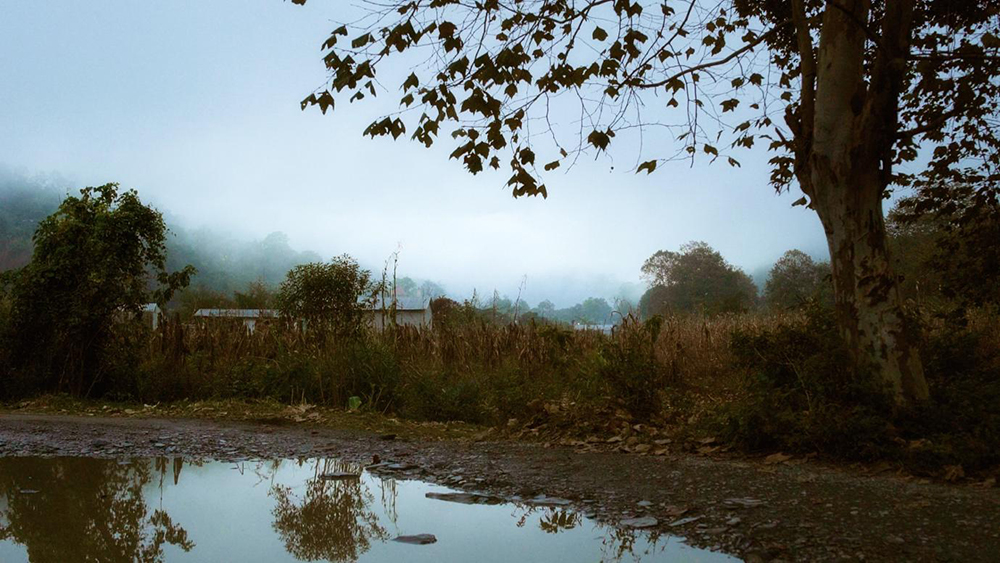
As for making it a strong cinematic experience, it begins with a good script. You need a narrative that carries the viewer through time. In that sense, cinema has more in common with music than with literature: it unfolds across a temporal experience. The design has to create that immersion. Visually, we relied on the majestic landscapes of the Sierra Mazateca, which bring a poetic element to the film. Sound design and music were equally important, evoking rural life while supporting a dramatic arc.
The film is 88 minutes long, with a conventional structure, allowing the audience to dive into a story, to take their eyes off their own surroundings and discover other realities — realities that are part of the same social and political fabric we all inhabit. It raises questions: What do I believe? Who am I? What is my political stance as a Mexican? What does it mean to be a citizen, an indigenous person? It’s good that these conversations exist.
Q: To expand on the last part you mentioned, did you have any examples while developing El Edén Subvertido that you felt were references in your subconscious — documentaries that didn’t directly inspire you, but where the process felt similar?
A: Good question as well. Well, there are many. Formally, it’s a very classic documentary. It has a lot of text, many words, testimonials, and not too much music — only when it’s truly needed. It’s a film made with a lot of humility, really. It’s not pretentious, it doesn’t seek to create artificial effects. It aims to represent a complicated situation with justice, nothing more. That’s part of its strength. It’s a film about indigenous people, farmers, and social justice. There aren’t many glamorous elements, the kind you usually see in cinema or show business. Glamour has no place here. It could even be uncomfortable, perhaps, but that’s what felt right. The treatment had to be very respectful, because many of the interviewees had suffered deeply. So it’s a story told through many voices.
I don’t narrate the story, nor does anyone else. The story is built from the fragments that each of these individuals contributed, around twenty to twenty-five people in total. We also included testimonies from archival material, which we didn’t film ourselves. With so many interviewees in an 88-minute film, each one speaks just a little, but together they construct the narrative. It’s the story of the town of Eloxochitlán de Flores Magón. We decided to focus on that town, and here we are six years later, ready for its premiere. We’ll see what the repercussions, consequences, and reactions are. Surely something positive, because in the end, what we’re proposing are themes and atmospheres. It’s not something harmful. Many people are doing different things, and this is our contribution.
Q: Were you aware of which people to show in the film, among all these voices? How did you decide to represent the spirit of Ricardo Flores Magón?
A: I was directed toward the right people. Through my contacts, we were introduced to those we needed to meet. We were received by the families of the political prisoners in their struggle. These struggles are very harsh. Those who watch the film will see that it’s hard to live like that, in resistance, in constant struggle. It’s very delicate — they’re not characters, they’re real people. A lot of tact and diplomacy were required on both sides of the conflict. That’s something many people found hard to grasp. I can’t abandon that principle; for me, it’s a fundamental criterion. But in the political terrain, it doesn’t always work like that.
I’m not a judge of anyone. The film itself contains the investigation. It’s not my opinion that matters. It’s not a pamphlet documentary, so to speak — it’s made from the place of the human being I am. Of course, it contains personal elements, like my relationship with the Magón family. I’ve given it everything in good faith.
Q: I understand. So you’re a neutral observer — not choosing one side or the other, but focusing on what Magón left behind.
A: Relatively, yes. Of course, in the end, it’s still a story told by someone, so it’s subjective by nature. Magón’s presence could have been left out; the film could have been only about political prisoners. But I decided otherwise. I chose to highlight Magón. It’s not an arbitrary decision — his ghost still haunts that town, and will continue to, because the situation remains difficult. I’m speaking generally: this one town is just an example.
That’s why, in the end, it’s a very universal film.
Q: That’s why it’s a very universal film in the end. There are lots of conflicts like that. Not only physical violence, but also other forms of oppression, division, and fragmentation.
A: Yes, lots of fragmentation everywhere.
Q: Adaptation also raises the concept of fidelity. In this sense, what does fidelity mean when adapting the ideas of a historic revolutionary figure? If you had made the film with Magón himself, could you say you shaped it through his eyes?
A: That’s a very difficult question! Who knows what he would’ve said? I’m not sure. He was extremely radical — and his era demanded that radicality. He lived in his own time. And we are living in ours. Good question. We can all ask ourselves: What would Don Ricardo say?
Because people who dedicate their lives to social causes are like the watchtowers of society. At any moment, we could be asking ourselves: What would Jesus have said? Or Ricardo Flores Magón? Or Ché Guevara? I think they would’ve told us we’ve become a wave of ‘‘normie’’ conformists! They were people of action.
They need to be our teachers. That’s the importance of this film: to point out where there is a maestro, a teacher, a role model. Whether you like him or not, whether you have time for him or not, whether it works for you or not — go ahead. The same with Rita: to show where there’s a good example. That’s the idea.
Magón, I think, would be surprised at how relevant he still is. He would’ve said, “The revolution has not yet triumphed. Go on then, damn it!” It’s important at least to keep that awareness alive — that utopias exist. You need utopias to know which direction to walk in, even if we haven’t arrived there. To know which way could be good, like with Rita.
Q: In that sense, the documentary feels like a journey through dystopia and utopia — just as the title The Subverted Eden suggests.
A: I agree. That’s how we live. It’s how human beings live. We try to agree — sometimes we manage, sometimes we don’t. Documentaries help us create historical consciousness more effectively. Sadly, producing good documentaries is very difficult — for many reasons. But it’s worth making them, it’s worth watching them. And of course, it’s worth being faithful to the figure of Flores Magón.
Q: What do you hope to achieve with the film after six years of your life and resources? Do you think it’s important for it to be shown in other regions? It deserves that recognition, doesn’t it? It’s like building a house and later enjoying living in it — the fruits of your work.
A: Yes, it’s interesting how these things work. For me, in a certain sense, the film already feels complete. But at the same time, it’s only truly born once it’s shown on the big screen. I hope it goes forward, that I can keep doing work like this — focusing my energy on purposeful projects, improving each time. And for the film to find its place.
I know I’ll have to accompany the project for a long while. Rita took four years to make, and then one more year of screenings. Even now, I still accompany it — this year, for example, it was shown in the Chamber of Deputies and at the National Cineteca. It still has a life of its own. With Edén, it feels like having another child.
The chapters of my life, like anyone’s, are simply lived — but for me, each chapter takes the name of a project. This one is El Edén Subvertido. The previous one was Rita. Who knows what the next one will be called? We’ll see how we “dress it up.” The craft of a filmmaker — whether in fiction or documentary — is always connected to the theatrical, the expository, the didactic, the dramaturgical. To keep making cinema is the main thing. Whatever form it takes — anthropology, philosophy — I love all of it.
Q: Me too. Esotericism, theology…
A: All of it. It could be anything.
Q: There’s one person in particular in the documentary I want to ask you about, without spoiling too much: the healer, the shaman. For a Western audience, this is an interesting point — many are divided on such topics. Some exploit or commercialize them, especially in places like Tulum or in luxury retreats abroad, turning them into a kind of package deal. But in the film, I was fascinated by this figure.
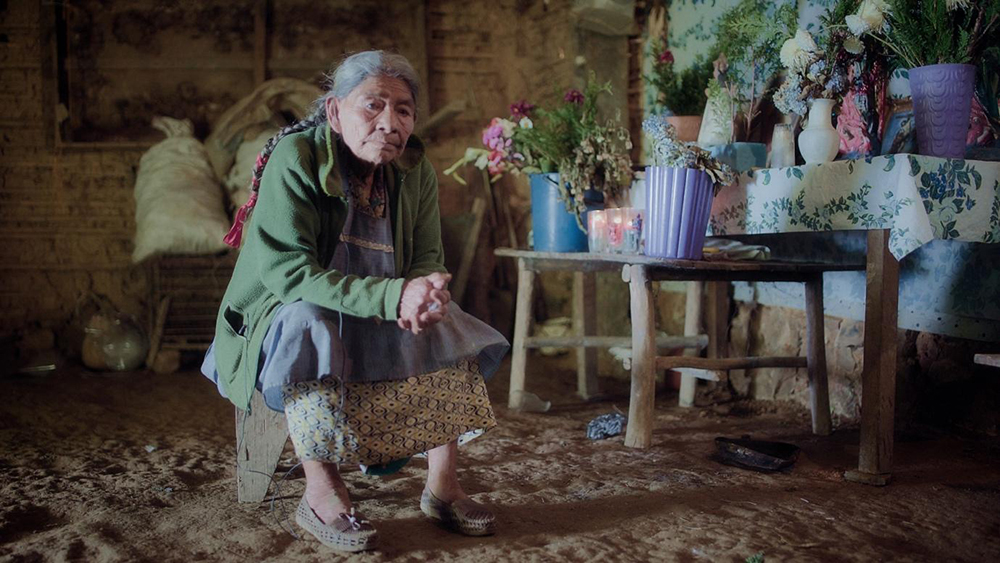
A: Yes, Doña Florencia. I imagine that in every town there is some sort of shaman, some wise person, someone who carries knowledge about life. Imagine living in the Sierra, raising many children, facing all the dangers and obstacles of rural life, and reaching such an advanced age.
Shamans are often labeled as witches because of their magical thinking. But they also inhabit a dimension we don’t understand. It’s hard to form an opinion on them or to really know them. But it’s very interesting to meet them, to learn from them, and to feel their presence.
In Doña Florencia’s case, she helped people with everyday medical needs and emergencies, even childbirth, through traditional medicine, herbs, mushrooms, and other substances found in the region. Each shaman has their own methods.
I’m not deeply versed in these subjects, but I have great respect for them. It’s one of the most fascinating aspects of Mazatec culture. Within it, there’s huge diversity: at least eight to ten dialects. Oaxaca itself is extremely complex, with 22 languages in total. The Mazatec language alone is already very rich. And within that diversity, each shaman has different ways of healing.
Meeting Doña Florencia was a privilege. Sadly, she has since passed away. We only spent a few hours with her, but it was enough. In the documentary, her presence isn’t the longest, but it’s memorable. I may one day publish the full interview with subtitles — there was so much material that didn’t make it into the film. That’s the nature of editing: you have to leave so much behind. The transcriptions alone are over 700 pages. That could easily become a book.
We would have to be doing very well. What I’d like is to participate in festivals. The first screening of El Edén Subvertido is already at a very good festival, DocsMX, and that inspires me to seek out other important spaces. For that, we need resources to help give this film its place in life. DocsMX will be its first theatrical screening, open to the public, with several showings that week. From there, we’ll see how the press reacts. We have a website and will be preparing press releases a month before so that, at the time of the screening, everything is ready for publication. Of course, it might be difficult — reactions could be good, could be bad. You know how reviews in the media work.
But you have to have hope. We try to work constructively, to propose good ideas amidst the saturation of information, politics, and economics. A documentary allows us to take some distance, to reflect on current events, on others, on the indigenous, and on the elderly. I think that’s important. For example, in an interview with one of the political prisoners, he asks what it means to be indigenous and what it means to be Mexican at the same time.
Q: Thank you very much. To conclude: the documentary brings together conversations, historical texts, oral traditions, community traditions, and testimonials in a single cinematic work. How aware were you of this intermedial translation, and what challenges did you face in bringing these rituals and voices to the screen?
A: It’s important to recognize the distance between one culture and another. Portraying an environment to which I do not belong is a double-edged sword. On one hand, I have a certain privileged distance, a kind of objectivity. But on the other hand, there will always be things I cannot access — like we mentioned with the shamans, whose world I cannot truly enter. That’s what happened with the Mazatec world in general. They speak a language I will never understand.
This distance is something you must remain conscious of. The director’s relationship to the subject is made explicit in the film: the perspective is that of someone who isn’t from there and who can never fully internalize the histories, family stories, culture, language, and complexity. At the same time, this provides a “cold” view. Both perspectives are present — and both are clarified — because ultimately, this is my relationship to the subject. I tried to approach it with as much tact and respect as possible, with a spirit of conciliation, even if it risks being inauthentic.
And above all, to recognize that no one enters a conflict because they want to, but because of circumstances. That’s the central question the documentary raises: what lies behind all this violence? Because violence is never the beginning — it’s what remains after many other things have already happened. That is what El Edén Subvertido seeks to explore.
Thank you very much, Arturo. All the best with the film.
Q: Thank you too.
Biographical Notes:
Niels Barrezeele is a Belgian documentary photographer and filmmaker of the grassroots project Diarios Del Sur, writer, social worker, and NGO management expert (Universitat Barcelona), as well as an independent contributor to UN Today. In 2022, after pursuing a film production course at Arte7, Mexico City, he contributed as a production assistant and producer of the trailer under the mentorship of Mr. Santana on his documentary El Edén Subvertido. In 2023, after other earlier short documentaries, he made the meditative and immersive Through The Veil in Nepal with music from musician/composer Matthew Liam Nicholson along with the Indian composer Calm Whale, which received selections at FEICCA Mexico City, Istanbul International Spring Film Festival and Kuala Lumpur International Film Academy Awards. Links to his work, including Through The Veil, can be found here: https://vimeo.com/diariosdelsur
Works Cited
Barrezeele, Niels. “Bardo & El Edén Subvertido.” Substack, 21 July 2025, https://substack.com/home/post/p-168713983.
---. “Photography as Tool in Human Rights.” UN Today, Dec. 2024/Jan. 2025, pp. 20-21.
Castellanos, Laura. “La batalla de Oaxaca.” Gatopardo, 17 June 2019, https://www.gatopardo.com/articulos/archivo-la-batalla-de-oaxaca.
Cuarón, Alfonso, director. Roma. Esperanto Filmoj, Netflix, 2018.
Díaz Santana, Arturo, director. Rita, el documental. CUEC, IMCINE, 2018.
DocsMX 2025 Programa. DocsMX, Oct. 2025, https://docsmx.org/formacion/docsforum/index.php.
Flores Magón, Ricardo. La esclavitud voluntaria (Voluntary Slavery). 1915. Reprinted in Obras completas de Ricardo Flores Magón, Ediciones Antorcha, 2000.
Guzmán, Patricio, director. La cordillera de los sueños (The Cordillera of Dreams). Atacama Productions, 2019.
Huezo, Tatiana, director. Noche de fuego (Prayers for the Stolen). Pimienta Films, 2021.
Hutcheon, Linda. A Theory of Adaptation. 2nd ed., Routledge, 2013.
Jenkins, Barry, director. If Beale Street Could Talk. Annapurna Pictures, 2018.
Northup, Solomon. Twelve Years a Slave: Narrative of Solomon Northup, a Citizen of New-York, Kidnapped in Washington City in 1841, and Rescued in 1853. 1853.