VOL.53, NO. 4
Plots Twist: An exploration of what film adaptations can tell us about authorship, and cinematic constructions of impairment and disability.
Alison Wilde
Introduction
“Graduation. Today I hear the crowd's applause. Receive the congratulations from my friends. Today I ask if I've found a place among the rest, who studied, read, wrote, and passed the test in cap and gown. Today I hope you see a man upon this stage”.
As a voiceover in the opening credits of The Sessions (2012) film, these are the first words we hear from John Hawkes, the actor who plays Mark O’Brien, a disabled American poet and journalist on whom the film is based. The statement is spliced between original news footage of O’Brien’s graduation, with the newscaster informing us that this statement was written by O’Brien. In just over a minute of this footage, there are images of him transporting himself (via mouth control) through the streets to the university, lying on his motorized gurney, the presentation of the award and a final statement by the newscaster on the merits of his courage and perseverance.
Released thirteen years after O’Brien’s death, the film is an adaptation of “On seeing a sex surrogate” a powerful essay, written by O’Brien in 1983, on sex and disabled identity. Eventually published in 1990, this essay was one of the earliest challenges to representations of disability impairment and sexuality, especially disabled manhood.
As the first words spoken in the film, the voice-over in the opening credits encapsulates O’Brien’s main messages to the world in a singular statement about disabled masculinity, and socio-cultural acceptance. Less explicit in these opening words is the centering of disabled sexuality, in comparison to the emphasis of the original essay; instead, writer and director Ben Lewin constructs the film in a way where this topic gradually evolves, to become the focal point of the film, within the context of his life. O’Brien’s more direct and unambiguous call to reconsider his sexuality as a disabled man spoke clearly of disabled people’s sexuality, a taboo subject in mainstream culture until the early twenty-first century1 (see Sancho for example). As such, the chances of this being adapted by filmmakers or broadcasters were slim until the manifestos, campaigns, and initiatives for change arrived in the early 2000s (Wilde, “Disabled People”).
By the time the film was released in 2012, both the broadcast and film industries had responded to widespread calls for change in media representations from disabled activists and academics. This resulted in some engagement with the need to improve the poor quality of representations of disability and impairment. Perhaps the most notable of these were the actions taken to increase the number of disabled women characters on screen, to employ more disabled actors in roles which featured impairments, to acknowledge and portray disabled people in romantic and sexualized roles, and increased recognition of the tendency to characterize disabled people as signifiers of abnormality or a pathological moral lessons.2 Even at this arguably more enlightened stage, The Sessions was received by critics with some surprise and caution regarding its content, (e.g., Todd McCarthy, reviewing the film for Hollywood Reporter, described it as an “unusual topic” which was “surprisingly accessible.”
These calls for change emerged from the burgeoning disability movement, and Disability Arts (DA) community, from the 1970s, especially in the UK and United States, often in alignment in the growing discipline of Disability Studies (DS) (e.g., see Barnes). Later developments of DS, in the forms of Cultural and Critical/Disability Studies, have played significant roles in helping us to understand the complexities of cultural representations of disability over the past two decades. However, academic theorizing has equally helped to trouble these matters further. Not least of the difficulties is the (easily forgotten) question of whether and how we can re/discover a disability aesthetic, on the lines proposed by Paul Darke in 2003, or Tobin Siebers in 2010. Siebers explained disability aesthetics as a practice which “prizes physical and mental difference as a significant value in itself. It does not embrace an aesthetic taste that defines harmony, bodily integrity, and health as standards of beauty” (19). Both Darke and Siebers argue that these traits lie at the heart of a disability ethics and, in Siebers’ words, create an “objection to aesthetic standards and tastes that exclude people with disabilities” (Darke; Siebers 19).
Darke believed that a disability aesthetic could come best from Disability Arts. Created by disabled artists, he conceptualizes it as “virtually a sociology of the art of society” proposing that it “is about the nature of the barbarism of contemporary culture in relation to itself through explorations of the nature of otherness and disability,” posing a “threat to the core aesthetic cultures of contemporary culture” (132).
While the notion of these fundamentally radical paradigms of DA continues to be an important discussion, the current field of DA is diverse, with a range of meanings attributed to it both within and outside the community of practitioners and theorists. These meanings are often a topic of debate amongst the DA community, with a large degree of acceptance that DA is many things to many people.3 Nonetheless, all these positions have one thing in common: they all place disabled people’s ideas of creativity and the desire to portray alternative worldviews at the center.
DA frequently contests cultural and media tropes, and a growing number of disabled artists from DA have made substantial inroads into mainstream media (Wilde, Film).Alongside other fundamental aspects of DA, the banishment of “myths and stereotypes of the disabled experience” (Gould) has become increasingly visible in mainstream media. Ruth Gould, a pioneer in DA in the UK, recognized both these principles amongst her “six actions for change,” to “encourage more positive representation of disabled people and disability issues within mainstream media and popular culture.”4 Members of the DA community are being increasingly included in mainstream television and film, with recent television content often informed by DA and a “disability aesthetic;” a key example of this in the UK is Crip Tales (2020), a series of new monologues created, curated, and performed by disabled people, specifically designed to challenge conventional perceptions of disability. The series received much praise (e.g., see Ferguson; Franklin), especially from those within the disabled people’s community seeking representational change (e.g., see Powell). Paradoxically, such opportunities for disabled actors, writers, and directors have demonstrated intractable problems of disability representation, illuminating significant differences of perspective and conflict, even where disabled people have played central roles in the production of media. One episode from the BBC’s Crip Tales anthology series, “The Real Deal,” was perceived as deeply wounding to many disabled people as it worked to “conflate invisible disability with benefit fraud” (Chronic Illness Inclusion Project). The monologist, Meg, reports her neighbor for faking his impairment, in a story that focused on her own considerable struggles with the benefits system. Nonetheless, complaints from both individual viewers and disabled people’s organizations ensued (led by the Chronic Illness Inclusion Project), immediately followed by other disabled people defending the story (e.g., Caulfield).
The dissent surrounding Crip Tales demonstrates that agreement on the character of disabled people’s reality is elusive, and that a standpoint for judging films and other media on this basis is not apparent, despite widespread dissatisfaction and disidentification with, or complete rejection of common media portrayals (Wilde, Film). Whilst we are probably at an impasse, and the possibility of finding solutions which are universally accepted may be impossible, it is clear that the high levels of support for the series, and the people involved in it (including disabled people in acting, writing, and directing roles) have added to perceptions of authenticity within some of the disabled audience.
Using The Sessions film as a case study of an adaptation of a disabled person’s account, my aim is to show how the analysis of a specific adaptation can illuminate the ways in which cinematic re/constructions of disabled “realities” are articulated in ways that meet, trouble, or confound expectations of disability within films. I will argue that if we can find ways forward to make progress, some of the answers are to be found in the ways that stories of disability are re/constructed, according to the embodied life-worlds of their authors, within the evolving context of widespread cultural misrepresentations of disabled people (e.g., as asexual, dependent, and objects of pity). Thus, I examine the embodied cultural capital/positioning of writers and directors, exploring the ways in which lived experience informs how stories are told, and how these relate to disability aesthetics, such as those proposed by Darke and Siebers. I see adaptations as a valuable starting point to start tracing how cinematic representations translate and transform cultural and individual narratives and texts on impairment and disability, informed by implicit or explicit forms and relations of embodiment. This is especially so when the source material is from a disabled person telling their own version of their lives, i.e., a disabled gaze on a disabling world.
Why adaptations?
With difficulties of representation in mind, the remainder of this article is about gaining more clarity on how portrayals of disability are constructed in relation to disabled people’s lives and according to the intentions of the storytellers involved. Given that many disabled people have referenced their complaints in terms of verisimilitude to their own lives (Wilde , “Disabling Masculinity”) highlighting persistent gaps, even chasms, between cultural tropes and the truth of impairment and disablement, it seems fruitful to investigate the specific ways in which representations of disabled and non-disabled people are transformed in the processes of translating original literary texts by disabled people to visual forms, in this case cinema. In so doing, it should be possible to discern differences and similarities between the narrative of a disabled person and the adaptation of their story, illustrating some of the ways that story is shaped to; a) anticipate the needs of the intended film audience, and b) reflect the ideas of those involved in the production and direction of films.
Adaptations provide a unique opportunity to discern how the production of specifically cinematic texts alter material in ways which rearticulate meanings attributed to disability and impairment. Moreover, the use of specific examples from true-life accounts is likely to provide insights into wider aspects of cinematic re-presentation. This is certainly true of films featuring disability, which continue to recycle, and occasionally rearticulate, cultural understandings according to dominant cultural narratives or tropes (e.g., those identified by Arthur Frank), as part of a wider “metagenre” (Carter) of disability (i.e., a body of cultural scripts which emphasize the abnormality and difference of disability).
As Christine Geraghty suggests, a fundamental part of interpretation is the placing of new representations within audience acts of “recall,” which draws on prior images or understandings. She demonstrates that recall is achieved through “an act of comparison,” in which film can draw on “literary origins,” memories, other media and versions of the original; for disabled people, this might include anything from previous disabling imagery, familiar tropes, or their own daily experiences of disability and impairment. However, rather than taking a prescriptive approach – which would perhaps emphasize the fidelity of the film to its source, the personal experience of the viewer, or the casting of a non-disabled actor in the lead – Geraghty has suggested placing comparisons between texts within a more film-centered approach (e.g., genre, stars, sound, and visual features such as mise-en-scène and editing decisions), an approach consistent with Cultural, and Critical/Disability Studies. Before examining these things in The Sessions, some discussion of conventional depictions is necessary.
Adaptations and the re-production of disability representations
As suggested, most films tend to utilize wider hegemonic scripts of disability. Carter encourages us to think of the ensuing disability metagenre as: "Representing a ‘higher category,’ metagenre is ‘a genre of genres,’ an expansive notion that points to ‘similar kinds of typified responses to related recurrent situations…’” (qtd. in Carpenter 393). This metagenre of disability is wide and flexible enough to be sorted and re-arranged or re-assembled into a wide range of “typified responses” e.g., predictable media tropes such as pity and charity (Carpenter 10). One of the central questions for the future of disability representation is how we escape this quagmire, where disabled people are always already different from subjects who are assumed to be “normal” in culture, media, and film.5 Even challenges to everyday notions of disability are inextricably mired in prior, highly predictable understandings, which cumulatively encourage filmmakers and viewers to “draw on existing stereotypic knowledge” (Allen and Nairn 379).
Recent films that aim to foster new understandings of disability and impairment which are heavily reliant on the metagenre of disability, tend to emphasize bravery and pity, including Music (Sia, 2021), Wonder (Stephen Chbosky, 2017) and Me Before You (Thea Sharrock, 2016). All these films are based on the speculation and imagination of their non-disabled authors, using conventional tropes of disability as inspiration and heroism, with their disabled protagonists practiced in the individualistic art of “mind over matter.” It is probable that the fictions created by the imaginations of non-disabled writers is seen to be more palatable, true, and acceptable to contemporary understandings of disability to the film industry, given their easy fit with pre-existing viewer knowledge in a culture which centers non-disabled bodies/gazes (Shakespeare). For example, the writers of the three aforementioned films all state that their ideas for their films resulted from a curiosity or compassion they developed in encounters with disabled people occurring in their own lives i.e., people who are autistic, have a visible difference evident in facial features (Changing Faces), and a person with quadriplegia.6 These moments led them to imagine what it would be like to have such impairments. It is clear to see why these films are more likely to be funded; not only do the ideas fit comfortably within Anglo-American industry beliefs of what will be profitable, they are, moreover, premised on an othering of those whose forms of embodiment have been deemed as abnormal in a media culture where non-disabled people dominate at all levels.7 Ergo, films which center people outside the dominant concerns of white, middle-class, non-disabled men are regarded as “niche,” — hence “risky”— by the Hollywood industry, thereby perpetuating the homogeneity of stories which are told (Wilde, Film).
Thus, many disability films which gain commercial success are far removed from the type of disability aesthetic envisaged by Siebers or Darke, i.e., as a “sociology of the art of society”. Even if we use a generous definition of DA to evaluate the films outlined above, disabled people’s ideas and creativity are far from central, and the worldviews portrayed mirror those found in conventional disability films.8 I have argued that films which are devoid of DA and a disability aesthetic are likely to be seen as much safer by funders, commissioners, many filmmakers, and audiences, whereas stories from disabled people are seen as risky (see Wilde, Film). Those films which set out to challenge deeply held beliefs or present political messages (Wilde, Film 215), are less likely to be greenlighted for production if they veer against cultural expectations, especially as stories of disabled people are often seen as lying outside universal narratives, with disabled people usually deemed other to the “everyman” figure presumed to be central to the wishes of the “model viewer” (Wilde, Film 54). With these challenges and expectations in mind, I now turn to The Sessions.
“On Seeing a Sex Surrogate”/The Sessions
Mark O’Brien’s essay “On Seeing a Sex Surrogate”, and its adaptation in the film The Sessions, were both written (and the film directed) by disabled men, both with the same impairment. Mark O’Brien contracted polio when he was six, resulting in paralysis from the neck down, and both the original text and the film focus closely on his unwanted sexual status as a thirty-eight-year-old virgin and his desire to be an active sexual subject, also reflecting on his earlier experiences as the story unravels. The adaptation has much to tell us about the ways in which the mechanisms, practices and processes of cinematic storytelling serve to re/construct stories of impairment and disability. As a rare example of disability-led direction and writing, it is well-positioned to show how cinematic techniques can be used to tell the life story of the original writer whilst showing how cinematic storytelling demands significant differences in re-presentation.
Although it often seen as desirable to cast a disabled actor to play disabled characters (Wilde, Film), Hawkes’s performance in the role is a convincing portrayal, closely resembling the body and voice we see and hear in real footage of his life.9 As important as the employment of disabled actors is in a mediascape where they are woefully underemployed (Randle and Hardy), it is no guarantor of good representations of disability, or indeed of resolving the under-employment of disabled actors (Wilde, Film). I therefore place my focus on other crucial, wider issues of inclusive representations in film production, such as writing, direction, cinematography, casting teams, music, and mise-en-scène. These are arguably more important aspects of representation than physical resemblance in portrayals, especially where they aim to communicate the authenticity of disabled people’s lives, emphasizing emotional, experiential, and agentic forms of verisimilitude.
Questions of authenticity, disablement and the audience ’gaze’
Mark O’Brien begins his article “On Seeing a Sex Surrogate” with a sentence telling us that he had written an article on sex and disabled people; thus, the reader is immediately drawn into a world where his agency and talent can be assumed. Conversely, after the opening credits, news footage, and O’Brien’s graduation statement, the film starts (and finishes) with lingering shots of the iron lung on which he depended on breathing. A voiceover of O’Brien is the first word we hear: “breathing”. Then, a ginger cat makes its way to his room; this is the first shot of the “real film,” directly following the opening credits, featuring the original news coverage of O’Brien’s real story. The camera proceeds to follow the carefully enacted movements of the cat making its way into and around the room. Images of the cat’s freedom of movement are interspersed with the slow and steady actions of an iron lung, before moving to a medium shot of the whole machine. The continuous movement of the machine in this last shot contrasts sharply with rigidity and motionlessness of O’Brien’s body within the machine. Without O’Brien’s voiceover, we could be forgiven for thinking this was just an inert, even dead, body in a machine; the very last shot of the film, the iron lung, seems to be a comparison to O’Brien’s coffin.
Perhaps, for the unknowing, this entry into his world even suggests a lack of sentience. It may even be read as an image where the machine can be seen to have more agency than he does, rendering him a cyborg at best. But, with the initial news clip, featuring him on his motorized gurney, and the ensuing narrative, this short scene can be seen as a provocation which encourages us to reflect on the deficit-led assumptions we may have brought to the film. Even the film’s final images of the empty machine may serve to trigger reflections on these perceptions after we have borne witness to the fullness of his life. As clinical as this may seem, it can be seen as a shocking re-establishment of O’Brien as an active agent in his own life.
The film wastes no time in demonstrating his capacities for action and our assumptions of his worth. Directly challenging deficit medical assumptions viewers may have, the second and third words he thinks/speaks (in voiceover) in this first scene are “look you.” This is perhaps readable as an immediate provocation to the viewer to acknowledge their own spectatorship, his status as spectacle, his precarious situation, whilst commanding the audience to look at him, and the machine. The first words spoken are those (selectively) taken from parts of his poem “Breathing” and are edited in a way which perhaps underlines the intention of the both the author (O’Brien) and the film writer/director, Ben Lewin, to bring our attention to the medical conditions of his life and his undoubted abilities to articulate them.
Although O’Brien’s protagonism is asserted through his own first words, Lewin’s decision to switch and omit some lines immediately place the emphasis on the positionality of the viewer. The following lines indicate that the machine “presses down on me,” to emphasize the weight placed upon him, both physically and metaphorically/emotionally perhaps a succinct indication of the physical and emotional burdens he is made to bear.
After this brief introduction to our own expectations – our anticipated gaze – and the conditions of his life, the film swiftly switches tone, and the action begins, giving the viewer an immediate introduction to his dark sense of humor. He immediately communicates his dim view of his personal attendant, before moving towards the film’s main narrative. His ire is directed at Joan, a middle-aged woman who is larger than average, with frizzy red hair. O’Brien’s voiceover swiftly informs us that she is a “crazy bitch.” Her pathologizing attitude towards him is depicted briefly, with one of her few lines being, “You polios are screamers.” Although none of this is part of the original text, Joan’s subsequent dismissal and her replacement by younger, more (conventionally) attractive, and empathetic assistants serve to communicate several aspects of the original text, such as his expectations of care assistance.
Whilst there is a stark difference between the disappointingly lazy, battleaxe stereotype of older women medical assistants (Hallam) and younger women, this switch from older to younger10 could possibly be seen as a strategy aimed at maximizing audience engagement with the beginning of his struggle to overcome his embattled masculinity, communicating the frustrations associated with his feelings of dependency and shame – emphasized perhaps by the suggestion that he has “even” become aroused by the touch of this “monstrous woman.”
The sexual attraction he goes on to show for his first replacement assistant, Amanda, conveys much of the detail set out in the first three paragraphs of O’Brien’s account, especially as she rejects his feelings towards her. While these film events are fictional (sometimes echoing a detail, e.g., similarities between Amanda and his real-life infatuation with a friend), the text brings us close to the essence of the problem his account conveys. The first paragraph bemoans his inability to shrug off the shame-based, infantilizing expectations of his parents. The second paragraph tells us, “Whenever I had sexual feelings or thoughts, I felt accused and guilty,” before the third explains how his sexual desires often embarrassed him in the process of acts of daily care, such as bed baths; He writes of “the profound shame I felt. I imagined they, too, hated me for becoming so excited.” This shame is tied closely to the “unrelenting presence” and “dread” of his parents and their disapproval of his sexuality – points that reverberate through his article up to the end, including the struggle to decide to see a surrogate, and the discussion of the sessions he has with her. Apart from one direct reference to his parents and the role of Catholicism in Cheryl’s dictation of case notes in the film, these feelings are only brought up implicitly within discussions of shame with the priest.
These aspects of his account are communicated in ways which allow us to engage with significant aspects of his life, whereas the film expresses his feelings in discussion “sessions” with the priest, and his sexual sessions with the sex surrogate, Cheryl Cohen Green. In accordance with the original text, the use of these characters enables the narrative to remain firmly fixed on his feelings and agency in relation to significant others – creating a strong emotional verisimilitude with his own written account. The character of the priest Father Brendan (William H. Macy) is his primary confidante in the film but is barely there in the original account (as “Father Mike”). Indeed, the visual aesthetics of the film support the significance of this change; from the Catholic iconography we see from the very first scene (a picture on the wall and a magnet on the iron lung) to an overplaying of O’Brien’s original account of his religious commitments.
The title The Sessions is clearly a double entendre in the references made to both sexual therapy and discussions with the priest. Overall, Lewin did stick quite closely to O’Brien’s account, despite a range of changes and a more balanced approach to the lives of the three main protagonists: O’ Brien, his surrogate Cheryl, and the priest; but it is important to recognize the determining role that directors and writers play in adaptations, according to their own agendas. In this case, Lewin adopted O’Brien’s text after he had already decided to make a situation comedy on sex and disability – having “stumbled” on this article after an internet search for relevant material (Ability Magazine). Although O’Brien remains central to the story as the leading figure, Lewin extends protagonism to both Cheryl (Helen Hunt), and to the priest, extending the initial account beyond the three years O’Brien discussed, up to his death. Although both writers set out to bust stereotypes of disability, sexuality, and agency, perhaps the most significant difference between them is to be found in the incorporation of humor in the film and their endings. The original ends pessimistically in terms of O’Brien’s views of his own desirability, while Lewin shows how O’Brien’s account was a pivotal phase within a longer, happier narrative, perhaps reflecting his initial interest in emphasizing the lighter, more comedic aspects of people’s lives.
The film scenes with the priest are the ones that bear the hallmarks of O’Brien’s original account and his evolving consciousness of his sexual agency. The sessions with Father Brendan occur several times, spaced throughout the film, and this trajectory is charted right to the final eulogy, providing a framework for the film’s acts. Together, both Father Brendan and Cheryl can be seen to help O’Brien effect changes in his life which work to alter his self-perception as a (cis) heterosexual man. Indeed, the shame and inadequacy he reveals at some length in the original article can be seen as “reliant” masculinity (Gerschick and Miller), a form of coping used commonly by disabled men conceptualized as a form of “internalized oppression” involving acceptance of “hegemonic ideals” (Wilde, “Disabling Masculinity” 364). In both the original text and the film, the eventual decision to use the sex surrogate can equally be seen as a quest to achieve a “reformulated masculinity” (Gerschick and Miller), a compromise made with hegemonic ideals renegotiated in a more achievable way, “willing” some aspect of recovery from aspects of impairment-related status (Wilde “Disabling Masculinity”, 364). In this case the movement is one towards active sexual manhood from virginity, and an assumed or imposed asexuality.
The sessions with Father Brendan add weight to these masculine trajectories. Notably, a man who presumably chooses celibacy as part of his vocation is perhaps the safest and least judgmental person to provide advice on his sexual status. This relationship is used well to introduce comedic elements and to signify disabling contexts. Use of mise-en-scène, for example, provides fictionalized motifs of his disablement; the lack of access to a confessional booth (given the size of the gurney and the lack of universal design) means he discusses the minutiae of sex acts and desire in full view and hearing of members of the congregation close by who inevitably leave in disgust. This is a subtle, yet amusing, reminder of the cultural scripts which shaped the reasons for his own self-contempt.
Significantly, Father Brendan’s character offers a male sociality otherwise lacking in the original account. They share a dark sense of humor, even banter, on the moral aspects of his sexual encounters. In a later scene Father Brendan visits his home with a six-pack of beer, to learn about his successful act of penetration. After congratulating him, O’Brien informs him that he will write about it, and Father Brendan questions if he is only doing it for the money, before they turn to a more serious discussion about Cheryl. He tells Father Brendon that “she’s the most wonderful person on the planet,” perhaps acknowledging a growing capacity for recognizing interdependencies with women, and O’Brien’s psycho-emotional trajectory from one form of masculinity to another.
In accordance with his growing recognition of intersubjectivity, and women’s needs, Cheryl’s role is more multi-dimensional than in the original, including disclosures she makes about her own life and desires shortly before she has penetrative sex with O’Brien. Shifts in her feelings towards O’Brien and relationship difficulties with her husband subsequently follow – all film fictions. Similarly, O’Brien expresses new needs, e.g., being “seen” in public (a subtle reminder of identities in the views of the social cultural world), and more romance-based desires, contrasting sharply with the original account where he makes a clear decision to stop sex therapy after achieving penetrative sex and orgasm. However, such additional scenes with Cheryl, Father Brendan, and Amanda aid in communicating most of O’Brien’s final ruminations in the article, e.g., that “intensive psychotherapy” may have been a better solution to address his “desire to be loved, caressed, and valued,” and to address unmet needs and desires. Driving these points home, the film shows Cheryl making a case note that his “deeper emotional needs lie outside the scope of my potential involvement.”
The film departs completely from O’Brien’s account as it begins to draw to a close with a fictionalized medical emergency. In the film he meets Susan Fernbach, his future wife, when he is admitted to hospital; in real life he met her a few years later at a screening of Jessica Yu’s film about him, Breathing Lessons (Indiewire Team). Whilst it is a shame that the completely fictional “meet cute” written by Lewin reinforces O’Brien’s status as a medical subject rather than a social one, it helped the film gain closure and a relatively happy ending, rather than ending on the pessimism and low expectations of the original. Moreover, Fernbach acted as a special consultant on The Sessions,11 probably lending the film more authenticity and insights into the fictionalized scenarios and this later period of his life.
O’Brien and Lewin’s portrayals of women and masculinity
It is regrettable that the women in The Sessions are somewhat reduced to their functions in O’Brien’s life: the embodiment of the monstrous feminine in the character of Joan (Creed), the objectification of the younger women, and the fictionalized version of Fernbach. One could argue that the objectification of women within the film is true to the original, especially as O’Brien acknowledged that this was his view of the world when writing, even telling Jessica Yu that he was “angry with all women for not falling in love with me” (Indiewire). Both accounts work to position a “successful” disabled male sexuality within the framework of “hierarchical heterosexuality” or (cis) heteronormativity, as do many other media performances of disabled masculinity (Wilde, “Disabling Masculinity”). As such, the film allows the audience to gain closure on a successfully “reformulated masculinity” (Gerschick and Miller) – completing his journey from a “reliant” masculinity to the status of sexual subject and ultimately as heterosexual (cis) man worthy of romance and marriage. In remaining faithful to O’Brien’s central themes, it can be seen as a “successfully” authentic adaptation. Although the interdependencies of their lives may have afforded a more equal point of view of the women in his life, and shown that he had more to offer, it would probably have been less authentic in communicating his own experiences and views. Nonetheless, Lewin did convey O’Brien’s acknowledgement that his desire to lose his virginity was part of a much bigger problem: of self-perception, of finding greater trust, and gaining control over his own life, overcoming self-loathing, comprehending his isolation, and confronting his fear of rejection, love, and acceptance.
Layering, verisimilitude, direction, and the progressive status of The Session
Despite the closure Lewin imposes on the story, one might go so far as to say that there are some elements of the film which have a resemblance to the work of the influential avant-garde, radical, disabled film-maker Stephen Dwoskin. Like O’Brien and Lewin, he also had polio, and he often put his own body and experiences of impairment and disablement at the center of both the viewer’s and other characters’ gazes. Dwoskin makes the audience look hard at disability and the people who gaze on each other. Key themes in the presentation of these gazes are his own impairment and illness, often combined with static lingering shots of women’s faces, and slow camera movements, frequently in extreme/close-up (stephendwoskin.com). Much of this work centers on his use of characters returning gazes and provides what Willemen has termed the “fourth look,” a view which goes beyond the camera, the character or viewer, standing in for the “gaze of society itself” a view which is always there in films but usually remains unseen (Goldsmith).
Lewin’s strategies do work to emulate Dwoskin’s “fourth look” in some ways, in that they expose the viewer’s presence as voyeur, particularly in the medicalized introduction to the film, and in the central subject matter which contested prior audience assumptions of the asexuality of men with impairments of this type, sometimes with the cinematic object acting to return the gaze of the audience. While Laura Mulvey theorized three looks in the cinema – between characters, of the camera and by the viewer – Dwoskin’s fourth look includes the look at the viewer; “In the filmic process, this look can be represented as the look which constitutes the viewer as visible subject” (Willemen 107).
Conventional cinematic techniques seek to minimize and obscure this element, leaving the viewer/voyeur alone to enjoy the scopohilic pleasures; Dwoskin, argues Willemen, seeks to unsettle this innocent isolation, turning the gaze (and scopic drive) back on the viewer, something which “can, quite understandably, be accompanied by a change from voyeuristic pleasure to unpleasure,” (Willemen 108) creating a closeness between subject and object which is likely to result in discomfort. 12
Not surprisingly for a mainstream-oriented film, these types of camera shots are not evident in The Sessions. The camera privileges medium shots and, although there are images of the protagonist’s face in close-up, there are no extreme close-ups – not even in moments of ecstasy – and his gaze is often to the right of the camera, rather than creating a direct gaze, such as that used in Dwoskin’s work. One place in the film where the un-self-conscious order might be challenged is when Cheryl – fully-clothed – holds up a long mirror for O’Brien to see his own body, where we see her looking at him, and him viewing himself; in his nakedness he becomes the spectacle for all, accentuating their separateness, whilst reminding us of our own scopophilic gaze (see Figure 1). This is a small, but powerful, example of the possibilities, rarely utilized, to use cinematic technique to challenge and disturb the norm. In this scene, and repeated reminders of his disabled, almost immobile body, Lewin comes close to the fourth look.
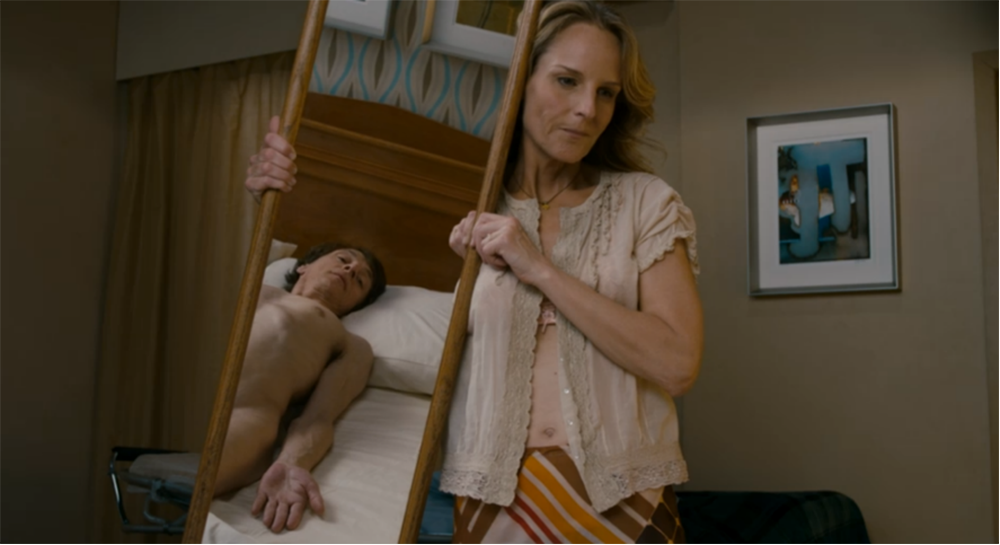
However, Lewin does not emulate Dwoskin’s approach to creating a participatory desirous gaze, as theorized by academics such as Brenez and Delshad. Drawing on an interview with Brenez, Delshad has argued that the ways Dwoskin used the camera and space to show women as complex subjects of desire was a “turning point in the history or representation” (Brenez).13 Delshad argues that Dwoskin’s approach, e.g. “constant and intense close-ups” represents women, often deep in their thoughts and feelings, as active desiring subjects (see Figure 2).
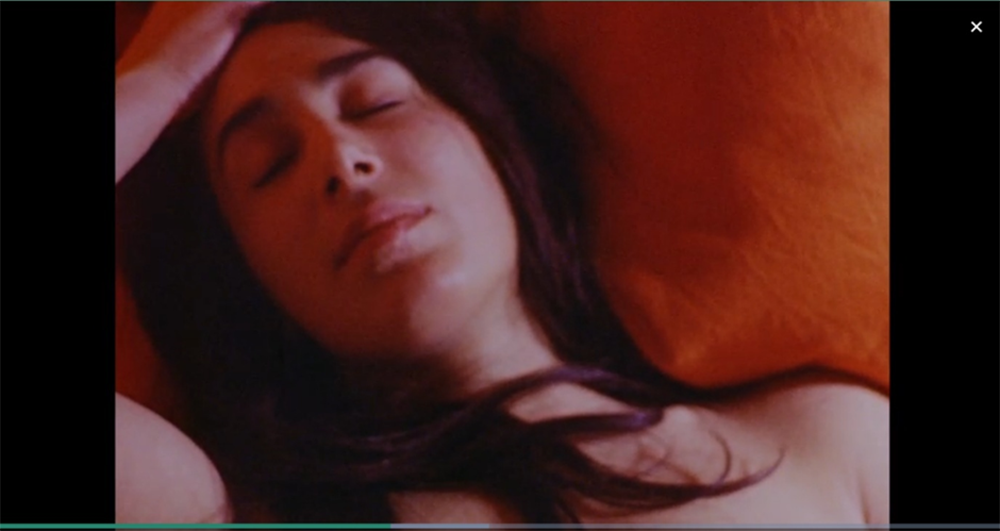
Delshad argues that such visual emphasis is inextricably related to a deliberate positioning of the camera as himself/his gaze, thus acknowledging the agency of Dwoskin’s gaze as a disabled man. Rather than promoting voyeurism/an exploitative scopophilic visual relationship, Delshad shows us that Dwoskin’s presence in the films and the clear acknowledgement of the limitations of his own body within his films, and the direct gaze of women into the camera, create great participation, and shape a participant/partner relationship (para 7), where the camera is fully acknowledged by both.
However, in The Sessions, there is no sense of O’Brien’s desirous gaze through lingering close-up shots of Cheryl’s facial expressions, nor is the camera placed for O’Brien’s point of view. In contrast with Dwoskin’s relational, participatory, approach, this cinematic depiction of desire falls back on women as the object/s of desire (the conventional societal gaze) simultaneously denying O’Brien the desiring gaze as a disabled man. As such, neither Cheryl nor O’Brien acknowledge the camera as Dwoskin’s work usually did. As the gaze of the film viewer and society, these camera choices undermine the fourth look apparent in other aspects of the story, e.g., his wish to be seen in public, and the reminders of our own expectations, thus minimizing opportunities to confront and challenge societal views of disabled people’s desire, and desires towards them.
One might say that Lewin’s strategy of exposing elements of the fourth look throughout the film, e.g. in sexual and opening scenes, are key to the overturning of the metagenre of disability; in the metagenre, the only way that producers and audiences can move beyond predictable forms of disability representation is to engage and deconstruct their own voyeuristic gazes or create challengingly disruptive “ethical encounters” with disabled “others” (Hadley) which interrogate audience notions of selfhood. The authenticity of the film can perhaps also be interpreted through analysis of a range of directorial decisions made by Lewin. Of his connection to O’Brien’s life and work, Lewin has said, “I feel like and I were soulmates in a sense […] I didn’t want to make a cripple-of-the-week movie. The struggle to survive is definitely part of his story but the story I wanted to tell is more about the struggle to connect (qtd. in De Souza). This marks out Lewin’s intentions to move beyond the metagenre of disability representations. Like the original text, the central narrative can be seen to be transgressive; accounts of disabled people’s rights to sex, not to speak of the use of sex surrogates, were scant when O’Brien wrote about his experiences – both significant layers in the processes of producing meaning.
Geraghty demonstrates the importance of the “layering process”14 (196) in the making of films, and the crucial adjustments which must be considered by filmmakers in translating previous accounts to contemporary understandings and sensibilities. She shows that crucial decisions need to be made in the embedding of “regressive” portrayals (e.g., historical attitudes) in new accounts with more progressive intentions in new accounts. We can see, for example, the difficulties which arise when attempts are made to challenge racism which has occurred in an actual event, particularly where disproportionate amounts of research time are spent on understanding aspects of white racism, rather than its effects (Collins).
In the layering process for creating more anti-oppressive representations, one such adjustment would be casting disabled actors in roles marked as disabled. This would not only address criticisms of the lack of authenticity in nondisabled actors playing disabled characters but also appease the disability movement led by scholars and journalists.15 As important as this may be in the layering of improved meanings attributed to disabled people, it is one of many ways to challenge regressive depictions.
My analysis of The Sessions shows that, despite the arguably wrongful casting of a non-disabled actor to play O’Brien, this adaptation can be regarded as a radical leap in representation. That is, it has a strong disability aesthetic at its core, challenging many aspects of disablism whilst showing significant psycho-emotional effects of cultural scripts of disability in the lives of disabled men, and is very likely to augment viewers’ feelings about disabled people, especially men with polio.
What can we learn from The Sessions?
I have argued that although O’Brien’s own text was deeply mired in the circulation of dominant portrayals and wider cultural scripts of disability, the raison d'être for his publication was to confront and alter these narratives. As such, his account might be considered problematic as a pure example of disability aesthetics, especially if judged on the way his original account buys into the metagenre. One could easily accuse O’Brien of seeing no worth in portraying “physical and mental differences as a significant value in itself” and as possessing little bodily integrity, given the self-contempt he expressed. However, his account in its entirety raised clear objections to the “standards and tastes,” which Siebers sees as central to disabled people’s exclusion. As such, O’Brien can be seen as a leader in transgressing the metagenre, and in developing a new aesthetic of disabled people’s sexuality.
Despite its flaws, we can see that The Sessions contains many of the truths revealed in the original account, despite its diversions from the facts of O’Brien’s actual life. Playing as it does into the commercial imperative of casting a (non-disabled) star in a role, and the need to minimize risks in appealing to a large audience (Wilde, Film), it can still be seen to resonate with a disability aesthetic and several aspects of DA. Indeed, O’Brien’s creativity is writ large from the first seconds of the film, and the need to build alternative worldviews is central to his own psycho-emotional journey, and the questioning of wider discourses of disabled people’s sexuality.
The alternative worldview grows partially from borrowing elements of more radical approaches. We are reminded of the importance of the viewer’s gaze, for example, and the synthesizing of the knowledge and lived experiences of a writer/director with the same impairment is likely to have enhanced the emotional resonance for many viewers, especially in creating the visual cues which produce affect. In turn, I suggest that attention to the disability aesthetics of cultural representation should take more account of the teams which produce culture, rather than the emphasis being on simpler measures of diversity, e.g., the impairment status of those seen on our screens. This is especially so when we consider the obstacles posed by the commercial imperative to appeal to large audiences, where a disability aesthetic is often seen as too risky (Justin Edgar in Brimingham Post; Koutsourakis; Wilde, Film).
Overall, there is much we can learn from this in terms of the rights and wrongs we impose on all screen portrayals, not least in understanding the fundamental acts of meaning-making which should inform us to place reception at the center of our analysis. This takes us back to the crucial role of acts of recall and cultural memory. Geraghty’s invocation for us to understand the production of meaning through paying close attention to the “interpretative and social processes that work to pin down meaning at a particular point” (4) seems especially salient for our analysis of depictions of disability in adaptations, other films, and in other screen media.
There have been gradual moves toward trusting and commissioning disabled actors, writers and directors (as discussed above) resulting in a range of screen media informed by disability aesthetics.16 In being released at a time when disabled sexuality was rarely depicted in screen media, and in being a rare example of a disabled person telling a disabled story from an original source, The Sessions is an ideal case study to explore how disability representations can become more nuanced in ways that align more closely with disabled people’s experiences of a disabling world.
Moreover, this analysis has shown the value of scrutinizing how a real-life written account of a disabled person’s life can be adapted into a film such as this, in ways that convey some of the most important original meanings to a wide audience. This approach could be valuable for guiding the screen industries in the future, especially when we consider how Lewin created fictional scenarios to retain faithfulness to the fourth look, and O’Brien’s original emphasis on the disabling world. The sharing of an impairment –in this case, polio – undoubtedly informed Lewin’s strategies, which possibly makes it feel more authentic to audiences with polio and those with similar impairment effects, e.g. those needing extensive support to optimize independence.
Going beyond strategies and initiatives which pay lip-service to equality, diversity and inclusion, the need to pay more attention to the embodiment of non-disabled media-makers and commissioners who dominate the “pinning” of disablement and impairment remains. This is a crucial task if we are to work towards reshaping the cultural expectations and memories of disability, which indisputably inform media representations of, attitudes toward, and actions involving disabled people.
Endnotes
1 There was certainly discussion of disabled people’s sexuality in the burgeoning disability movement, emerging from the 1960s onwards (Campbell and Oliver, 1997), and this was a growing element of disability of disability art and culture; see Jo Pearson’s “Freak Fucking Basics,” for example, featuring Mat Fraser (Pearson)
2 See Wilde, “Disabled People”, for an outline of industry initiatives, and improvements made.
3 Frequently a topic of debate as conferences and festivals, e.g. the “How do we choose which words to use” panel at Sick Festival, 2019, see http://www.sickfestival.com/events/unlimited-connects-north/ [Accessed 27th January, 2021)
4 The article referenced below is no longer available online, so another reference has been added; this is a paper the author has sent me, on which the article was based.
5 This is a term borrowed from Althusser who used the concept of “always already” to refer to being subjected to, and being made a subject, through ideology.
6 Initially Moyes said that the catalyst for her writing was her curiosity about a person who was quadriplegic. This source, by Rice, in Signature, is no longer available, but she has since given an interview which mentions the original person in more depth, adding another explanation. See Rice and Good Reads in the works cited. Palacio also explained the incident which initiated Wonder as a shocking encounter when she was with her children, in an interview with NPR staff. Sia has explained her creation of the film Music as a “love letter to caregivers and to the autism community” (Charles, 2025).
7 See Wilde, “Film,” for analysis of recent figures and attitudes, especially pages 152-3, and Ramón et al., 2024, for most recent figures
8 This is especially true in their promotion of pity and inspiration (see Wilde, 2018, for a longer discussion on why films such as these did well at the box office).
9 This can be seen and heard at the beginning of The Sessions, and in Breathing Lessons.
10 There is a tendency here to associate some characteristics with older age (e.g., level of conventional attractiveness and body size) perpetuating tropes of older male love interest with younger women.
11 See https://www.imdb.com/name/nm5587641/.
12 It is these kinds of discomforts which are likely to explain many of the taboos on screen representations of sexuality, as demonstrated by Sancho in 2003, and the assessments of risk in the screen industries’ decisions on what films and TV shows are commissioned/made (see Wilde, Film, Comedy, and Disability).
13 This originally read “Desde el punto de vista antropológico, lo que Dwoskin ha elaborado con el cuerpo femenino representa un hito en la historia de las representaciones.”
14 Geraghty uses the word “layering” to mean processes such as the layering of one “author” (e.g., director) over another (e.g., writer, or a historical figure’s actions), with added meanings created by the presence of particular stars or designers.
15 See Lee for an outline of the arguments.
16 It is impossible to consider all these media since the early 2000s, as they are diverse. The disabled writers and directors/cinematographers who have prime responsibilities for layering these meanings are also a diverse group who may also take other approaches, which are closer to traditional depictions, potentially re-stigmatising disabled characters. However, representations once considered taboo, are increasingly visible in screen media; a recent example, which demonstrates how far we have come in terms of embracing disabled women’s sexuality is the BBC’s “We may regret this” (BBC) (see Wilde’s “We May Regret This” review, co-written by Kyla Harris, a disabled woman, and her former Personal Assistant Lee Getty).
Works Cited
Albera, Francois. “Stephen Dwoskin Director.” http://www.stephendwoskin.com/02bio.html Accessed 16th February 2021.
Allen, Ruth, and Raymond Nairn. “Media Depictions of Mental Illness: An Analysis of the Use of Dangerousness.” Australian and New Zealand Journal of Psychiatry, vol. 31, no. 3, June 1997, pp. 375–81. https://doi.org/10.3109/00048679709073847.
Althusser, Louis. On the Reproduction of Capitalism: Ideology and Ideological State Apparatuses. Translated by G.M. Goshgarian, Verso, 2014.
Barnes, Colin. Disabling Imagery and the Media: An exploration of the principles for media representations of disabled people. Ryburn, 1992.
Breathing Lessons: The Life and Work of Mark O’Brien. Directed by Jessica Yu. Inscrutable Films and Pacific News Service, 1996.
BusinessLive. “Birmingham Film-Maker Justin Edgar Hits Out at Hollywood
Treatment of Disabled.” Birmingham Post, 21 Nov. 2008. http://www.birminghampost.co.uk/whats-on/film-tv/birmingham-film-maker-justin-edgar-hits-3953525 . Accessed 11 January 2017.
Campbell, Jane and Mike Oliver. Disability Politics – Understanding our past, changing our future. Routledge, 1996.
Carpenter, Rick. “Disability as Socio-Rhetorical Action: Towards a Genre-Based Approach.” Disability Studies Quarterly, vol. 31, no. 3, Aug. 2011. https://doi.org/10.18061/dsq.v31i3.1666.
Carter, Michael. “Ways of Knowing, Doing, and Writing in the Disciplines.” College Composition and Communication, vol. 58, no. 3, Feb. 2007, pp. 385–418. www.thelemming.com/lemming/POP-CULTURE/ways%20of%20knowing.pdf.
Casey, James. Disability, Deficiency and Excess: A Critical Re-examination of the Construction, Production and Representations of Physical Disability in Contemporary European Film. 2014. National University of Ireland, Galway, PhD thesis.
Caulfield, Deborah. “BBC 4’s series of monologues Criptales gives us the real deal.” Disability Arts Online Magazine, 20 Nov. 2020. https://disabilityarts.online/magazine/reviews/bbc-4s-series-of-monologues-finally-gives-us-the-real-deal/. Accessed 30 November 2020.
Charles, Matt. “Challenging the Neurotypical Gaze through collaboration: Sia’s Music (2021) and the misrepresentation of autistic individuals.” School of Humanities, University of Westminster, 2025. https://blog.westminster.ac.uk/hellohumanities/challenging-the-neurotypical-gaze-through-collaboration-sias-music-2021-and-the-misrepresentation-of-autistic-individuals/. Accessed 4 September 2025
Creed, Barbara. The Monstrous-Feminine: Film, Feminism, Psychoanalysis. Routledge, 1993.
Changing Faces. “About Visible Difference.” Changing Faces.org.uk, n.d.. https://www.changingfaces.org.uk/. Accessed 3rd September 2025
Darke, Paul Anthony. Link: An evaluation. Unpublished consultation paper for Yorkshire Television, 1995.
---. “Now I Know Why Disability Art is Drowning in the River Lethe (with thanks to Pierre Bourdieu).” Disability, Culture and Identity. Edited by Nick Watson and Sheila Riddell, Routledge, 2003, pp.31-42.
Delshad, Sara. “Dwoskin, Stephen.” Senses of Cinema: Great Directors, Oct. 2022. https://www.sensesofcinema.com/2022/great-directors/dwoskin-stephen/. Accessed 27 December 2024.
De Souza, Karen. “The Sessions tells the story of late Berkeley writer Mark O’Brien.” The Mercury News, 9 Oct. 2012. https://www.mercurynews.com/2012/10/19/the-sessions-tells-story-of-late-berkeley-writer-mark-obrien/.
Chronic Illness Inclusion Project. “To the BBC team involved in making CripTales: ‘The Real Deal,’” Letter to the BBC, 16 November 2020. https://www.centerforwelfarereform.org/uploads/attachment/749/ciip-letter-to-bbc.pdf Accesse4 September 2025 .Ferguson, Euan. “The week in TV: CripTales; Who do you think you are?; Aung San Suu Kyi; The Fall of an Icon and more.” The Guardian, 8 November 2020. https://www.theguardian.com/tv-and-radio/2020/nov/08/criptales-review-liz-carr-who-do-you-think-you-are-aung-san-suu-kyi-fall-of-an-icon-the-vow-dont-rock-the-boat. Accessed 15 June 2024.
Frank, Arthur W. The Wounded Storyteller: Body, Illness and Ethics. University of Chicago Press, 1995.
Franklin, Euan. “CripTales, BBC Four Review.” Culture Whisper, 2 Nov. 2020. https://www.culturewhisper.com/r/tv/crip_tales_bbc_4_review_ruth_madeley_liz_carr/15976. Accessed 15 June 2024.
Goodreads. Interview with Jojo Moyes. 31 Jul. 2013. https://www.goodreads.com/interviews/show/884.Jojo_Moyes. Accessed 4 September 2025
Gould, Ruth. “Disability Arts - A catalyst for change.” British Council blogs. 2021 https://www.britishcouncil.org/arts/culture-development/our-stories/disability-arts Accessed 6 September, 2021.
Gould, Ruth. “Disability Arts - a catalyst for change - Ruth Gould 2018.” Paper sent through personal communications, which was the basis for the British Council Blog
Geraghty, Christine. Now a Major Motion Picture: Film adaptations of literature and drama. Rowman and Littlefield Publishers, Inc., 2008.
Gerschick, Thomas J. and Adam S. Miller. “Coming to terms—masculinity and physical disability.” Men’s Health and Illness: Gender, Power and the Body, edited by D. Sabo and D. F. Gordon, Sage, 1995, pp.183-204.
Goldsmith, Ben. “To Be Outside and In-Between: On Paul Willemen, Looks and Frictions: Essays in Cultural Studies and Film Theory.” Film-Philosophy, vol. 2, no. 1, Dec. 1998. https://doi.org/10.3366/film.1998.0029.
Gowland, Ronda. “Freak Fucker: Stereotypical Representations of Sexuality in British Disability Art.” Disability Studies Quarterly, vol. 22, no. 4, Fall 2000, pp. 120-127. www.cds.hawaii.edu/dsq.
Hadley, Bree. Disability, Public Space Performance and Spectatorship: Unconscious Performers.Palgrave MacMillan, 2014.
Hallam, Julia. “Angels, battleaxes and good-time girls: Cinemas images of nurses.” Signs of Life: Cinema and medicine. Edited by G. Harper and A. Moor, Wallflower Press, 2005, pp. 105-120.
Indiewire Team. “The Story behind Sundance Hit The Sessions is in Breathing Lessons.” IndieWire, 27Jan. 2012. https://www.indiewire.com/2012/01/the-story-behind-sundance-hit-the-surrogate-is-in-breathing-lessons-49412/. Accessed 1 March 2021.
Koutsourakis, Angelos. “Cinema of the Body: Politics of performativity in Lars von Trier’s Dogville and Yorgos Lanthimo’s Dogtooth.” Cinema: Journal of Philosophy and the Moving Image, vol. 3, pp. 84–108.
Lee, Gae. “The problem of ‘cripping up’ and why casting disabled people matters.” ABC News, 27 Dec. 2021, https://www.abc.net.au/news/2021-12-28/cripping-up-and-why-casting-disabled-matters/100705512. Accessed 28 December 2024.
Martín, Adrián. “The Hungry Cinema of Stephen Dwoskin.” Film Quarterly, vol. 61, no. 1, Jan. 2007, pp. 62–63. https://doi.org/10.1525/fq.2007.61.1.62.
McCarthy, Todd. “The Sessions: Film Review.” Hollywood Reporter, 23 Jan. 2012. https://www.hollywoodreporter.com/movies/movie-reviews/sessions-film-review-284158/. Accessed 25 December 2024.
Me Before You. Directed by Thea Sharrock, New Line Cinema and Metro-Goldwyn-Mayer Pictures, 2016.
Music. Directed by Sia, HanWay Films, 2021.
NPR Staff. “How one unkind moment gave way to ‘Wonder’” NPR.org, Sep 2013. https://www.npr.org/2013/09/12/221005752/how-one-unkind-moment-gave-way-to-wonder. Accessed 4 September 2025
O’Brien, Mark. “On Seeing a Sex Surrogate.” The Sun Magazine, May 1990. https://www.thesunmagazine.org/issues/174/on-seeing-a-sex-surrogate. Accessed 26 January 2020.
Pearson, Jo, director. Freak Fucking Basics. The Arts Council of England, 1995.
Powell, Melody. “The CripTales and Inclusive Education.” ALLFIE, 25 Feb. 2021.
https://www.allfie.org.uk/news/inclusion-now/inclusion-now-58/the-criptales-and-inclusive-education/. Accessed 15 June 2024.
Ramón, Ana-Christina, Michael Tran and Darnell Hunt. “Hollywood Diversity Report – Featuring Film.” Institute for Research on Labour and Employment. https://socialsciences.ucla.edu/wp-content/uploads/2024/06/UCLA-Hollywood-Diversity-Report-2024-Film-3-7-2024.pdf. Accessed 28 December 2024.
Randle, Keith, and Kate Hardy. “Macho, Mobile and Resilient? How Workers with Impairments Are Doubly Disabled in Project-based Film and Television Work.” Work, Employment and Society, vol. 31, no. 3, June 2016, pp. 447–64. https://doi.org/10.1177/0950017016643482.
Rice, Kay. “Jojo Moyes Up Front: An Interview with the Me Before You Author.”
Signature. 2016. http://www.signature-reads.com/2016/05/jojo-moyes-upfront-an-interview-with-the-me-before-you-author/. Accessed 6 January 2018.
Sancho, Jane. Disabling Prejudice: Attitudes to disability and its portrayal on television. 2003. https://downloads.bbc.co.uk/guidelines/editorialguidelines/research/disabling-prejudice.pdf Accessed 28December 2024.
Shakespeare, Tom. “Cultural Representation of Disabled People: Dustbins for Disavowal.” Disability and Society, vol. 9, no. 3, 1994, pp. 283-299.
Siebers, Tobin. Disability Aesthetics. University of Michigan Press, 2010.
The Sessions. Directed by Ben Lewin., Such Much Films and Rhino Films, 2012.
“The Sessions: the 38-year-old virgin.” Ability Magazine, July 2013, https://abilitymagazine.com/the-sessions-the-38-year-old-virgin/. Accessed 13 Feb. 2021. We May Regret This. Directed by Nick Collett. United Kingdom, TV Series. 2024
Wentworth, Tom and Ewan Marshall. “The Real Deal.” CripTales. BBC 4, 1 October
2020.
Wonder. Directed by Stephen Chbosky, Lionsgate, 2017.
Wilde, Alison. “Disabled People on Film and Television.” The International Encyclopedia of Gender, Media, and Communication, edited by K. Ross, I. Bachmann, V. Cardo, S. Moorti and M. Scarcelli, 2020. https://doi.org/10.1002/9781119429128.iegmc142.
---. We May Regret This: Disability and impairment issues refreshingly cast as part of the messiness of everyday life. Disability Arts Online, 2024. https://disabilityarts.online/magazine/reviews/we-might-regret-this-disability-and-impairment-issues-refreshingly-cast-as-part-of-the-messiness-of-everyday-life/. Accessed 28 December 2024.
---. Film, Comedy, and Disability: Understanding Humour and Genre in Cinematic Constructions of Impairment and Disability. 2018. Routledge.
---. “Disabling Masculinity: The isolation of a captive audience.” Disability & Society, vol. 19, no. 4, 2004, pp. 355–370. https://doi.org/10.1080/09687590410001689467.
Willemen, Paul. Looks and Frictions: Essays in Cultural Studies and Film Theory, BFI and Indiana University Press, 1994.
Willemen, P. (1994) Looks and Frictions: Essays in Cultural Studies and Film Theory Bloomington and Indianapolis: Indiana University Press; London: British Film Institute;